
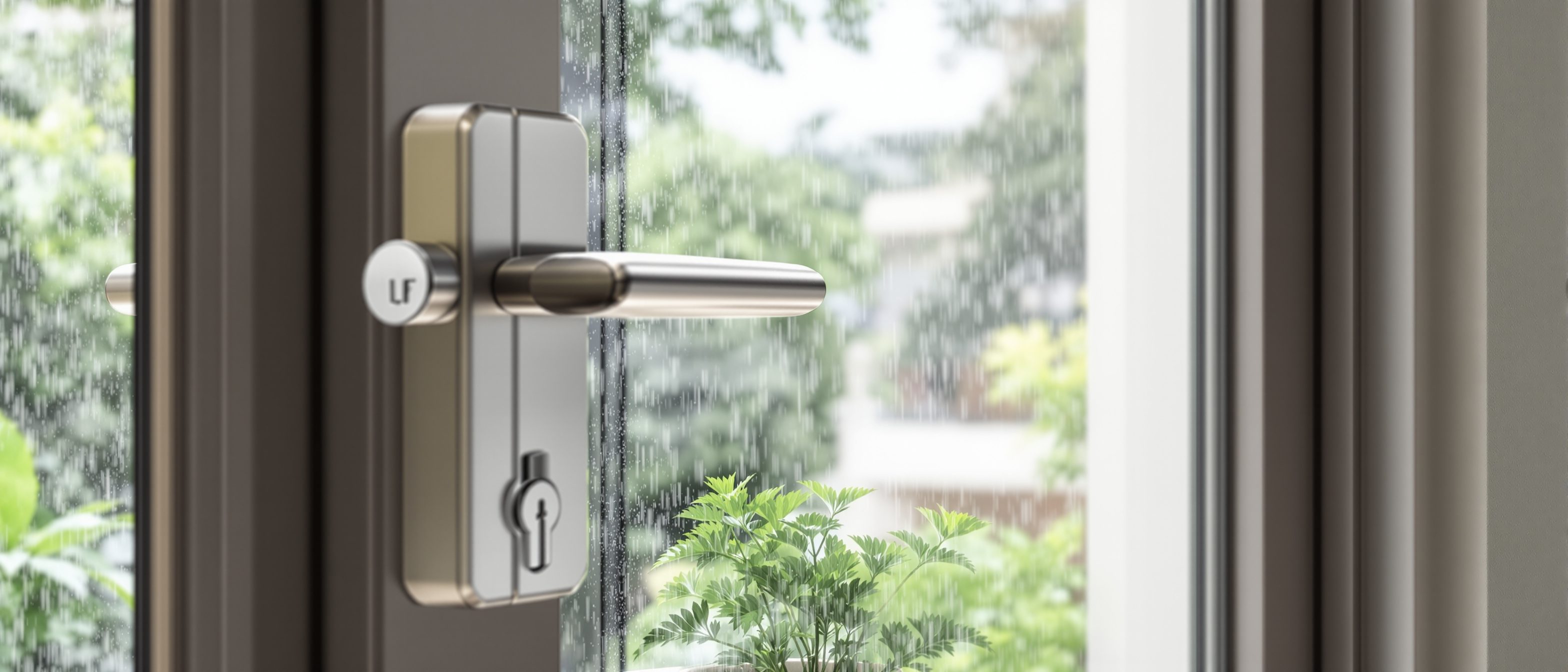
Window Locks and Hardware
A buyer and retrofit guide to multipoint locks, anti-lift fittings and restrictors — organised by window type, sliding windows first
A window is only as secure as the smallest piece of metal holding it shut. You can buy a heavy aluminium frame and laminated glass, but if the sash still swings on a single spring latch, an intruder pops it with a screwdriver in seconds. Locks and hardware are the cheapest, most upgradeable layer of window security in an Indian home, and the one most often neglected.
This is the component-level guide. For the whole forced-entry-rated window as a system, read the sibling Burglar-Resistant Windows, which covers EN 1627 resistance classes (RC2, RC3) for the complete unit. This guide zooms into the lock and the hardware alone — what each part does, what to buy for each window type, and crucially, what you can retrofit to a window you already own. For the bigger picture of frame, glass, grille and sensors working together, start at the pillar, Window Security Guide.
No lock makes a window burglar-proof. A good lock buys delay and deterrence — the two things that send an opportunist to an easier target.
How a window actually fails
Most break-ins through windows use no real tools. The three common failures are: a thin latch that levers open, a sash that lifts clean out of its track, and a handle that turns from outside once the glass near it is cracked. Good hardware defeats each one — by spreading the locking force, by stopping the lift, and by removing the handle as an entry trigger.
The hardware vocabulary
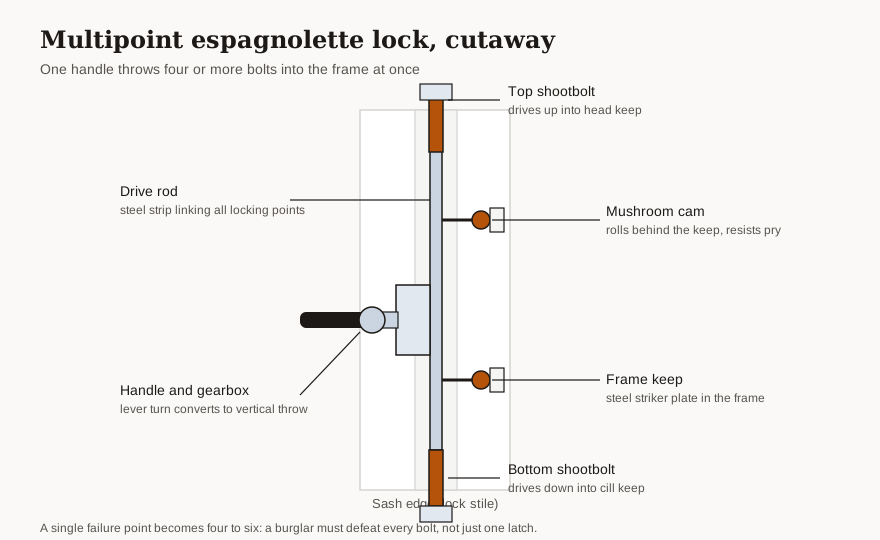
- Multipoint lock (espagnolette / shootbolt): one handle drives a steel rod that throws bolts into the frame at the top and bottom (and often the sides). Because the sash is held at several points, it cannot be pried at a single weak spot. This is the single biggest upgrade for a casement.
- Mushroom cams plus anti-lift keeps: instead of a flat roller, the locking studs are mushroom-shaped and pull into a matching keep, resisting levering. Essential anti-pry detail.
- Key-locking handle: the handle will not turn without the key, so even if the glass beside it breaks, an arm reaching in cannot open the window. Keep the key off the sill, but reachable for fire egress.
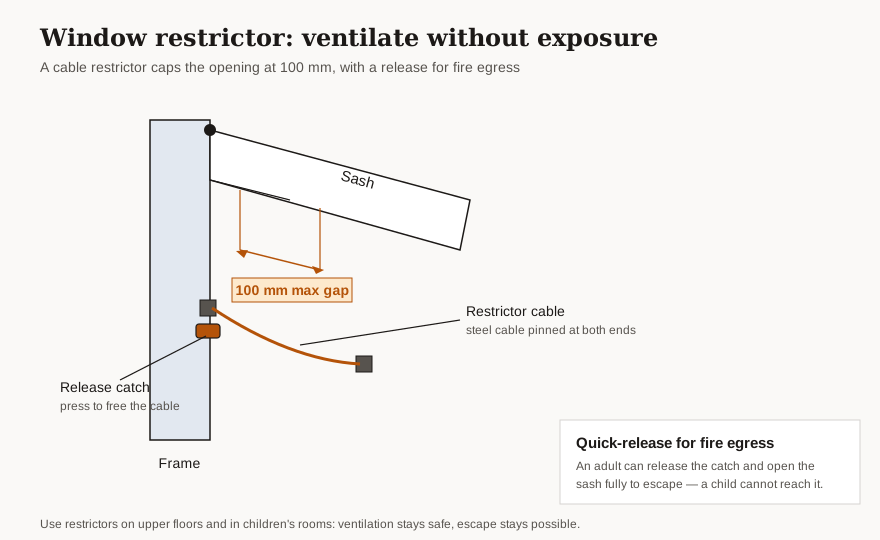
- Restrictor / limiter: holds the window to a safe opening (commonly 100 mm or less) for ventilation without giving body access. Doubles as child fall-safety.
- Sash lock and sliding-window lock: small auxiliary locks that pin a sliding or sash window in place, defeating the lift-and-slide attack.
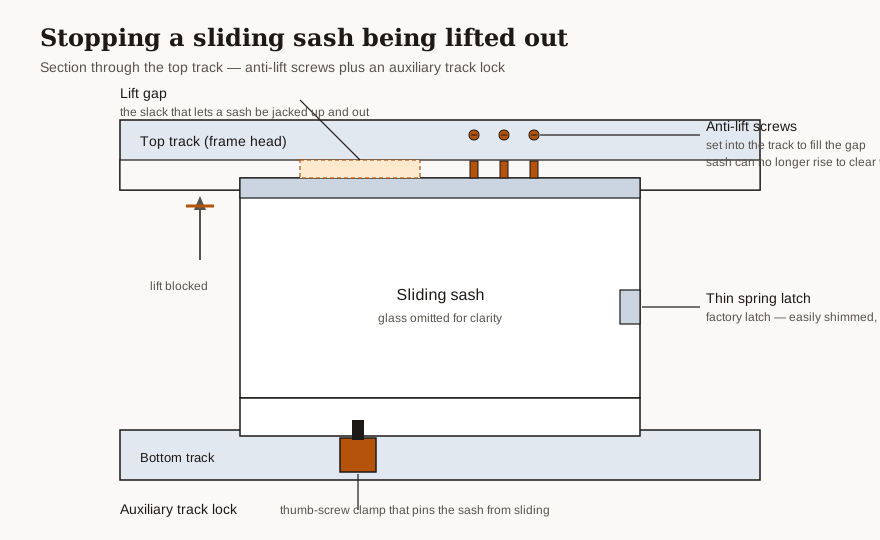
- Anti-lift blocks / track screws: stop a sliding sash being lifted out of its track — the classic weakness.
- Sash jammer: a cheap surface-mounted swivel block that physically jams a sash shut; the easiest true retrofit.
- Patio / shootbolt bolt: a deep-throw bolt at top and bottom of a sliding patio door, the most vulnerable large opening.
Organise by window type — sliding is the weakest
Indian homes mix aluminium and uPVC sliders, openable casements, top-hung awning windows and a few tilt-and-turn units. They do not share the same weaknesses, so they should not get the same lock.
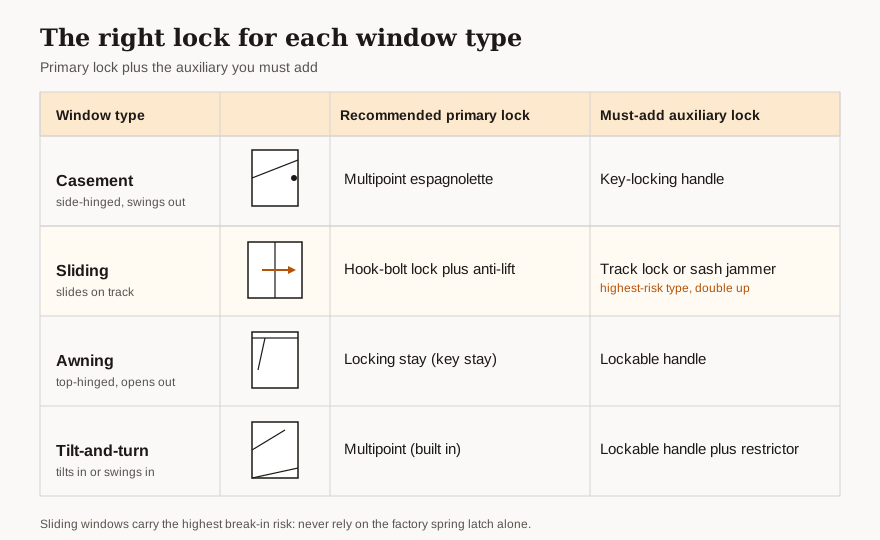
| Window type | Primary lock | Must-add auxiliary | Main weakness |
|---|---|---|---|
| Casement (side-hung) | Multipoint espagnolette plus key-locking handle | Hinge-side bolts | Single latch on cheap units |
| Sliding (aluminium / uPVC) | Hook-bolt or claw latch | Anti-lift block plus track lock or charley bar | Lifts out of track; thin latch |
| Awning / top-hung | Locking stay plus cam fastener | Restrictor for ventilation | Stay levers off |
| Tilt-and-turn | Multipoint (built in) | Lockable handle | Handle accessible if glass broken |
| Patio sliding door | Multipoint with shootbolts | Floor patio bolt plus foot bolt | Largest opening, lift-out |
Sliding windows deserve special attention. They fail two ways at once: the sash lifts out of its track, and the standard latch is a thin spring tongue that a flat tool pushes aside. The fix is layered — fit anti-lift blocks or screws into the top track so the panel cannot be raised, then add an auxiliary lock (a keyed sliding-window lock, a track stop, or a charley bar / foot bolt) so the panel cannot be slid even if the latch is beaten.
What to add to a window you already own
You rarely need to replace a window to make it meaningfully harder to open. This retrofit table is ordered cheapest-first.
| Existing window | Retrofit to add | Roughly | Effort |
|---|---|---|---|
| Any sliding sash | Anti-lift screws plus track stop / charley bar | Rs 150 to 600 | DIY |
| Aluminium slider latch | Keyed sliding-window lock | Rs 200 to 700 | DIY |
| Casement, single latch | Sash jammers (two per sash) | Rs 200 to 500 | DIY |
| Casement, better | Replace handle with key-locking handle | Rs 600 to 1,500 | Easy fit |
| Casement, best | Retrofit multipoint espagnolette kit | Rs 1,800 to 4,500 | Fitter |
| Patio sliding door | Surface-mount patio bolt top and bottom | Rs 500 to 1,200 | Easy fit |
| Ventilation gap window | Cable or pin restrictor | Rs 250 to 700 | DIY |
The order matters: stop the lift first, then stop the slide, then stop the handle. A keyed handle on a sliding sash that still lifts out is wasted money.
Restrictors, egress and the fire trade-off
A restrictor that caps the opening at 100 mm or less stops a child or a body passing through, which is why it appears again in our Child-Safe Window Design guide. But security hardware must never trap people inside. The rule for India is simple: every room needs at least one window or grille that opens from inside without a separate tool, for fire escape. Key-locking handles and restrictors should have a quick interior release, and the key must live somewhere fixed and known to the household — not in a drawer, not on a hook outside the room.
This is also why grilles, covered in Window Grills Design, should include at least one openable, internally-latched panel per room. Locks and grilles are layers, not a cage.
Material and quality — what to look for
Hardware lives in monsoon humidity and coastal salt air, so corrosion kills cheap locks within a year or two.
- Choose SS304 stainless bolts, cams and handles for coastal and high-humidity homes; zinc-alloy with a powder coat is acceptable inland.
- Look for anti-drill, anti-pick cylinders on key-locking handles, and mushroom cams rather than flat rollers.
- Insist on steel keeps screwed into the frame reinforcement, not just into thin aluminium — a multipoint lock is only as strong as what its bolts shoot into.
- Match hardware to the frame: branded uPVC and aluminium systems sell their own espagnolette gearboxes; mixing parts voids the fit.
Do and avoid
| Do | Avoid |
|---|---|
| Layer anti-lift plus auxiliary lock on every slider | Trusting the factory spring latch alone |
| Fit key-locking handles near breakable glass | Leaving the key in the lock or on the sill |
| Use multipoint plus mushroom cams on casements | A single central latch on a wide sash |
| Keep one internally-openable egress window per room | Locking every window with a key you cannot find |
| Specify SS304 hardware on the coast | Bright unbranded zinc locks in salt air |
Where hardware sits in the bigger system
Hardware is one layer. It pairs with a strong frame and laminated glass (the rated whole window in Burglar-Resistant Windows), with grilles, and with sensors. Get the lock right and you have done the highest-value, lowest-cost part of the job. To see how all the layers fit, return to the Window Security Guide, and to choose the right window style before you even pick hardware, see Types of Home Windows.
References
- Bureau of Indian Standards, IS 2553 (Part 1):2018 Safety Glass — https://www.bis.gov.in
- National Building Code of India 2016, BIS — https://www.bis.gov.in/standards/technical-department/national-building-code/
- IS 875 (Part 3) Wind Loads, BIS — https://www.bis.gov.in
- EN 1627 burglar resistance classes (reference) — https://www.bhma.org.uk
Export this guide
Related Guides — Deep-dive reading
Window Security Guide
The layered-defence model for Indian homes — frame, glass, locks, grille and sensors working together
Windows & GlazingDoor and Window Security Assessment for Indian Homes
Go opening by opening and rate the hardware itself — leaf and frame, hinges and locks, strike plates, grilles, glazing and latches — so you can grade each door and window's real resistance while never trapping anyone behind it.
SecurityThe Complete Guide to Door and Window Security in India (2026)
The pillar reference for every opening in your home — how to think about doors, windows and glazing as a system, why the weakest opening decides your safety, and where each part of the library takes the detail further.
SecurityRelated Tools — Try Free
Window Grill Design Selector
Pick a window grille style and material by priority — security, looks, budget, view — and estimate cost.
Window ToolWindow Hardware Cost Calculator
Estimate window hardware cost — hinges, handles, locks, rollers and multipoint gears.
Window CalculatorWindow Material Comparison Tool
Compare uPVC, aluminium, wood, steel and composite windows on cost, life, upkeep and insulation.
Compare