
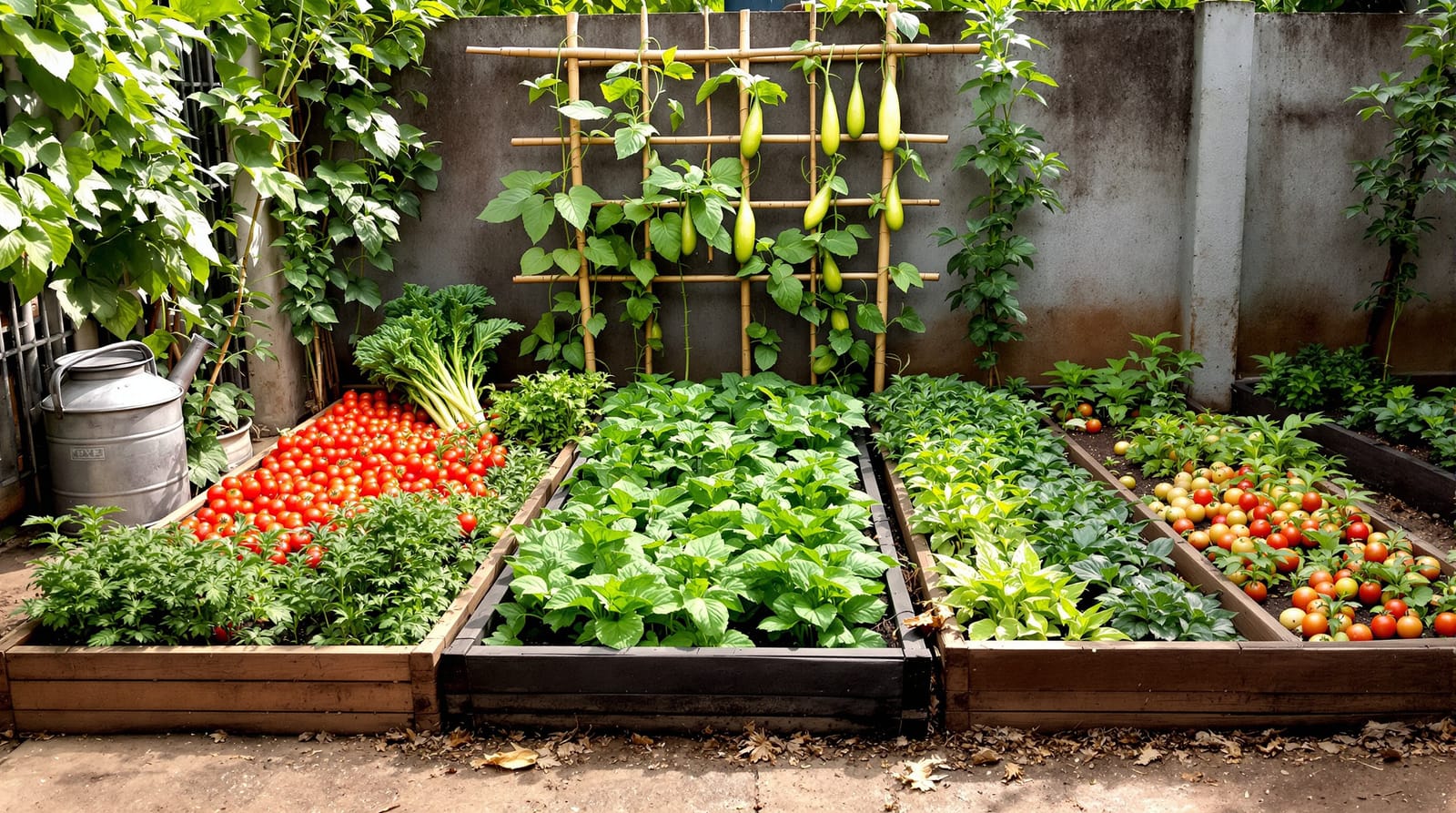
Productive Gardens Explained — Growing Food at Home in India
The how-to of yield — bed layout, soil and compost, the Kharif/Rabi/Zaid crop calendar, watering, succession and the honest effort a home vegetable garden takes
A productive home garden in India is not a romantic idea — it is a small, demanding system that, run honestly, can put a steady supply of leafy greens, herbs and seasonal vegetables on your table for the cost of seeds, compost and roughly thirty focused minutes a day. This guide is about the growing, not the looking. If you want to weave edibles into a beautiful, designed landscape — fruit trees as shade, herbs in the front border, a mango as a specimen tree — read its sibling, Edible Landscapes for Indian Homes. Here we stay in the soil: how to size a bed, build a crop calendar around the Indian seasons, water sensibly, and harvest something real.
What a productive garden realistically gives you
Let us be honest before you buy a single seed packet. A well-run home vegetable garden in India is excellent at three things: leafy greens (palak, methi, amaranth), kitchen herbs (coriander, mint, curry leaf, chillies), and a rotating supply of one or two seasonal vegetables you actively want. It is mediocre at making you self-sufficient in staples — you will not grow your family's wheat, rice, dal or cooking oil, and a few tomato plants will not end your trips to the sabziwala.
A realistic yardstick: a well-tended raised bed of roughly 1.2 m × 2.4 m (about 3 square metres) can produce 12–20 kg of mixed vegetables across a season if you keep it planted continuously. Three or four such beds, plus pots of herbs, will meaningfully reduce a small family's green-vegetable buying and give you flavour and freshness that no market matches — but it is a hobby that returns food, not a farm.
The honest trade is this: the garden rewards consistency, not heroics. Twenty to thirty minutes most days — watering, a quick pest check, a little harvesting and sowing — beats a frantic four-hour Sunday. Skip a week in peak summer and you can lose a bed. Go in with that expectation and you will enjoy it; go in expecting a grocery replacement and you will quit by the second monsoon.
Siting and sizing the garden
Sun is the first non-negotiable
Most vegetables — tomato, brinjal, okra (bhindi), chillies, gourds, beans — are sun-hungry and need 6 or more hours of direct sun. Leafy greens and herbs (palak, methi, coriander, mint) tolerate 3–4 hours and actually prefer dappled afternoon shade in the brutal April–May heat. Before you dig, watch your plot for a few days and map where the sun actually falls. In most Indian homes the harsh element to manage is the hard western afternoon sun, not a lack of light — a spot with morning sun and some afternoon relief is often ideal. For the wider logic of placing zones by sun, slope and access, see Residential Site Planning.
Bed dimensions are set by your arm, not your ambition
The single most useful sizing rule: never make a bed wider than you can comfortably reach into from both sides without stepping on the soil. That means a maximum bed width of about 1.2 m (roughly 4 feet) if accessible from two sides, or 0.6–0.75 m if it sits against a wall. Length is flexible — 1.8–2.4 m is easy to manage. Keep paths between beds at least 45–60 cm wide so you can crouch, carry a watering can and run a wheelbarrow.
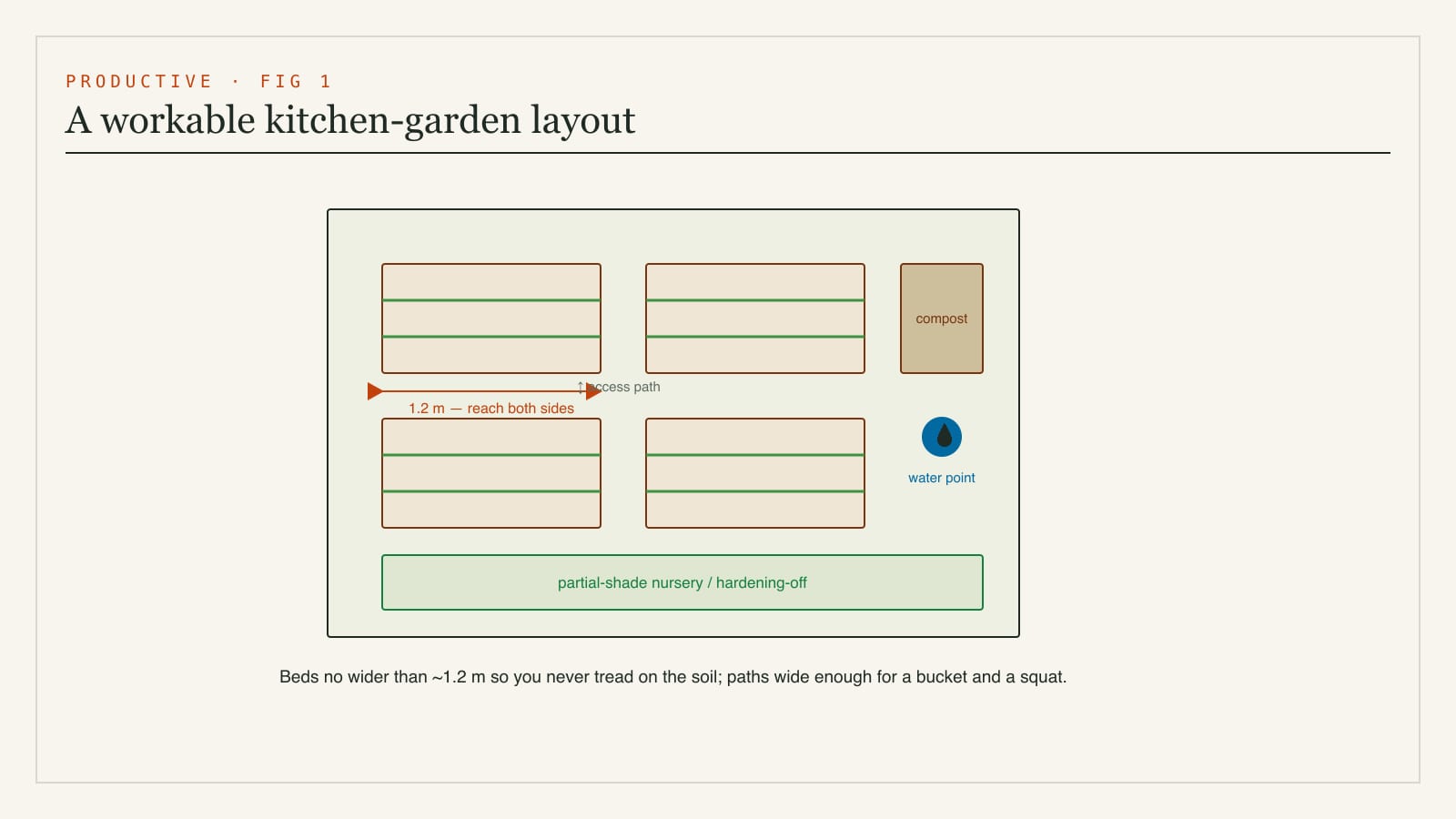
Plan the whole plot, not just the beds: a compost corner in semi-shade, a water point within hose reach, and a small partial-shade nursery patch for raising seedlings before they go out.
Raised beds vs ground beds
| Factor | Raised beds (15–30 cm high) | Ground beds |
|---|---|---|
| Drainage | Excellent — critical in heavy monsoon | Poor where soil is clayey |
| Soil control | You build the mix; ignores bad native soil | Depends on existing soil |
| Cost to start | Higher (frame, imported soil/compost) | Lower |
| Back strain | Less bending | More |
| Best for | Apartments, terraces, poor/clay soil, monsoon belts | Large plots with decent loamy soil |
For most urban and peri-urban Indian homes — and certainly for terraces and balconies — raised beds or large grow-bags win, chiefly because they solve the monsoon drainage problem that drowns ground-level roots.
Soil and compost — the real foundation
Nothing matters more than your soil. A productive bed wants a loose, dark, water-holding-but-free-draining medium rich in organic matter. A reliable home mix is roughly one-third good garden soil or red soil, one-third compost or well-rotted cow manure (gobar khaad), and one-third a lightener such as cocopeat, sand or rice husk. Add a couple of handfuls of neem cake and a little bone meal per bed for slow nutrition and pest resistance.
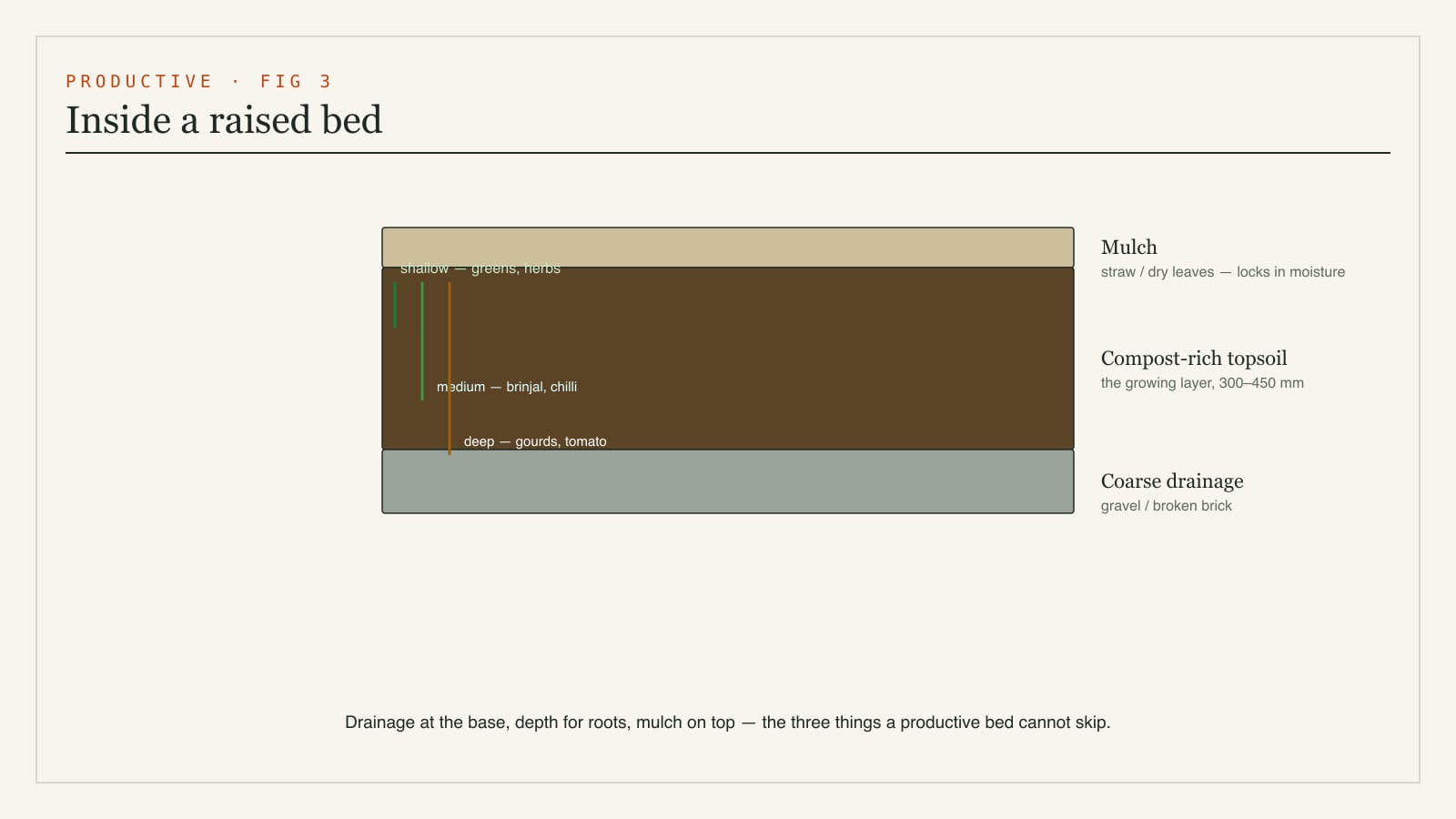
As the cross-section shows, a working raised bed has layers with a job each: a thin coarse drainage zone at the very bottom, the deep compost-enriched mix where roots live, and a mulch blanket on top. Match crops to depth — shallow-rooted greens and coriander are happy in 15–20 cm, while brinjal, tomato and gourds want 30 cm or more of good soil to root down.
Make your own compost — it is free and it is the point
Buying compost forever defeats the economics. A home garden should feed itself. Two easy methods for India:
- Aerobic pile or three-bin system: layer "greens" (kitchen vegetable scraps, fresh weeds) with "browns" (dry leaves, shredded paper, coir). Keep it as damp as a wrung-out sponge, turn it every week or two. In Indian warmth it matures in 6–10 weeks.
- Vermicompost: add composting worms (Eisenia fetida) to a shaded bin of half-rotted scraps and cow dung. It is cleaner, faster and produces superb dark castings — ideal for terraces. Keep it out of direct sun and never let it dry out or flood.
Keep cooked food, oil, dairy, meat and citrus peel out of an open pile — they smell and attract rats and dogs. A simple covered bin handles a typical kitchen's wet waste and closes the loop: your garden eats your kitchen's leftovers and gives back to your plate.
The Indian crop calendar — Kharif, Rabi and Zaid
India's growing year runs on three traditional seasons, and matching crops to them is the difference between thriving plants and constant failure. Work with the seasons, not against them.
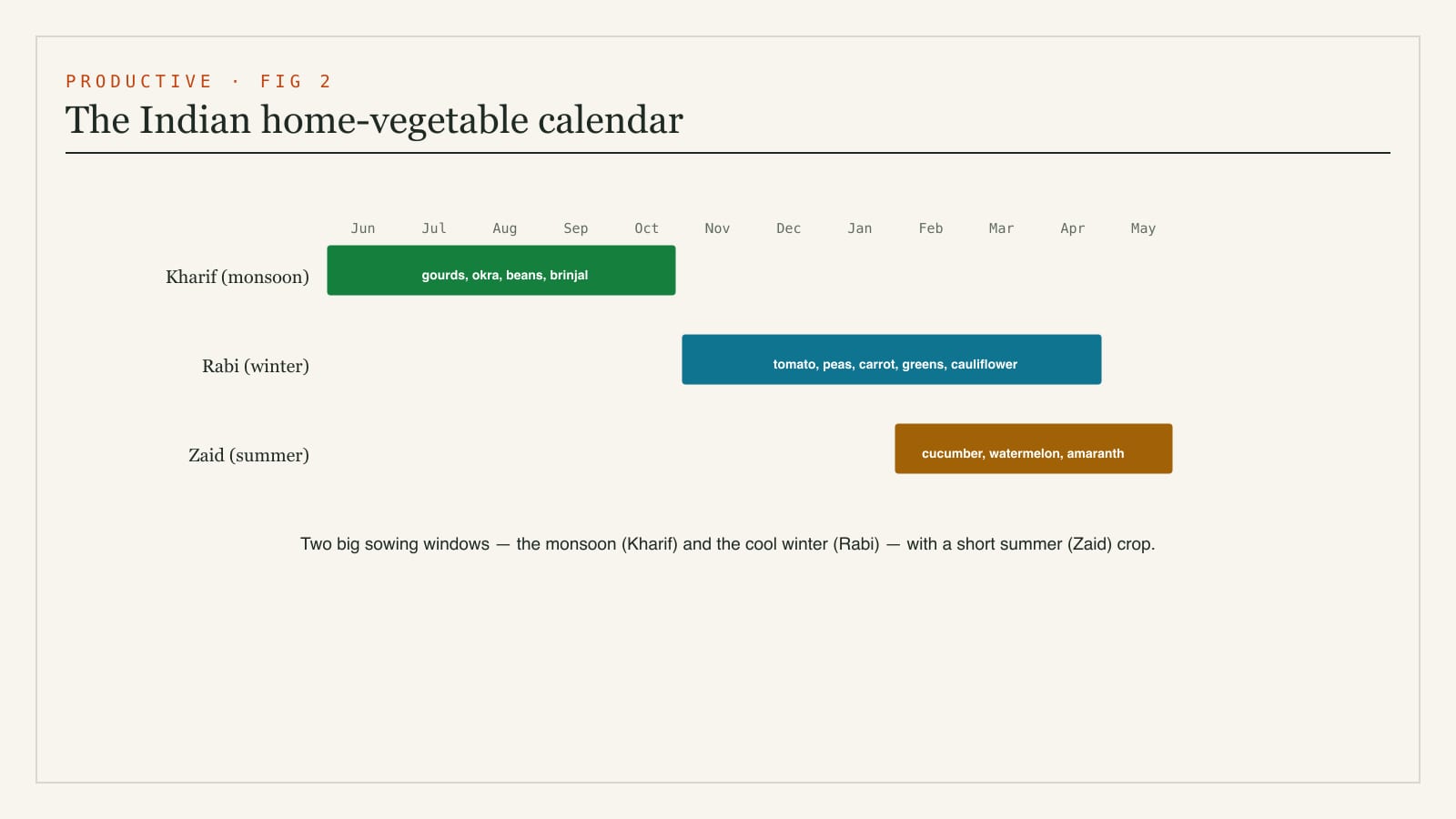
| Season | Rough timing | Character | Sow these at home |
|---|---|---|---|
| Kharif (monsoon) | Sow Jun–Jul, harvest Sep–Oct | Warm, wet; watch for waterlogging and fungal disease | Okra (bhindi), all gourds (lauki, bottle, ridge, bitter), cowpea/beans, brinjal, chillies, amaranth |
| Rabi (winter) | Sow Oct–Nov, harvest Jan–Mar | Cool, dry, sunny — the best and easiest season | Tomato, palak, methi, coriander, carrot, radish, peas, cabbage, cauliflower, onion, garlic, beetroot |
| Zaid (summer) | Sow Feb–Mar, harvest Apr–Jun | Hot, dry; heat- and water-stress are the enemy | Cucumber, watermelon, muskmelon, pumpkin, summer gourds, heat-tolerant amaranth, okra |
This is a national guide — adjust by 2–4 weeks for your zone. The cool hill regions and the deep south run different windows from the north Indian plains; coastal humidity favours different crops from the dry Deccan. If you are new, start in Rabi: the cool, sunny, low-pest winter is the most forgiving season in most of India, and a winter bed of palak, methi, coriander, radish and tomato is hard to fail at.
The best home crops for beginners
Start with crops that are fast, forgiving and genuinely useful in an Indian kitchen. Quick wins build the habit that keeps a garden alive.
| Crop | Best season | Days to harvest | Difficulty | Realistic home yield |
|---|---|---|---|---|
| Coriander (dhania) | Rabi / cool weather | 30–45 | Very easy | Cut-and-come-again from a single pot |
| Methi (fenugreek) | Rabi | 25–40 | Very easy | Two or three cuttings per sowing |
| Palak (spinach) | Rabi | 30–45 | Very easy | Repeated cuttings over weeks |
| Amaranth (chaulai) | Kharif / Zaid | 25–40 | Very easy | Continuous picking in warm months |
| Okra (bhindi) | Kharif / Zaid | 45–60 | Easy | Several pods per plant, picked every 2–3 days |
| Chilli | Year-round (transplant) | 70–90 | Easy | Months of picking from a few plants |
| Tomato | Rabi (best) | 70–90 | Moderate | 2–4 kg per healthy plant |
| Brinjal (baingan) | Kharif / Rabi | 70–85 | Moderate | Months of fruiting from each plant |
| Bottle/ridge gourd (lauki/turai) | Kharif / Zaid | 55–70 | Easy on a trellis | Heavy yields; needs vertical space |
| Curry leaf, mint, lemongrass | Perennial | — | Very easy | A standing kitchen supply for years |
Herbs and perennials (curry leaf, mint, lemongrass, ajwain) deserve a permanent pot or corner — they are planted once and give for years, the highest return for the least effort in any Indian garden.
Watering and irrigation
Water is where most home gardens are won or lost, and India hands you two opposite problems in one year: drought and deluge.
- Deep and less often, not shallow and daily. A thorough soak that wets the full root zone every couple of days grows deeper, tougher roots than a daily sprinkle that only damps the surface. Water in the early morning so leaves dry before night, which cuts fungal disease.
- Mulch is half the battle. A 5–7 cm blanket of dry leaves, straw or coir over the soil dramatically cuts evaporation in summer, smothers weeds and keeps roots cool. In peak Indian summer, mulch can halve your watering.
- Drip is the gold standard. A simple low-cost drip kit or a length of soaker hose on a timer delivers water straight to the roots with very little waste — invaluable in the Zaid season and for anyone who travels. It pays for itself in saved water and saved plants.
- Monsoon means stop and protect. During heavy rain, switch the irrigation off, make sure beds drain freely, and watch for root rot and fungal leaf spots. This is exactly when raised beds earn their keep.
Pair your garden with rainwater harvesting and you make the whole thing far more sustainable — see Sustainable Water Management in the Landscape for storing the monsoon to irrigate through the dry months, and Climate-Responsive Landscape Design for working with — rather than against — your local climate.
Succession, rotation and intercropping
These three habits separate a bed that produces all season from one that gives a single flush and then sulks.
Succession sowing means never leaving soil empty and never sowing everything at once. Sow a short row of coriander or palak every two or three weeks rather than one big patch — you get a steady kitchen supply instead of a glut followed by a gap. The moment one crop finishes, refresh the soil with a handful of compost and replant.
Crop rotation means not growing the same plant family in the same bed season after season, which is how soil pests and diseases build up. A simple home rotation cycles a bed through families:
- Leafy greens (palak, methi, amaranth, coriander)
- Fruiting crops (tomato, brinjal, chilli, gourds, okra)
- Legumes (beans, peas, cowpea) — these fix nitrogen and naturally feed the next crop
- Roots (radish, carrot, beetroot, onion, garlic)
Intercropping packs more into the same space: grow fast coriander or radish between slow tomato plants and harvest it before the tomatoes need the room; or run beans up a gourd trellis. The classic logic — tall plants giving partial shade to heat-sensitive greens below — is genuinely useful in the Indian summer.
Organic pest basics
A home garden is for eating from, so keep chemical pesticides out. Build defence in layers:
- Healthy soil and the right season prevent most trouble before it starts — stressed, crowded, wrongly-timed plants get hit hardest.
- Neem is the Indian gardener's mainstay. A neem-oil spray (a few ml per litre of water with a drop of mild soap as emulsifier, sprayed in the evening) deters and disrupts aphids, whiteflies, mealybugs and caterpillars. Neem cake worked into the soil also suppresses soil pests.
- Invite the good bugs. A few flowering plants — marigold, basil (tulsi), coriander left to flower — draw ladybirds, lacewings and predatory wasps that eat your pests for free. Marigold along bed edges is a traditional, effective companion.
- Physical methods work. Hand-pick caterpillars and snails, blast aphids off with a jet of water, use yellow sticky traps for whitefly, and net young seedlings against birds.
- Accept some loss. A truly pest-free garden is a sprayed garden. A few nibbled leaves are the price of safe, chemical-free food. For the wider biodiversity case for this approach, see Biophilic Landscape Design.
The realistic time commitment
So how much of your life does this take? An honest breakdown for three or four beds plus herb pots:
| Task | Frequency | Rough time |
|---|---|---|
| Watering (less with drip + mulch) | Daily to alternate days | 10–15 min |
| Pest check, harvesting, tidying | Most days | 10–15 min |
| Sowing, transplanting, composting | Weekly | 30–45 min |
| Soil refresh, bed turnover, trellising | Per season | A half-day, a few times a year |
The pattern that works is little and often. A garden visited briefly every morning — coffee in hand, scissors in pocket — stays healthy and joyful. A garden visited only on weekends drifts into pest outbreaks, bolted greens and dried-out beds, especially in summer. If your life genuinely cannot give it daily minutes, scale down honestly: a few pots of curry leaf, mint, chilli and coriander on a sunny ledge is a real, rewarding productive garden too, and a far better outcome than four ambitious beds left to die in May. For the broader case for time spent outdoors among growing things, see Outdoor Wellness Spaces.
Start small, succeed, and expand. One well-kept Rabi bed of greens that actually feeds you beats a sprawling plan that defeats you — and once you have tasted coriander cut ten minutes before it hits the pan, the habit tends to keep itself.
References & further reading
- ICAR – Indian Council of Agricultural Research: vegetable cultivation packages of practice and seasonal sowing guidance.
- ICAR–IIHR (Indian Institute of Horticultural Research), Bengaluru: home and kitchen-garden resources, including nutri-garden models and "Arka" vegetable varieties.
- ICAR–IARI (Indian Agricultural Research Institute), New Delhi: kitchen garden layouts and crop calendars for Indian conditions.
- Krishi Vigyan Kendra (KVK) network: free local, district-level advice on what to sow and when in your specific zone.
- Royal Horticultural Society (RHS): general vegetable-growing, composting and crop-rotation fundamentals.
- ISOLA – Indian Society of Landscape Architects: for integrating productive planting into a designed home landscape.
Export this guide
Related Guides — Deep-dive reading
The Best Trees for Indian Homes
A research-grade guide to choosing and placing trees around an Indian home — the real cooling and clean-air numbers, the right species for shade, flowers, fragrance and fruit, and the placement science that keeps roots out of your walls and drains.
LandscapeHow Buildings Can Give Back: Biodiversity and Environmental Health
How an Indian home and its plot can actively improve the ecology and environment around it, not just reduce harm
SustainabilityEdible Landscapes for Indian Homes — Beautiful and Productive
Weaving food plants into the ornamental garden — borders, hedges, containers, vertical screens and specimen fruit trees that look gorgeous and feed the family
LandscapeRelated Tools — Try Free
Cross-Ventilation Analyzer
Estimate airflow and air changes per hour (ACH) from room size, window areas, layout, and local wind — with NBC 2016 Part 8 compliance check.
Ventilation CalculatorRainwater Tank Sizer
How big should your rainwater tank be? Computes annual harvest, recommended tank capacity in litres, water-bill savings, and payback — for 10 Indian cities.
RWH CalculatorGarden Planning Toolkit
Get a tailored garden plan — planting layers, Indian species, features and a checklist — from your climate, space, sun and goals.
Planner