
Why Topography Matters
Reading the land's levels and fall — contours, drainage and the low point, cut-and-fill and plinth, and how landform quietly governs orientation, views, breeze and cost
The plot looked perfect on the brochure. A neat rectangle on the edge of a fast-growing suburb, a tar road along one side, a clutch of new houses already rising next door. The buyers, a young couple planning their first home, walked it on a dry February morning, paced out the boundaries, imagined the gate here and the garden there, and signed. It was only when the first heavy pre-monsoon shower arrived in late May that they understood what the brochure had not shown them: a sheet of brown water slid off the higher land behind, crossed their plot in a quiet diagonal, and pooled against the very corner where they had pictured the front door. The land had been telling them something all along. They simply had not learned to read it.
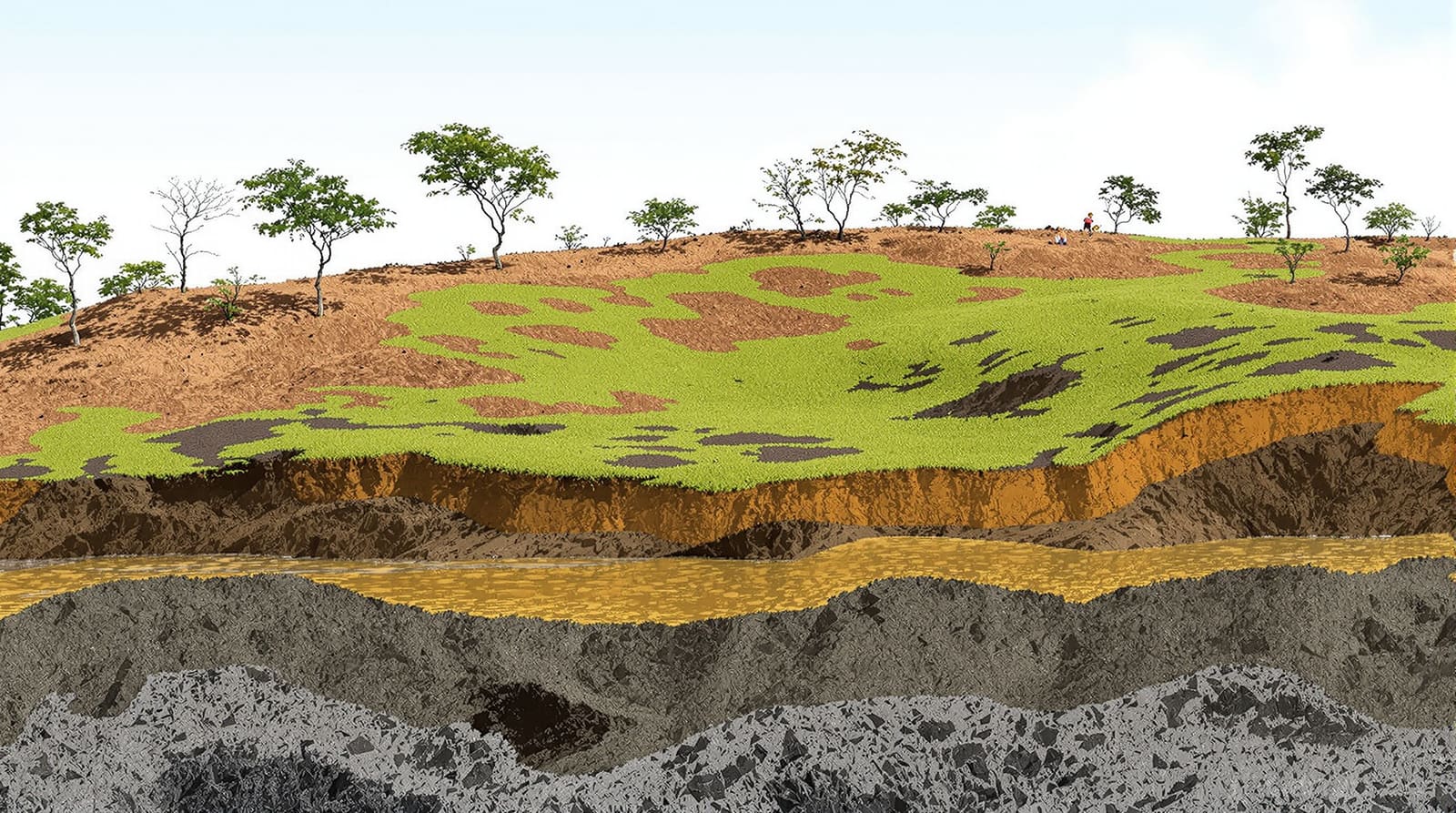
What they had missed was not a defect in the soil or a problem with the title. It was the shape of the ground itself — the way it rose by less than a metre across forty feet, the way that almost-invisible fall decided where every drop of rain would go. Before you think about plans, plinths or elevations, you must read the land's own form — its levels, its slopes, its high and low points — because the shape of the ground silently governs drainage, cost, orientation and comfort long before a single brick is laid.
What topography actually is
Topography is simply the three-dimensional shape of your land — not its outline on paper, but its rise and fall. Two plots can have identical boundaries and identical area on the sale deed and yet behave completely differently, because one is dead flat and the other tips gently towards the road. That difference is topography.
The language for describing it is the contour. A contour line joins all the points on the ground that sit at the same height, or level. Picture the land sliced horizontally at regular intervals — every half-metre, say — and each slice traced as a line on a plan. Where those lines bunch close together, the ground is steep; where they spread far apart, it is gentle. Where they are absent over a wide area, the land is more or less flat. Read alongside spot levels — individual height readings at the corners, the road, the existing trees — contours let you see the land's form without standing on it.
A few terms are worth fixing in your mind, because they recur in every conversation with an architect or contractor:
- The high point and low point are exactly what they sound like — the parts of your plot that sit highest and lowest. Water moves from high to low, always, so finding the low point is the single most useful thing you can do on a first visit.
- The fall is the total height difference across the plot, often quoted as a number of metres or as a gradient (for instance, a fall of one metre over a length of twenty metres). A small fall is easy to miss on foot but decisive once it rains.
- Reduced levels, marked RL on a survey, are heights measured against a fixed datum — typically the crown of the abutting road or a permanent benchmark — so that everyone is working from the same zero.
None of this is exotic. It is the grammar the land speaks in, and learning it changes how you walk a plot forever. Our pillar guide on how to read your plot before you buy treats this alongside the wider site survey; here we stay with the form of the ground itself.
How to read a level survey — and why you should commission one
You can sense topography by eye. Stand at the road and look across to the rear boundary; watch where last week's rainwater stained the soil; notice which neighbour's plinth sits higher than the next. But for anything more than a flat, tiny plot, the eye is not enough, and this is where a proper contour-and-level survey earns its modest fee many times over.
A topographic survey, carried out by a licensed surveyor with a total station or, increasingly, drone photogrammetry, returns a drawing showing your boundaries, the road level, contours at a stated interval, spot levels at every significant point, existing trees, drains, poles, structures and the levels of adjoining plots. Reading it is a matter of asking three questions in order. First, where is the high point and where is the low point — which way does the land fall? Second, how much does it fall, and how abruptly — are the contours evenly spaced or crowded in one band? Third, how does my land sit relative to the road and the neighbours — am I above the road, level with it, or below it?
Commissioning this before you buy, or at the very least before you finalise the design, is one of the cheapest forms of insurance available to an Indian homebuilder. A survey that costs a few thousand rupees can reveal that the plot sits below the road — meaning rainwater will run in, not out — or that a steep band along one edge will demand expensive retaining work. These are not things to discover after the foundation is poured. A clear-eyed reading of levels feeds directly into understanding your site constraints, where slope joins setbacks, soil and access as a hard fact you design around rather than against.
Why water decides everything
If you remember one principle from this guide, make it this one: water always finds the low point, and it does not negotiate. Every design decision about levels is, underneath, a decision about where rain will go.
In India this matters with particular force because of the monsoon. A site that drains imperceptibly for ten months of the year can be overwhelmed in an afternoon cloudburst, and the difference between a dry home and a flooded one is often a matter of a few hundred millimetres of level, planned or unplanned. The discipline is to identify, early, the natural drainage path across your plot — the invisible channel along which water already wants to travel — and then to make sure your home, and especially its plinth, sits clear of it. You either keep the building off the low point, or you provide a generous, engineered path for water to leave (surface gradients, garden swales, a peripheral drain connected to the municipal storm-water line) so it never ponds against the structure.

This is also where the relationship between your plot, the road and the monsoon becomes concrete. The municipal road is your drainage reference and, usually, the eventual destination for your runoff. If your finished plinth sits comfortably above the crown of the road, water leaves you. If it sits at or below road level, water can back up towards the house every time the roadside drain overflows — a depressingly common scene on Indian streets in July. Where the wider neighbourhood floods, the water table rises, or the plot lies in a known low-lying pocket, the plinth must be set not merely above the road but above the recorded flood level, with the soil and water-table behaviour confirmed by the geotechnical investigation. Treating water as a landscape system rather than an afterthought is the subject of landscape planning before you build; read it as the companion to everything in this section.
Cut, fill, plinth and the cost of moving earth
Once you know the land's form, the next question is how you will create a stable, level platform to build on — because a house needs a flat base even when the land does not offer one. The answer is the balance of cut and fill. You cut soil away from the higher part of the platform and use it to fill the lower part, ideally moving as little earth as possible and reusing what you excavate so that you neither pay to import soil nor pay to cart it away.

Getting this balance wrong is expensive in three distinct ways. Over-filling means building on loose, made-up ground that must be properly compacted in layers, or it will settle and crack your floors years later. Over-cutting can undermine a neighbour's boundary or expose you to retaining-wall costs you never budgeted for. And ignoring the balance altogether — simply ordering lorry-loads of soil to raise the whole plot — burns money that could have built a better roof. The plinth level you finally fix is the outcome of this reasoning: high enough to clear the road and the flood line, generous enough to drain freely, but no higher than it needs to be, because every extra course of plinth masonry and every cubic metre of fill is real rupees. On genuinely sloping land the detailed mechanics of split levels and stepped foundations deserve their own treatment — that is the job of our sloping-site design guide, and we deliberately do not repeat that depth here.
How landform shapes more than drainage
Topography is not only a hydraulic problem. The shape of the land quietly steers orientation, views, breeze and privacy too. A plot that falls away from the road opens the rear of the house to a longer, more private outlook, letting you place living spaces and openings to face the valley side rather than the street. Higher ground tends to catch the prevailing breeze that lower, sheltered ground misses — a real comfort dividend in much of India, and a factor that sits alongside the sun path and wind in any honest site reading. A slope can be used to bury the harsh west-facing wall partly into the earth for thermal calm, or to lift bedrooms above eye level for privacy without a single boundary wall. Conversely, a plot that rises steeply towards a busy road may force the entrance and parking into the only workable corner, constraining the whole plan. The land's form, in other words, is not a neutral backdrop; it is an active collaborator in deciding where the good rooms go and where the views and air come from.
Gentle, steep — and the myth of the "free" flat plot
Different slopes enable different homes, and it helps to hold a rough mental map of what each invites. The table below pairs a topographic feature with what it affects and the design response it calls for — a quick reckoner for your first walk across any plot.

| Topography feature | What it mainly affects | The design response |
|---|---|---|
| Flat land, plot at or above road | Drainage & plinth height | Set plinth clear of road & flood level; engineer positive surface gradients so water still leaves |
| Flat land, plot below road | Flooding & backflow risk | Raise plinth on compacted fill; peripheral drain & a pump or non-return path to the storm line |
| Gentle slope (small fall) | Drainage direction & modest earthwork | Place home on the higher ground; let the natural fall carry water away; minimal cut-and-fill |
| Moderate slope | Plinth strategy & cost | Consider split levels or a stepped plinth; balance cut & fill on site; see the sloping-site guide |
| Steep slope | Stability, retaining & foundation cost | Terracing, retaining walls, possibly a walk-out lower level — specialist design & geotechnical input |
| Plot sits in a low pocket | Monsoon flooding & water table | Raise above recorded flood level; confirm soil & water table by geotechnical test before fixing levels |
Notice what the table refuses to say: that a flat plot is "free" of topographic concern. This is the most persistent misconception among first-time buyers. Flat land is wonderfully easy to build a platform on, but it still has to shed water somewhere, and dead-level ground sheds water reluctantly. On a flat plot you must engineer the gentle gradients that nature would otherwise have provided, lift the plinth above the road and any flood line, and make sure runoff does not simply sit and seep. Flat is convenient; it is never effortless.
What to actually do on a real plot
In practice, reading topography is a sequence you can begin on your very first visit and complete with professional help. Walk the plot after rain if you possibly can, and watch where the water goes and where it lingers — the land will show you its low point for free. Note whether you stand above or below the road, and by how much, and glance at the neighbours' plinths for a reference. Then, before you commit serious money, commission the contour-and-level survey and have the geotechnical investigation done in parallel, because soil bearing and the water table are part of the same conversation as levels. Bring the survey to your architect early — earlier than you think necessary — so that levels, plinth and drainage are designed together rather than patched afterwards. All of this folds into the broader habit of understanding a site's potential: the land's form is not a constraint to lament but a logic to work with.
When you reach that stage, you can let the levels, the orientation and the drainage shape the design rather than fight it — and tools like DesignAI can help you visualise how a home sits on its actual ground, levels and all, before you ever break the soil.
References
1. National Building Code of India 2016 (Bureau of Indian Standards) — Part 3 on Development Control Rules & General Building Requirements, and provisions on drainage and site development.
2. The relevant State Town & Country Planning Act and the local Development Control Regulations / municipal building bye-laws (vary by city and authority).
3. IS 1904 (foundations on soils) and IS 6403 (bearing capacity of shallow foundations), Bureau of Indian Standards — relevant where cut, fill and plinth levels meet soil behaviour.
4. Kevin Lynch & Gary Hack, "Site Planning" (MIT Press) — landform, grading and the reading of site topography.
5. Joseph De Chiara & Lee Koppelman, "Site Planning Standards" — grading, drainage and cut-and-fill practice.
Pair this with understanding your site constraints and the site-analysis pillar, and bring your plot to life with DesignAI.
Export this guide
Related Guides — Deep-dive reading
Sloping Site Design: Building on a Gradient
How to read a slope, choose between terracing, cut-and-fill and stilts, and turn a hillside plot in Pune, Bengaluru's outskirts or the Ghats into an asset instead of a liability.
Site PlanningSite Analysis for Homeowners: How to Read a Plot Before You Build
The master guide to reading your land — its legal envelope, sun, wind, slope, soil, access, neighbours, views, services and microclimate — before you buy a plot or draw a plan.
Site PlanningUnderstanding Site Planning for Residential Projects
A homeowner's landscape guide to reading your plot's sun, wind, water, soil and trees before zoning and building the grounds.
LandscapeRelated Tools — Try Free
Rainwater Tank Sizer
How big should your rainwater tank be? Computes annual harvest, recommended tank capacity in litres, water-bill savings, and payback — for 10 Indian cities.
RWH CalculatorCross-Ventilation Analyzer
Estimate airflow and air changes per hour (ACH) from room size, window areas, layout, and local wind — with NBC 2016 Part 8 compliance check.
Ventilation CalculatorFee Proposal Builder
Build a professional architectural design fee proposal with itemised stages and deliverables.
Fee Proposal