
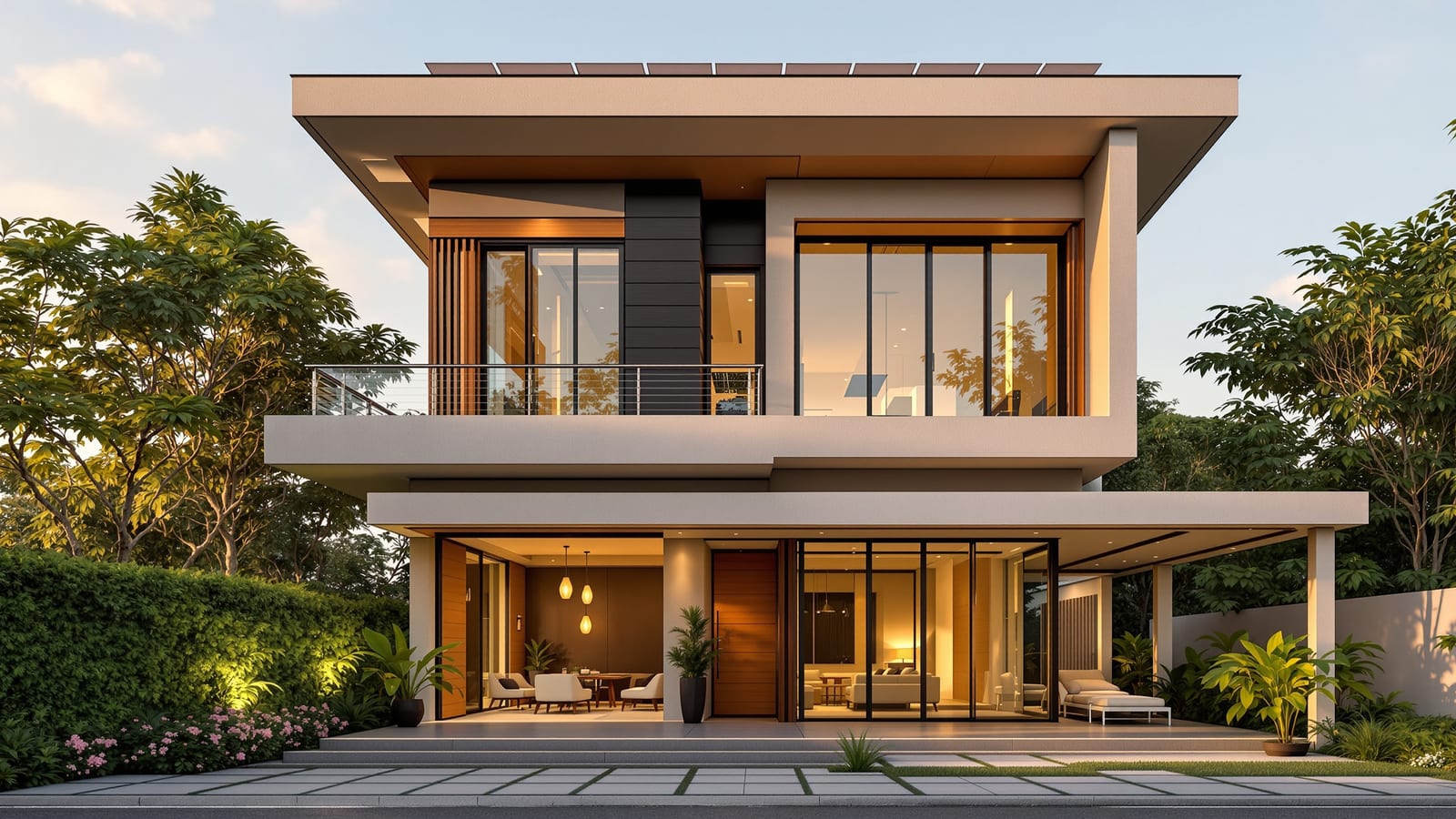
What Makes a Building Sustainable? A Plain-Language Guide for Indian Homeowners
The six dimensions that make a home genuinely sustainable, energy, water, materials, health, site and durability, and how to tell real green design from green-washing
If you ask ten people what a "sustainable building" is, you will get ten different answers. One will point at the solar panels on a neighbour's roof. Another will mention a rainwater tank. A builder might wave a glossy "green certified" sticker at you. None of them is wrong, exactly, but none of them is the whole picture either. A genuinely sustainable home is not a gadget you bolt on at the end. It is a set of decisions made early, mostly about shape, orientation, openings and materials, that together let your house stay comfortable, cost less to run, use less of everything, and last for decades without falling apart or poisoning the air inside it.
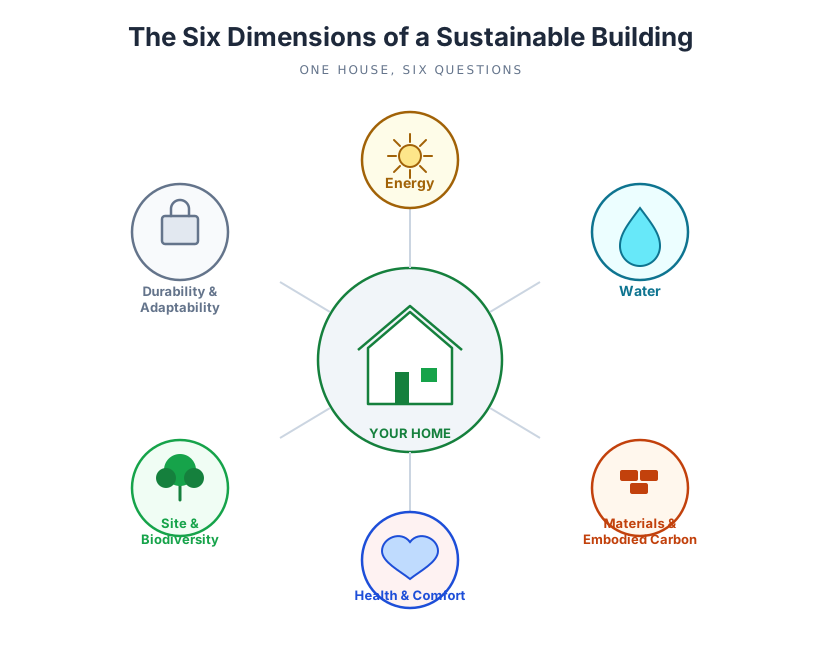
This guide is the plain-language starting point. It explains what "sustainable" actually means for an ordinary Indian homeowner or buyer, and breaks it into the six dimensions that matter. We will keep it honest about cost and trade-offs, ground it in India's own climate and traditions, and point you to deeper companion guides for each piece. By the end you should be able to walk through a flat or a plot of land and judge for yourself whether a building is genuinely sustainable or just wearing the costume.
1. So what does "sustainable" actually mean?
Strip away the marketing and a sustainable building is one that meets your needs today without quietly running up a bill, on money, on resources, and on the environment, that you or the planet have to pay later. The most useful way to think about it is the building's whole life: the energy and materials it takes to build, the energy and water it consumes every year you live in it, the comfort and health it gives you, and what happens to it at the end.
A useful mental test: a sustainable home is comfortable on a hot afternoon with the AC switched off for as long as possible, uses less electricity and water than a conventional home of the same size, was built with materials that did not cost the earth to make, keeps the air inside healthy to breathe, gives something back to its surroundings, and is built well enough to still be standing and useful in fifty years. Everything below is just unpacking that picture.
Crucially, sustainability is decided mostly at the design stage, before a single brick is laid. Once a house faces the wrong way or has huge unshaded west windows, no amount of later gadgetry fully fixes it. That is why we keep returning to the idea of "passive first."
2. Energy: get the design right before you reach for solar
This is the dimension everyone thinks of first, and the one most often done backwards. The instinct is to build a normal house and then add solar panels and a powerful AC. The smarter order is the reverse.
Start with passive design: using the building's own shape, orientation and openings to stay comfortable with little or no machinery. In most of India that means orienting the longer faces north and south (where the sun is easy to shade) rather than east and west (where low morning and evening sun pours straight in), shading windows with overhangs (chajjas) and the kind of deep eaves our grandparents took for granted, insulating the roof (which takes the worst of the summer sun), and placing windows so a breeze can cross the room. India's own residential energy code, the Eco-Niwas Samhita (the Energy Conservation Building Code for homes, issued by the Bureau of Energy Efficiency in 2018), is built almost entirely around this idea: limit heat coming through the envelope, and allow good natural light and ventilation. The aim of that code is roughly a quarter less energy use than a conventional home, and it gets there mainly through envelope decisions, not gadgets.
Only after the design is doing its job do efficiency and renewables make sense: efficient appliances and a high-star-rated AC for the days you do need it, LED lighting, a solar water heater, and rooftop solar panels to generate your own electricity. Done in this order, the solar array you need is smaller and cheaper, because the house is asking for less in the first place. A home that pushes this all the way, generating over a year as much energy as it uses, is called net-zero; see net-zero energy homes for how realistic that is for an Indian household and what it costs. For the climate-by-climate playbook of which passive moves work in hot-dry Jaipur versus humid Chennai versus composite Delhi, read passive design for Indian climate zones.
3. Water: India's quieter crisis
Energy gets the headlines, but in much of India water is the harder problem, and a sustainable home takes it seriously. The three moves, in order, are: use less, reuse what you can, and capture what falls.
Using less is the cheapest win: low-flow taps and showers and dual-flush toilets cut consumption with no loss of comfort once you are used to them. Reuse means treating greywater (the relatively clean water from washbasins, showers and laundry) and using it for flushing or garden irrigation rather than sending fresh drinking-quality water down the drain for those jobs. Capture means rainwater harvesting: directing roof runoff into a storage tank for use, or into a recharge pit so it refills the groundwater under your plot rather than flooding the street. In many Indian cities rainwater harvesting is now expected by local rules, but the point here is the homeowner benefit, not the rule: a water-secure home stays liveable through a dry spell or a tanker shortage. The deeper guide on designing for this is water-secure homes.
4. Materials and embodied carbon: the footprint you cannot see
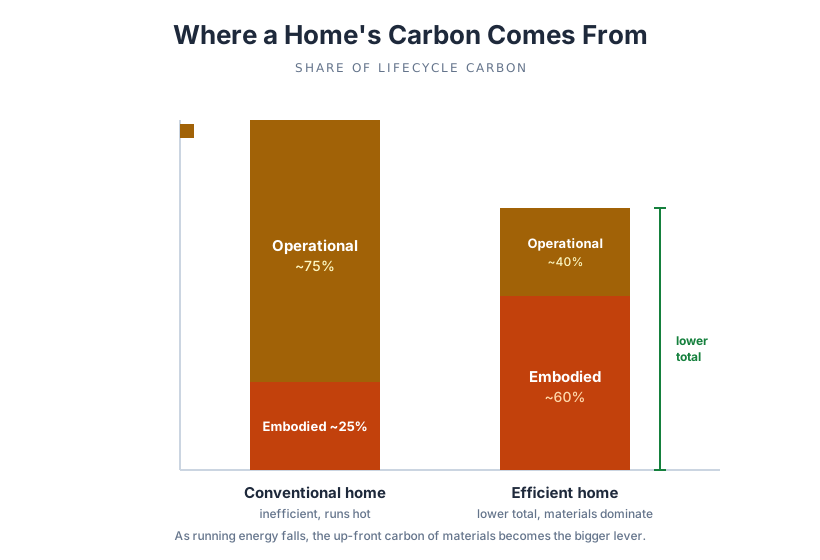
Every material in your house, the cement, steel, bricks, tiles, glass and timber, took energy and emitted carbon when it was made, long before you moved in. This is called embodied carbon, and it is the part of sustainability nobody can see once the walls are plastered. It matters enormously in India: cement and steel are both very carbon-intensive to produce, and as our buildings get more efficient to run, this up-front footprint becomes a bigger share of the total. Estimates for India put embodied emissions at roughly 40 percent of a building's lifecycle carbon, with operations the other 60 percent, and the embodied share rises as homes get more efficient.
For a homeowner, the practical levers are simpler than the science. Favour local materials (a stone quarried 50 km away beats marble shipped across the country). Favour durable ones that will not need replacing in ten years. Be open to lower-carbon options where they suit your climate: fly-ash or slag-blended cement, stabilised earth or compressed-earth blocks, and reclaimed or certified timber. And resist over-building, the extra slab thickness or the marble you do not need is embodied carbon for no benefit. The full story, including how to read a material's footprint, is in embodied carbon in construction; where the field is heading is covered in the future of green building materials; and the bigger idea of designing so materials can be reused rather than dumped is circular economy in construction.
5. Health and comfort: the dimension you feel every day
A building can tick every efficiency box and still be a miserable place to live. Sustainability includes the people inside, and this is the dimension you actually experience: light, air, temperature and the air you breathe.
Daylight means designing so rooms are bright by day without switching on a bulb, which is pleasant and cuts lighting energy. Ventilation means fresh air moving through, both for comfort and to flush out indoor pollutants; cross-ventilation (openings on two sides of a room so air flows through) is the oldest trick in the book and still the best. Thermal comfort means staying comfortable across the seasons leaning on shade, mass and breeze first, so the AC is a backstop for the worst weeks rather than a year-round crutch. And non-toxic materials matter more than most buyers realise: many paints, adhesives, boards and finishes release volatile organic compounds (VOCs), gases that worsen indoor air. Low-VOC paints and adhesives, and well-cured engineered woods, make a measurable difference to the air your family breathes. This is also where India's rating systems put real weight: GRIHA and IGBC both score health, well-being and indoor air quality, not just energy.
6. Site, landscape and biodiversity: the building in its surroundings
A sustainable home does not stop at its walls. How it sits on its plot, and what it does to the land and air around it, is its own dimension. Three things matter most for a homeowner.
Green cover, trees and planting, shades walls and paving, cools the air around the house (a well-placed shade tree on the west side does real work against the afternoon sun), and supports birds and insects. Permeability means keeping enough of your plot as soil, grass or porous paving rather than sealing it all in concrete, so rain soaks in and recharges groundwater instead of running off and the ground stays cooler. Microclimate is the combined effect: a planted, permeable, shaded plot is noticeably cooler and pleasanter than a paved, bare one, which lightens the load on your AC. Taken together these also make your home part of the solution to the urban heat-island effect rather than adding to it. The deeper guide on designing a home that actively improves its patch of the city is how buildings can give back: biodiversity and environmental health.
7. Durability and adaptability: built to last, built to change
The greenest building is often the one you do not have to rebuild. A house that needs major repairs or demolition after twenty years has wasted all the carbon and money that went into it. So durability, using good detailing and weather protection so the building resists rain, damp, heat and time, is a genuine sustainability dimension, even though it sounds like plain good construction.
Adaptability is its quieter cousin: designing so the building can change use without being torn down. A ground floor that can become a shop, a room that can be split or joined, a layout that suits you at 35 and still works at 70. A home you can adapt is a home you keep, and keeping it is the most sustainable thing you can do. India's National Building Code (NBC 2016) frames sustainability in exactly this whole-life way, considering the energy to build, the energy to run, and the impact at end of life, and explicitly nudges designers back towards traditional Indian practices and local materials.
8. The six dimensions at a glance, and how to spot green-washing
Here is the whole picture in one table, with what to look for as a homeowner.
| Dimension | What it really means | What to look for |
|---|---|---|
| Energy | Comfortable and low-bill, design first, gadgets second | North-south orientation, shaded windows, insulated roof, then solar |
| Water | Use less, reuse, and capture rain | Low-flow fittings, greywater reuse, rainwater harvesting or recharge |
| Materials and embodied carbon | A low up-front footprint that lasts | Local, durable materials; blended cement; no over-building |
| Health and comfort | A home that feels good and is safe to breathe | Daylight, cross-ventilation, low-VOC finishes, comfort without constant AC |
| Site and biodiversity | The building helps its plot and neighbourhood | Trees and planting, permeable ground, a cooler microclimate |
| Durability and adaptability | Built to last and to change use | Sound detailing, weather protection, a flexible layout |
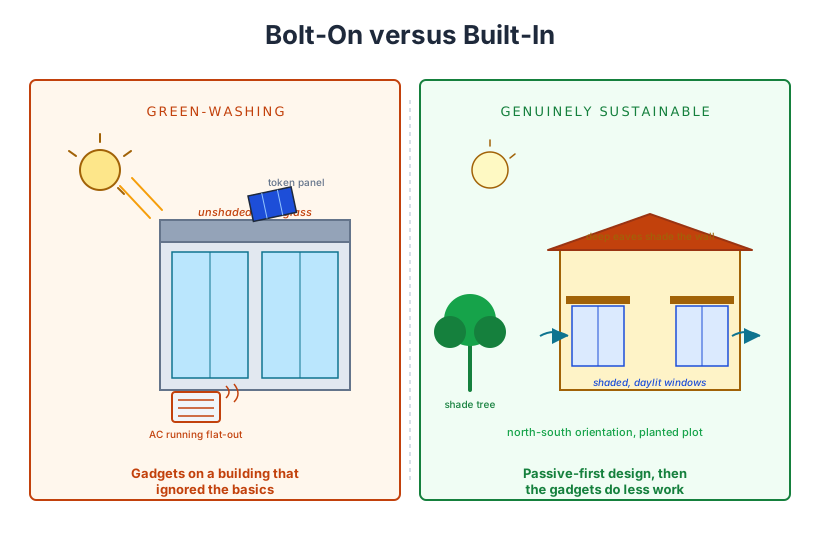
This table is also your green-washing detector. Green-washing is when a building wears the look of sustainability, the solar panel, the certificate, the "eco" brochure, without the design behind it. The tell is almost always the same: gadgets bolted onto a building that ignored the basics. A flat with big unshaded west-facing glass and a token rooftop panel is not sustainable; it is an expensive AC bill with a green sticker. Genuine sustainability is passive-first and shows up in the dimensions above, most of which cost little or nothing extra if decided early. For how the rating systems try to certify the real thing, and where they fall short, see green building certifications.
9. India was sustainable before the word existed
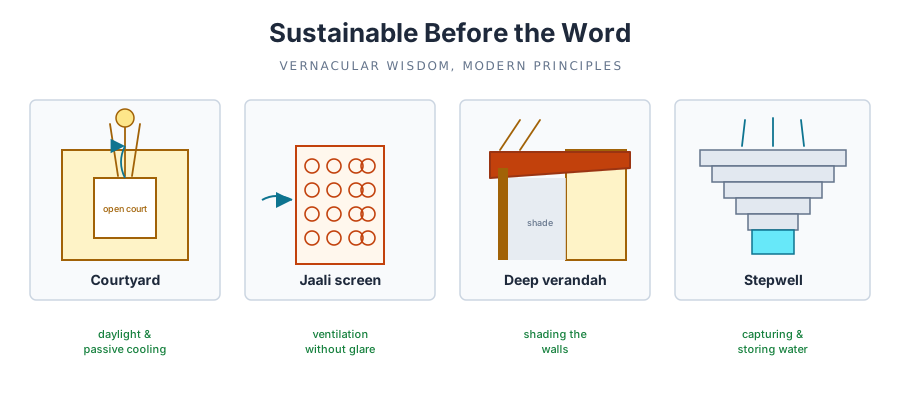
Before "sustainable" became a brochure word, traditional Indian homes were quietly nailing most of these dimensions out of necessity. Thick stone or mud walls stored coolness through the day. Courtyards pulled in light and air and drew hot air upward. Jaalis (perforated screens) let breeze through while cutting glare. Deep verandahs shaded walls and windows. Buildings used what was local, because hauling materials far was expensive: laterite on the coast, sandstone in Rajasthan, timber and sloping roofs in the rainy hills. Step wells and tanks captured water. None of this needed electricity, and all of it is exactly the "passive-first" thinking modern codes are trying to reintroduce.
The lesson for a homeowner is not nostalgia but confidence: the most powerful sustainability moves are old, cheap and proven for our climate. You do not need to import a single gadget to make a meaningfully greener home. You need shade, orientation, ventilation, the right materials and a bit of green, the same things that kept a Chettinad or a Rajasthani haveli liveable long before the AC.
What this means for you
You do not need to be an architect to judge a building, and you do not need to chase a perfect score. Sustainability is a direction, not a pass-or-fail exam. Run any home, your current one, a flat you are considering, or a plot you plan to build on, through the six-question scorecard below, and you will know far more than the brochure tells you.
Quick homeowner scorecard, count the yeses:
1. Energy: Are the main windows shaded and facing north or south, with an insulated roof, before any talk of solar?
2. Water: Is there low-flow plumbing, and any rainwater harvesting or greywater reuse?
3. Materials: Were local, durable materials used, without obvious over-building or pure-show finishes?
4. Health: Do rooms get daylight and cross-ventilation, and were low-VOC finishes used?
5. Site: Is there real green cover and permeable ground, not a fully paved plot?
6. Durability: Is it built soundly, and could the layout adapt as your life changes?
Five or six yeses is a genuinely sustainable home. Two or three means good bones with room to improve. Mostly noes with a solar panel on top is green-washing. The encouraging part is that almost every one of these is decided cheaply and early, which is exactly why understanding them before you buy or build is the most valuable thing you can do.
When you are ready to go deeper, start with the broad companion sustainable home design in India and the climate playbook in passive design for Indian climate zones; understand the labels with green building certifications; and then follow the dimension that matters most to you, the money case in why sustainable buildings cost less over time, the hidden footprint in embodied carbon in construction, what is coming in the future of green building materials, the reuse mindset in circular economy in construction, giving back to your surroundings in how buildings can give back: biodiversity and environmental health, and the ambitious end-points in net-zero energy homes and water-secure homes. A sustainable home is not out of reach or only for the rich. It is mostly good, old, sensible design, and now you know what to look for.
Sources
- Bureau of Energy Efficiency (BEE), Eco-Niwas Samhita (Energy Conservation Building Code for Residential Buildings), 2018 and later editions: https://www.beeindia.gov.in/ and https://udit.beeindia.gov.in/eco-niwas-samhita/
- Ministry of Power, Government of India, press release on the launch of Eco-Niwas Samhita 2018: https://www.pib.gov.in/newsite/PrintRelease.aspx?relid=186406
- Bureau of Indian Standards, National Building Code of India (NBC) 2016, Part 11 Approach to Sustainability: https://www.bis.gov.in/
- GRIHA Council, Green Rating for Integrated Habitat Assessment, rating criteria overview: https://www.grihaindia.org/
- Indian Green Building Council (IGBC), green homes and rating systems: https://igbc.in/
- Alliance for an Energy Efficient Economy (AEEE), Tackling embodied carbon from India's building sector: https://aeee.in/tackling-embodied-carbon-from-indias-building-sector/
- UN Environment Programme, Building Materials and the Climate: Constructing a New Future (2023): https://www.unep.org/resources/report/building-materials-and-climate-constructing-new-future
Export this guide
Related Guides — Deep-dive reading
Designing a Naturally Energy-Efficient Indian Home
Comfort first, gadgets last — passive design, orientation, insulation, ventilation and the climate wisdom that cuts Indian energy bills
SustainabilityHow Buildings Can Give Back: Biodiversity and Environmental Health
How an Indian home and its plot can actively improve the ecology and environment around it, not just reduce harm
SustainabilityEmbodied Carbon in Construction: Cutting the Carbon Locked Into Your Indian Home
The CO2 baked into your cement, steel and bricks is paid up front and can never be undone. Here is where it hides in an Indian home, and the low-cost choices that cut it by roughly a quarter.
SustainabilityRelated Tools — Try Free
Cross-Ventilation Analyzer
Estimate airflow and air changes per hour (ACH) from room size, window areas, layout, and local wind — with NBC 2016 Part 8 compliance check.
Ventilation CalculatorRainwater Tank Sizer
How big should your rainwater tank be? Computes annual harvest, recommended tank capacity in litres, water-bill savings, and payback — for 10 Indian cities.
RWH CalculatorBrise-Soleil Visualizer
Interactive horizontal-louvre cut-off angle calculator — sun altitude, louvre depth, and spacing inputs with a live shadow preview. Computes θ = arctan(spacing/depth) for façade shading, ECBC envelope compliance, hospital daylight design, and tropical sun-control detailing.
Sun Shading Tool