
Circular Economy in Construction: A Homeowner's Guide to Building Without Waste in India
How to move from take-make-waste to keeping materials in use, on your own plot
When your grandparents built a house, very little was thrown away. Old beams became new rafters. Broken bricks went into the foundation. A worn-out door was rehung in the cattle shed. They were not being trendy; they were being careful, because materials were precious and waste was money lost.
Somewhere in the last few decades, that instinct faded. The modern building industry runs on a simple, wasteful loop: dig up raw materials, turn them into a building, and one day knock it all down into a heap of rubble. Take, make, waste. Repeat.
The "circular economy" is just a serious-sounding name for getting back to that older, wiser habit, but doing it deliberately and at scale. This guide explains what it means for an ordinary Indian homeowner or small builder, why it matters more than ever in India, and the practical things you can actually do on your own plot.
1. The linear model: take, make, waste
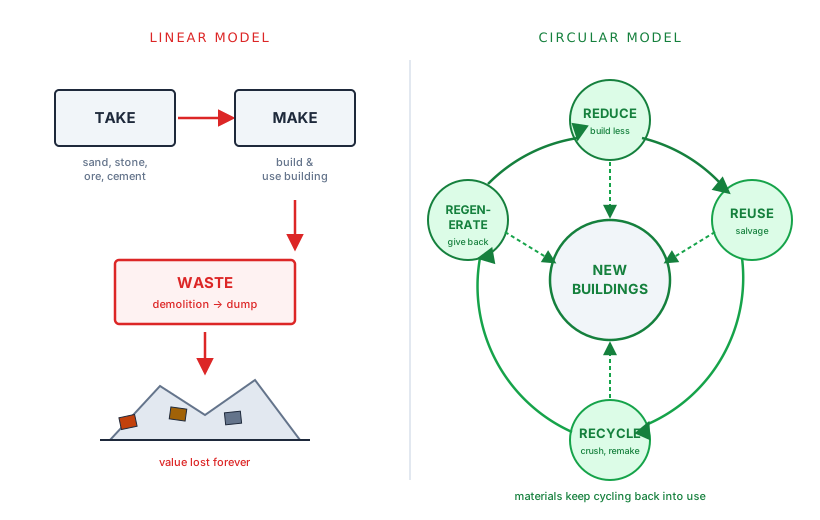
Most construction today follows what experts call a "linear" model. Picture a straight line:
You extract raw materials (sand from a riverbed, stone from a quarry, iron ore for steel, limestone for cement). You manufacture and build with them. The building is used for some years. Then it is demolished, and almost everything ends up as debris dumped on the edge of the city or in a low-lying field.
Every step loses value. The river never gets its sand back. The energy baked into the cement is gone. And the rubble, which still contains perfectly good material, becomes a problem to dump rather than a resource to use.
The circular model bends that straight line into a loop. Instead of materials flowing one way to a dump, they keep cycling back into use. The idea was popularised globally by the Ellen MacArthur Foundation, but it is, at heart, the logic your grandparents already understood.
2. The four Rs of circular building
A circular approach is usually summed up in four words, in order of priority:
- Reduce — build less, and build only what you truly need. The greenest brick is the one you never buy.
- Reuse — use a material again, as-is, for the same or a new purpose. A salvaged door becomes a door again.
- Recycle — break a material down and remanufacture it. Old concrete is crushed into aggregate for new concrete.
- Regenerate — go beyond doing less harm, and actively give back: compost that enriches soil, greywater that feeds a garden, materials that return safely to nature.
The order matters. Reducing is far better than reusing, which is far better than recycling, which still takes energy. People often jump straight to "recycling" because it feels productive, but the biggest wins come earlier in the list, from simply needing and wasting less.
3. Why construction is India's biggest waste and resource problem
Construction is not a small contributor to waste. It is one of the largest material streams on earth, and India sits right at the centre of the pressure.
The waste side. India generates a very large volume of construction and demolition (C&D) waste each year. Government bodies have cited figures in the range of 150 million tonnes annually, while an independent analysis by the Centre for Science and Environment (CSE) estimated the total to be far higher. Treat any single number as illustrative rather than exact, because measurement is patchy. What is not in dispute is the scale: it is enormous, and it is growing as our cities rebuild themselves.
The more troubling figure is how little comes back. CSE analysis has indicated that India recovers and recycles only around 1 per cent of this C&D waste. The rest is dumped, often illegally, where it clogs drains, fills wetlands, and adds to the dust and air pollution choking our cities.
The resource side. At the same time, we are running short of the raw materials we keep digging up. River sand and stone aggregate are under severe strain. The UN Environment Programme has warned that global sand extraction, at roughly 50 billion tonnes a year, is rising faster than nature can replace it, and that India and China are among the most critical hotspots. Illegal sand mining lowers water tables, worsens flooding, and damages rivers across the country.
So we have a strange situation: mountains of usable rubble going to waste at one end, and a scramble for fresh sand and stone at the other. The circular economy is simply about connecting those two ends.
4. Practical circular strategies at home scale
You do not need a research lab to build circular. Here are the strategies that genuinely work on an individual plot, roughly in order of impact.
| Strategy | What it means in practice | Why it helps |
|---|---|---|
| Build less, build adaptable | Right-size the house; design rooms that can change use over time | Avoids material use entirely; the building lasts through life changes instead of being rebuilt |
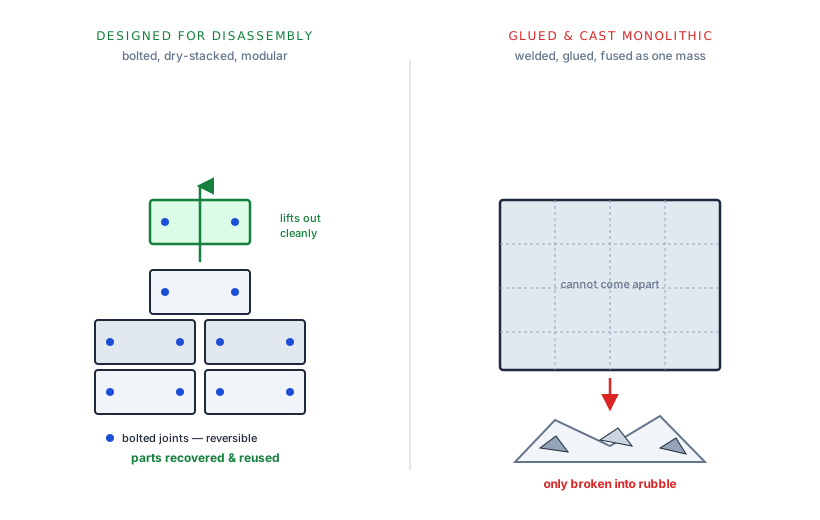
| Design for disassembly | Use bolted joints, dry-stacked or modular elements, screws over glue, so parts can later come apart cleanly | Materials can be recovered and reused at end of life instead of smashed |
| Reuse salvaged materials | Old teak doors, windows, brick, stone, country tiles, beams from demolition | Keeps high-quality material in use; often cheaper and more characterful |
| Choose recyclable or recycled materials | Steel, fly-ash bricks/blocks, recycled aggregate, C&D-recycled blocks | Lower fresh-resource demand; steel is endlessly recyclable |
| Adaptive reuse | Renovate or extend an old structure instead of demolishing it | Saves the entire embodied effort of a new building |
| Repair over replace | Refinish, refit and mend rather than rip out and buy new | Extends the life of what you already own |
| Close loops on site | Compost kitchen and garden waste; reuse greywater for the garden | Keeps nutrients and water cycling on your own plot |
Build less, and build adaptable
The single most circular decision you can make is to build a smaller, smarter house than the one you first imagined, and to design it so it can change without being torn apart. A study room that later becomes a bedroom, a wide doorway that can take a wheelchair in old age, a layout that allows a future floor — these mean the building flexes with your life rather than being demolished and rebuilt.
Design for disassembly
This is the quietly powerful idea most people have never heard of. A building put together with bolts, screws, dry joints and modular parts can one day be taken apart, and its materials recovered intact. A building glued and welded into one mass can only be smashed. When you discuss details with your architect or contractor, ask: "If we ever change this, can it come apart cleanly?"
Reuse salvaged materials
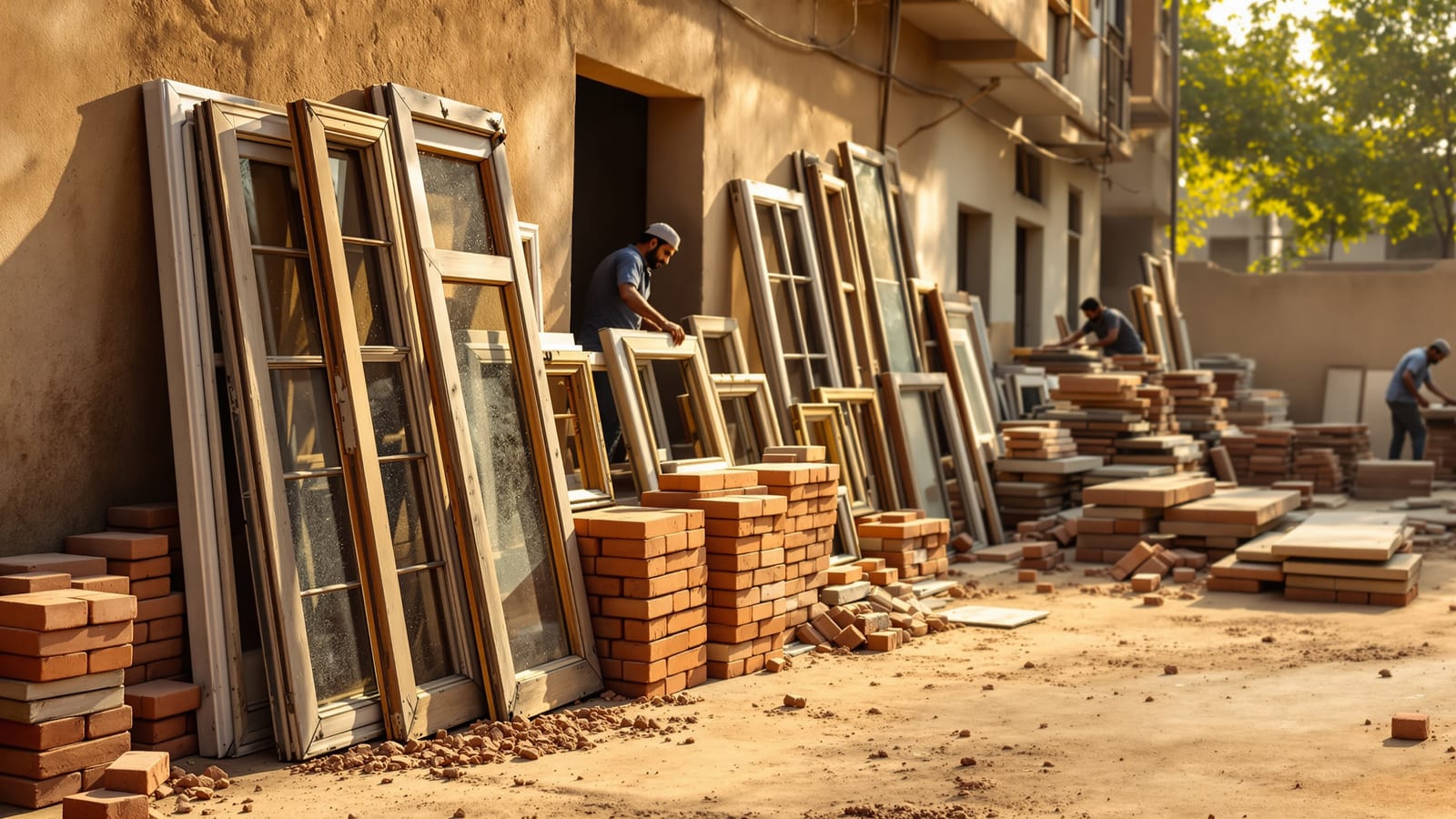
India already has a deep, living salvage culture, which we will come to. Reclaimed teak doors and windows, old Burma teak beams, country-fired bricks, Kota and other natural stone, and antique fittings are often stronger and more beautiful than today's mass-market equivalents, and they keep good material out of the dump.
5. Choosing recycled and recyclable materials
When you do buy new, you can favour materials that already carry recycled content or that can be recycled later.
- Steel is the star of circular construction. It is recycled endlessly without losing strength, and most steel sold in India already contains a large share of recycled scrap.
- Fly-ash bricks and blocks reuse a waste product from coal power plants instead of fired clay, saving topsoil and kiln energy.
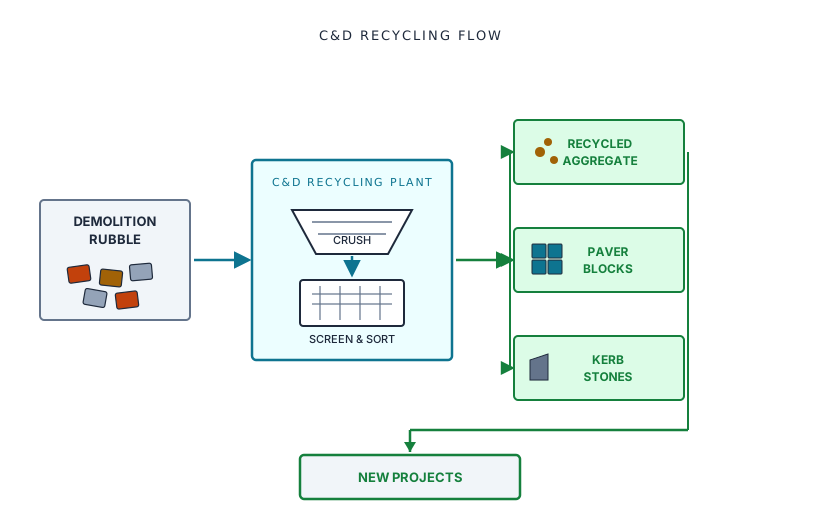
- Recycled aggregate and C&D-recycled blocks come from crushed concrete and rubble. Recycling plants in cities turn debris into aggregate, paver blocks and kerb stones. Used in non-structural and paving applications, these reduce demand on quarries.
- Manufactured sand (M-sand), crushed from rock, is a partial substitute for river sand and eases pressure on rivers.
A fair warning: recycled-content products vary in quality and availability, and structural uses (the parts holding your house up) demand certified, tested material. Use recycled aggregate where it is appropriate, such as paving, fill and non-load-bearing work, and follow your engineer's advice for anything structural.
6. Adaptive reuse: the greenest building is the one already standing
Sometimes the most circular move is to not build at all, but to breathe new life into a structure that already exists. Converting an old bungalow into a homestay, an unused warehouse into a workshop, or a tired ground floor into a shop saves the entire mountain of materials and energy a new building would have demanded.
Adaptive reuse keeps the "embodied" investment alive — all the cement, steel, brick and labour already locked into the old walls. It also tends to keep neighbourhoods rooted and characterful rather than bulldozed and generic. Before you decide to demolish, get a structural engineer to tell you honestly whether the old building can be saved, strengthened and reused. Often it can.
7. Modularity, repair, and closing loops on site
Modularity means designing in standard, repeatable, separable units — modular kitchens, demountable partitions, standardised window sizes. Modular parts are easier to repair, replace and eventually reuse, because they are not fused into the whole.
Repair over replace is a mindset as much as a method. A solid wood door can be sanded and refinished many times. A leaking tap can be reseated. A sofa can be reupholstered. Each repair is a small refusal to send something to the dump and buy a replacement.
Closing loops on site brings the "regenerate" idea home. A compost pit turns kitchen and garden waste into soil for your plants. A simple greywater system can route water from washing into the garden instead of the drain. Rainwater harvesting closes the water loop. These keep nutrients and water cycling on your own plot rather than leaving as waste.
8. The India context: rules, plants, and the kabadi economy
India is not starting from zero. Three things are worth knowing.
The C&D Waste Management Rules, 2016. Notified by the central government, these rules made C&D waste a formally regulated stream for the first time. Anyone generating more than a set quantity of such waste (the rules set a threshold) is expected to segregate it into streams such as concrete, soil, steel, wood and bricks, and to hand it over for proper processing rather than dumping. Local authorities are made responsible for collection and for setting up processing, and the rules push government projects to use a share of recycled C&D material. Enforcement is uneven, especially for small home projects, but the legal direction is clear: rubble is meant to be recovered, not dumped.
Recycling plants. A growing number of Indian cities have set up or announced C&D recycling facilities, with metros leading the way. Capacity is still small relative to the waste generated, but it is expanding, and many municipalities can now tell you where to send sorted debris.
The informal reuse economy. Long before any rule, India had one of the world's most effective reuse systems: the kabadiwala, the scrap dealer, the salvage yard, the demolition contractor who carefully removes and resells doors, windows, beams, steel and bricks. This informal network already keeps vast quantities of material in use. As a homeowner, you are plugging into a system that has always existed. Sell or donate what you remove; buy from reclaimed-material yards; let the demolition crew salvage rather than smash.
Green-building rating systems also reward circular choices. Both IGBC and GRIHA award credits for construction-waste management, for reuse, and for recycled content — GRIHA explicitly builds its assessment around a philosophy of refuse, reduce, reuse and recycle. If you are pursuing a green rating, circular practices earn points directly.
9. Honest limits
Circular construction is powerful, but it is not magic, and it is fair to know the catches.
- Quality and certification. Salvaged and recycled materials must be checked. Old wood can carry termites or hidden rot; recycled aggregate is not suited to every structural job. Test before you trust.
- Availability and effort. Reclaimed materials take hunting, and recycling plants are not yet in every town. Circular building can demand more of your time and attention than ordering everything new.
- Cost is mixed. Salvage and adaptive reuse are often cheaper; design for disassembly and some recycled specialty products can cost a little more upfront.
- Skills. Not every contractor knows how to dismantle for reuse or build with reclaimed material. You may need to find craftspeople who do.
None of these are reasons to give up. They are reasons to plan early, ask questions, and choose your battles.
What this means for you
You do not have to do everything at once. Even one or two circular choices keep real material in use and ease the strain on India's rivers and dumps. Here is a homeowner's circular checklist:
- Before you build: Can I build smaller, or adapt and reuse an existing structure instead of demolishing?
- In the design: Have I designed rooms to change use over time, and details that can come apart (bolted, modular, dry joints) rather than be smashed?
- Sourcing materials: Have I looked at reclaimed doors, windows, wood, brick and stone before buying new? Where I buy new, have I chosen steel, fly-ash blocks, M-sand, and recycled aggregate where suitable?
- During construction: Am I segregating waste into streams (concrete, steel, wood, brick, soil) and sending it to a recycling plant or salvage dealer, not a dump?
- For the long run: Am I designing for repair over replacement, and closing loops on site with composting, greywater and rainwater harvesting?
- If demolishing: Am I letting a salvage crew recover doors, beams, steel and brick before anything is broken?
Circular building is less about expensive technology and more about a careful, old-fashioned mindset: nothing precious gets wasted. For deeper companions, read sustainable interiors India and modern construction materials. To understand the bigger picture, see embodied carbon in construction, the future of green building materials, and what makes a building sustainable.
Sources
- Ministry of Environment, Forest and Climate Change / Central Pollution Control Board — Construction and Demolition Waste Management Rules, 2016 (CPCB rules portal).
- Centre for Science and Environment (CSE) — analyses on C&D waste generation and recovery rates in India ("India recovers and recycles only about 1 per cent of its C&D waste").
- Ministry of Housing and Urban Affairs (MoHUA) / Building Materials and Technology Promotion Council (BMTPC) — estimates of annual C&D waste generation in India (illustrative figures).
- United Nations Environment Programme (UNEP) — reports on sand and aggregate extraction and sustainability ("Sand and Sustainability"); India as a critical extraction hotspot.
- Ellen MacArthur Foundation — foundational framing of the circular economy (reduce, reuse, recycle, regenerate).
- IGBC and GRIHA rating frameworks — construction-waste-management, reuse and recycled-content credits; GRIHA refuse-reduce-reuse-recycle philosophy.
Export this guide
Related Guides — Deep-dive reading
Recycled Building Materials in India: The Circular-Economy Guide (2026)
What recycled construction materials actually are, where they can and cannot go into a building, and how to specify recycled content without gambling on quality - a specify-and-select guide for Indian homes and projects.
Building MaterialsEmbodied Carbon in Construction: Cutting the Carbon Locked Into Your Indian Home
The CO2 baked into your cement, steel and bricks is paid up front and can never be undone. Here is where it hides in an Indian home, and the low-cost choices that cut it by roughly a quarter.
SustainabilityHow Buildings Can Give Back: Biodiversity and Environmental Health
How an Indian home and its plot can actively improve the ecology and environment around it, not just reduce harm
SustainabilityRelated Tools — Try Free
Cross-Ventilation Analyzer
Estimate airflow and air changes per hour (ACH) from room size, window areas, layout, and local wind — with NBC 2016 Part 8 compliance check.
Ventilation CalculatorRainwater Tank Sizer
How big should your rainwater tank be? Computes annual harvest, recommended tank capacity in litres, water-bill savings, and payback — for 10 Indian cities.
RWH CalculatorHome Building & Interior Cost Calculator — 20 Cities
Construction + interior costs for 20 Indian cities across kitchen, wardrobes, flooring, painting, ceiling.
Cost Calculator