
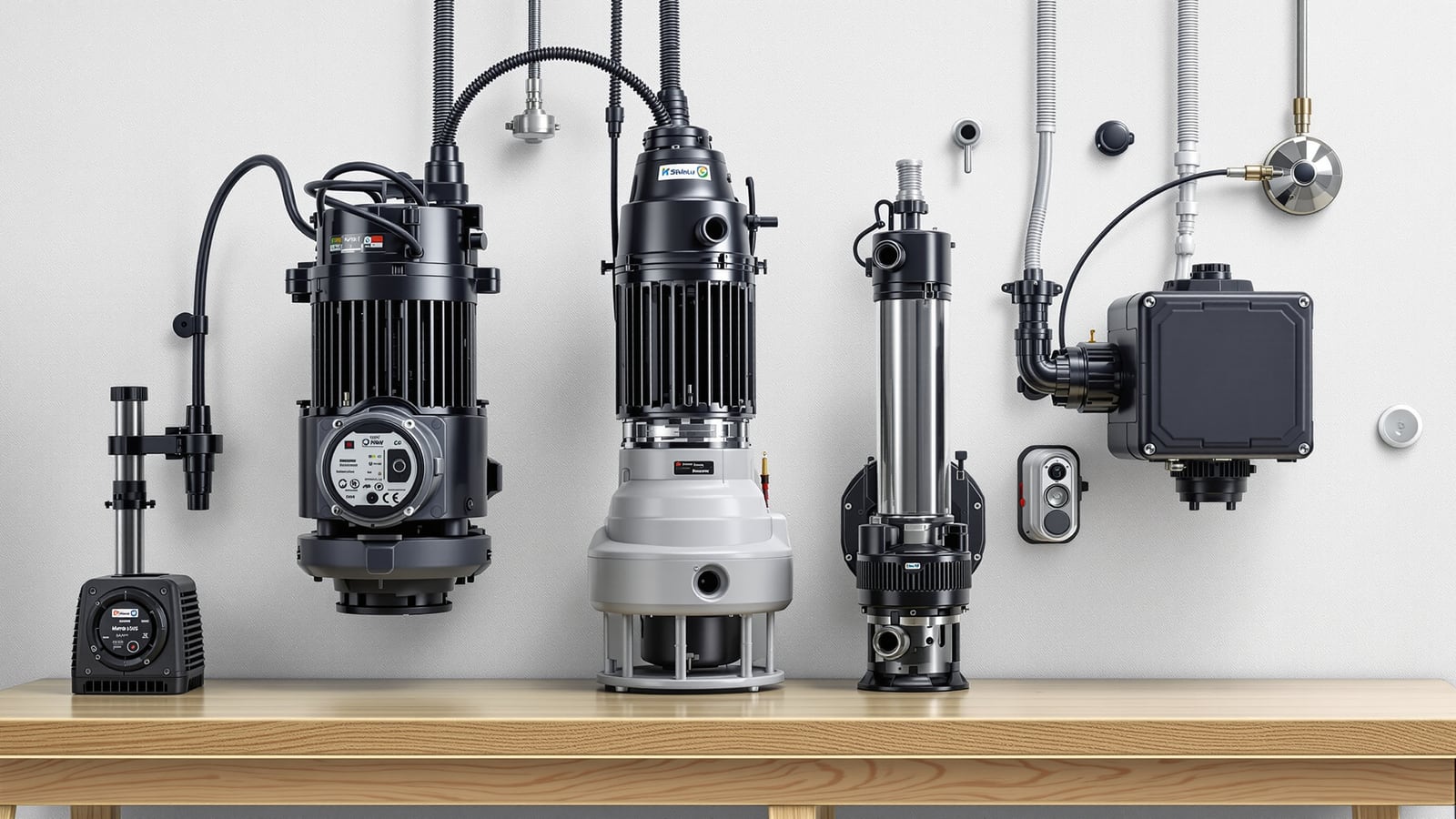
Water Pumps Guide for India: Types, How to Choose & Size (Head, Flow, Phase)
The master overview of domestic and building water pumps — what a pump actually does (lift plus pressure), the two numbers that decide everything (HEAD in metres and FLOW in LPM), a pump-type-to-use table, single vs three phase, priming, foot valve and NRV needs, dry-run protection, and BEE star rating with running cost at a glance for an Indian home.
Almost every Indian home moves water with a pump. Municipal pressure is rarely enough to fill an overhead tank, borewells sit tens of metres down, and upper floors need a push that gravity from a rooftop tank cannot always give. The pump is the small machine that does all of that quietly in the background — until it hums, trips, runs dry or delivers a weak trickle, and you suddenly need to understand it.
This is the master overview under the Studio Matrx plumbing systems pillar. It explains what a water pump actually does, the two numbers that decide which pump you buy, and how the common types differ. Sibling guides go deeper on each family — centrifugal and monoblock pumps, submersible pumps, booster pumps and borewell pumps — and when it is time to size one, use the pump size calculator.
The job: a pump does two things at once
A water pump does not simply "give water". It does two separate jobs, and confusing them is the single biggest reason people buy the wrong pump.
- Lift — raising water against gravity. Pulling from a sump two metres below, then pushing it up to a tank on a three-storey roof, is pure lift.
- Pressure — the push left over once the water arrives, so a shower or tap actually flows well instead of dribbling.
Both are measured in the same currency: metres of head. That is the elegance of pump sizing — vertical rise, pipe friction and the pressure you want at the outlet all convert into metres, add up, and the pump must beat that total.
A pump is not judged by horsepower. Two 1 HP pumps can perform completely differently — one built for deep lift, another for high flow at low lift. Always match a pump to head and flow, never to HP alone.
The two numbers that decide everything: HEAD and FLOW
If you remember nothing else from this guide, remember these two.
- HEAD (metres, m) — how high and hard the pump can push. It is the total of the vertical height the water climbs, plus friction losses in the pipe and fittings, plus the residual pressure you want at the top. A pump might be rated for a maximum head of 30 m; run it near that limit and the flow drops to almost nothing.
- FLOW (litres per minute, LPM) — how much water it delivers per minute at your working head. Filling a 1,000-litre tank in ten minutes needs roughly 100 LPM at the head your system presents.
The two trade off against each other. Every pump has a performance curve: as the head it must overcome rises, the flow it can deliver falls. A pump quoted as "40 metres, 100 LPM" cannot do both at once — it gives 100 LPM at low head and near-zero flow at 40 m. You choose the pump whose curve comfortably covers your head and flow together.
Do not size a pump by feel. Feed your tank size, floors, pipe length and source depth into the pump size calculator; for bathroom shower pressure specifically, the shower pump calculator is the right tool. The guidance below is indicative only — always confirm the duty point against a real performance curve and, ideally, a local pump dealer.
The pump-type-to-use table
Most homes only ever meet five or six of these. Match the situation to the type first, then size within that family.
| Pump type | What it does | Typical HP / kW | Head range (m) | Flow (LPM) | Best used for |
|---|---|---|---|---|---|
| Monoblock / centrifugal | Motor and pump in one casing, self-priming variants common | 0.5-2 HP (0.37-1.5 kW) | 10-40 | 30-120 | Sump-to-overhead-tank filling, general home supply |
| Submersible (borewell) | Long thin pump sits inside the borewell, pushes up | 0.5-3 HP (0.37-2.2 kW) | 30-150+ | 20-100 | Deep borewells, high lift from below ground |
| Jet / self-priming shallow well | Uses a jet to lift from shallow depth without losing prime | 0.5-1.5 HP | 15-45 | 20-70 | Open wells and shallow sources up to ~7-8 m |
| Booster / pressure pump | Adds pressure to already-supplied water | 0.5-1 HP | 10-30 | 20-60 | Weak taps and showers on upper floors |
| Sump / drainage pump | Moves clean or slightly dirty water out of a pit | 0.5-1.5 HP | 5-15 | 100-300 | Emptying sumps, rainwater pits, flooded basements |
| Sewage / effluent pump | Passes solids-laden water | 0.5-2 HP | 5-20 | 100-400 | Draining sewage/effluent (treatment is separate) |
| Solar water pump | DC/AC pump run from PV panels | 0.5-5 HP | 10-70+ | 20-150 | Off-grid or day-time borewell/irrigation supply |
A sump or sewage pump only moves water — it does not clean it. Wastewater treatment belongs to a sewage treatment plant, and the pumps that feed and dose one are covered under STP pumps and instrumentation. Smart, app-controlled and IoT pumps exist across most of these families; the connectivity is a layer on top and belongs to smart-home coverage, not to pump selection.
How the common types actually differ
- Monoblock / centrifugal is the default Indian home pump: a spinning impeller flings water outward to create flow and pressure. Cheap, robust, easy to service — but a plain centrifugal must be primed (its casing filled with water) before it will lift, which is why the foot valve below matters.
- Submersible pumps sit underwater inside a borewell, so they never need priming and never lose suction — the water they push is already around them. They are the answer whenever lift exceeds what a surface pump can suck (roughly 7-8 m of suction is the practical ceiling for any surface pump, because atmosphere can only push water up so far).
- Jet / self-priming pumps cleverly recirculate a little water to keep their prime, so they tolerate shallow wells and intermittent supply without you re-priming them each time.
- Booster pumps assume water is already arriving — from a tank or the mains — and simply raise its pressure, often with a pressure switch that starts the pump when you open a tap.
Single phase vs three phase
- Single phase (1φ, 230 V) runs on an ordinary domestic connection. Almost all home pumps up to about 2 HP are single phase. Simpler, cheaper, works on your normal supply.
- Three phase (3φ, 415 V) needs a three-phase connection and is used for larger pumps (roughly 3 HP and above) — deep borewells, large buildings, pumping stations. Three-phase motors run cooler and more efficiently at higher power, but the connection costs more and single-phasing (loss of one phase) can burn the motor without a protection relay.
For most independent homes and small apartments, single phase is the whole story. If a dealer quotes a three-phase pump for an ordinary bungalow, question whether the duty really needs it.
Priming, the foot valve and the NRV
A surface pump can only pull water if there is water in its casing to begin with — that is priming. Lose the prime and the pump spins on air, moving nothing while its seals overheat.
Two one-way valves keep the prime and protect the pump. Both are check valves (non-return valves), fitted in different places:
- Foot valve — a check valve with a strainer at the bottom of the suction pipe, sitting in the water. When the pump stops, it holds the suction column full so the pump stays primed for the next start. The strainer keeps grit and leaves out.
- NRV on the discharge — a check valve just after the pump outlet. It stops the tank's water rushing back down through the pump each time it stops, which prevents water hammer and reverse spin.
Skip the foot valve and a surface pump loses prime every time it stops; skip the discharge NRV and you get water hammer, reverse rotation and a shorter pump life. On borewell submersibles the NRV is often built into the pump body.
Dry-run protection
The fastest way to kill a pump is to let it run dry — no water to cool or lubricate it. It happens constantly in India: the sump empties, the borewell yield drops, or the mains simply stops mid-cycle, and the pump keeps spinning against nothing until its seals and windings cook.
- Dry-run preventer / controller — an electronic device that senses no-flow or under-current and cuts the pump before damage.
- Float / level switch — a simple float that stops the pump when the sump falls below a set level and restarts it when water returns.
- Automatic pump controllers — combine dry-run cutoff with tank-full and tank-empty sensing so the pump only runs when it should.
On any pump that draws from an unreliable source — and most Indian sources are unreliable — dry-run protection is not optional. It costs a fraction of a replacement motor.
BEE star rating and running cost at a glance
Pumps run for hundreds of hours a year, so efficiency is real money. Many domestic pumps now carry a BEE (Bureau of Energy Efficiency) star rating — more stars means the same water for less electricity. A 5-star pump can use meaningfully less power than an unrated one of the same HP.
The rough running cost of any pump is simply its power draw multiplied by hours run and your tariff:
| Pump size (indicative) | Approx. power draw | ~Hours/day | ~Units (kWh)/month | Indicative ₹/month* |
|---|---|---|---|---|
| 0.5 HP (~0.37 kW) | ~0.45 kW | 1 | ~13.5 | ₹110-150 |
| 1 HP (~0.75 kW) | ~0.9 kW | 1 | ~27 | ₹220-320 |
| 1.5 HP (~1.1 kW) | ~1.3 kW | 1.5 | ~58 | ₹470-700 |
| 2 HP (~1.5 kW) | ~1.8 kW | 1.5 | ~80 | ₹650-950 |
*Assumes a domestic tariff of roughly ₹7-9 per unit; your tariff, actual run-hours and pump efficiency will vary. Treat these as ballpark, not a bill.
A higher star rating and correct sizing beat any running-cost trick: an oversized pump throttled by a half-closed valve wastes power every second it runs. Buy the pump that matches your head and flow, and it will draw only what the job needs.
Common problems and quick reads
- Weak flow upstairs — head too high for the pump, or a booster is needed. See booster pumps.
- Pump runs but no water — lost prime, air leak on suction, or failed foot valve.
- Pump won't stop / short cycles — leaking NRV, waterlogged pressure vessel, or a stuck float.
- Motor trips or overheats — dry running, voltage issues, or an oversized/wrong-phase pump.
- Loud knock on stopping — water hammer from a missing or failed discharge NRV.
Indicative costs
| Item | Indicative ₹ |
|---|---|
| 0.5-1 HP monoblock/centrifugal | ₹3,000-8,000 |
| 1-2 HP self-priming/jet pump | ₹6,000-16,000 |
| Borewell submersible (1-3 HP + wiring) | ₹12,000-45,000+ |
| Domestic booster/pressure pump | ₹6,000-20,000 |
| Foot valve + discharge NRV | ₹400-2,500 |
| Dry-run/automatic controller | ₹800-4,000 |
Prices swing widely by brand, material and city; use these only to sanity-check a quote, and confirm the duty point with a local pump dealer before buying.
References
- Bureau of Energy Efficiency (BEE) — star-labelling programme for water pumps and motors.
- Bureau of Indian Standards — standards for monoblock, submersible and centrifugal pumpsets (confirm the current IS number with your supplier before specifying).
- Studio Matrx: plumbing systems guide, check valves, borewell water system, and the pump size calculator.
Export this guide
Related Guides — Deep-dive reading
Borewell Pumps in India: How to Size HP by Depth, V3/V4/V6 Types, Stages and Running Cost
The deep-well submersible pump is the heart of a private borewell — a slim multi-stage unit that sits underwater and pushes your supply up to the tank. This guide explains how to pick horsepower by borewell depth, water level and yield, which body diameter (V3/V4/V6) fits your bore, why more stages mean more head, and how oversizing wastes electricity and can dewater the bore.
PlumbingCentrifugal Pumps in India: How Monoblock Water Pumps Work, Sizing & Cost
The impeller-and-volute workhorse behind almost every domestic monoblock and surface pump — how the spinning impeller lifts water, self-priming vs non-self-priming and the foot valve, reading the head-vs-flow pump curve, single vs three phase, cavitation and priming problems, and indicative prices for an Indian home.
PlumbingJet Pumps in India: Self-Priming Shallow-Well Pumps, Suction Lift and How to Choose
The self-priming jet pump is the workhorse for homes that must draw water up from an open well, a sump or a shallow borewell sitting below the pump — how the ejector and venturi make it self-prime, what suction lift it can really manage, shallow-well versus deep-well jet, and how it stacks up against submersible and plain centrifugal pumps.
PlumbingRelated Tools — Try Free
Rainwater Tank Sizer
How big should your rainwater tank be? Computes annual harvest, recommended tank capacity in litres, water-bill savings, and payback — for 10 Indian cities.
RWH CalculatorShower Pump Calculator
Check whether your shower needs a pressure-boost pump and what size — available vs required pressure from your tank height or supply.
Bathroom CalculatorLift Power Requirement Calculator
Connected load, single vs three phase, MCB and cable guidance for a home lift.
Lift Calculator