
Jet Pumps in India: Self-Priming Shallow-Well Pumps, Suction Lift and How to Choose
The self-priming jet pump is the workhorse for homes that must draw water up from an open well, a sump or a shallow borewell sitting below the pump — how the ejector and venturi make it self-prime, what suction lift it can really manage, shallow-well versus deep-well jet, and how it stacks up against submersible and plain centrifugal pumps.
Some homes sit above their water. The well, the sump or the shallow borewell is below the pump, and the pump has to reach down and lift the water to itself before it can push it anywhere. An ordinary centrifugal pump struggles with that job — it loses its prime the moment air gets in. The self-priming jet pump was built exactly for it. This guide explains how a jet pump works, what suction lift it can really manage, and when it is the right tool for an Indian home.
This is a pump guide inside the Studio Matrx Plumbing Knowledge Hub. For the full family of domestic pumps and how to choose between them, start with the water pumps guide for India.
A jet pump's trick is not raw power. It is the ability to draw water up to itself and hold its prime, so it can sit dry and high above an open well or sump and still deliver.
How a jet pump works
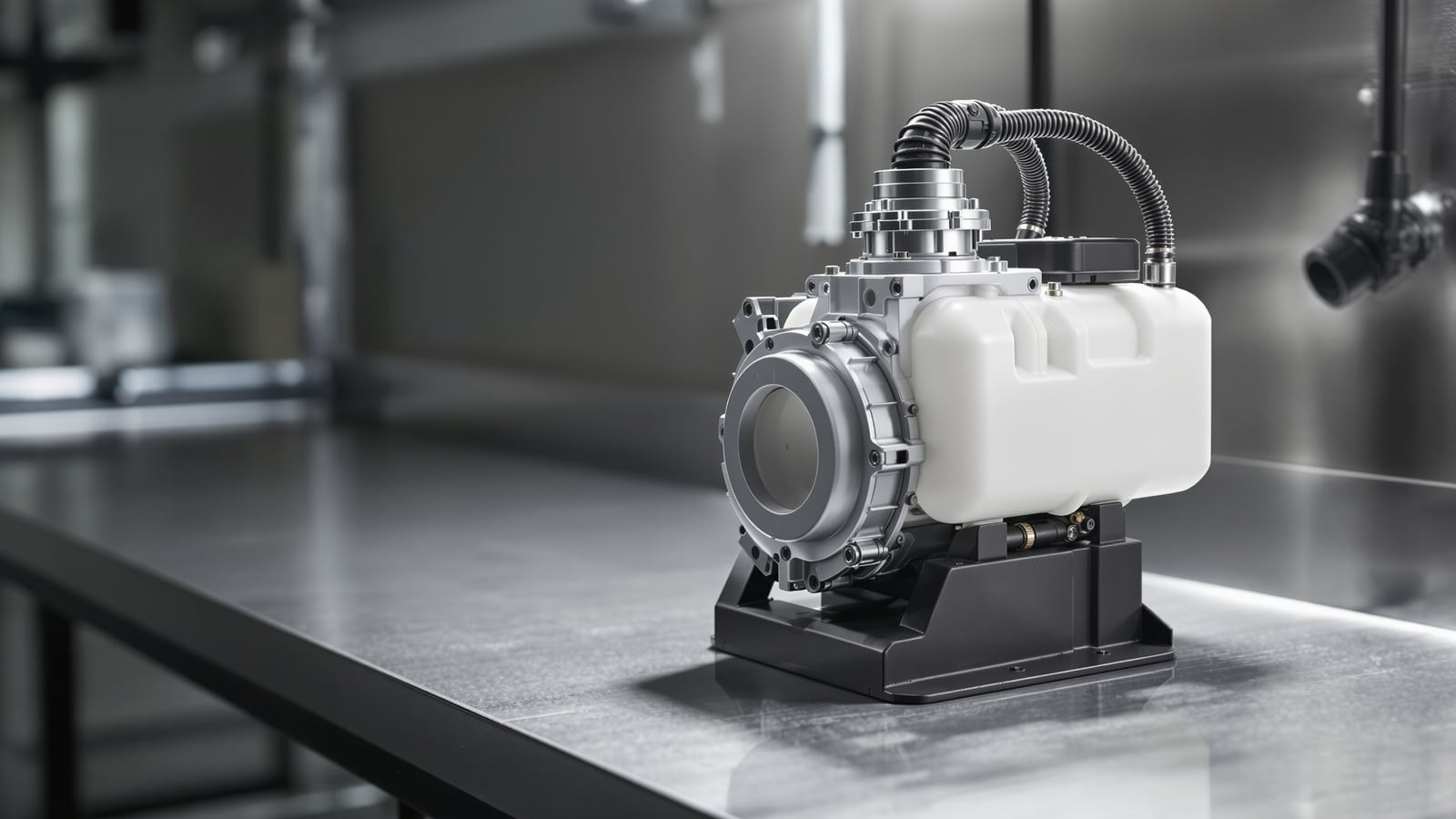
A jet pump is really two things bolted together: an ordinary centrifugal impeller, and a small nozzle-and-venturi assembly called an ejector (or jet). The impeller does the pushing; the ejector does the self-priming and the suction lift.
Here is the loop it runs:
- The impeller throws water outward at pressure, exactly as a centrifugal pump does.
- A share of that pressurised water is sent back down to the ejector, where it is forced through a fine nozzle. Squeezing through the nozzle turns pressure into a fast jet of water.
- That fast jet shoots through a shaped throat called a venturi. A fast-moving stream creates low pressure around itself, and that low pressure -> a partial vacuum -> sucks fresh water (and any air) in from the suction pipe.
- The recirculated water and the newly drawn water combine and go back up to the impeller, which lifts the whole lot and sends part out to the house and part back down the loop again.
Because the ejector will happily pull air as well as water, the pump can clear the air out of its own suction line and prime itself — no need to keep pouring water in before every start once it is charged. That single behaviour is what separates a jet pump from a plain monoblock.
Self-priming: the real advantage
An ordinary centrifugal pump has to be full of water to work — a dry impeller just spins uselessly against air. That is fine when the pump sits below the water and gravity keeps it flooded. It fails when the water is below the pump, because as soon as the pump stops, the suction column can drain back and let air in.
A jet pump handles this in three ways that matter to an Indian home:
- It draws from below itself. Mount it on a plinth in the pump room, run a pipe down into the open well, sump or shallow borewell, and it pulls the water up to itself. This is called working against negative suction or suction lift.
- It tolerates some air. The ejector clears air out of the line, so the pump re-primes after the source dips or the line partly drains, instead of running dry and giving up.
- It is happy where a submersible can't go. A shallow open well too narrow or too silty for a submersible, or a sump you want to keep the motor out of, suits a jet pump because the motor stays high and dry on the surface.
For homes drawing from a traditional dug well, this pairs directly with the open well water system guide.
Shallow-well versus deep-well jet
Jet pumps come in two arrangements, split by where the ejector sits.
- Shallow-well jet (single-pipe). The ejector is built into the pump body on the surface. Simple, cheap, and the common choice for Indian homes. Practical suction lift is roughly 7 to 8 metres — beyond that, atmospheric pressure simply can't push water up the pipe fast enough and the flow collapses.
- Deep-well jet (twin-pipe / convertible). The ejector is lowered down into the well on a second pipe, close to the water, so it does the hard suction work down there and only the lift-to-surface is left to the pipe. This reaches deeper sources — indicatively 15 to 30 metres — though it moves less water for a given HP and is fussier to set up. For genuinely deep water most Indian homes now simply fit a submersible pump instead.
The 7 to 8 metre suction limit is not a marketing figure — it is physics. At sea level the atmosphere can only lift a water column about 10 metres in theory, and friction, temperature and altitude eat into that. Treat 8 metres of vertical lift as the honest ceiling for a shallow-well jet.
Sizing, head and flow
Domestic jet pumps in India run mostly 0.5 HP to 1.5 HP, single-phase, and are rated by how high they can push water (head, in metres) and how much they move (flow, in litres per minute). A jet pump trades some flow for its suction and pressure ability, so litre-for-litre it moves less water than a plain centrifugal pump of the same HP — you pay for the self-priming trick.
For actual sizing — matching HP to your total head and required flow — use the pump size calculator rather than guesswork; the figures below are only indicative starting points.
| Model (indicative) | HP / kW | Phase | Max head | Max flow | Practical suction lift | Typical home use |
|---|---|---|---|---|---|---|
| Shallow-well jet | 0.5 HP / 0.37 kW | 1φ | 25-35 m | 25-35 LPM | up to 7-8 m | Small home, one tank from a sump |
| Shallow-well jet | 1.0 HP / 0.75 kW | 1φ | 35-45 m | 35-45 LPM | up to 7-8 m | Open well to overhead tank, 2-3 floors |
| Shallow-well jet | 1.5 HP / 1.1 kW | 1φ | 45-55 m | 40-55 LPM | up to 7-8 m | Larger home, higher tank |
| Deep-well / convertible jet | 1.0-1.5 HP | 1φ | 30-45 m | 20-35 LPM | 15-30 m (twin-pipe) | Deeper well, low yield source |
Priming water, foot valve and dry running
A jet pump self-primes once it has water in the body — but you still have to fill it the very first time, or after the suction line has drained completely. That first charge of water poured into the priming plug is the "priming water".
To keep the prime and protect the pump:
- Fit a foot valve at the bottom of the suction pipe. This one-way valve holds the water column in the line when the pump stops, so it doesn't have to re-prime from empty every cycle. Its cousin, the non-return valve, is covered in the check-valves and NRV notes of the water pumps guide.
- Keep suction joints airtight. A jet pump's weakness is an air leak on the suction side — even a slightly loose threaded joint will break the prime and leave the pump humming but dry. Use thread tape and metal or good PVC fittings.
- Guard against dry running. If the well or sump runs dry, the pump churns the same water, overheats and can seize. A low-water cut-off or a dry-run protector is cheap insurance, especially on summer-lean open wells.
Running cost, common problems and price
A 1 HP jet pump draws roughly 0.75 kW and, running a couple of hours a day to fill tanks, adds only a modest amount to a domestic bill — but a badly primed or air-leaking pump that runs long and delivers little wastes both water and power.
Common complaints and their usual cause:
- Won't prime / no water: air leak on suction side, failed foot valve, or suction lift too high — the classic jet-pump trio.
- Weak, pulsing delivery: partial air entry, a choked nozzle in the ejector, or the well level dropping near the 8 m limit.
- Runs hot / trips: dry running, or a jammed impeller.
Indicative prices (2026, hardware only, before pipe and fittings):
| Pump | Indicative price |
|---|---|
| 0.5 HP shallow-well jet | ₹4,500 - ₹7,500 |
| 1.0 HP shallow-well jet | ₹6,500 - ₹11,000 |
| 1.5 HP shallow-well jet | ₹9,000 - ₹15,000 |
| Deep-well / convertible jet | ₹12,000 - ₹22,000 |
Jet versus submersible versus centrifugal
| Feature | Jet pump | Submersible | Plain centrifugal / monoblock |
|---|---|---|---|
| Where it sits | On surface, above water | Inside the water | On surface |
| Self-priming | Yes | N/A (always flooded) | No (needs positive suction) |
| Draws water up to itself | Yes, up to ~7-8 m (shallow) | No — pushes from below | Poorly / not at all |
| Best source | Open well, sump, shallow borewell below pump | Deep borewell, deep well | Water at or above pump level |
| Flow per HP | Lower | High | Highest |
| Access for service | Easy (motor on surface) | Must be pulled out | Easy |
The rule of thumb: if your water sits below the pump and within about 8 metres, the jet pump is the natural fit. If it is deep, go submersible. If the water is at or above the pump already, a plain centrifugal pump moves more water for less money.
Where a jet pump earns its place
Reach for a jet pump when:
- You draw from an open well or dug well and want the motor kept safely on the surface.
- Your underground sump or tank sits below the pump room and you need reliable, self-priming pull-up.
- You have a shallow borewell with the water within about 8 metres and don't want a submersible.
- The house suffers negative suction — the source is lower than the pump — where a plain monoblock would keep losing prime.
For pushing that water around the house at good pressure once it is lifted, and for bathroom shower pressure specifically, see the pressurised-system and pump guidance linked from the water pumps guide and size any booster with the pump size calculator.
References
- Bureau of Indian Standards — Indian Standards for centrifugal and self-priming pumps for clean water (refer to the current IS listings for domestic pumpsets).
- Bureau of Energy Efficiency (BEE) — star-labelling programme for domestic monoblock and self-priming pumps; prefer a higher-star model for lower running cost.
- Manufacturer pump curves — always match head and flow to the specific model's published curve before buying; the figures here are indicative.
Export this guide
Related Guides — Deep-dive reading
Centrifugal Pumps in India: How Monoblock Water Pumps Work, Sizing & Cost
The impeller-and-volute workhorse behind almost every domestic monoblock and surface pump — how the spinning impeller lifts water, self-priming vs non-self-priming and the foot valve, reading the head-vs-flow pump curve, single vs three phase, cavitation and priming problems, and indicative prices for an Indian home.
PlumbingWater Pumps Guide for India: Types, How to Choose & Size (Head, Flow, Phase)
The master overview of domestic and building water pumps — what a pump actually does (lift plus pressure), the two numbers that decide everything (HEAD in metres and FLOW in LPM), a pump-type-to-use table, single vs three phase, priming, foot valve and NRV needs, dry-run protection, and BEE star rating with running cost at a glance for an Indian home.
PlumbingWater Pressure Booster Pump India: Fix Weak Shower Flow Before You Buy a Rain Head (2026)
Gravity from an overhead tank cannot run a rain shower or body jets — especially on the top floor. This is the honest India-first guide to pressure booster pumps: pressure-switch vs flow-switch, single-fixture vs whole-house sizing by head and LPM, dry-run protection, noise, mounting, electricals and real rupee ranges.
BathroomsRelated Tools — Try Free
Rainwater Tank Sizer
How big should your rainwater tank be? Computes annual harvest, recommended tank capacity in litres, water-bill savings, and payback — for 10 Indian cities.
RWH CalculatorShower Water Flow Calculator
Shower water use per shower, day and month by head type, plus a pressure-adequacy check for your tank height or pump and low-flow savings.
Bathroom CalculatorShower Pump Calculator
Check whether your shower needs a pressure-boost pump and what size — available vs required pressure from your tank height or supply.
Bathroom Calculator