
Borewell Pumps in India: How to Size HP by Depth, V3/V4/V6 Types, Stages and Running Cost
The deep-well submersible pump is the heart of a private borewell — a slim multi-stage unit that sits underwater and pushes your supply up to the tank. This guide explains how to pick horsepower by borewell depth, water level and yield, which body diameter (V3/V4/V6) fits your bore, why more stages mean more head, and how oversizing wastes electricity and can dewater the bore.
A borewell is only as good as the pump inside it. The hole in the ground holds the water, but a deep-well submersible pump is what actually lifts it, hour after hour, from far below the ground up to your tank. Choose that pump well and it runs quietly for years on modest electricity; choose badly — usually by buying "extra" horsepower — and you pay for it every single day in wasted power and, worse, in a bore that keeps running dry.
This guide sits inside the Studio Matrx Plumbing Knowledge Hub. It is about the pump specifically — how to size and specify the unit for the borewell application. For how the whole borehole, casing and water table deliver water, read the companion borewell water system guide rather than duplicating it here; for the pillar overview of every home pump type, see the water pumps guide; and for the wider submersible family (open-well, dewatering, pressure-boosting) see the submersible pumps guide.
Rule of thumb before you shop: a borewell pump is sized to the worst-case water level, not to the depth of the hole. What matters is how far the pump has to lift water when the level has dropped after an hour of pumping — plus the height of your tank — not how many metres of empty pipe hang below it.
How a borewell pump works
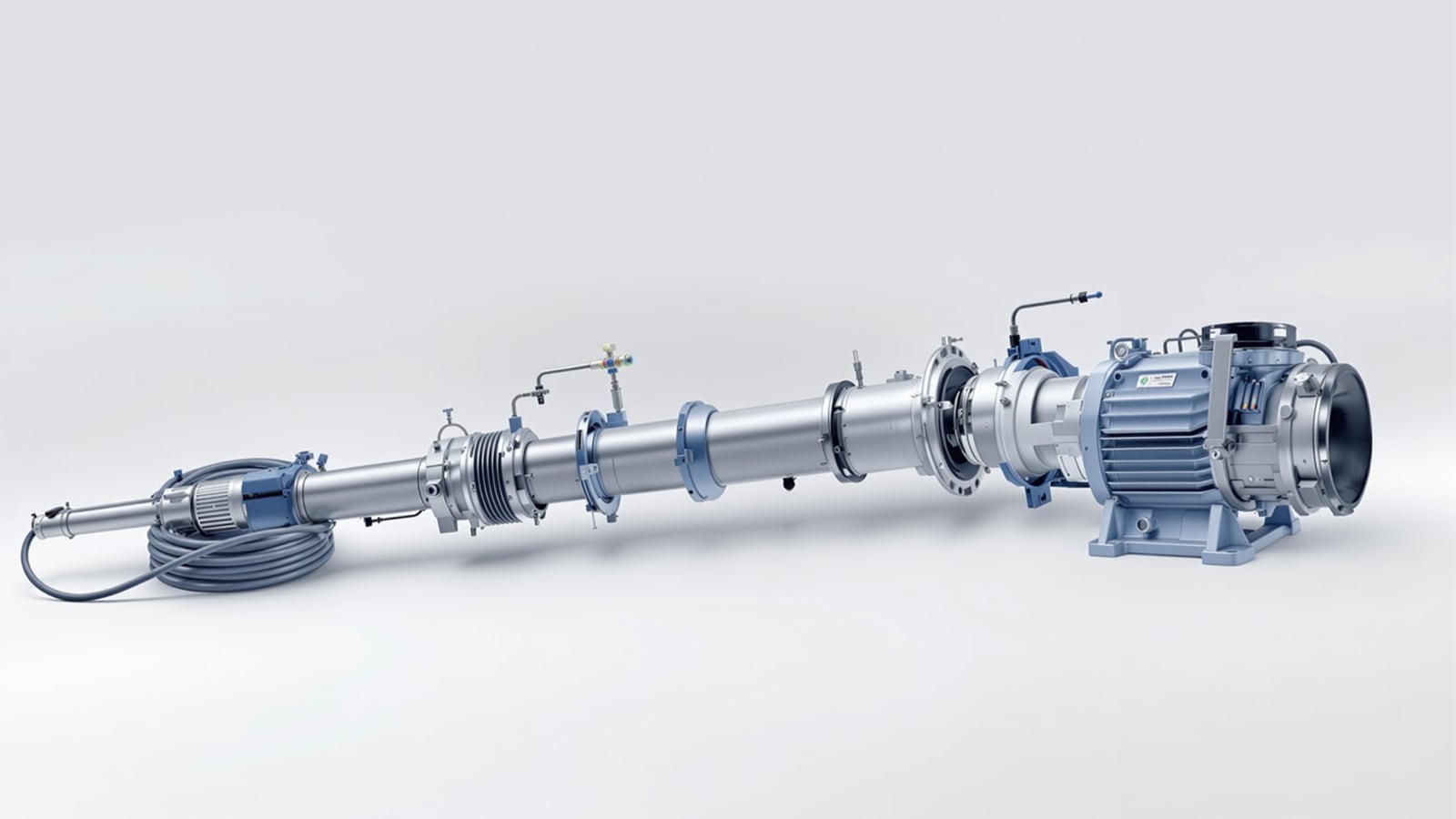
A borewell pump is a long, slim cylinder built to fit inside the narrow 150 mm (6-inch) casing of a home borewell. It has two stacked parts: a submersible motor at the bottom and a multi-stage pump above it. The whole assembly is lowered deep into the bore on the delivery pipe, hangs fully underwater below the water level, and pushes water up — it does not suck. That is the entire reason submersibles exist: beyond about 7–8 metres, a surface pump can no longer suck water up, so for a bore tens or hundreds of metres deep, the pump must go down to the water and push.
Each stage is one impeller-and-bowl set. Stacking many stages in series is how the pump builds enough pressure to lift water a long way: roughly speaking, more stages means more head (metres of lift), while the impeller diameter sets the flow (litres per minute). A "1 HP, 20-stage" pump and a "1 HP, 12-stage" pump can share the same motor but suit very different depths.
Sizing HP by depth, water level and yield
This is the decision that matters most — and the one people most often get wrong by rounding up. The right horsepower depends on three things working together:
- Total head — the vertical distance the pump lifts water, from the drawn-down water level up to your tank inlet, plus friction losses in the pipe. A deep static water level and a first-floor tank add up fast.
- Required flow — how many litres per minute you want to fill tanks in a reasonable time, without asking for more than the bore can give.
- Bore yield — how much water the aquifer sustainably supplies. This is the hidden ceiling: a pump that can move more than the bore yields will simply pump the level down to its intake and gasp.
As indicative guidance only — for a standard 150 mm domestic bore feeding an overhead tank — the horsepower typically rises with the depth to water:
| Depth to water level (approx) | Indicative HP band | Typical body / stages | Notes |
|---|---|---|---|
| Up to ~45 m (150 ft) | 0.5–1 HP | V4, fewer stages | Most shallow-water homes |
| ~45–90 m (150–300 ft) | 1–1.5 HP | V4, more stages | Common Indian domestic range |
| ~90–150 m (300–500 ft) | 1.5–3 HP | V4/V6, many stages | Deep hard-rock bores |
| Beyond ~150 m (500 ft) | 3 HP+ | V6, high-stage | Often needs 3-phase supply |
Treat every figure above as a starting point for a conversation with a pump dealer, not a spec. The honest way to size a borewell pump is to take your real drawn-down water level, tank height, pipe length and desired flow into a proper calculation. Do not eyeball it — use the Studio Matrx pump size calculator to turn your numbers into a head-and-flow requirement, then pick the pump whose performance curve meets that duty point.
V3, V4, V6 — matching the pump to the bore diameter
Borewell pumps are classified by the diameter of the pump body in inches, written with a "V" (for the vertical/borewell form): a V3 is about 3 inches, a V4 about 4 inches, a V6 about 6 inches. The number tells you the smallest casing the pump will physically fit inside — and it must sit comfortably in your bore with clearance for cooling water to flow past the motor.
- V3 — for narrow bores (about 100 mm / 4-inch casing). Slim, lower flow; used where the bore is tight.
- V4 — the workhorse of Indian homes. Fits the standard 150 mm (6-inch) domestic bore with room to spare, covers roughly 0.5–5 HP, and is what most houses install.
- V6 — a bigger 6-inch body for deep and high-flow duties (bungalows, farms, apartments, deep hard-rock bores). Needs a 150 mm+ bore and usually a higher HP, often three-phase.
For almost every independent house on a 150 mm bore, the answer is a V4 in the appropriate HP; you only step up to V6 when depth or flow genuinely demands it.
The motor: oil-filled vs water-filled
The submersible motor at the bottom of the stack is sealed and runs underwater. Two constructions are common in India, and it is worth knowing the difference:
- Water-filled (wet) motors are filled with clean water, which both lubricates and cools. They are the common domestic choice, generally cheaper, and if the winding fails they can often be rewound by a local motor shop.
- Oil-filled motors use oil for lubrication and cooling. They are typically sealed units, can be robust, but a failure usually means replacement rather than a cheap rewind.
For most homes a good water-filled V4 motor is the sensible default. Whichever you choose, the motor only cools if water flows past it, which is why the pump must always stay submerged and why running dry is so damaging.
Control panel, dry-run and starter protection
The pump lives underwater and out of sight, so its control panel at the surface is its bodyguard. A bare on/off switch is a false economy — a proper panel protects a motor that costs many times more than the panel itself. Look for:
- Dry-run protection — cuts the pump the moment the water level falls to the intake, so a motor starved of water does not burn out. This is the single most valuable feature for a borewell, where seasonal drawdown is a fact of life.
- Starter and overload protection — a proper starter (DOL for smaller single-phase, or star-delta for larger three-phase) with thermal overload guards against a stalled or overloaded motor.
- Voltage and single-phasing protection — Indian supply sags and spikes; low-voltage cut-off and single-phasing preventer (on three-phase) stop the motor cooking on bad power.
- A capacitor (single-phase units) sized to the motor, and clear volt/current indication so you can spot trouble early.
Automatic controllers that combine dry-run sensing with tank-level control are widely available and well worth it — they stop the pump both when the tank is full and when the bore runs low.
Cable, delivery pipe and check valve
Three supporting items decide whether the install is reliable:
- Submersible cable — a special flat, three-core waterproof cable rated for continuous submersion runs the full depth from panel to motor. It must be sized to the depth and HP: too thin a cable over a long drop causes a voltage drop that overheats the motor. Do not skimp on cable gauge on a deep bore.
- Delivery (column) pipe — rigid PVC/GI column pipe or heavy-duty flexible pipe carries water up and takes the pump's weight, alongside a safety rope. It must be rated for the pressure the pump develops at depth.
- Non-return (check) valve — most borewell pumps have a built-in NRV at the outlet, but a line check valve keeps the delivery pipe primed and stops water hammering back down when the pump stops. See the check valves guide for how NRVs protect the column and the pump.
Why oversizing is a costly mistake
The temptation is always to buy "a bit more HP to be safe". For a borewell this backfires twice over:
- It wastes energy every day. A bigger motor draws more power for the same tank fill; over years that oversizing shows up on every electricity bill for no benefit.
- It can dewater the bore. A pump that moves more than the aquifer yields simply sucks the water level down to its own intake within minutes, then starts cycling on dry-run cut-off — hard on the motor and useless for supply. The bore has not failed; the pump is bigger than the bore can feed.
The correct size is the smallest pump that meets your head and delivers a flow the bore can sustain. That is genuinely better, not just cheaper — it runs cooler, lasts longer, and keeps the water level stable. Right-sizing is why the calculator step matters.
Indicative prices and running cost
Prices vary widely by brand, HP, stages and copper content in the winding, so treat these as indicative and get local quotes:
| Item | Indicative range (₹) | Notes |
|---|---|---|
| 0.5–1 HP V4 pump + motor | ₹8,000–₹18,000 | Shallow-water domestic |
| 1.5–2 HP V4 pump + motor | ₹15,000–₹30,000 | Common Indian home band |
| 3 HP+ V6 (often 3-phase) | ₹30,000–₹70,000+ | Deep or high-flow bores |
| Control panel / auto-controller | ₹1,500–₹8,000 | Dry-run + overload protection |
| Submersible cable | ₹40–₹120 per metre | Sized to depth and HP |
On running cost, a roughly 1 HP pump draws under a unit of electricity per hour; a home that runs it an hour or two a day to fill tanks spends only modestly on power each month. The far bigger levers on lifetime cost are right-sizing the HP (so you are not paying for wasted watts) and protecting the motor (so you are not replacing an expensive unit early). Spend on the panel and the cable; do not overspend on horsepower.
The bottom line
A borewell pump is a precise piece of kit, not a "bigger is better" purchase. Match the V4 (or V6) body to your bore, size the HP to the real drawn-down water level, tank height and bore yield using the pump size calculator and a dealer's pump curve, insist on a proper control panel with dry-run protection, and use correctly rated cable, column pipe and a check valve. Right-sized and well-protected, a borewell pump quietly earns its keep for years on very little power.
References
- National Building Code of India (NBC) 2016, Part 9 — Plumbing Services — water supply, pumping and distribution within buildings.
- Bureau of Energy Efficiency (BEE) — star-labelling and energy performance framework for pumps and motors.
- Bureau of Indian Standards specifications for submersible pumpsets and motors — construction and performance requirements for borewell pumps (confirm the current standard number with your supplier).
HP bands, depths, prices and running costs here are indicative for planning only. Size the pump to your actual water level, yield, tank height and pipe run with the calculator and a licensed pump dealer before you buy.
Export this guide
Related Guides — Deep-dive reading
Water Pumps Guide for India: Types, How to Choose & Size (Head, Flow, Phase)
The master overview of domestic and building water pumps — what a pump actually does (lift plus pressure), the two numbers that decide everything (HEAD in metres and FLOW in LPM), a pump-type-to-use table, single vs three phase, priming, foot valve and NRV needs, dry-run protection, and BEE star rating with running cost at a glance for an Indian home.
PlumbingWater Pressure Booster Pump India: Fix Weak Shower Flow Before You Buy a Rain Head (2026)
Gravity from an overhead tank cannot run a rain shower or body jets — especially on the top floor. This is the honest India-first guide to pressure booster pumps: pressure-switch vs flow-switch, single-fixture vs whole-house sizing by head and LPM, dry-run protection, noise, mounting, electricals and real rupee ranges.
BathroomsCentrifugal Pumps in India: How Monoblock Water Pumps Work, Sizing & Cost
The impeller-and-volute workhorse behind almost every domestic monoblock and surface pump — how the spinning impeller lifts water, self-priming vs non-self-priming and the foot valve, reading the head-vs-flow pump curve, single vs three phase, cavitation and priming problems, and indicative prices for an Indian home.
PlumbingRelated Tools — Try Free
False Ceiling Cost Estimator
Live ₹/sqft across 8 ceiling types — POP, gypsum, designer, metal, PVC, wooden — with cove and spot lighting for 20 Indian cities.
Cost CalculatorRainwater Tank Sizer
How big should your rainwater tank be? Computes annual harvest, recommended tank capacity in litres, water-bill savings, and payback — for 10 Indian cities.
RWH CalculatorApartment Video Door System Planner
Enter flats, entrances, floors and guard desk for a first-pass building intercom plan — door stations, indoor monitors, guard station, the right architecture and an indicative cost band.
Building Planner