
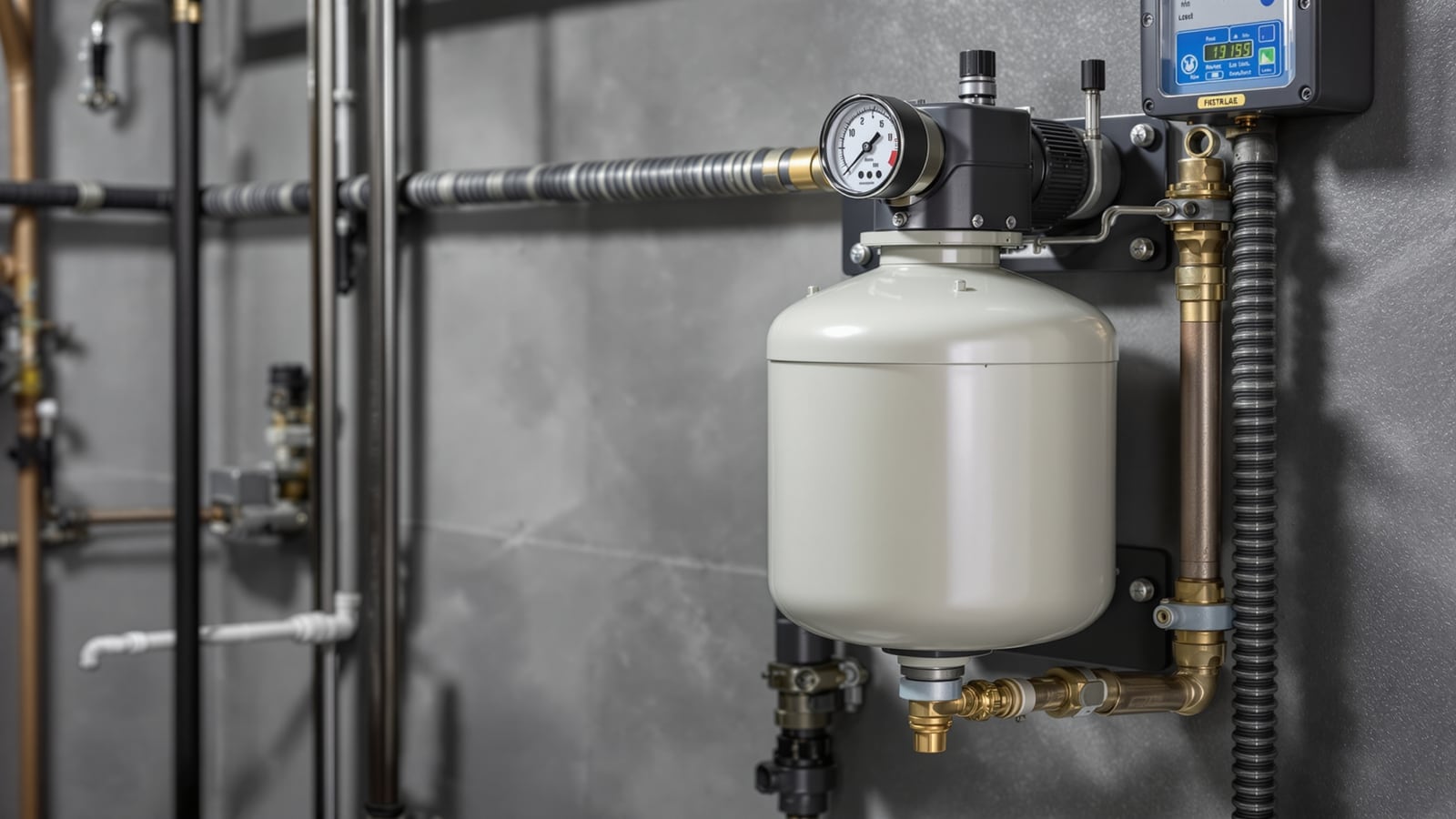
Booster & Pressure Pumps in India: How to Get Strong, Even Water Pressure at Every Outlet
The pump that fixes weak, trickling taps and limp rain showers — how pressure boosting works, constant-pressure vs pressure-switch-and-tank vs hydro-pneumatic vs VFD boosters, where each is needed, target pressures in bar, correct install position, dry-run and auto cut-off, noise, and indicative cost for an Indian home.
If your top-floor tap trickles, your rain shower drips instead of drenches, or two bathrooms running together turn every outlet feeble, the problem is almost never quantity of water — it is pressure. A booster pump (also sold as a pressure pump) sits on your supply line and raises the pressure so water arrives at every outlet with the same strong, even push, regardless of the floor or how many taps are open.
This guide sits under the Studio Matrx water pumps pillar. A booster is a close cousin of the centrifugal pump that lifts and moves water — the difference is job and control: a booster is optimised to hold pressure steady at the outlets rather than simply fill a tank. If you have not yet decided between a tank-fed and a mains-pressure layout, read the pressurised plumbing system guide first, because that decision changes which booster you need.
What pressure boosting actually does
Water pressure at an outlet is what makes a tap feel strong and a shower feel like a shower. In a plain overhead-tank home, that pressure comes only from the height of the tank above the outlet — roughly 0.1 bar for every metre of drop. A tank sitting three metres above a ground-floor tap gives about 0.3 bar, which barely runs a modern rain shower head that wants 1–1.5 bar to open fully. On the top floor, directly under the tank, the drop is almost nothing and the flow is a sad dribble.
A booster pump adds the pressure the height cannot. It senses that an outlet has opened, spins up, and holds a target pressure across the whole house.
Boosting raises pressure, not the amount of water available. If your tank runs dry or your inlet pipe is undersized, a booster cannot invent water — it will only cavitate and trip. Fix supply first, then boost.
Two numbers describe every pump: head (the height/pressure it can produce, in metres or bar) and flow (litres per minute it can deliver). For a booster you care most about the pressure it can hold while several outlets flow at once. Do not eyeball this — use the pump size calculator for whole-home sizing, and for bathrooms specifically the shower pump calculator, which matches a pump to your shower head's flow and pressure demand.
Target pressures: what "good" feels like
Different fittings want different pressures. These are indicative working pressures to design for at the outlet:
| Outlet / fitting | Comfortable pressure (bar) | Notes |
|---|---|---|
| Basic tap / bib cock | 0.5–1.0 | Trickles below 0.3 bar |
| Standard overhead shower | 1.0–1.5 | Most Indian homes target this |
| Rain shower / large drencher | 1.5–2.5 | Big heads are pressure-hungry |
| Instant / tankless geyser | 1.0–2.0 | Won't ignite below its minimum flow |
| Washing machine / dishwasher | 1.0–3.0 | Check the appliance's rated range |
| Whole-home comfortable target | 2.0–3.0 | Even flow with two outlets open |
Most Indian homes are comfortable designing to a 2–3 bar house pressure. Going much above 3 bar wastes water and energy and stresses joints; above about 4–5 bar you should add a pressure reducing valve to protect fittings.
The four kinds of booster — and where each fits
1. Pressure-switch + pressure tank. The classic, cheapest booster. A small self-priming pump is wired to a pressure switch and a diaphragm/bladder tank. Open a tap, pressure drops, the switch starts the pump; close it, pressure builds, the pump stops. The tank stores a little pressurised water so the pump does not restart for every tiny draw. Simple and cheap, but pressure sags and surges between cut-in and cut-out, and it cycles noisily. Best for one or two bathrooms where perfect steadiness is not critical.
2. Constant-pressure pump (self-regulating). A pump with a built-in electronic controller that starts on flow and modulates to hold one target pressure. Smoother than a bare pressure switch, compact, and increasingly the default for a single home. Many are sold simply as "self-priming pressure pumps" with a flow sensor.
3. Hydro-pneumatic system. A pump (or pumps) paired with a larger pressurised air-over-water tank. The air cushion smooths delivery, reduces pump starts, and rides through short demands without running the motor. Common for larger homes, villas and small apartment blocks feeding many outlets. Bulkier and dearer, but robust and quiet in operation.
4. VFD / variable-speed booster. A Variable Frequency Drive continuously varies motor speed to hold exactly one pressure whether one tap or six are open — the flattest, quietest, most energy-efficient option, and the one that makes a big rain shower behave. It is the premium choice for a whole-home or multi-floor system. Often built as a packaged skid with one or more pumps.
| Booster type | Pressure steadiness | Typical use | Relative cost |
|---|---|---|---|
| Pressure switch + tank | Fair (sags/surges) | 1–2 baths, budget | ₹ (lowest) |
| Constant-pressure pump | Good | Single home, few floors | ₹₹ |
| Hydro-pneumatic | Good–very good | Large home / small block | ₹₹₹ |
| VFD variable-speed | Excellent, flat | Whole home, rain showers, multi-floor | ₹₹₹₹ |
Where a booster is actually needed
- Top-floor outlets right under the overhead tank — almost no gravity head, so flow is weakest exactly where people shower.
- Rain showers and multi-jet / body-spray systems — big heads need 1.5 bar or more to open fully; gravity rarely delivers it.
- Direct-pressure (mains-fed) homes — where the municipal or tank line feeds outlets directly with no dedicated pressure, a booster gives even flow.
- Multiple outlets used together — two bathrooms, or a shower plus a washing machine, that go weak when shared point straight at a pressure shortfall.
- Instant geysers and some appliances — which refuse to fire below a minimum flow/pressure.
Where and how to install it
A booster goes on the supply line after the source, boosting water that is already available to it:
- In an overhead-tank home, install it on the outlet line coming down from the tank (a "tank booster"), so it always has flooded suction and never runs dry.
- In a mains-fed home, install it on the incoming line — but check local rules, since directly boosting off the municipal main is restricted in many areas; boost from an underground sump or tank instead.
- Never install a pressure booster to suck from an empty or unreliable line. If the source is a borewell or sump, that is a different sizing exercise — see the borewell water system guide.
Fit a strainer/filter before the pump, an isolation valve each side for servicing, and a check valve so boosted water cannot push back into the tank. Use flexible connectors or a short rubber section to keep vibration out of the pipework, and mount the pump on a firm, level base.
Dry-run protection and auto cut-off
The single most important protection on a booster is dry-run (run-dry) cut-off. A centrifugal pump relies on water to cool and lubricate it; run it dry for minutes and the mechanical seal burns out. Good boosters cut off automatically when the suction loses water and restart when it returns.
The pressure switch or flow sensor provides the everyday auto cut-off: the pump stops the moment demand stops, so it is not running while the house sleeps. Between them, these two controls mean a booster is genuinely fit-and-forget — but confirm both are present, because the cheapest bare pumps omit dry-run protection.
Noise, energy and running cost
- Noise. A booster near bedrooms is the commonest regret. Choose a pump with a quiet rating, mount it on rubber anti-vibration feet, use flexible connectors, and site it in a utility area, not against a bedroom wall. VFD and hydro-pneumatic units are the quietest because they start soft and cycle less.
- Energy. Home boosters are small — typically 0.5–1.5 HP (about 0.37–1.1 kW). A VFD only draws what the moment needs, so it is markedly cheaper to run than a fixed-speed pump that slams full-power on and off. Look for BEE star-rated motors.
- Running cost. Because a booster runs only while outlets are open, monthly cost is modest for a normal household; the bigger the pump and the more it cycles, the more it costs, which is another reason steady VFD control pays back over time.
Indicative sizing and cost
Use the calculators for a real number; the table below is only to set expectations for a typical Indian home. Figures are indicative — confirm with a pump dealer for your exact head, flow and phase.
| Home / duty | Typical rating | Phase | Approx head | Indicative price |
|---|---|---|---|---|
| One bathroom, pressure-switch type | 0.5 HP (0.37 kW) | 1φ | 15–20 m | ₹4,000–₹9,000 |
| 2–3 baths, constant-pressure | 0.5–1.0 HP | 1φ | 20–30 m | ₹9,000–₹22,000 |
| Large home / rain showers, VFD | 1.0–1.5 HP | 1φ | 30–40 m | ₹25,000–₹60,000 |
| Villa / small block, hydro-pneumatic | 1.5–3 HP+ | 1φ or 3φ | 40 m+ | ₹60,000+ |
Most single homes run on single-phase (1φ) boosters; three-phase (3φ) appears only on larger multi-pump hydro-pneumatic skids.
Common problems and quick checks
- Pump cycles rapidly (hunting). Usually a waterlogged diaphragm tank or wrong air pre-charge — recharge the tank's air to just below cut-in pressure, or a constant-pressure/VFD unit avoids the issue.
- Still weak flow after boosting. The bottleneck is downstream: undersized pipe, a half-closed valve, or a clogged aerator/shower head. Boosting cannot fix a pinched pipe.
- Pump won't stop. A leak, a stuck-open tap, or a failed pressure switch keeps demand alive.
- Trips on start / burns seals. Missing dry-run protection with an empty suction — fix the supply and add run-dry cut-off.
- Noise and vibration. Loose mounting or rigid pipe connections transmitting into walls.
When you do NOT need a booster
If your overhead tank is genuinely high above the outlets and you only run one or two conventional fittings, gravity may already give comfortable flow. Adding a booster then just adds cost, noise and a part that can fail. Boost when the pressure at the outlet is short — not automatically.
References
- Bureau of Energy Efficiency (BEE) — star labelling for monoset / domestic pumps (buy a star-rated motor).
- Bureau of Indian Standards (BIS) — Indian Standards for centrifugal and self-priming pumps for clean, cold water; ask your dealer for the pump's IS conformity.
- Studio Matrx: water pumps guide, centrifugal pumps, pressurised plumbing system.
- Tools: pump size calculator, shower pump calculator.
Export this guide
Related Guides — Deep-dive reading
Water Pressure Booster Pump India: Fix Weak Shower Flow Before You Buy a Rain Head (2026)
Gravity from an overhead tank cannot run a rain shower or body jets — especially on the top floor. This is the honest India-first guide to pressure booster pumps: pressure-switch vs flow-switch, single-fixture vs whole-house sizing by head and LPM, dry-run protection, noise, mounting, electricals and real rupee ranges.
BathroomsPressurized Plumbing System in India: Booster Pumps, Pressure Vessels & VFD Supply
How a pump-driven, hydro-pneumatic water supply delivers even, strong pressure at every outlet — constant-pressure and booster pumps, pressure vessels, VFD drives, target pressures in bar, and where a pressurised system beats plain gravity in an Indian home.
PlumbingWater Pumps Guide for India: Types, How to Choose & Size (Head, Flow, Phase)
The master overview of domestic and building water pumps — what a pump actually does (lift plus pressure), the two numbers that decide everything (HEAD in metres and FLOW in LPM), a pump-type-to-use table, single vs three phase, priming, foot valve and NRV needs, dry-run protection, and BEE star rating with running cost at a glance for an Indian home.
PlumbingRelated Tools — Try Free
Shower Pump Calculator
Check whether your shower needs a pressure-boost pump and what size — available vs required pressure from your tank height or supply.
Bathroom CalculatorShower Water Flow Calculator
Shower water use per shower, day and month by head type, plus a pressure-adequacy check for your tank height or pump and low-flow savings.
Bathroom CalculatorRainwater Tank Sizer
How big should your rainwater tank be? Computes annual harvest, recommended tank capacity in litres, water-bill savings, and payback — for 10 Indian cities.
RWH Calculator