
Centrifugal Pumps in India: How Monoblock Water Pumps Work, Sizing & Cost
The impeller-and-volute workhorse behind almost every domestic monoblock and surface pump — how the spinning impeller lifts water, self-priming vs non-self-priming and the foot valve, reading the head-vs-flow pump curve, single vs three phase, cavitation and priming problems, and indicative prices for an Indian home.
The centrifugal pump is the workhorse of Indian water supply. Nearly every "monoblock" or surface pump humming beside a sump, filling an overhead tank or boosting water into a house is a centrifugal pump at heart. It has no pistons, no complicated valves inside — just a spinning wheel that flings water outward. Understand that one idea and most domestic pumps stop being a mystery.
This guide sits under the Studio Matrx water pumps pillar. It is the companion to the guides on jet pumps, which use the same impeller but add a nozzle to pull water from deeper, and booster pumps, which are centrifugal pumps arranged to raise pressure inside the house.
How a centrifugal pump works
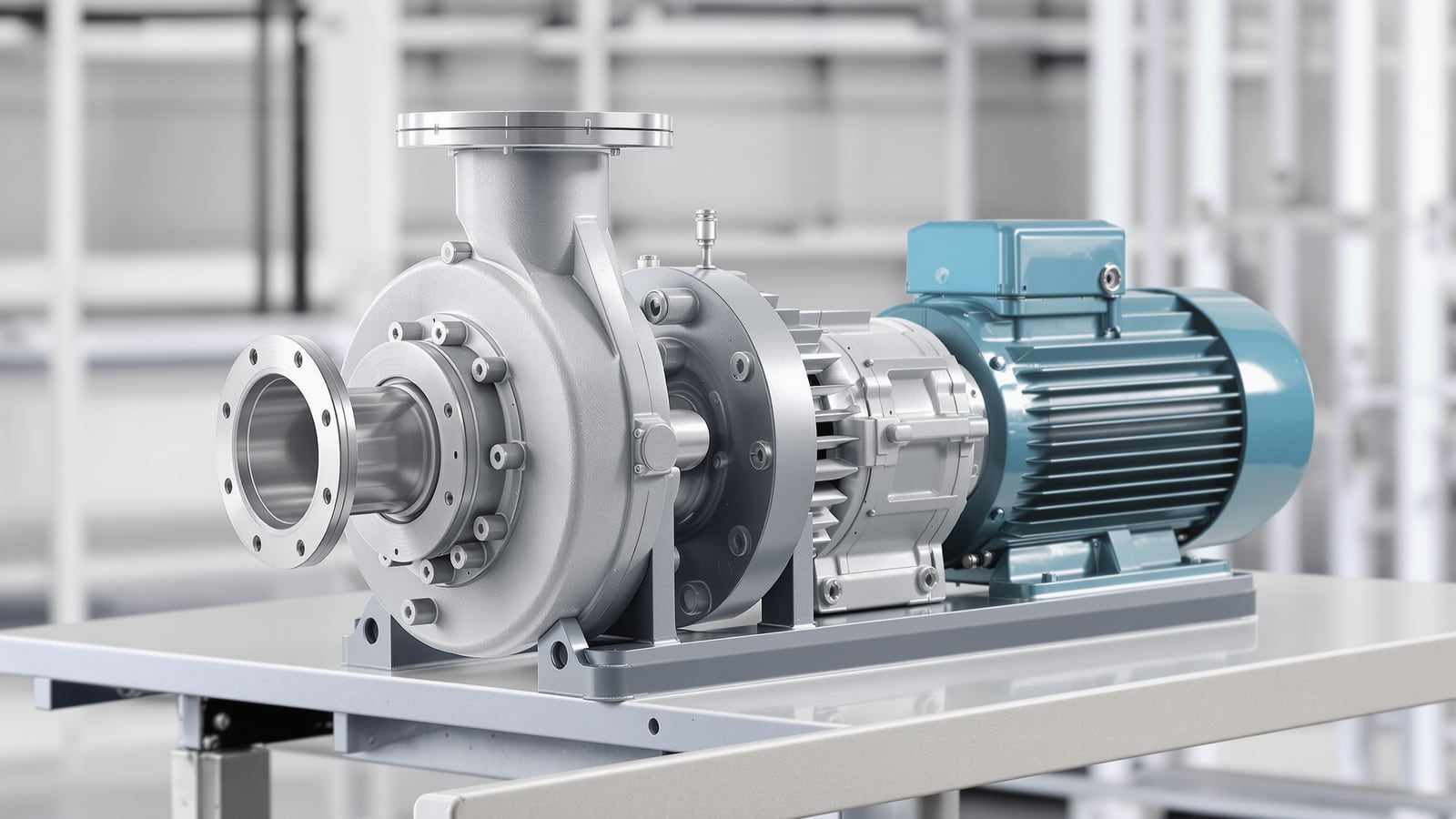
Inside the pump body is a disc with curved vanes called an impeller, spinning fast on the motor shaft. Water enters at the centre (the "eye"), and as the impeller spins, the vanes throw it outward by centrifugal force. The water leaves the impeller rim at high speed and enters a spiral-shaped casing called the volute, which gradually widens. That widening slows the water down and — this is the clever part — converts its speed into pressure. Fast-moving water becomes high-pressure water able to climb up a pipe.
No spin, no pressure. A centrifugal pump only moves water while the impeller is turning against water that is already in the casing. Run it with air trapped inside and the impeller spins uselessly — this is why priming matters so much.
Because it depends on flinging water, the pump body must be full of water to start. Air is far too light to be thrown outward with any force. Filling the pump and suction pipe with water before starting is called priming, and how a pump handles priming splits domestic pumps into two families.
Self-priming vs non-self-priming
- Non-self-priming pumps must have their casing and suction line kept full of water. If the water drains back down the suction pipe between runs, the pump loses prime and spins on air. To hold water in the line, a foot valve — a spring or flap check valve with a strainer — is fitted at the bottom of the suction pipe. It lets water be drawn up but shuts to stop it draining back. A lost foot valve is the single most common reason a pump "runs but gives no water".
- Self-priming pumps carry a small water reservoir inside the casing. On starting they mix that water with the incoming air, expel the air and pull a fresh column of water up on their own — so a one-off manual fill (through a priming plug on top) is usually enough. They tolerate a leaky foot valve or short dry patches far better, which is why most modern domestic monoblocks sold in India are self-priming.
Either way, a centrifugal surface pump can only suck water up about 6-7 metres in practice, because it relies on atmospheric pressure to push water into the eye. Water deeper than that needs a jet pump, a submersible, or a pump placed lower down.
Monoblock vs coupled
- Monoblock — the motor and pump share a single shaft in one sealed cast body. Compact, cheaper, no alignment to worry about, and by far the most common domestic form for sump-to-tank and general lifting.
- Coupled (bare-shaft) sets — a separate motor and pump joined by a coupling on a common base plate. Used at larger sizes where a motor may need replacing independently, or where three-phase motors above a few HP are standard. Overkill for most homes.
Reading the pump curve: head vs flow
The two numbers that matter are head and flow, and they trade off against each other.
- Head is the vertical height (in metres) the pump can push water, plus an allowance for friction in the pipes. A tank on a three-storey terrace might sit 12-15 m above the sump.
- Flow is how much water it delivers, usually in litres per minute (LPM) or litres per hour.
Every pump has a pump curve printed on its box or datasheet: head on the vertical axis, flow on the horizontal. As you demand more height, the flow drops; ask for the maximum flow and the head falls to almost nothing. You want your real duty point — the actual lift plus pipe friction, at the flow you need — to sit comfortably on the middle of the curve, not at either extreme end.
For anything beyond a rough guess, don't reach for a formula — put your lift, pipe length and required flow into the Studio Matrx pump size calculator, which sizes the pump for you. For bathroom pressure specifically, the shower pump calculator is the right tool.
Single phase vs three phase and HP ranges
Most Indian homes run on a single-phase (1φ, 230 V) supply, and domestic centrifugal pumps up to about 2 HP are made for it. Larger farm, apartment and commercial pumps use three-phase (3φ, 415 V), which runs more efficiently and starts more smoothly at higher power. The table below is indicative — always match to your actual head and flow, not just HP.
| HP (kW approx.) | Phase | Typical head | Typical flow | Where it fits | Indicative price |
|---|---|---|---|---|---|
| 0.5 HP (0.37 kW) | 1φ | up to ~18 m | 25-40 LPM | Small home, sump to single tank | ₹2,800-4,500 |
| 1.0 HP (0.75 kW) | 1φ | up to ~25 m | 40-70 LPM | Typical 2-3 floor home, tank filling | ₹4,500-7,500 |
| 1.5 HP (1.1 kW) | 1φ | up to ~32 m | 60-90 LPM | Larger home, longer runs, some boosting | ₹6,500-11,000 |
| 2.0 HP (1.5 kW) | 1φ / 3φ | up to ~40 m | 80-120 LPM | Big house, small building, transfer | ₹9,000-16,000 |
| 3-5 HP (2.2-3.7 kW) | 3φ | 30-60 m+ | 150-400 LPM | Apartments, farms, bulk transfer | ₹18,000-45,000 |
Never oversize on HP alone. A bigger motor pushed to move more water than your pipe and tank need just wastes electricity and can run the pump off the end of its curve. Size to the duty point.
Where centrifugal pumps are used
- Drawing from a sump or tank — the classic job: lifting stored municipal water from an underground sump to an overhead tank. See the borewell water system guide for bore-fed setups and pressurised plumbing for pump-driven house supply.
- Water transfer — moving water between tanks, filling a construction drum, emptying a low tank.
- General lifting and boosting — raising water where gravity alone is too weak; a pressure-boosting arrangement is covered in the booster pumps guide.
Priming, foot valve and dry-run protection
- Always fit a foot valve with strainer at the suction end (non-self-priming pumps require it; self-priming pumps still benefit). Fit a check valve / NRV on the delivery line to stop back-drain and water hammer.
- Fit a dry-run preventer or a level switch. A centrifugal pump running dry overheats the mechanical seal in minutes and can crack the casing — the most expensive avoidable failure.
- Keep the suction line short, air-tight and one size larger than the delivery pipe. Air leaks on the suction side are the classic cause of a pump that primes then loses water.
Cavitation and common problems
Cavitation is what happens when the pressure at the impeller eye drops so low that water flashes to vapour; the bubbles then collapse violently against the impeller, causing a distinctive rattling "gravel in the pump" noise, pitting damage and lost output. Causes are a suction lift that is too high, a blocked strainer, or too long a suction pipe. Fix it by lowering the pump, shortening or widening the suction line, and clearing the strainer.
| Symptom | Likely cause | What to check |
|---|---|---|
| Runs but no water | Lost prime / bad foot valve | Re-prime; replace foot valve, seal suction air leaks |
| Rattling, "gravel" noise | Cavitation | Suction too high or strainer choked |
| Low flow to tank | Undersized pump or clogged pipe | Check duty point against the curve |
| Trips or overheats | Dry run, low voltage, seized bearing | Dry-run guard, voltage, motor condition |
| Leaks at shaft | Worn mechanical seal | Replace seal; never let it run dry |
Energy and running cost at a glance
A 1 HP pump draws roughly 0.75 kW. Filling an overhead tank in, say, 30-40 minutes a day works out to a small daily unit cost, but an oversized or poorly primed pump that runs too long quietly inflates the bill. Look for a BEE star rating where available and size honestly. For smart level controllers and auto on/off, keep it simple and see the smart-home resources rather than over-specifying the pump itself.
References
- Bureau of Indian Standards — centrifugal pump specifications for clear, cold water (verify the current IS number and edition with your dealer before quoting it).
- Bureau of Energy Efficiency (BEE) — star-labelling programme for monoblock and agricultural pumps.
- Pump manufacturer datasheet and pump curve for your specific model — the definitive source for head, flow and duty point.
Export this guide
Related Guides — Deep-dive reading
Water Pumps Guide for India: Types, How to Choose & Size (Head, Flow, Phase)
The master overview of domestic and building water pumps — what a pump actually does (lift plus pressure), the two numbers that decide everything (HEAD in metres and FLOW in LPM), a pump-type-to-use table, single vs three phase, priming, foot valve and NRV needs, dry-run protection, and BEE star rating with running cost at a glance for an Indian home.
PlumbingWater Pump Maintenance & Troubleshooting in India: Fix a Pump That Won't Start, Runs Dry or Loses Prime
A homeowner's guide to keeping a domestic water pump alive and diagnosing it when it fails — a routine maintenance schedule (leaks, bearing noise, capacitor, foot valve, priming, dry-run protection, impeller) and a symptom-to-cause-to-fix table for the five faults every Indian pump eventually throws: won't start, runs but no water, low flow, won't stop, and trips or overheats.
PlumbingWater Pressure Booster Pump India: Fix Weak Shower Flow Before You Buy a Rain Head (2026)
Gravity from an overhead tank cannot run a rain shower or body jets — especially on the top floor. This is the honest India-first guide to pressure booster pumps: pressure-switch vs flow-switch, single-fixture vs whole-house sizing by head and LPM, dry-run protection, noise, mounting, electricals and real rupee ranges.
BathroomsRelated Tools — Try Free
Shower Pump Calculator
Check whether your shower needs a pressure-boost pump and what size — available vs required pressure from your tank height or supply.
Bathroom CalculatorLift Power Requirement Calculator
Connected load, single vs three phase, MCB and cable guidance for a home lift.
Lift CalculatorRainwater Tank Sizer
How big should your rainwater tank be? Computes annual harvest, recommended tank capacity in litres, water-bill savings, and payback — for 10 Indian cities.
RWH Calculator