
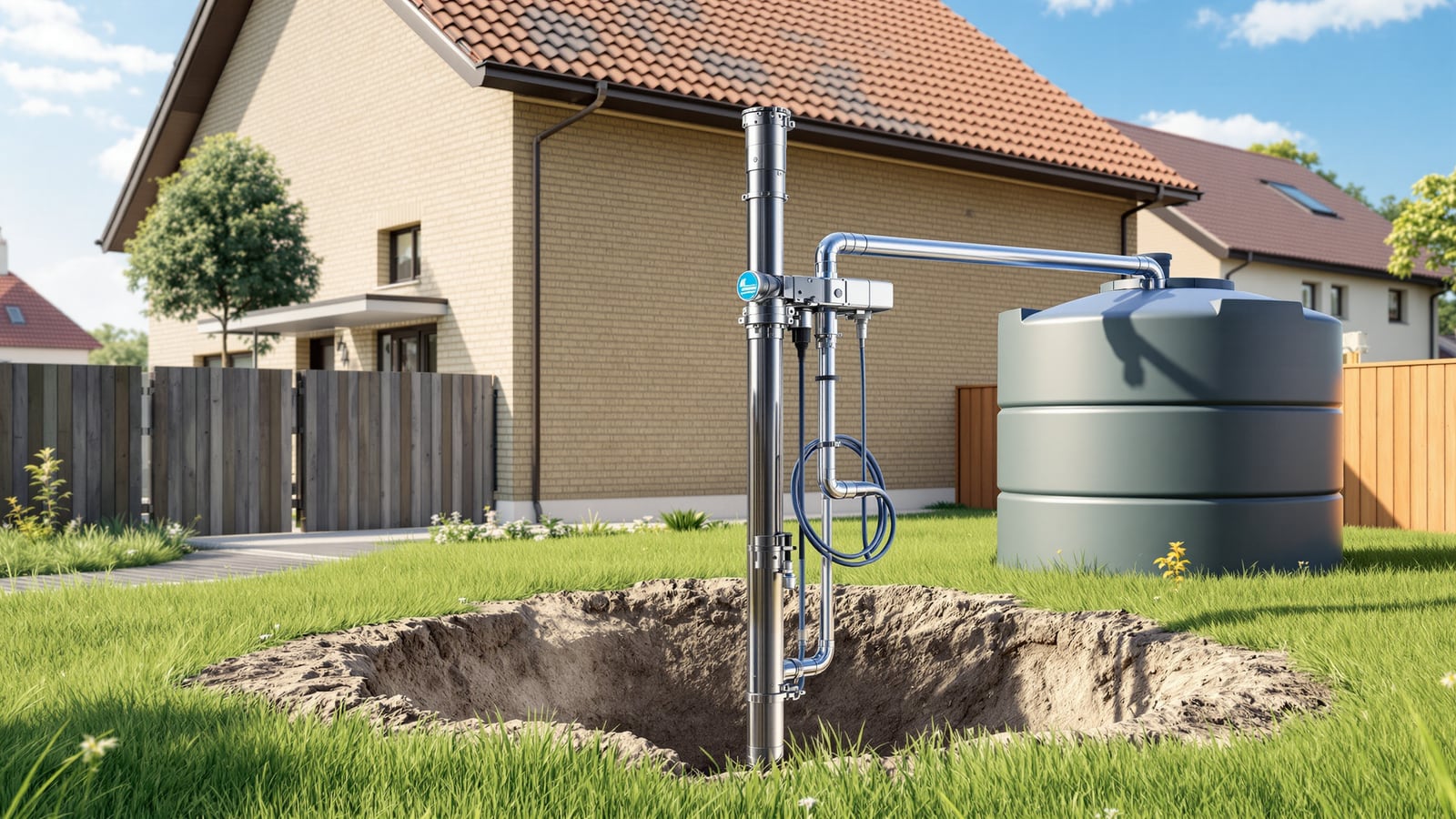
Borewell Water System for Indian Homes: How It Works, Depth, Rules, Water Quality and Cost
The private-borewell setup that supplies millions of Indian homes — how the borehole, casing and water table actually deliver water, how the submersible pump lifts it to your tank, how deep you may need to drill, the groundwater permissions to know about, why borewell water is often hard, and what it costs to run.
For a huge share of Indian homes — especially in peri-urban layouts, independent houses and areas where the municipal main is thin or absent — water does not arrive from a pipe in the road. It comes from under your own plot, pulled up out of the ground by a borewell. This guide explains the whole borewell water system in plain terms: how the hole in the ground actually holds and yields water, what lifts it to your tank, how deep you may need to go, the permissions that apply, and why the water often needs treating before you drink it.
This guide sits inside the Studio Matrx Plumbing Knowledge Hub. It is a water-supply guide — one of the two main ways water gets into an Indian home. For the full picture of how borewells, municipal mains and stored water fit together, start at the pillar water supply systems guide; for the piped-utility alternative, see the municipal water supply guide.
A borewell is not a bottomless well of free water. It taps a shared underground resource — the groundwater under your whole neighbourhood — and what you draw, your neighbours cannot. Treat yield as a budget to be managed, not a tap to be left open.
How a borewell actually works
A borewell (or borehole) is a narrow vertical hole, typically 150 mm (6 inches) in diameter for a home, drilled straight down through soil and rock until it reaches water-bearing ground. Four ideas explain the whole system:
- The borehole is the drilled shaft itself. A rig bores it in a day or two, far narrower and far deeper than an old open dug well.
- The casing is a pipe — usually PVC or, for deeper or unstable ground, mild-steel — lowered into the top section of the hole. It stops the loose upper soil from collapsing in and keeps surface dirt and contaminated shallow water out of your clean supply.
- The water table is the depth below which the ground is saturated with water. Above it the pores in the soil and rock hold air; below it they hold water. Rain and surface water percolate down to keep it topped up, and pumping draws it down.
- The yield is how much water the borewell can sustainably give — measured in litres per hour or per minute. It depends on how permeable the water-bearing rock is and how well the aquifer recharges, not just on how deep you drilled.
The key mental model: your borewell does not create water, it intercepts groundwater that is already there and flowing slowly through the rock. A "good" borewell is one that hits a well-connected, well-recharged water-bearing layer — which is partly geology and partly luck.
The submersible pump and delivery pipe
Home borewells are far too deep for a surface pump to suck water up — beyond about 7–8 metres, suction simply fails. Instead, a submersible pump sits deep inside the borewell, fully underwater, and pushes water up. It is a long, slim cylinder that fits inside the 150 mm casing, sealed against water, with the motor and pump stacked together.
The pump is suspended in the hole on the delivery pipe (usually rigid PVC/GI column pipe or a heavy-duty flexible pipe), with the power cable strapped alongside and a safety rope taking the weight. When you switch it on, it lifts water up the delivery pipe, out at the surface, and along to your underground sump or overhead tank — from where the rest of the house is usually fed by gravity.
A few things worth knowing about the pump without going deep into pump selection:
- The pump must be rated for the depth — the deeper the water and the taller your tank, the more "head" (metres of lift) the pump must overcome.
- It should sit below the water table but above the very bottom, so it stays submerged (running dry burns out the motor) without sucking in silt.
- A dry-run preventer or auto-controller is strongly recommended: it cuts the pump if the water level drops below the intake, protecting an expensive motor.
Choosing the exact pump rating — horsepower, head and flow — is its own topic. For sizing the pump to your borewell depth and tank height, see the forthcoming Studio Matrx water pumps guide.
Depth, drilling and yield
There is no single "correct" borewell depth in India — it depends entirely on local geology and how far down the reliable water-bearing rock lies. Depths vary enormously by region and have generally been getting deeper over the years as shallow groundwater is over-drawn. The figures below are indicative ranges only; a local driller who knows your area is the real authority.
| Aspect | Indicative figure for a home | Notes |
|---|---|---|
| Borehole diameter | 150 mm (6 in) | Standard domestic size |
| Typical depth range | 60 m to 250 m+ | Highly region-dependent; deeper in hard-rock and over-drawn areas |
| Casing depth | Through soil into firm rock | Protects the hole and keeps out shallow contamination |
| Sustainable yield | A few hundred to a few thousand litres/hour | Depends on the aquifer, not the depth |
| Pump rating | ~0.5 to 2 HP for most homes | Rises with depth and tank height |
Two cautions every homeowner should hold on to. First, deeper does not mean better water — very deep hard-rock water can carry more dissolved minerals, not less. Second, a borewell can run dry seasonally or fall in yield over years as the water table drops; a fat yield the week it is drilled is not a guarantee for a decade. That is exactly why recharge (below) matters.
Permissions and groundwater regulation
Groundwater in India is a shared and increasingly stressed resource, and drilling a borewell is not always a free-for-all. Rules vary by state, city and — critically — by whether your area is officially classified as over-exploited or "notified" for groundwater.
You should expect to encounter some or all of the following, described here by name — always confirm the current specifics with your local authority, because the details and thresholds change:
- The Central Ground Water Authority (CGWA), under the Central Ground Water Board (CGWB), regulates groundwater extraction and, in notified/over-exploited areas, requires an NOC (No Objection Certificate) for new borewells — with domestic use often treated differently from commercial or bulk use.
- State groundwater authorities and municipal bye-laws may add their own registration, permission or borewell-notification requirements, and some cities mandate rainwater harvesting as a condition of approval.
- Many local bodies require an existing or abandoned borewell to be capped or sealed so it is not an open shaft — a serious child-safety obligation.
Do not treat borewell permissions casually. In notified areas an unauthorised borewell can attract penalties, and mandatory rainwater-harvesting conditions are increasingly enforced. Check with your local municipal office and the state groundwater department before the rig arrives.
The honest position: the exact permission, fee and NOC requirement for your plot depends on your state and whether your block is notified. Verify it locally rather than assuming — and if in doubt, ask the drilling contractor, who deals with local rules routinely, and confirm independently with the authority.
Borewell water quality — often hard, sometimes worse
Here is the point most first-time borewell owners underestimate: borewell water is groundwater, and groundwater is rarely soft or ready to drink. As water percolates through soil and rock it dissolves minerals, so borewell supply commonly arrives with:
- Hardness — dissolved calcium and magnesium. This is the classic borewell complaint: white scale on taps and geysers, soap that will not lather, stiff laundry, and scaling that shortens the life of heaters and washing machines.
- Iron and manganese — which stain fixtures and laundry reddish-brown and give a metallic taste.
- High TDS (Total Dissolved Solids) — the overall dissolved-mineral load. As a rough guide, BIS drinking-water guidance treats up to 500 mg/L TDS as acceptable and up to 2,000 mg/L as permissible only where no better source exists; many borewells sit well above the comfortable range.
- Location-specific contaminants — some regions carry naturally elevated fluoride, nitrate, salinity or arsenic. These are health issues, not just nuisance ones, and are impossible to judge by eye.
The non-negotiable step: get the water lab-tested for hardness, TDS, iron, fluoride and bacteriological safety before you rely on it for drinking or cooking. Do not assume clear water is safe water.
| Borewell water issue | What you notice | Typical fix (see treatment guide) |
|---|---|---|
| Hardness (Ca/Mg) | Scale, poor lather, geyser scaling | Water softener / anti-scale |
| Iron / manganese | Reddish-brown stains, metallic taste | Iron-removal filter / aeration |
| High TDS | Salty or flat taste, overall mineral load | RO purifier for drinking water |
| Bacteria | Not visible — only a lab test shows it | UV disinfection / chlorination |
| Fluoride / arsenic (regional) | Not visible — health risk | Specialised media; expert advice |
Solving this is a treatment topic in its own right — softeners, iron-removal, RO and UV are all separate kit sized to your test results. This guide keeps to the supply and safe-storage side; for the fixes, see the forthcoming Studio Matrx water treatment guide. To size the storage tank that sits between your borewell and your bathrooms, use the bathroom water tank calculator.
Recharge — keeping the borewell alive
Because a borewell draws on shared groundwater that pumping steadily depletes, the single most important thing a homeowner can do to protect long-term yield is to put water back into the ground. This is where borewell recharge and rainwater harvesting meet: instead of letting monsoon runoff drain away, you direct it into a recharge pit or a dedicated recharge borewell so it percolates down and helps replenish the water table your borewell depends on.
- A recharge pit near the borewell captures rooftop and surface rainwater, filters it through sand and gravel, and lets it soak into the ground.
- Recharging the aquifer — even modestly — helps stabilise the water table, improves yield reliability, and can slowly dilute dissolved minerals over time.
- In many cities rainwater harvesting is not just good practice but a legal condition of the building or borewell approval.
A borewell taken in isolation is a slow drawdown; a borewell paired with recharge is a far more sustainable system. For how to design pits, storage and rooftop capture, see the forthcoming Studio Matrx rainwater harvesting guide.
Running cost at a glance
The appeal of a borewell is that the water itself is "free" — but pumping it is not. The running cost is essentially the electricity to lift water, plus periodic maintenance, spread over a large upfront drilling and pump cost.
- Upfront cost — drilling, casing, pump, cable, panel and installation together typically run into the low lakhs; deeper holes and steel casing push it higher. Treat any single figure as indicative and get local quotes.
- Running cost — a domestic pump of roughly 1 HP draws under a unit of electricity per hour of running; a home rarely runs it more than an hour or two a day to fill tanks, so the monthly power cost is usually modest.
- Maintenance — the submersible motor, starter panel and pipe wear over years; a pump replacement every several years is a realistic line item.
- Treatment running cost — do not forget filter media, RO membranes and softener salt, which add a small recurring cost on top of the pump.
Against a metered municipal connection, a borewell trades a large one-off cost and self-maintenance for freedom from daily supply timings — attractive where the municipal supply is unreliable, but only responsible when paired with metered restraint and recharge.
The bottom line
A borewell is a genuinely powerful way to make an Indian home water-secure — but it is a system, not a magic tap: a borehole and casing tapping shared groundwater, a submersible pump lifting it to your tank, a real duty to treat the water before drinking, a legal duty to respect groundwater rules, and a moral and practical duty to recharge what you draw. Get the water lab-tested, get the permissions checked with your local authority and a licensed driller, and pair the borewell with rainwater harvesting so it keeps giving for decades rather than years.
References
- National Building Code of India (NBC) 2016, Part 9 — Plumbing Services — water supply, storage and distribution within buildings.
- CPHEEO Manual on Water Supply and Treatment, Ministry of Housing and Urban Affairs — per-capita demand (around 135 lpcd for fully plumbed homes) and source planning.
- Central Ground Water Board (CGWB) / Central Ground Water Authority (CGWA) — groundwater regulation, notified areas and NOC framework for extraction.
- Bureau of Indian Standards drinking-water specification — acceptable and permissible limits for TDS, hardness and contaminants.
Figures here — depths, yields, costs and quality limits — are indicative for planning only. Verify the geology, permissions and water quality for your specific plot with a licensed driller, a NABL-accredited water-testing lab and your local groundwater authority before you commit.
Export this guide
Related Guides — Deep-dive reading
Borewell Regulations in India: Permissions, Registration, Recharge and Capping Rules Explained
Drilling a borewell and pumping groundwater is a regulated act in India, not a free-for-all on your own plot. This plain-English guide explains who governs groundwater, when you may need permission from the Central Ground Water Authority or your state groundwater authority, why the rig and the borewell often have to be registered, the recharge conditions many local bodies attach, and the legal duty to cap abandoned borewells — while stressing that the rules vary sharply by state and area and change often.
PlumbingMunicipal Water vs Borewell: Which to Rely On for an Indian Home?
A fair, India-first head-to-head: corporation (municipal) supply is treated and cheap to run but comes for a few hours a day, while a borewell gives you your own 24x7 groundwater at an upfront drilling cost — with hardness and a falling water table to manage. When to pick each, and why most homes end up keeping both.
PlumbingBorewell Pumps in India: How to Size HP by Depth, V3/V4/V6 Types, Stages and Running Cost
The deep-well submersible pump is the heart of a private borewell — a slim multi-stage unit that sits underwater and pushes your supply up to the tank. This guide explains how to pick horsepower by borewell depth, water level and yield, which body diameter (V3/V4/V6) fits your bore, why more stages mean more head, and how oversizing wastes electricity and can dewater the bore.
PlumbingRelated Tools — Try Free
Rainwater Tank Sizer
How big should your rainwater tank be? Computes annual harvest, recommended tank capacity in litres, water-bill savings, and payback — for 10 Indian cities.
RWH CalculatorCross-Ventilation Analyzer
Estimate airflow and air changes per hour (ACH) from room size, window areas, layout, and local wind — with NBC 2016 Part 8 compliance check.
Ventilation CalculatorMonsoon-Readiness Checklist
Pre-rain home audit across 9 categories — terrace, drains, waterproofing, electrical, HVAC, pest, vehicles, documents.
Seasonal Audit