
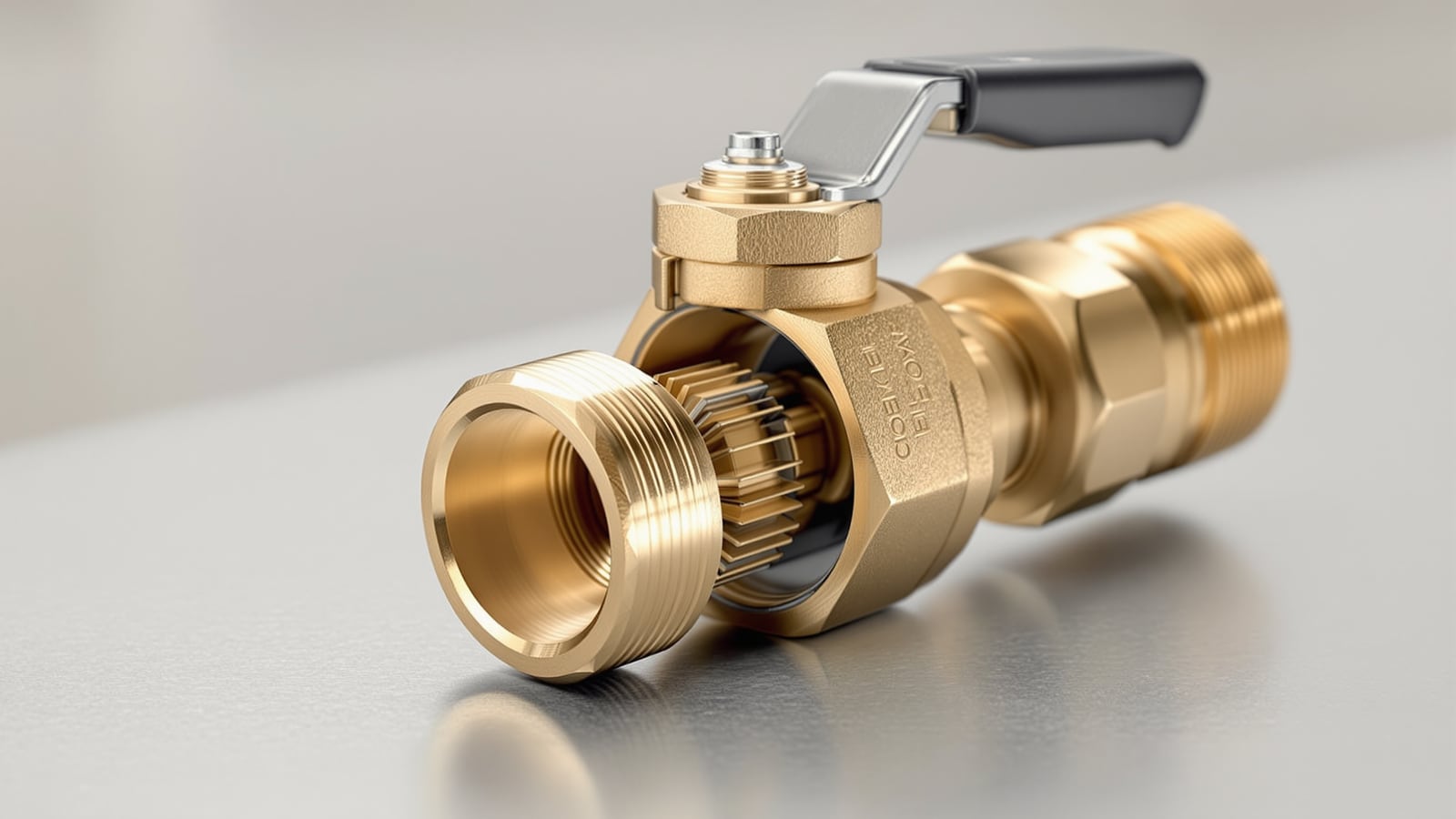
Check Valves (Non-Return Valves) in India: Types, Where to Fit Them & How to Buy
The one-way valve that lets water flow forward but slams shut on backflow — swing, spring, lift, wafer and dual-plate types, why every pump discharge and borewell riser needs one, how to read the flow arrow, what causes valve slam and water hammer, and indicative sizes, materials and cost for an Indian home.
A check valve — sold across India as an NRV or non-return valve — is the simplest valve in your home to understand and one of the easiest to fit wrong. It has one job: let water flow one way and slam shut the instant it tries to flow back. There is no handle and nothing to operate; the water itself opens and closes it. Get its direction or position right and it silently protects your pump, your tank and your drinking water for years.
This guide sits under the Studio Matrx plumbing valves pillar and is the companion to the guide on ball valves, which handle isolation and on/off duty — a different job entirely. Where a ball valve is you deciding to stop the flow, a check valve is the water deciding, automatically, that it must not run backwards.
What a check valve does and how it works
Every check valve contains a moving part — a hinged disc, a spring-loaded poppet, or two spring-loaded half-discs — that forward flow pushes open and reverse flow pushes closed against a seat. Forward pressure holds it open; the moment upstream pressure drops below downstream pressure, the disc drops onto its seat and seals. That is the whole mechanism.
A check valve is not a shut-off. It cannot be told to stay open or closed, and it will never fully replace a ball or gate valve for isolation. Its only skill is blocking reverse flow — but that one skill prevents a surprising amount of damage.
Because it works on pressure difference alone, a check valve must be fitted the right way round. Every valve has a cast or stamped arrow on the body showing the direction of forward flow. Fit it backwards and it either blocks all flow or never seals — a genuinely common site error.
The main types you will meet in India
Not all check valves are equal. The type decides how fast it closes, how much it resists flow, and how badly it will bang your pipes.
Swing check valve
The classic and cheapest. A hinged disc swings open with flow and drops shut by gravity. Common in brass or gunmetal for domestic lines and in cast iron for larger service. It works best mounted horizontally with the hinge on top, or vertically with flow going upward. Its weakness is slow closing — the disc has to swing all the way back, so on a pump that stops suddenly the reverse column of water can build speed before the disc catches it, producing a bang.
Spring-loaded check valve
A poppet held closed by a light spring; forward flow pushes it open, and the spring snaps it shut the instant flow stops — before reverse flow can build up. This makes it far kinder on pump systems and it works in any orientation, including vertical. Slightly more flow resistance than a swing type, but the quiet, fast close is worth it on pump discharge.
Lift check valve
The disc lifts straight up off its seat and drops straight back. Positive sealing and good for higher pressure, but it must be fitted horizontally (or vertical-up for the piston kind) and adds more resistance. More common on pumps and industrial-style lines than on simple house plumbing.
Wafer and dual-plate check valves
Thin-bodied valves that clamp between two pipe flanges, saving space and weight. The dual-plate (twin-disc) type has two spring-loaded half-discs that snap shut very fast, so it resists water hammer well — the go-to for larger diameter and pump-house or overhead-tank riser duty in apartments.
Foot valve
A check valve with a built-in strainer, fitted at the bottom of a suction pipe in a well, sump or borewell. It keeps the suction pipe and pump full of water (holds prime) when the pump stops, and its strainer blocks grit and leaves. Any surface pump drawing from an open well or sump needs one; without it the pump loses prime and runs dry.
| Type | Closes | Best orientation | Water-hammer risk | Typical home use |
|---|---|---|---|---|
| Swing | Slow (gravity) | Horizontal / vertical-up | Higher | Tank inlet, general line |
| Spring | Fast (spring) | Any, incl. vertical | Low | Pump discharge, geyser inlet |
| Lift | Medium | Horizontal | Medium | Higher-pressure lines |
| Dual-plate wafer | Very fast | Between flanges | Lowest | Large riser, pump house |
| Foot valve | On stop, with strainer | Bottom of suction pipe | n/a | Well / sump / borewell pump |
Where a check valve is essential
- On every pump discharge. When the pump stops, the water above it wants to fall back through the impeller. A check valve on the discharge holds that column up, stops the tank draining back, and — with a fast-closing spring or dual-plate type — controls the slam. This is the single most important place to fit one.
- On a borewell riser / foot valve. Keeps the riser pipe primed so the pump does not run dry, and the strainer keeps grit out. See the borewell water system guide.
- To stop contamination backflow. A check valve near a connection to the municipal main, or upstream of any point where dirty water could be siphoned back, keeps stored or used water from flowing back into clean supply.
- On dual-supply cross-connections. Where a home mixes municipal and borewell / tanker supply, a check valve on each source stops one supply pushing back into the other, or into the city main — which is both a contamination risk and, in many places, not allowed.
Water hammer and valve slam
When a pump stops, the water it was pushing wants to reverse. A slow check valve lets that reverse column pick up speed before it slams the disc shut — and stopping a fast-moving column of water suddenly sends a pressure shock down the pipe. That is water hammer: the bang you hear, and over time it loosens joints and cracks fittings.
The cure is a fast-closing valve that seals before the reverse flow gets moving — a spring-loaded or dual-plate type — plus, on a hard-hit line, an air chamber or anti-hammer arrestor. If your pump bangs the pipes every time it cuts out, a slow swing NRV is the usual culprit; swapping it for a spring type often fixes it.
Sizes, materials and indicative cost
Domestic check valves are sold by pipe size, usually stated in inches. Match the valve to your pipe run — commonly ½", ¾" or 1" on house lines, larger on pump and riser mains.
| Size | Type & material | Connection | Typical use | Indicative ₹ |
|---|---|---|---|---|
| ½" (15 mm) | Brass spring NRV | Threaded | Geyser inlet, appliance | ₹250 – ₹600 |
| ¾" (20 mm) | Brass / gunmetal swing | Threaded | Tank inlet, general line | ₹350 – ₹900 |
| 1" (25 mm) | Gunmetal spring NRV | Threaded | Domestic pump discharge | ₹700 – ₹1,800 |
| 1"–1½" | Foot valve, brass + SS strainer | Threaded | Well / sump suction | ₹600 – ₹2,500 |
| 2"–4" | Dual-plate / CI wafer | Flanged / wafer | Riser, pump house | ₹1,500 – ₹12,000 |
Figures are indicative retail ranges for 2026 and vary by brand, city and finish — confirm locally. Buy ISI-marked brass or gunmetal for potable lines; the cheapest zinc-alloy NRVs corrode and jam within a couple of years.
Pros, cons and common failures
Pros: fully automatic, no operation needed, cheap, and it protects expensive equipment (the pump) far out of proportion to its price.
Cons: it adds flow resistance, it wears out silently, and it cannot isolate a line — you still need a ball valve beside it for maintenance.
Common failures to watch for:
- Fitted backwards — no flow, or no sealing. Always check the arrow.
- Grit under the seat — the disc no longer seals and water leaks back; foot valves are especially prone in silty water.
- Worn or perished disc/spring — the valve chatters, or slowly stops holding prime and the pump loses suction.
- Wrong orientation — a swing valve fitted vertical-down will not close reliably.
A check valve that has started to pass backwards shows up as a pump that keeps switching on for no reason, a tank that slowly drains overnight, or a pump that has to be re-primed each morning. When forthcoming Studio Matrx guides on water pumps go live, they cover pump-side symptoms in more depth.
References
- IS 5312: Swing check type reflux (non-return) valves — dimensions and requirements.
- Choose ISI-marked valves and confirm the flow-arrow direction and orientation against the maker's fitting instructions before installing.
Export this guide
Related Guides — Deep-dive reading
Butterfly Valves in India: Wafer vs Lug vs Flanged, Sizing, Operators & Cost
The compact quarter-turn disc valve that isolates and throttles large-diameter lines — building risers, pump headers, tank connections, HVAC chilled-water and fire mains — at a fraction of the size, weight and cost of a gate valve. How the rotating disc works, which body style to specify, lever versus gear operator, materials and sizes, pros, cons and indicative pricing.
PlumbingGate Valves in India: How the Wheel Isolation Valve Works, Where to Use It & When to Replace It
The multi-turn wheel valve that isolates larger water lines and mains with a full-bore, low-resistance opening — how the rising and non-rising wedge-gate mechanism works, why it is strictly ON/OFF and not for throttling, why it seizes and drips over time (and got replaced by ball valves at fixtures), where it still earns its place, and how to size, specify and cost it in an Indian home.
PlumbingPlumbing Valves Guide (India): Every Valve, What It Does and Where It Goes
A homeowner's master overview of the valves in an Indian plumbing system — the four jobs valves do (isolation, throttling, one-way, pressure control), which valve type does which job, where each one belongs from the main to every fixture, plus materials, threaded versus flanged connections and how to choose.
PlumbingRelated Tools — Try Free
Rainwater Tank Sizer
How big should your rainwater tank be? Computes annual harvest, recommended tank capacity in litres, water-bill savings, and payback — for 10 Indian cities.
RWH CalculatorApartment Video Door System Planner
Enter flats, entrances, floors and guard desk for a first-pass building intercom plan — door stations, indoor monitors, guard station, the right architecture and an indicative cost band.
Building PlannerCircadian Light Meter
Patient-centric circadian lighting visualizer for Indian healthcare design — time-of-day × intensity → CCT, melanopic lux (EML / mEDI), melatonin suppression, and an alertness curve. Calibrated against WELL v2 L03 Circadian Lighting Design, CIE S 026:2018, Brainard 2001, and Lucas et al. 2014.
Circadian Tool