
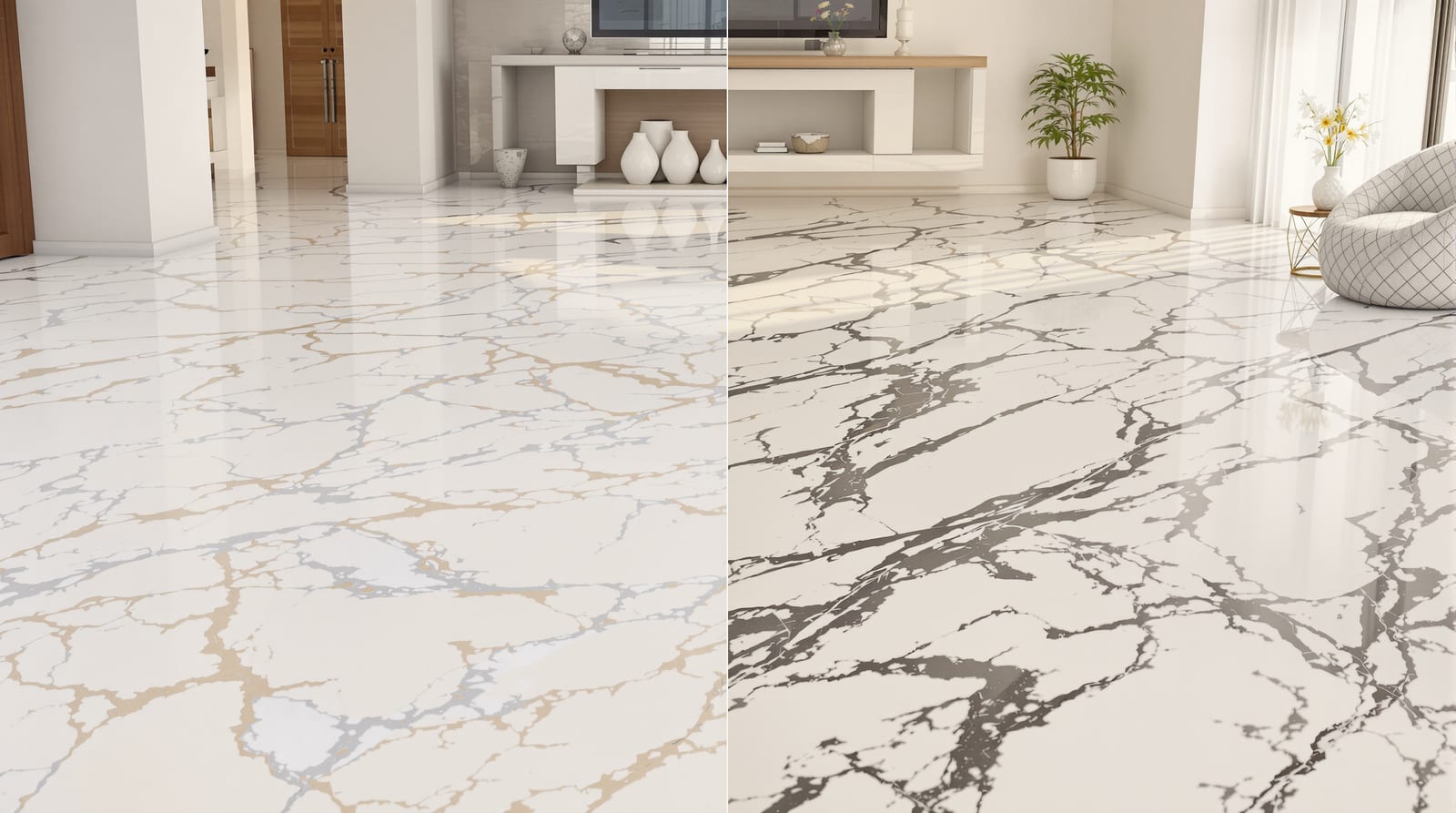
Marble vs Vitrified Tiles in India: Honest Head-to-Head (2026)
Real marble against marble-look PGVT vitrified tiles — look, ₹/sq ft cost, maintenance, durability, slip and joints, plus the honest verdict for most Indian homes.
This is the decision almost every Indian homeowner reaches eventually: the real marble floor you have always pictured, or the marble-look vitrified tile that costs a quarter as much and looks startlingly close. Walk a showroom today and a polished glazed vitrified tile (PGVT) printed with Statuario veining can fool you from standing height. So is paying several times more for genuine stone worth it — or is the smart money on the tile? This is the honest head-to-head, criterion by criterion, for real Indian homes, climates and budgets.
The two contenders, plainly
Real marble is natural stone — metamorphic limestone, mostly calcium carbonate, quarried in slabs from Rajasthan (Makrana, Udaipur, Morwad, Banswara) or imported from Italy (Carrara, Statuario, Botticino, Dyna). Every slab is unique, it is cool underfoot, and a worn floor can be ground back and re-polished to like-new. It also stains, etches with acid, scratches, and needs sealing and periodic polishing. The full picture is in our marble flooring guide.
Vitrified tiles are man-made — fine clay, feldspar, quartz and silica pressed and fired at very high temperature into a dense, near-vitreous (glass-like) body with under 0.5% water absorption (IS 15622, group BIa). The marble-look version is usually PGVT (polished glazed vitrified tile): a high-resolution digital print of marble veining under a glossy glazed surface. There is also matte GVT and the body-coloured double-charged tile. Start with the vitrified tile flooring guide and the PGVT deep-dive for the full taxonomy.
So the real fight is usually real marble vs marble-look PGVT — and that is where this guide spends most of its time.
Head-to-head at a glance
| Criterion | Real marble | Vitrified tiles (PGVT marble-look) |
|---|---|---|
| Material cost ₹/sq ft | Indian 80-350; Italian 250-1,500+ | 40-150 (PGVT); double-charged 45-90 |
| Laid cost (with labour, bed, polish) | High — material + bed + grinding + polish + sealing | Moderate — material + adhesive/bed + grout |
| Look | Genuine depth, unique veining, ages with character | Excellent printed marble look; repeats across boxes |
| Each piece unique | Yes — one-off slabs, book-matchable | No — same few designs repeat |
| Feel underfoot | Cooler (high thermal mass) | Cool, but slightly less than stone |
| Stain resistance | Porous; stains (turmeric, oil) unless sealed | Near stain-proof; <0.5% absorption |
| Acid/etch resistance | Etches with lemon, curd, tomato, cola | Unaffected by household acids |
| Scratch resistance | Soft (Mohs 3-4); scratches | Hard glazed surface; PGVT gloss can micro-scratch over years |
| Maintenance | Seal + periodic re-polish; wipe spills fast | Near-zero; mop and go |
| Slip when wet | Polished marble slippery; hone for safety | Glossy PGVT slippery wet; matte/anti-skid safer |
| Joints | Few — large slabs, near-seamless | Grid of grout lines (smaller with large-format) |
| Repairability | Re-polishable — restores fully | Crack/chip means replacing the tile |
| Lifespan | Decades; renewable | 15-25+ years; not renewable |
| Resale signal | Strong "premium" cue | Reads as quality value |
Look: depth and uniqueness vs a brilliant copy
This is where marble earns its premium. Real marble has translucency and depth — light penetrates a few millimetres into the calcite crystals and scatters back, which is why a marble floor seems to glow rather than just shine. The veining is three-dimensional and continues through the slab's thickness, so a chipped edge still shows the same pattern. And every slab is a one-off: book-matched white marble across a lobby, with veins mirroring around a central axis, is something a printed tile cannot reproduce.
PGVT's answer is genuinely impressive. Modern digital printing reproduces Carrara, Statuario, Onyx and travertine looks so faithfully that, at standing height, most people cannot tell. But the copy has two tells. First, the pattern is printed only on the surface skin — chip the glaze and the body colour shows through. Second, vitrified tiles come in a finite set of "faces": a box of marble-look tiles repeats the same handful of veining patterns, so across a large floor a sharp eye catches the repetition. Marble never repeats. For most rooms PGVT looks superb; for a feature lobby where the floor is the statement, real marble still wins on uniqueness and depth.
Cost: where the gap is widest
Cost is marble's biggest disadvantage, and it is not only the slab rate. Marble carries a stack of extras that vitrified largely avoids.
| Cost component (₹/sq ft, indicative) | Real marble | Vitrified PGVT |
|---|---|---|
| Material | 80-350 (Indian); 250-1,500+ (Italian) | 40-150 |
| Laying labour | 25-60 (heavy slabs, skilled masons) | 15-40 |
| Bedding | Cement-sand bed (in labour) or adhesive 12-30 | Adhesive 12-30 or cement-sand |
| Grinding + polishing | 20-60 (on-site, essential to the look) | Not required |
| Grout/joint filling | Slurry/epoxy joint fill | Grout 5-15 |
| Sealing | Periodic, ongoing | Not required (optional grout sealer) |
| GST | +18% on material | +18% on material |
Add it up and a finished Indian marble floor commonly lands far above its headline slab rate, while an Italian marble floor is a different budget altogether. A finished PGVT floor sits at a fraction of that — and then keeps saving you money, because marble carries a recurring re-polish cost every few years that vitrified never does. For your own numbers, run the flooring cost calculator and the marble flooring cost calculator.
Maintenance: marble's discipline vs tile's "mop and go"
If cost is the headline difference, maintenance is the one you live with daily. Marble is calcium carbonate, and that single fact drives its care:
- It etches. Lemon, tamarind, curd, tomato, sambar, cola — any household acid reacts with the calcite and leaves a dull rough mark that no cleaner removes. Only re-polishing fixes it. This is why marble and Indian kitchens are a hard pairing.
- It stains. Porous stone soaks up turmeric, oil, beetroot and ink unless sealed and wiped promptly. Turmeric on white marble is the classic regret.
- It needs sealing and re-polishing. A penetrating sealer (re-applied periodically) buys time; a professional diamond re-polish every few years restores the gloss. Budget both as ongoing costs.
Vitrified PGVT is the opposite. With under 0.5% water absorption and a glazed surface, it is effectively stain-proof and acid-proof for household purposes — turmeric, lemon and oil wipe off, no sealing, no polishing, no etching. For a busy joint-family home, this difference alone often decides it.
Durability, scratch and the long view
On hardness, vitrified wins day-to-day. The fired glazed surface resists scratching from grit and furniture far better than marble at Mohs 3-4, which scuffs under dragged almirahs and shoe-tracked sand. Double-charged vitrified is the toughest body type for high traffic; PGVT's glossy glaze is hard but can pick up fine micro-scratches and lose some shine over many years in a busy entry.
But marble has the trump card on the very long view: it is renewable. A scratched, etched, dull, 30-year-old marble floor can be ground and re-polished back to like-new — the same physical floor, restored. A vitrified tile that cracks, chips or wears its glaze must be replaced, and matching the exact design and dye-lot years later is often impossible. So vitrified resists damage better; marble recovers from it better. Over a 40-year horizon a well-kept marble floor can outlast two tile installs — at a higher running cost.
Slip when wet: a real safety point
Both can be slippery, and both have a safe version. A high-polish marble floor and a glossy PGVT tile are each genuinely slick when water lands on them — a fall risk at entries, balconies and bathrooms, especially for elders and children. The fixes differ slightly: for marble, choose a honed (matte) finish in wet-prone areas; for vitrified, choose matte GVT or a rated anti-skid tile (look for DIN 51130 R10+ for wet zones). In wet areas the practical winner is anti-skid vitrified or porcelain — it stays safe and shrugs off the constant water that punishes marble. See bathroom flooring and balcony flooring.
Joints: slabs vs the tile grid
Marble's large slabs mean very few joints — laid well with matching slurry, a marble floor reads as one continuous, near-seamless surface, which is a big part of its luxury. Vitrified is a grid: even the largest formats (800x1600, 1200x1200) leave grout lines on a 2-3 mm joint. Large-format tiles and a close-tone, anti-fungal grout shrink the visual impact a lot, but the grid is still there, and grout in high-traffic or wet areas needs occasional cleaning. If a monolithic, joint-free look matters to you, that favours marble slabs; if you are comfortable with a tidy large-format grid, vitrified is fine.
Where each one wins
Choose real marble when:
- The floor is the statement — a formal living room, entrance lobby or staircase where genuine depth, unique veining and a near-seamless slab floor justify the spend.
- You value cool-underfoot comfort in a hot, dry climate (Rajasthan, Gujarat, the plains).
- You want a floor you can restore for decades rather than replace, and you accept the sealing and re-polishing discipline.
- Resale and prestige matter, and the budget is genuinely there for material plus laying, polishing and upkeep.
Choose vitrified PGVT when:
- You want the marble look at a quarter of the cost, with the money freed for kitchens, wardrobes or fittings.
- Low maintenance is non-negotiable — a busy joint family, working couple, or anyone who wants "mop and go" with no sealing, polishing or etch worries.
- You need stain- and acid-resistance in real-life Indian rooms — kitchens, dining, kids' areas where turmeric, lemon and oil land daily.
- You want design consistency across a large area, or anti-skid safety in wet zones via a matte/rated tile.
For the related trade-offs, see marble vs granite flooring (the other natural-stone contest) and use the flooring material comparison tool side by side.
The honest verdict for most Indian homes
For the majority of Indian homes today, marble-look vitrified PGVT is the smarter default — it delivers ninety-odd percent of the look for a fraction of the cost, with effectively none of the staining, etching, sealing and re-polishing burden, plus better everyday scratch resistance and a wet-area-safe matte option. It is the value-and-sanity choice for the whole floor of a busy home.
Real marble still wins where it is meant to shine: a feature living room, a grand lobby, a staircase — places where genuine stone's depth, uniqueness, cool comfort and re-polishable longevity are worth the money and the discipline. The most common smart compromise in Indian homes is exactly this hybrid: real marble in the formal living and entrance for impact, and marble-look vitrified everywhere else for value and easy upkeep. Decide room by room, not house-wide — and let the floor's job in each room make the call.
Frequently asked questions
Are marble-look vitrified tiles as good as real marble?
For looks at standing height, modern PGVT tiles are remarkably close — most people cannot tell them apart. Where they differ is depth and uniqueness: real marble glows with light penetrating the stone and every slab is one-of-a-kind, while vitrified prints repeat across boxes and are surface-only. For everyday performance, vitrified is actually better — stain-proof, acid-proof and near-zero maintenance. Real marble wins on genuine luxury, cool feel and being re-polishable for decades.
Which is cheaper, marble or vitrified tiles?
Vitrified is much cheaper, and the gap is wider than the slab rate suggests. Marble adds laying with a cement-sand bed, on-site grinding and polishing, sealing, and a recurring re-polish every few years. A finished marble floor commonly costs several times a finished PGVT floor, and Italian marble far more again. Vitrified also has no ongoing maintenance cost.
Is marble or vitrified better for an Indian kitchen?
Vitrified, clearly. Marble etches and stains with exactly the acids and oils a kitchen produces — lemon, tamarind, curd, tomato, turmeric. Vitrified tiles shrug those off with no sealing and no etching. If you love stone in the kitchen, granite is far more practical than marble. See our kitchen flooring guide.
Which is more slippery when wet?
Both polished marble and glossy PGVT are slippery when wet. The safe versions are honed (matte) marble or matte/anti-skid vitrified rated DIN 51130 R10 or higher. For bathrooms, balconies and entries, anti-skid vitrified or porcelain is the practical winner because it stays safe and resists the constant water that damages marble.
Does marble add more resale value than vitrified tiles?
Real marble carries a stronger premium signal — buyers and valuers read it as a luxury, permanent floor, especially in living rooms and lobbies. Quality vitrified reads as a smart, well-finished home rather than a luxury one. If resale prestige is a priority and the budget allows, real marble in the main rooms adds the most perceived value; otherwise vitrified delivers better value per rupee spent.
Export this guide
Related Guides — Deep-dive reading
Italian Marble Flooring in India: Carrara, Statuario, Botticino, Cost & the High-Maintenance Reality (2026)
Imported Italian marble gives the most luxurious floor money can buy in India — here is the honest homeowner's guide to Carrara, Statuario, Botticino, Dyna Beige, Michelangelo and Onyx, book-matching, why it costs 250-1,500+ /sq ft, the real sealing and anti-etch upkeep, and whether it beats PGVT marble-look tiles.
Flooring & SurfacesMarble Flooring in India: Indian vs Italian, Types, Cost & Care (2026)
Marble is India's aspirational natural-stone floor — cool underfoot, luxuriously veined and re-polishable. Here is the homeowner's honest guide to Makrana and the popular Indian types, Indian vs Italian marble, ₹/sq ft costs, the staining and etching downsides, where to use it and how it is laid and polished.
Flooring & SurfacesHow to Choose Flooring for an Indian Home: A Step-by-Step Framework (2026)
A decision framework to pick the right floor for any room — weighing traffic, water, comfort, budget, maintenance, look, climate, durability and resale, with the key natural-stone vs tile vs wood vs resilient trade-offs.
Flooring & SurfacesRelated Tools — Try Free
Flooring Cost Calculator
Estimate the all-in cost of a floor — material, laying, wastage, skirting and GST — by area and material.
Flooring CalculatorMarble Flooring Cost Calculator
Estimate installed marble-floor cost — material, laying, grinding and polishing, sealing, wastage and GST.
Flooring CalculatorApartment Furniture Size Chart
Standard furniture dimensions for Indian apartments — sofas, beds, tables, dining, storage.
Reference Chart