
Vehicle Turning Radius for Parking in India: Swept Paths, Aisles and Corners (2026)
How turning circle and turning radius really work, why a turning car needs far more room than its own width, and how the swept path sets your aisle widths, corners, ramp turns and dead-end turnarounds — indicative numbers you confirm against NBC and your local rules.
A parking layout can pass every bay-size and headroom check on paper and still fail the moment a real car tries to move through it. The reason is almost always turning geometry — the space a car needs to change direction is far larger than the space it needs to stand still. Get the vehicle turning radius wrong and drivers scrape columns, shunt back and forth to enter a bay, or simply cannot exit forward. This guide explains how turning circle and turning radius actually work, why a turning car sweeps a much wider band than its own width, and how that swept path decides your aisle widths, corners, ramp turns and dead-end turnarounds.
It is the circulation-geometry companion to the parking layout and aisle design guide and the car parking dimensions guide, and it feeds directly into ramp design, where turning and gradient combine into the hardest problem in the whole layout. For the wider planning picture, start at parking design principles.
Scope & how to read this. Every dimension here is typical and indicative — a planning starting point to confirm against NBC (SP 7:2026), your local development-control regulations and the vehicle manufacturer's own data; for anything non-trivial a transport or parking consultant runs a proper swept-path analysis, and structural, ramp and ventilation work is licensed-engineer territory.
Turning circle vs turning radius: the words, precisely
The two terms are used loosely and mean slightly different things, so it is worth being exact.
- Turning circle is the diameter of the smallest circle a car can drive around with the steering on full lock. It is the number carmakers publish (often as "turning circle" or "turning diameter"), and it is the most useful single figure for parking design.
- Turning radius is half of that — the radius of the same circle. People often say "turning radius" when they mean the turning circle, so always check whether a quoted number is a diameter or a radius before you use it.
There is a second, more important distinction hidden inside the published figure:
- Kerb-to-kerb turning circle measures the circle traced by the outer front tyre (where a wheel would clip a kerb). This is the smaller, more flattering number, and it is what most brochures quote.
- Wall-to-wall turning circle measures the circle traced by the outermost front corner of the body — the bumper overhang that swings wider than the wheel. This is the number that matters near a wall, column or parked car, and it is typically 0.4 to 0.9 m larger in diameter than kerb-to-kerb.
The design lesson is simple: in a basement or a tight layout you are turning between walls and columns, not kerbs, so design to the wall-to-wall figure, not the brochure kerb-to-kerb number.
A worked feel for the numbers
A common Indian hatchback quotes a kerb-to-kerb turning circle around 9.8 m (radius about 4.9 m). Its wall-to-wall figure might be closer to 10.5 m. That difference — most of a metre — is exactly the clearance you lose if you plan to the wrong one. A large SUV can sit near 12 m wall-to-wall, which is why a layout that works for a hatchback can trap a big SUV at the same corner.
The swept path: why a turning car needs more than its own width
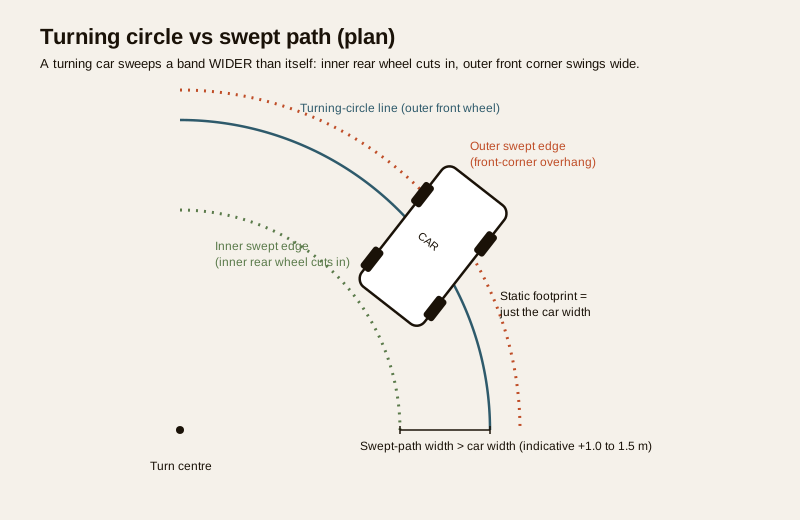
Here is the idea that trips up most amateur layouts. When a car goes straight, it occupies a band exactly as wide as the car. When a car turns, the front wheels and the rear wheels follow different circles, and the body sweeps a much wider band called the swept path.
Two effects combine:
- Off-tracking (inner rear wheel cut-in). The rear wheels turn on a tighter circle than the front wheels, so the inner rear wheel cuts inside the path of the inner front wheel. This is why a bus mounts the kerb at a corner — and why a car clips a column that "looked clear" from the driver's seat.
- Front overhang swing (outer corner). The front corner of the body, ahead of the front axle, swings outward beyond the outer front wheel. On the outside of the turn this is what strikes a wall.
The band between the innermost point (inner rear wheel) and the outermost point (outer front corner) is the swept path, and it is always wider than the car. For a mid-size car negotiating a 90-degree turn the swept path can be 1.0 to 1.5 m wider than the vehicle body. Plan to the car's parked width and you will be short by exactly that much.
The one rule to remember
Check the swept path, not just the centre-line. A centre-line arc drawn at the turning radius tells you the car's midpoint can make the turn; it says nothing about whether the inner rear wheel clears the inside kerb or the outer front corner clears the outside wall. Real swept-path checks are done with vehicle-tracking software (or physical turning templates) that plot both edges through the whole manoeuvre.
How turning radius sets minimum aisle width
The aisle is the drive lane a car reverses or drives into a bay from, and its width is governed by turning geometry, not by traffic. The tighter the parking angle, the more the aisle has to give the car room to swing in.
For 90-degree (perpendicular) parking — the most space-efficient and most common bay layout in India — a car must turn a full right angle from the aisle into the bay in one or two moves. That demands the widest aisle. As bays are angled to 60, 45 or 30 degrees, the turn into them eases and the aisle can narrow, at the cost of bay-packing efficiency (angled bays waste end space). The layout and aisle design guide covers the angle-vs-efficiency trade in full; here we care only about the turning driver.
The table below pairs indicative turning circles by vehicle class with the sort of 90-degree aisle each implies. Wider design vehicle means wider aisle.
| Vehicle class (India) | Indicative kerb-to-kerb turning circle | Indicative wall-to-wall | Implied 90-degree aisle (indicative) |
|---|---|---|---|
| Small hatchback / city car | 9.4 - 10.0 m | ~10.2 - 10.7 m | ~5.4 - 5.5 m |
| Mid hatchback / compact sedan | 9.8 - 10.6 m | ~10.5 - 11.2 m | ~5.5 m |
| Sedan / mid SUV | 10.6 - 11.4 m | ~11.2 - 12.0 m | ~5.5 - 6.0 m |
| Large SUV / 7-seater MUV | 11.4 - 12.4 m | ~12.0 - 13.0 m | ~6.0 m |
| Tempo / small goods van | 12.0 - 14.0 m | ~13.0 - 14.5 m | 6.0 m+ / dedicated route |
| Ambulance (van type) | 12.0 - 14.0 m | ~13.0 - 14.5 m | 6.0 m+ / dedicated route |
A widely-used planning value for a 90-degree two-way car aisle is about 6.0 m, and about 5.4 to 5.5 m where a slightly tighter one-way arrangement and small-car design vehicle allow it. Treat these as indicative — confirm the governing minimum against NBC (SP 7:2026) and your local development-control rules, and against the largest vehicle you actually intend to serve.
Choosing the design vehicle
Every layout is sized around a design vehicle — the largest car it must comfortably serve. Size for a hatchback and a homeowner's new SUV will not fit; size everything for a tempo and you waste enormous area. The honest method is to pick the realistic largest regular vehicle (for most Indian homes and societies, a large SUV) as the design vehicle, and then separately check that essential access vehicles — an ambulance, a shifting tempo, a fire-service appliance where required — can at least reach the building, even if not every bay.
Corners and the 90-degree turn
A right-angle turn in a driveway or aisle is where swept paths bite hardest, because the car changes direction by a full 90 degrees in a short distance.
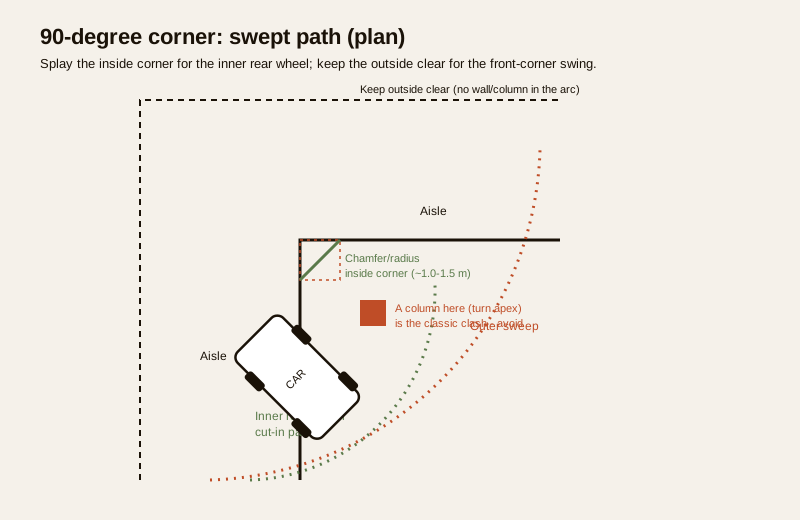
- Splay the inside corner. A square inside corner will be clipped by the inner rear wheel. Chamfer or radius the inside kerb so the swept path has somewhere to go; a splay of roughly 1.0 to 1.5 m on the inside corner transforms a tight turn.
- Keep the outside clear. The outer front corner swings wide, so keep the outside of the turn free of walls, columns and parked cars through the arc.
- Watch columns above all. A column planted at the apex of a turn is the classic basement mistake — see the column-clash note below.
Ramp turns and the compound problem
A straight ramp only asks the car to climb. A turning ramp — a curved ramp, or a half-turn between basement levels — asks it to climb and turn at the same time, and the two problems compound.
- The inner edge of a curved ramp climbs steeper than the centre-line for the same gradient, because it is a shorter path around the curve. So the inner kerb can exceed a comfortable slope even when the "ramp gradient" on paper looks fine.
- The swept path widens on the curve exactly as it does on the flat, so a curved ramp needs more width than a straight one.
- Ground-clearance and transition problems (scraping at the top and bottom of the slope) get worse on a curve.
The safe rule for homeowners and societies is to keep ramps straight wherever possible, and treat any turning or helical ramp as a consultant-designed element — the geometry of a helical ramp (inner radius, super-elevation, width, transitions) is specialist work. The ramp design guide covers gradients and transitions, and you can sanity-check a straight slope with the Parking Ramp Gradient Calculator.
Dead-end aisles and turnarounds
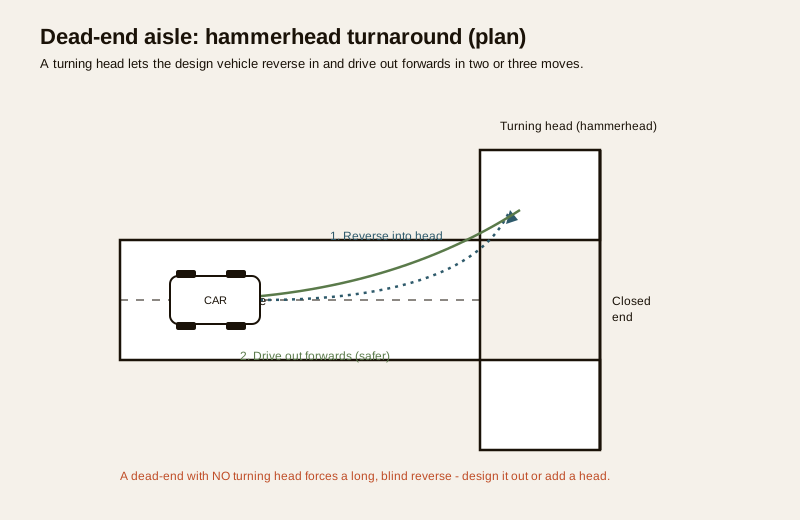
Any aisle that does not run through needs somewhere for a car to turn around rather than reverse its whole length. A dead-end without a turnaround forces a long, blind reverse — unsafe and, for a big SUV, sometimes impossible.
- Provide a turning head (a hammerhead or bay-and-back arrangement) at the closed end, sized so the design vehicle can turn in no more than two or three moves.
- Forward-out where you can. Bays arranged so a car can drive out forwards (rather than reverse into the aisle) are safer, especially near a home's pedestrian entry. Plan the geometry so the common daily manoeuvre is forward-out.
- A through aisle is always better than a dead-end — design them out first, and only add turnarounds where the plan genuinely cannot loop.
What to check: the turning-design checklist
Use this as a coordination checklist with your designer or consultant. Each row is a place turning geometry commonly fails.
| Check | What can go wrong | What to confirm |
|---|---|---|
| Corner sweep | Inner rear wheel clips a square inside kerb or column | Inside corner splayed / radiused; swept path plotted, not centre-line |
| Aisle width | Aisle sized for traffic, not for the turn into 90-degree bays | Aisle meets the turning minimum for the design vehicle; confirm vs NBC + local DCR |
| Ramp turn | Curved ramp too steep on the inner edge, too narrow, scrapes | Straight ramp preferred; any helical ramp designed by a consultant |
| Column clash | A column lands in the swept path at a turn or bay mouth | Column grid checked against swept paths; no column at a turn apex |
| Forward-out | Daily manoeuvre is a long blind reverse into the aisle | Turning head at dead-ends; forward-out geometry near pedestrian routes |
| Design vehicle | Layout sized for a hatchback; owner's SUV cannot turn | Realistic largest regular vehicle chosen; ambulance/tempo access checked |
| Wall-to-wall | Designed to brochure kerb-to-kerb near walls and columns | Use wall-to-wall turning circle for enclosed / basement layouts |
How it connects
- Layout that uses this geometry: parking layout and aisle design and the base car parking dimensions.
- Where turning gets hardest: parking ramp design and the parking headroom and clearance guide.
- The planning frame: parking design principles and, for open ground-floor parking, stilt parking.
- Managing the same drive lanes for safety (boom barriers, bollards, CCTV at turns and ramps): the Parking & Garage Security library.
- Try it: the Vehicle Turning Radius Calculator to test a design vehicle against an aisle, and the Parking Ramp Gradient Calculator for the slope side of the problem.
Key takeaways
- Turning circle is a diameter; turning radius is half of it — always check which a quoted number is before you design with it.
- Kerb-to-kerb flatters; wall-to-wall is the truth near walls and columns — design enclosed and basement layouts to the wall-to-wall figure.
- A turning car sweeps a band wider than itself: the inner rear wheel cuts in and the outer front corner swings out. Check the swept path, not the centre-line.
- Turning geometry sets aisle width — a 90-degree car aisle is typically around 6.0 m (indicative); confirm against NBC (SP 7:2026) and local rules.
- Splay inside corners, keep the outside clear, and never plant a column at a turn apex.
- Keep ramps straight; treat any turning or helical ramp as consultant-designed — the inner edge climbs steeper and the sweep widens.
- Design around a realistic largest regular vehicle, and separately confirm ambulance and tempo access.
References
- NBC (SP 7:2026), National Building Code of India — parking, circulation and ramp provisions (confirm the current parts and any state amendments).
- Local development-control regulations and municipal building bye-laws — the governing aisle widths, turning provisions and Equivalent Car Space (ECS) norms for your city.
- IS codes and Indian Roads Congress guidance on parking geometry and vehicle-tracking (verify current status via the BIS catalogue).
- Vehicle manufacturer data — the specific kerb-to-kerb and wall-to-wall turning circles for the cars a project must serve.
- Transport / parking consultant swept-path (vehicle-tracking) analysis for any non-trivial layout, ramp or basement.
All turning circles, aisle widths and dimensions here are indicative planning values that vary by vehicle and layout; confirm against NBC (SP 7:2026), your local development-control regulations and manufacturer data, and have a licensed engineer or parking consultant design, sign off and build anything non-trivial.
Export this guide
Related Guides — Deep-dive reading
Parking Layout and Aisle Design in India: 90, 60 and 45 Degree Bays (2026)
How the angle of a parking bay decides everything else — the aisle width behind it, whether traffic runs one-way or two, how many cars fit per 100 square metres, and which layout suits a basement, an open lot or a driveway. Indicative dimensions to plan with, then confirm against NBC and your local rules.
ParkingBasement Parking Design in India: Levels, Ramps, Ventilation and Drainage (2026)
How below-grade car parking is planned in Indian homes, societies and commercial buildings — when a basement makes sense over stilt or podium, the level grid and clear headroom under services, the entry ramp footprint, engineered carbon-monoxide and smoke-extract ventilation, waterproofing and the sump-and-pump drainage, fire safety and egress, lighting, and the real structural cost.
ParkingParking Security Lighting in India (2026): Lighting Basement, Stilt and Open Parking So Nothing Hides in the Dark
How to light apartment and commercial parking so vehicles, people and number plates are clearly seen, cameras can actually read the scene, and the space stops being a soft spot for theft and lurking, without ever compromising the emergency lighting on the escape route.
SecurityRelated Tools — Try Free
Vehicle Turning Radius Calculator
Turning radius, wall-to-wall clearance and indicative aisle width a car needs in a parking layout, from its turning circle.
Parking CalculatorParking Ramp Gradient Calculator
Ramp gradient, horizontal run, sloped length and transition zones from the floor-to-floor height and a target slope.
Parking CalculatorCross-Ventilation Analyzer
Estimate airflow and air changes per hour (ACH) from room size, window areas, layout, and local wind — with NBC 2016 Part 8 compliance check.
Ventilation Calculator