
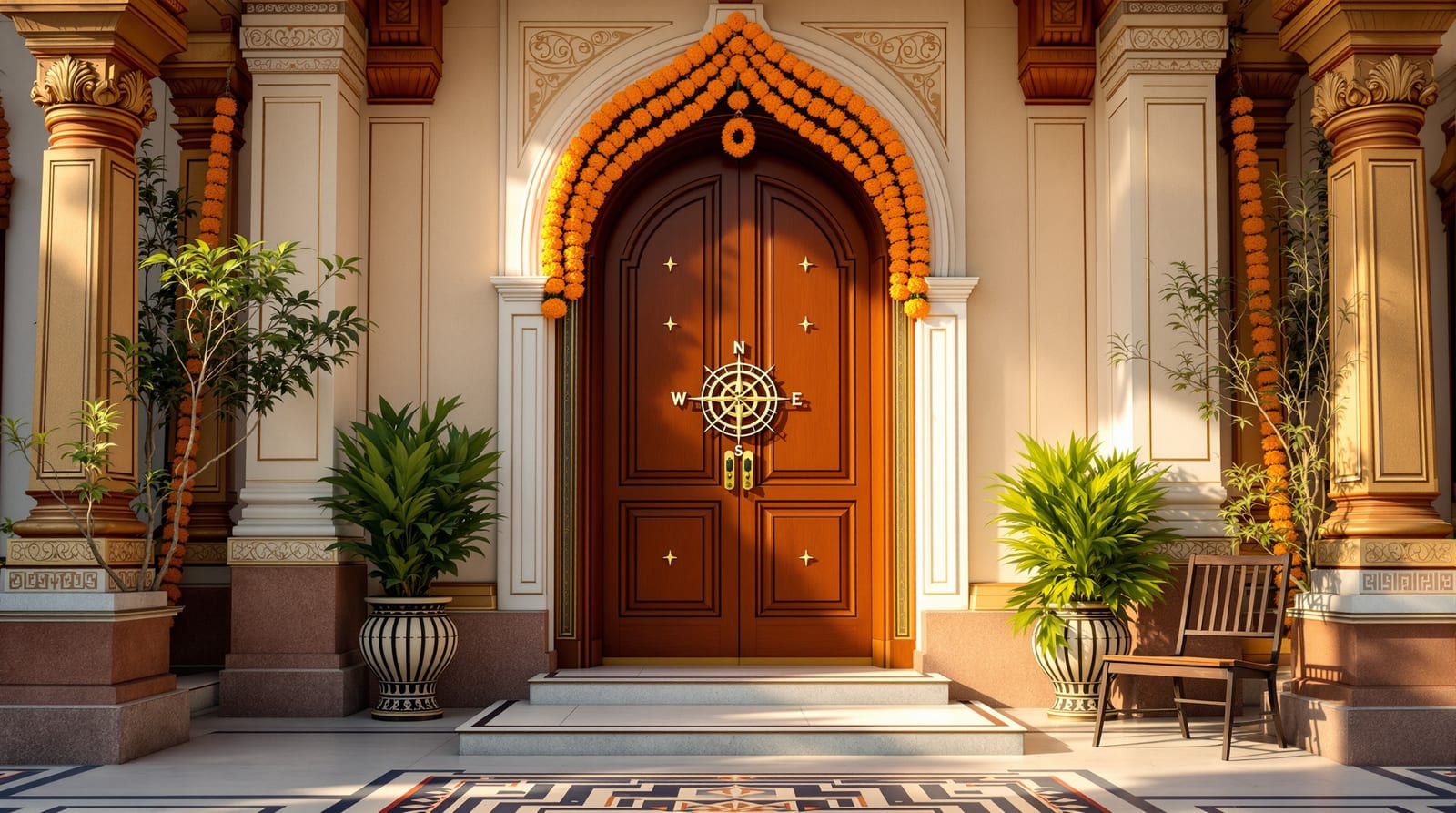
Main Door Direction in Vastu: Best Facing & Padas (India Guide)
Which direction your main door should face according to Vastu Shastra — the favoured north, east and north-east, the auspicious padas within each direction, what each facing is said to bring, and the practical light-and-access logic that sits alongside the tradition.
In Vastu Shastra the main door is treated as the mouth of the home — the single opening through which energy, light, air, guests and prosperity are believed to enter. So of all the Vastu questions Indian families ask, none is asked more often than which direction the main door should face. The short, traditional answer is north, east or north-east; the longer answer involves the precise "pada" or zone within that direction, what each facing is said to bring, and which facings are avoided by default. This guide goes deep on direction alone — and, just as importantly, sets the belief alongside the practical reasons (light, breeze and street access) so you can make a calm, informed choice rather than an anxious one.
This is the direction-specific companion to our broader Vastu main door guide and entrance Vastu guide. For how a door lines up with other doors and the wall it sits in, see door alignment Vastu in India; if your facing is not ideal, our Vastu door remedies guide covers correctives. To map your own plot quickly, the door Vastu planner lets you enter your facing and see the zones.
A note before we begin: everything here is presented as tradition and belief, not building science or law. Vastu is a cultural and spiritual framework many Indian families value; it is not a code like the NBC. Where a practical, verifiable benefit exists, we say so; where a rule is purely traditional, we label it as such. Treat the two columns of every table as exactly that — two different lenses on the same door.
First, fix what "facing direction" actually means
Most family arguments about main-door Vastu come from measuring the direction wrong. The convention is simple and worth getting right once:
- Stand inside the home, in the doorway, looking out through the main door as if you were about to leave.
- The direction you are facing is the door's facing direction. A door you exit while looking east is an east-facing door, regardless of which way the building's longest wall runs or where the road is.
- Use a magnetic compass (a phone compass app is fine for a first read) held flat at the threshold. Note the bearing, then step back and confirm. For anything you plan to act on, cross-check with a second reading on a different day, away from steel gates, switchboards, the meter box and reinforced concrete, all of which deflect a compass needle.
Vastu practitioners go one step finer. Each of the four cardinal directions is divided into smaller slices called padas (literally "steps" or "feet") — typically each 45-degree quadrant is split into multiple padas, each said to be governed by a deity and carrying a distinct quality. So "north-east facing" is not one thing: a door a few degrees one way or the other can fall in a pada considered highly auspicious or one to avoid. This is why two homes that both "face north-east" can be judged differently. For a precise pada you would need an accurate bearing; for most homeowners, knowing the broad direction plus roughly where in that quadrant the door sits is enough to make a sensible decision.
The favoured directions: north, east and north-east
Tradition ranks the three "light" directions highest for a main entrance. The reasoning blends symbolism with something genuinely practical in the Indian climate.
| Direction | Vastu view (belief) | Practical note (verifiable logic) |
|---|---|---|
| North-east (Ishanya) | Considered the most auspicious zone — the corner of the deity Ishana, associated with clarity, growth, health and spiritual energy. A door here is said to invite prosperity. | Catches gentle morning light without the harsh afternoon sun; the NE corner stays cooler, which suits a calm, well-lit entry. |
| East (governed by Surya) | Strongly favoured — associated with the rising sun, vitality, fame and new beginnings. A classic, safe choice for a main door. | First daylight enters the home each morning; good for ventilation and a bright, welcoming threshold. |
| North (Kubera) | Favoured — linked to Kubera, the lord of wealth, hence associated with money and opportunity. | In the northern hemisphere a north opening gets soft, even, glare-free light all day and avoids direct heat — comfortable for an entrance. |
Within these, practitioners point to specific auspicious padas: in the east, the padas near the centre-east and toward the north-east are favoured; in the north, the padas toward the north-east are preferred; and the north-east quadrant itself is held in high regard, though the extreme corner is sometimes treated with care rather than crowded with a heavy door. The repeated theme is that doors leaning toward the north-east are seen as the most beneficial slices of each quadrant.
Main-door direction at a glance
The diagram below shows the eight facings around a compass, shaded by how Vastu tradition generally regards each one for a main entrance.
The directions Vastu avoids by default — and the honest caveat
By default, south and south-west facings are the ones tradition is most cautious about for a main door, with south-east and west treated as workable but second-tier. Here is the balanced picture.
| Direction | Vastu view (belief) | Practical note (verifiable logic) |
|---|---|---|
| South (Yama) | Avoided by default — associated with Yama and linked in tradition to obstacles and instability. | In India the south face takes strong, hot afternoon sun; an unshaded south door can make the entry warm and the threshold area harsh without a shade or porch. |
| South-west (Nairutya) | The most cautioned-against for a main door — this is the "anchor" corner Vastu prefers heavy and closed (often the master bedroom), not opened up. | The SW corner is best kept solid for structural mass and to block the hottest low-angle west-south light; opening it conflicts with that. |
| West (Varuna) | Mixed — not forbidden, considered acceptable, sometimes even favourable for certain padas; commonly chosen where the plot demands it. | Gets warm evening light; manageable with a shade or deeper porch. Often simply the side the road is on. |
| South-east (Agni) | Cautioned — the fire corner; a main door here is said to bring friction unless balanced. | Morning-to-midday sun on this face; workable with shading. |
The crucial, honest point — and one good practitioners make themselves — is this: a "bad" direction is not a verdict on your home. Tradition holds that south and south-west doors can work when the door falls in an acceptable pada for that direction and when recognised remedies are applied. Many perfectly happy, prosperous homes face south because that is simply where the road and plot put the entrance. If your only available facing is south or south-west, the Vastu response is not to despair or to demolish — it is to choose the best pada within that wall, keep the door well-proportioned and the threshold clean and lit, and apply the customary remedies. We cover those in detail in the Vastu door remedies guide.
Direction is necessary but not sufficient
Even a textbook north-east door is judged by more than its compass bearing. Vastu treats the entrance as a small system, so practitioners also look at:
- Proportion and dominance. The main door should be the largest door in the home and ideally taller and wider than the internal doors, so it visually reads as the principal opening.
- Swing and panel count. Tradition prefers the door to open inward and clockwise into the house (welcoming energy in), and an even number of panels or shutters; a creaky or sticking leaf is considered inauspicious and is, practically, just bad maintenance.
- Alignment with other doors. Two doors directly facing each other in a straight line (called dwar vedha) is avoided; see door alignment Vastu.
- The threshold (dehleez). A defined threshold, often with a toran above and rangoli below, marks the transition; keep it clean, lit and unobstructed.
These sit in the broader Vastu main door guide and entrance Vastu guide; here the takeaway is that direction is the headline, not the whole story.
A practical decision path
When the plot already exists (the common case), you rarely get a free choice of facing — the road, the setback rules and the staircase decide a lot. A sensible sequence:
1. Measure the true facing by standing inside and reading a compass, as above.
2. If it is N, E or NE, you are in the favoured band; refine toward the auspicious pada (lean toward the north-east slice of the quadrant) and proportion the door well.
3. If it is W or SE, treat it as workable; pick a good pada and add shading for comfort.
4. If it is S or SW, choose the best pada on that wall, keep the door clean, well-lit and well-maintained, and apply customary remedies rather than forcing a structural change.
5. In every case, let real-world comfort guide you too: a door that gets morning light, a cross-breeze and easy, safe access from the street is a good door by any measure.
Working with a builder or architect on a fresh plot is the ideal moment to align tradition and practicality from the start — orient the entrance toward the favourable, naturally lit side before walls are poured.
Frequently asked questions
Which is the best direction for a main door as per Vastu?
North-east is traditionally considered the most auspicious, followed by east and north. All three are "light" directions that also bring gentle morning daylight and good ventilation in the Indian climate — so the belief and the practical comfort point the same way.
Is a south-facing main door always bad in Vastu?
No. South is cautioned against by default, but tradition holds it can work when the door sits in an acceptable pada for that direction and recognised remedies are applied. Many prosperous homes face south because that is where the road is. The honest Vastu answer is to optimise the pada and threshold, not to assume disaster.
How do I find my main door's exact direction?
Stand inside the doorway looking out as if leaving, hold a compass (a phone app works for a first read) flat at the threshold, and note the direction you are facing — that is the door's facing. Take a second reading on another day, away from steel, switchboards and the meter box, which deflect the needle.
What are padas in main-door Vastu?
Padas are the smaller zones each cardinal direction is divided into, each said to be governed by a deity with its own quality. They explain why two homes both "facing north-east" can be judged differently — the precise pada the door falls in matters, which is why an accurate compass bearing is useful.
Does the door also need to open inward?
Tradition prefers the main door to open inward and clockwise into the home, be the largest door in the house, and have an even number of panels. These are belief-based preferences (with the practical bonus that an inward door does not obstruct the street and is easier to keep maintained).
Export this guide
Related Guides — Deep-dive reading
Vastu for Main Door in India: Direction, Size, Panels, Threshold & Colour
A door-specific Vastu reference for the Indian home - best direction quick-table, the right size and proportion, why an even number of panels, the dehleez/threshold, auspicious colours and materials by direction, what to avoid, and remedies when an apartment door is builder-fixed.
Home Doors & EntrancesBedroom Door Vastu for Indian Homes: Direction, Placement & Remedies
Master, kids and guest bedroom door directions, why a door should not face the bed or another door, and practical remedies that respect both belief and buildability.
Home Doors & EntrancesKitchen Door Vastu for Indian Homes: Direction, Placement & Remedies
Where to place the kitchen door, which way it should open, and how to fix the alignments Vastu warns against — explained as tradition plus practical kitchen sense.
Home Doors & EntrancesRelated Tools — Try Free
Cross-Ventilation Analyzer
Estimate airflow and air changes per hour (ACH) from room size, window areas, layout, and local wind — with NBC 2016 Part 8 compliance check.
Ventilation CalculatorMain Door Vastu Planner
Check your main door direction against Vastu, with remedies and colour and material suggestions.
Vastu PlannerWindow Orientation Planner
Pick the best window type, glass and shading by wall direction — north, east, south and west.
Window Tool