

Ready Mix Concrete (RMC) in India: When to Order It vs Mix On Site (2026)
A homeowner and site-owner's guide to ready mix concrete - what RMC is, how it differs from site-mixed nominal-mix concrete, the delivery slip and slump checks that protect you, and the honest call on when a transit mixer is worth it and when a site mix is fine.
There is a moment on almost every Indian construction site when someone has to decide how the concrete will arrive. Will a gang of labourers stand at a pan mixer all day, shovelling sand, aggregate and cement bags in a rough ratio and hoping the tenth batch matches the first? Or will a truck reverse up to the gate, its drum turning, carrying concrete of a known grade batched by machine at a plant a few kilometres away? That second option is ready mix concrete, and for slabs and larger pours it has quietly become the default in urban India. This guide explains what RMC actually is, how it differs from the site mix your grandfather's mason would have made, and - most usefully - how to tell whether it is the right call for your particular pour.
The stance here is to help you specify and select. Choosing the concrete grade, approving the mix design, and supervising the placing, compaction, curing and cube testing are decisions for a qualified structural engineer or contractor. This guide gives you the vocabulary to ask the right questions and check the right things on delivery day.
Scope and how to read this. This is a selection and specification guide, not a construction manual. The grade of concrete your structure needs, the mix design behind it, and the placing, compaction and curing on site are safety-critical decisions that belong to your structural engineer and contractor. All prices, quantities and time windows here are indicative planning aids for 2026 - get written quotes from local RMC suppliers and follow your engineer's instructions on grade and pour method.
What "ready mix concrete" actually means
Concrete is a simple idea: cement, water, fine aggregate (sand), coarse aggregate (stone) and sometimes chemical admixtures, combined so the cement paste binds the stones into an artificial rock. What changes between RMC and site mix is not the ingredients but where and how they are combined.
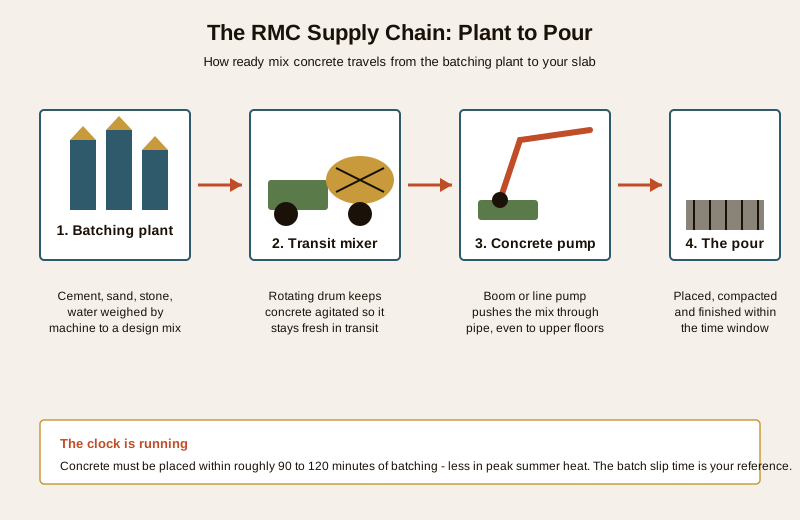
Ready mix concrete is batched at a dedicated plant. The materials are stored in silos and bins, weighed electronically to a designed recipe, and combined in a central mixer. The wet concrete is then loaded into a transit mixer - the familiar truck with a slowly rotating drum - which keeps it agitated so it does not stiffen or separate on the drive to your site. Because the plant weighs every ingredient by mass and controls the water precisely, each cubic metre is close to identical to the last. In India, RMC production is covered by the relevant Bureau of Indian Standards code for ready mixed concrete, and the concrete itself is designed and tested against the general concrete code (IS 456 governs plain and reinforced concrete practice).
Site-mixed concrete is made in the traditional way at your plot: materials are proportioned by volume, usually by counting head-pans or farmas against cement bags, and mixed in a drum or pan mixer or, on very small jobs, by hand on a platform. It can be perfectly good concrete - millions of sound Indian homes were built this way - but its quality depends entirely on the discipline of the gang doing the batching, and volume batching is inherently less precise than weigh batching.
That distinction connects to two more terms worth knowing before you compare them.
Nominal mix vs design mix
A nominal mix is a fixed recipe by volume - the classic "1:2:4" (one part cement, two parts sand, four parts coarse aggregate) or "1:1.5:3" that masons carry in their heads. It is simple and needs no laboratory, which is why it suits small site jobs. But it ignores the real properties of the specific sand and stone being used, and it usually errs toward extra cement to be safe, so it can be both less reliable and less economical than it looks.
A design mix is proportioned by a qualified person to achieve a target strength using the actual materials, tested in a lab, and adjusted for workability with admixtures. RMC is almost always supplied as a design mix to a stated grade. That is the core reason RMC gives more reliable strength: the recipe is engineered for the outcome, not copied from memory.
Grades run from lean concrete such as M10 and M15 (used for levelling courses and mass fill) up through M20 and M25 - the workhorses of residential slabs, beams and columns - to M30, M35 and M40 for more demanding structural work. The number is the characteristic compressive strength in MPa. Which grade your structure needs is an engineering decision; our guides on understanding concrete strength and choosing the right concrete grade explain what the grades mean, but the specification itself should come from your engineer.
RMC vs site mix - the honest comparison
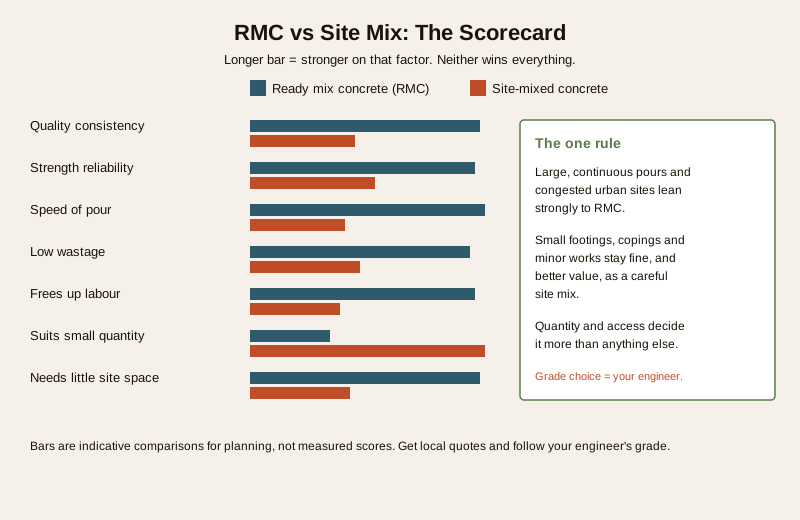
Neither method is universally better; they suit different jobs. The table below lays out where each one wins.
| Factor | Ready mix concrete (RMC) | Site-mixed concrete |
|---|---|---|
| Quality consistency | High - electronic weigh batching, uniform batch to batch | Variable - depends on the gang and volume batching discipline |
| Strength reliability | High - supplied as a tested design mix to a stated grade | Moderate - nominal mix, rarely lab-tested on small jobs |
| Speed of pour | Fast - a large slab can be poured in hours with pumping | Slow - limited by how fast labour can mix on site |
| Material wastage | Low - batched to order, little spillage or leftover | Higher - spillage, over-ordering, part-used bags |
| Labour needed | Minimal for mixing; crew focuses on placing and finishing | Large gang tied up mixing all day |
| Minimum viable quantity | Usually a few cubic metres per order (a part load costs more) | Any quantity, down to a single bag |
| Site space and storage | Little - no material stockpiles or mixer needed on site | Needs space for sand, stone and cement stacks plus a mixer |
| Indicative cost per cubic metre | Often a modest premium, sometimes competitive at volume | Cost of raw materials, but hidden wastage and labour add up |
| Dust, noise, neighbours | Contained - mixing happens off site | Dust and noise on site all day |
Read that table as a decision aid, not a verdict. The single biggest driver is usually quantity and access. A large monolithic slab that must be poured continuously strongly favours RMC, because a site mix simply cannot keep up and a cold joint mid-slab is a real structural concern. A small footing or a compound-wall coping is the opposite case: a part-load of RMC carries a minimum charge that makes it poor value, and a careful site mix is entirely appropriate.
Pumped concrete - the RMC partner
RMC is often paired with a concrete pump. Instead of head-pans carrying concrete up a ladder, a boom pump or a line pump pushes the mix through a pipe directly to the pour, even to upper floors. Pumping needs a more workable, well-designed mix - another reason it goes hand in hand with RMC rather than a stiff site batch. For a first-floor or higher slab in a congested urban plot with no room to stockpile materials, the combination of a transit mixer and a pump is often the only practical way to place a large pour quickly and cleanly. It is an additional cost, so weigh it against the labour and time it saves.
What to check on delivery day
This is where a homeowner or site-owner can genuinely protect the outcome, without needing to be an engineer. When the transit mixer arrives, five things matter.
The batch or delivery slip. Every load should come with a printed docket. Read it. It should state the grade ordered (say M25), the volume in cubic metres, the batching time, the water-cement ratio or the mix reference, and any admixture. This slip is your proof that what was ordered is what turned up.
Grade and quantity match. Cross-check the grade on the slip against what your engineer specified, and the volume against your order - our concrete volume calculator helps you sanity-check how many cubic metres a slab of known dimensions should need before the truck arrives.
Slump and workability. Slump is a simple field measure of how wet and workable the concrete is. Your site engineer or contractor does a slump test - concrete is packed into a cone, the cone is lifted, and the amount the concrete slumps is measured against the value the mix was designed for. Too high often means water was added on site, which quietly reduces strength; too low means it will be hard to place and compact. You should see this test being done, not skipped.
Cube samples for testing. For any structural pour, samples are cast into standard cubes, cured, and crushed in a lab at 7 and 28 days to confirm the concrete actually reached its grade. Making sure cubes are taken - and getting the test reports later - is the single best assurance that the strength you paid for is the strength you got.
The placing and curing time window. Concrete begins to stiffen from the moment cement meets water. There is a limited window - broadly around 90 to 120 minutes from batching in typical Indian conditions, less in peak summer heat - within which it must be placed and compacted. A truck that has sat in traffic past that window, or concrete retempered with extra water to loosen it, is a problem. Check the batching time on the slip against the clock. Curing then continues for days after the pour and is your contractor's responsibility to supervise; strength is built in those days, not on delivery day alone.
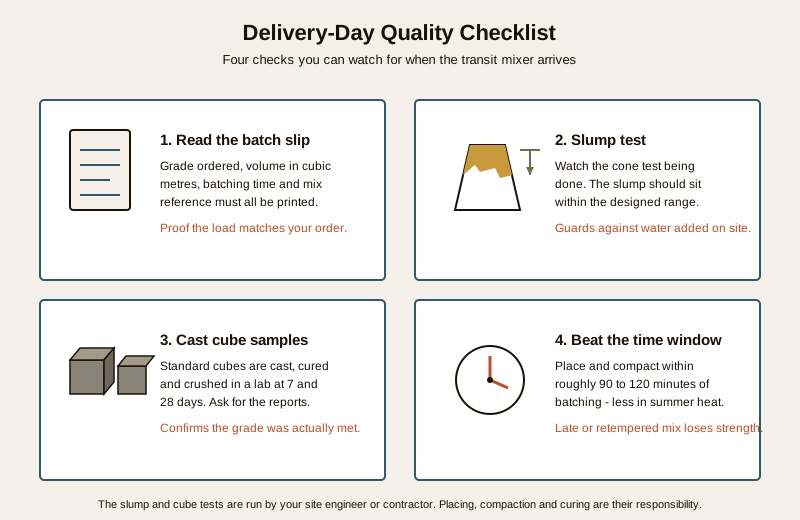
The table below turns those five checks into a quick reference you can keep on your phone.
| Checkpoint | What to look for | Why it matters |
|---|---|---|
| Delivery slip | Grade, volume, batching time, mix reference all printed | Proof the load matches your order |
| Grade match | Slip grade equals the engineer's specified grade | Wrong grade means wrong strength |
| Slump test | Test done on site, value within the design range | Guards against water added on the sly |
| Cube samples | Cubes cast for 7 and 28 day lab crushing | Confirms the concrete reached its grade |
| Time window | Placed and compacted within roughly 90 to 120 minutes | Late or retempered concrete loses strength |
An indicative price note
As a rough 2026 planning figure, RMC in most Indian cities is quoted per cubic metre and rises with grade - a lean M15 costs meaningfully less than an M30. Pumping is charged separately, and small "part-load" orders below the supplier's minimum carry a premium per cubic metre. Because rates swing with cement prices, aggregate availability, distance from the plant and city, treat any single number as a starting point only and gather two or three written quotes. Remember that a site mix is not free either: once you add material wastage, the labour tied up mixing, and the risk of a weaker or inconsistent batch, RMC's premium narrows and sometimes vanishes on larger pours. The ingredients behind either choice - your cement type, the sand and the coarse aggregate - are worth understanding whichever way you go, and no concrete does its job without the reinforcement steel it is cast around.
Key takeaways
- Ready mix concrete is batched by weight at a plant to a tested design mix and delivered in a transit mixer, giving far more consistent, reliable strength than volume-batched site mix.
- Nominal mix (like 1:2:4) suits small site jobs; design mix, which RMC almost always is, engineers the recipe for a target grade using the actual materials.
- RMC wins decisively on large continuous pours, congested urban sites, speed and low wastage; site mix is fine and often better value for small footings and minor works.
- Pumped concrete pairs naturally with RMC for upper floors and tight sites, at extra cost.
- On delivery, check five things: the batch slip, the grade match, the slump test, that cube samples are cast, and that the concrete is placed within its time window.
- Grade selection, mix approval, and supervision of placing, compaction, curing and cube testing belong to a qualified structural engineer or contractor - see the complete building materials guide for how this fits the wider material chain.
References
- Bureau of Indian Standards - the standard for ready mixed concrete (production and delivery) and IS 456 for plain and reinforced concrete practice, named generally; consult the current editions.
- National Building Code of India (SP 7:2026) - general guidance on materials and construction practice.
- Studio Matrx guide: understanding concrete strength in India.
- Studio Matrx guide: choosing the right concrete grade in India.
- Studio Matrx tool: concrete volume calculator.
- Indicative prices reflect 2026 market ranges and vary by city, grade, distance and supplier - always obtain local written quotes.
Export this guide
Related Guides — Deep-dive reading
Construction Aggregates in India: Sizes, Quality & Selection (2026)
What coarse aggregate actually does in concrete, how to pick the right nominal size (10mm, 20mm, 40mm), and the field and lab checks that separate strong stone from a bad load - a specify-and-select guide for Indian homes.
Building MaterialsConstruction Quality Control for Homeowners
How to make sure your house is actually built well, stage by stage, without an engineering degree — concrete, steel, cover and curing, the cardinal site sins to refuse, and the simple checks anyone can do.
Structural SafetyThe Complete Building Materials Buying Guide (India) (2026)
The capstone of the Building Materials hub - a stage-by-stage buying process (estimate, specify, shortlist, compare, verify, store) plus how to buy well in every material category, the mistakes that cost the most, and a smart-buyer checklist that routes to every deep guide and calculator.
Building MaterialsRelated Tools — Try Free
Cross-Ventilation Analyzer
Estimate airflow and air changes per hour (ACH) from room size, window areas, layout, and local wind — with NBC 2016 Part 8 compliance check.
Ventilation CalculatorConcrete Volume Calculator
Concrete volume for a footing, column or slab, plus indicative cement, sand and aggregate for a nominal mix grade.
Wall CalculatorMaterial Quality Evaluation Checklist
20-point checklist to evaluate interior materials before signing off at delivery.
Quality Checklist