
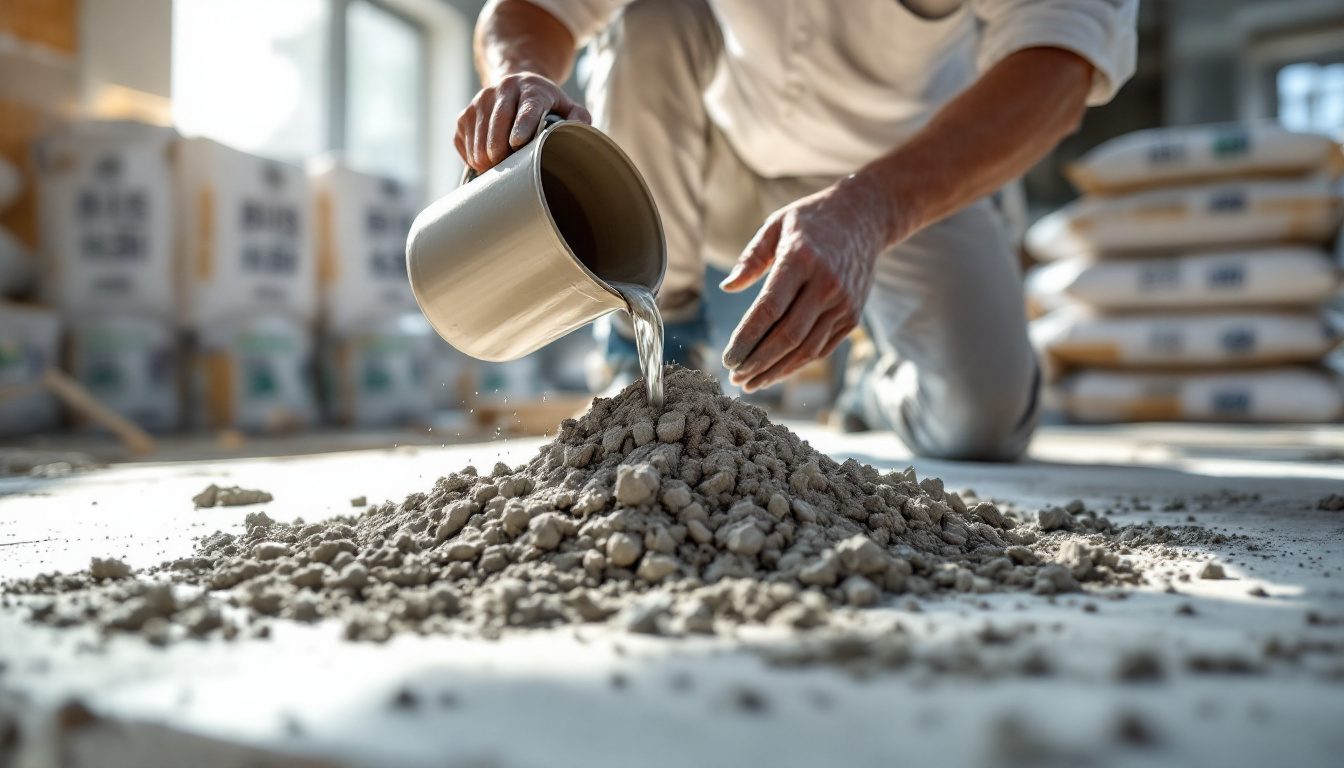
How Cement Actually Works
The grey powder that turns to stone — what cement is, how it is made, and the chemistry of hydration that explains curing, water-cement ratio and why the right cement matters.
The cement bag arrives on your site at seven in the morning — fifty kilograms of grey powder, fine as talcum, unremarkable as dust. By evening, mixed with sand, stone, and water, it has stiffened into a mass you cannot dent with your thumb. Leave it three weeks and you cannot cut it without a diamond blade. Nothing burned. Nothing froze. No glue was added. A silent chemical reaction turned mineral powder into artificial stone — and it is happening right now, in every slab, column, and plaster coat of every house being built in India today.
Most homeowners never pause to ask how. That silence is expensive. Because what you do not understand about cement — how long it takes to gain strength, why water must keep touching it for weeks, why the ratio of water to cement is the single most consequential decision on site — is exactly what a rushed contractor will get wrong while you are not watching.
Cement is a hydraulic binder: a powder that chemically reacts with water to form a rigid, water-resistant calcium silicate hydrate gel — the molecular glue that locks sand and stone into concrete.
Understanding that reaction, even at a basic level, gives you the language to insist on proper curing, reject a bag that has gone stale, ask the right question about water-cement ratio, and buy the grade of cement that actually suits your project. That is what this guide does.
1. What Cement Is Made Of
Walk past a cement plant and you will see two raw materials dominating the yard: limestone (calcium carbonate, CaCO3) and clay (a mix of silica, alumina, and iron oxide). In proportions roughly four parts limestone to one part clay, these unremarkable rocks become cement.
The raw materials are crushed, blended to an exact chemical recipe, and fed into a rotary kiln — a steel cylinder up to 80 metres long, slowly rotating, heated to approximately 1,450°C at its hottest zone. At that temperature, calcium carbonate breaks down, releasing CO2 (this is where most of cement's carbon footprint comes from), and the lime fuses with silica, alumina, and iron oxide to form hard, nodular lumps called clinker. Clinker is dark grey, glassy, and chemically very different from the powder you buy.
The clinker exits the kiln and is rapidly cooled, then ground in a ball mill with a small percentage (typically 3–5 %) of gypsum. Gypsum is the regulator — without it, cement would set within minutes of touching water, making it impossible to work with on site. The result of grinding clinker + gypsum is the familiar grey powder: Ordinary Portland Cement (OPC).
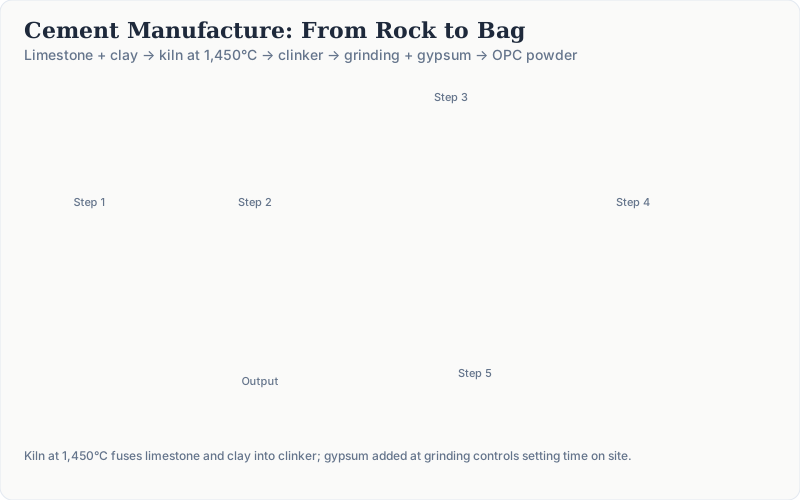
Fig. 1 — From limestone to cement bag: the clinker route. The kiln at 1,450°C is where chemistry happens; gypsum added at grinding controls setting time.
The four clinker compounds — in plain terms
Clinker is not a single mineral. It is a mixture of four main compounds, each playing a different role in the hardening story.
| Compound | Full name | Shorthand | Share in OPC (typical) | What it does |
|---|---|---|---|---|
| Tricalcium silicate | Alite | C3S | 45–65 % | Fast early strength (1–28 days); main contributor |
| Dicalcium silicate | Belite | C2S | 10–30 % | Slow but persistent long-term strength (28 days to years) |
| Tricalcium aluminate | Celite | C3A | 5–12 % | Very fast heat release, early setting; attacks sulphate soils |
| Tetracalcium aluminoferrite | Ferrite | C4AF | 5–12 % | Moderate strength; gives cement its grey colour; slow reaction |
Higher C3S content → faster strength, more early heat, useful in cold-weather casting or where quick formwork stripping matters. Higher C2S → slower strength but ultimately comparable, lower heat, better durability — this is why blended cements with lower clinker content can still deliver excellent long-term results.
This is also why OPC 53 (engineered for higher C3S, finer grind) gains strength faster than OPC 43, and why that faster gain does not always mean better for your house — more on that in Section 7.
2. The Chemistry of Hardening — Hydration
Pour water onto dry cement powder. Within seconds, the surface of each grain begins to dissolve. Within minutes, gel-like products start to precipitate. Within hours, a rigid lattice forms. Within weeks, the microstructure densifies to something closer to a fine-grained rock than a paste. This entire sequence is called hydration — and it is not drying. It is a cascade of exothermic chemical reactions.
The two most important reactions involve C3S and C2S:
C3S + water → C-S-H gel + calcium hydroxide + heat
C2S + water → C-S-H gel + calcium hydroxide + heat (slower, less heat)
The product doing all the structural work is C-S-H — calcium silicate hydrate. It forms as an interlocking mass of needle-like and plate-like crystals, nanometres in size, that fill the original water-filled spaces between cement grains. This gel is the glue. It is why concrete resists compression loads of 20, 25, 30 MPa or more. The calcium hydroxide (lime) produced is partly what makes concrete alkaline — important for passivating the steel reinforcement inside.
"The strength of concrete is essentially the strength of the hardened cement paste — and that paste is the C-S-H gel. Everything else is just a filler." — M.S. Shetty, Concrete Technology (adapted field paraphrase)
The heat released during hydration (the exothermic character) is measurable — you can warm your hand on a thick slab being poured on a cool morning. In large foundations or dams, this heat can cause thermal cracking if not managed.
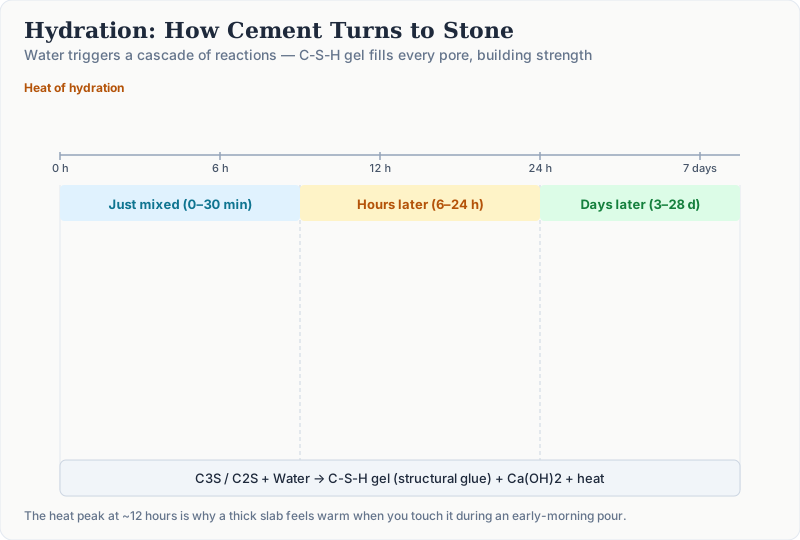
Fig. 2 — Hydration: cement grains dissolving, C-S-H gel precipitating, and pores filling over time. The heat peak at roughly 12 hours is why a thick slab feels warm.
Strength gain is not instant — it is a curve
Hydration does not stop at 28 days. It merely slows. Good-quality concrete in a moist environment continues gaining strength for months and years. The 28-day figure is a benchmark, not a ceiling.
| Day | Approx. strength as % of 28-day design strength (OPC 43/53) | Notes |
|---|---|---|
| 1 | 16–20 % | Initial set; no load-bearing yet |
| 3 | 40–50 % | Formwork for vertical elements may strip |
| 7 | 65–70 % | Minimum for slab soffit stripping in practice |
| 14 | 85–90 % | Most loading tests reference this |
| 28 | 100 % | Design-basis strength (IS 456 cube test age) |
| 90 | 110–120 % | Continued hydration yields bonus strength |
If curing stops early, the strength curve flattens well below its potential — concrete that could reach M25 at 28 days may stall at M15 equivalent if dried out at day 5.
3. Curing — The Step Most Contractors Skip
Here is the trap: once concrete looks solid (perhaps 24–48 hours after pouring), a contractor may assume the job is done and move on without covering or wetting the surface. The concrete looks fine. It feels hard. In fact, the hydration reaction is still mid-course and desperately needs water to continue.
Curing means keeping the concrete surface moist (or sealed) for a minimum of 7 days for OPC, and 14 days for blended cements (PPC, PSC), per IS 456. The goal is simple: the reaction consumes water, and if that water evaporates before the reaction finishes, hydration stops. Permanently. The C-S-H gel that would have formed in those unfilled pores never forms — leaving the concrete porous, weaker than designed, and more vulnerable to water, chloride, and sulphate attack.
On Indian sites in summer (35–45°C), surface water evaporates in hours. Hosing a slab once a day is not curing — it is theatre. Real curing means wet hessian or gunny bags kept saturated over all surfaces, or pond curing (sand borders, flooded slab surface), or curing compounds where water is scarce. Shade tarpaulins cut evaporation dramatically.
The construction quality control guide has site checklists for curing verification. The science behind durable buildings explains what under-curing leads to over decades — carbonation and chloride ingress exploit every pore that should have been C-S-H gel.
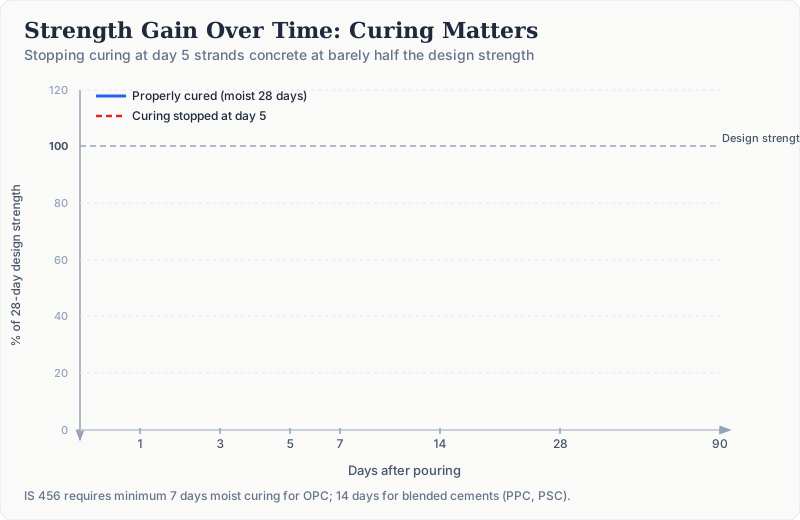
Fig. 3 — Curing stopped at day 5 leaves concrete stranded at barely half the design strength. The dashed red line represents what happens on many Indian sites in summer.
4. The Water-Cement Ratio — The Single Most Important Number
Every structural property of concrete — strength, durability, permeability, shrinkage — is dominated by one dimensionless number: the ratio of the weight of water to the weight of cement in the mix. Engineers call it w/c.
The chemistry is exact: complete hydration of cement requires a w/c of roughly 0.25–0.38 (that is, 25–38 kg of water per 100 kg of cement). Any water beyond that does not react with cement. It simply occupies space in the paste. When the excess water eventually evaporates or bleeds out, it leaves behind pores — capillary pores — and those pores are the highways for chloride, sulphate, and moisture to attack reinforcement and cause cracking and spalling.
"The water-cement ratio is the most important factor governing strength and durability of concrete. The lower the ratio, the higher the strength — provided adequate compaction is achieved." — A.M. Neville, Properties of Concrete, 5th edition
| Water-cement ratio (w/c) | Approx. 28-day compressive strength (MPa) | Permeability | Practical notes |
|---|---|---|---|
| 0.35 | 45–50 MPa | Very low | Requires plasticiser; high-performance concrete |
| 0.40 | 35–40 MPa | Low | M25–M30; good for structural concrete |
| 0.45 | 28–35 MPa | Moderate | M20–M25; minimum for reinforced concrete (IS 456) |
| 0.50 | 22–28 MPa | Moderate-high | IS 456 absolute limit for RCC in mild exposure |
| 0.55–0.60 | 15–20 MPa | High | Too much water; weak, porous, poor durability |
IS 456:2000, Table 5 sets maximum w/c limits by exposure condition — 0.55 for mild, 0.50 for moderate, 0.45 for severe, 0.40 for very severe, 0.35 for extreme (marine, chemical). These are not suggestions. They are the code's durability guarantees.
The problem on site: a mason adding extra water to make the mix "workable" for easier pouring is effectively destroying strength. Modern solution — use a superplasticiser (water-reducing admixture) to get workability without raising w/c. The guide on choosing the right concrete grade walks through this for specific structural elements.
Fig. 4 — Excess water does not strengthen cement — it punches holes in it. The left block is structurally what you are paying for; the right block is what too much water delivers.
5. Cement Types in India — Which Bag to Buy
Indian cement is governed by three main IS codes. The landscape is wider than most homeowners realise.
Ordinary Portland Cement (OPC) — IS 269:2015
OPC is the classic: nearly pure clinker, ground to different fineness levels, sold in three grades based on 28-day compressive strength of standard mortar cubes.
- OPC 33 — 28-day strength ≥ 33 MPa. Largely obsolete for construction; may appear in smaller or older markets. Not recommended for RCC.
- OPC 43 — 28-day strength ≥ 43 MPa (IS 8112:1989 / IS 269:2015). Workhorse of Indian construction. Suitable for general RCC, plastering, masonry.
- OPC 53 — 28-day strength ≥ 53 MPa. Higher C3S, finer grind, faster early-strength gain. Used for precast, prestressed elements, high-rise columns, anywhere rapid formwork cycling matters.
OPC 53 gains strength faster — but it also generates more heat of hydration, which in large pours can cause thermal cracking. It is not automatically "better" for a home; for most residential RCC work, OPC 43 or PPC is the practical choice.
Portland Pozzolana Cement (PPC) — IS 1489 (Part 1):1991
PPC replaces 15–35 % of clinker with a pozzolanic material — typically fly ash (the fine residue from thermal power plants). Fly ash does not react with water directly. Instead, it reacts with the calcium hydroxide produced during OPC hydration — a secondary reaction called the pozzolanic reaction — to produce additional C-S-H gel. The result:
- Slower early strength (roughly 70–75 % of OPC 43 at 7 days)
- Comparable or better long-term strength (meets 33 MPa equivalent at 28 days)
- Denser, less-permeable paste (the secondary C-S-H fills pores left by the primary hydration)
- Less heat of hydration — better for large pours
- Lower clinker content → lower CO2 footprint (~20–25 % less per tonne)
- Requires longer curing (14 days minimum)
For most Indian homes — slabs, beams, columns in mild to moderate exposure — PPC is the smart default. It is cheaper (₹360–400 per 50 kg bag, indicative 2026), widely available, and its density advantage more than compensates for the slower early strength in residential timelines.
Portland Slag Cement (PSC) — IS 455:1989
PSC blends clinker with ground granulated blast-furnace slag (GGBS) — a by-product of steel making. Slag content can reach 25–65 %. PSC has superior resistance to chloride and sulphate attack, making it the preferred choice for:
- Coastal Karnataka, Kerala, Tamil Nadu, Goa — marine chloride exposure
- Structures in contact with sulphate-bearing soils (common in parts of Rajasthan, Gujarat, Andhra Pradesh)
- Basement and underground structures
PSC has the lowest heat of hydration and excellent long-term strength, but its early strength is even slower than PPC. It needs moist curing for 14–28 days to realise its full potential.
Sulphate-Resistant Cement (SRC) — IS 12330:1988
A specialty OPC with very low C3A (less than 5 %), engineered to resist sulphate attack. Used in foundations on black-cotton or saline soils, sewage structures, marine foundations. Not a general-purpose cement.
White Cement — IS 8042:1989
Made from low-iron limestone; iron-free to avoid the grey colour. Used for architectural finishes, tile grouts, exposed concrete features. Significantly more expensive; no structural application.
| Type | IS Code | Clinker % | 28-day strength | Early strength | Best use | Eco rating |
|---|---|---|---|---|---|---|
| OPC 33 | IS 269:2015 | ~95 % | ≥ 33 MPa | Moderate | Obsolete for RCC | Poor |
| OPC 43 | IS 8112 / IS 269 | ~95 % | ≥ 43 MPa | Good | General RCC, plastering | Poor |
| OPC 53 | IS 12269 / IS 269 | ~95 % | ≥ 53 MPa | High | Precast, high-rise columns | Poor |
| PPC | IS 1489 Part 1 | 65–85 % | ≥ 33 MPa | Moderate-slow | Homes, slabs, plaster | Good |
| PSC | IS 455 | 35–75 % | ≥ 33 MPa | Slow | Coastal, sulphate soils | Excellent |
| SRC | IS 12330 | ~90 % | ≥ 33 MPa | Moderate | Sulphate-bearing ground | Moderate |
| White | IS 8042 | ~90 % | ≥ 33 MPa | Moderate | Finishes, grout | Poor |
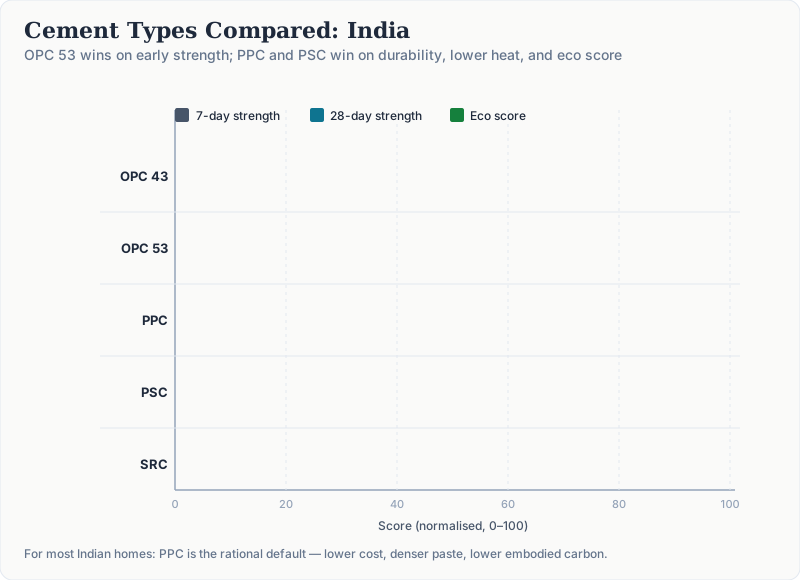
Fig. 5 — OPC 53 wins on early strength; PPC and PSC win on durability, lower heat, and environmental score. For most Indian homes, PPC is the rational default.
6. Freshness and Storage — Why Your Cement Bag Has an Expiry
Cement is hygroscopic — it absorbs moisture from humid air. Once those moisture molecules touch the cement surface, hydration begins. Not vigorously, not fast, but enough: a bag stored improperly for three months can lose 25–30 % of its strength before a single drop of mix water is added. A bag stored for six months on a damp godown floor may be nearly useless.
IS 269:2015 and trade guidelines recommend using cement within 90 days of manufacture date for OPC, and within 60 days for PPC (which is more reactive to ambient moisture due to the active fly ash surface). After that, strength loss accelerates.
Signs of cement gone bad: lumps that do not crumble when finger-pressed (partially hydrated pockets — reject the bag); smooth-cold feel replaced by grainy-warm texture; grey fading to off-white patches.
| Storage practice | Do | Don't |
|---|---|---|
| Floor | Raise bags on wooden pallets (150 mm above ground) | Place directly on concrete or mud |
| Stacking | Max 10 bags high; FIFO — oldest out first | Stack 15–20 high; bottom bags get crushed and damp |
| Cover | Tarpaulin on all sides including top | Leave exposed to rain or morning dew |
| Walls | Keep 300 mm gap from boundary walls | Bags tight against walls (wall moisture seeps through) |
| Duration | Use within 90 days (OPC) / 60 days (PPC) of manufacture | Buy months ahead of construction |
Check the manufacture date on every bag — printed on the bag or stamped on the top sewing. Refuse any bag where the date is illegible. On a large site, insist on FIFO delivery rotation.
7. Buying Cement Right — The Checklist
The Indian cement market has a genuine quality tier and a grey tier. At the genuine tier, major brands (ACC, Ultratech, Ambuja, Shree, Dalmia, JK, Ramco — cited as categories, not endorsements) sell IS-compliant product. At the grey tier, unbranded or locally-milled product may not meet IS specifications.
The single most important mark: BIS (ISI) Certification Mark. Look for the ISI mark with the relevant IS number on the bag. Under IS 269:2015, OPC bags must carry the BIS mark. PPC bags under IS 1489 Part 1, and PSC under IS 455, likewise. Buying a bag without the BIS mark is a risk no homeowner should accept for structural concrete.
| Buying checkpoint | What to verify | Red flag |
|---|---|---|
| BIS ISI mark | ISI mark + IS number on bag | No mark, or mark looks hand-stamped over original print |
| Net weight | 50 kg standard; weigh a bag on site scale | Bag feels light; stencil unclear |
| Manufacture date | Stamp on top or side of bag | Absent, overwritten, or over 90 days old |
| Grade match | Matches your structural drawing specification | Contractor downgrading without informing you |
| Bag condition | Intact, no tears, free-flowing | Stiff, lumpy, or wet patches |
| Price | ₹360–430 per 50 kg (OPC 43/PPC, indicative 2026) | 20 %+ below market — likely underweight or adulterated |
Adulteration in cement is real, particularly in tier-3 markets: fly ash added beyond IS limits, or off-grade limestone filler added to OPC to inflate volume. The simplest field test — a pinch between wetted fingers should feel gritty-slippery, not sandy-gritty. For structural elements, insist on a manufacturer's test certificate for each truck-load (major brands issue these routinely).
The understanding concrete strength guide explains how to request and read site cube tests, and the why reinforcement steel matters guide gives the equivalent steel-side checklist — together they form the procurement toolkit for a homeowner overseeing their own house.
For planning purposes, Studio Matrx DesignAI can help you model room layouts and design intent, but the structural procurement decisions here need an on-site structural engineer as your ally.
8. Cement and the Environment
Cement production accounts for approximately 7–8 % of global CO2 emissions. The culprit is the kiln: burning limestone releases CO2 locked in rock for millions of years, plus fuel combustion. One tonne of OPC clinker releases roughly 0.8–0.9 tonnes of CO2.
Blended cements (PPC and PSC) cut this by 20–35 %. By replacing clinker with fly ash or GGBS — industrial by-products that would otherwise fill landfills — they lower embodied carbon while improving long-term durability. Choosing PPC over OPC for your slabs, plaster, and masonry is a genuine climate action that also costs less.
The full picture across materials is in the modern construction materials pillar; embodied carbon over a building's life is in material lifespan comparison.
10. Connecting Cement to the Whole Structure
Cement does not stand alone. The modern construction materials pillar maps all eleven materials — from cement and concrete through TMT steel, AAC blocks, and waterproofing chemicals. The concrete strength guide translates the chemistry above into M-grades and site cube tests; choosing the right concrete grade tells you which M-grade goes in which element. The reinforcement steel guide covers the other half of the structural pair.
The science behind durable buildings explains what happens over decades when cement chemistry goes wrong — carbonation, chloride-induced corrosion, sulphate expansion — all preventable by the choices described here.
Buying a flat rather than building? The questions are the same. Ask the builder what grade of cement they use, whether they specify PPC or OPC 53, what their maximum w/c ratio is, and how long they cure slabs. A builder who can answer these fluently probably builds well. One who deflects is one to watch.
Author's Note
My father built our house when I was seven. I remember the cement bags arriving — dusty, heavy, stacked in the rain-shelter of our future living room. I remember the mason mixing it by hand. I did not know then that what I was watching was one of the most astonishing chemical reactions in daily life, happening slowly and silently in every surface of a house under construction.
That grey powder turning to stone is not magic. It is chemistry that anyone can understand — and once you understand it, you see exactly why a contractor who adds too much water, or skips curing, or uses stale cement, is not just cutting corners. They are breaking the chain of a reaction that only works once. Concrete cannot be un-poured and redone. The water-cement ratio of the slab above your head is permanently fixed in the past.
Know what cement is. Know what it needs. Be the homeowner who asks.
— Amogh N P
Disclaimer
This guide is for educational purposes. Cement grades, IS code requirements, and construction best practices are governed by BIS standards and evolving amendments — always verify against current IS publications. Price ranges cited are indicative for India in 2026 and will vary by region, supplier, and market conditions. Structural specifications must be prepared and reviewed by a qualified structural engineer; this guide is not a substitute for professional design or site supervision.
References
1. Bureau of Indian Standards. IS 269:2015 — Ordinary Portland Cement — Specification (4th revision). BIS, New Delhi.
2. Bureau of Indian Standards. IS 8112:1989 — Specification for 43 Grade Ordinary Portland Cement (2nd revision). BIS, New Delhi.
3. Bureau of Indian Standards. IS 12269:2013 — Specification for 53 Grade Ordinary Portland Cement. BIS, New Delhi.
4. Bureau of Indian Standards. IS 1489 (Part 1):1991 — Portland Pozzolana Cement — Fly Ash Based — Specification. BIS, New Delhi.
5. Bureau of Indian Standards. IS 455:1989 — Portland Slag Cement — Specification (4th revision). BIS, New Delhi.
6. Bureau of Indian Standards. IS 12330:1988 — Specification for Sulphate Resisting Portland Cement. BIS, New Delhi.
7. Bureau of Indian Standards. IS 8042:1989 — White Portland Cement — Specification (2nd revision). BIS, New Delhi.
8. Bureau of Indian Standards. IS 456:2000 — Plain and Reinforced Concrete — Code of Practice (4th revision), Clauses 6.1, 8.2 (water-cement ratio), 13.5 (curing). BIS, New Delhi.
9. Neville, A.M. (2011). Properties of Concrete, 5th edition. Pearson Education. (Chapters 1–3, hydration and strength development.)
10. Mehta, P.K. and Monteiro, P.J.M. (2014). Concrete: Microstructure, Properties and Materials, 4th edition. McGraw-Hill Education. (Chapter 2, structure of hydrated Portland cement; Chapter 3, concrete durability.)
11. Shetty, M.S. (2019). Concrete Technology: Theory and Practice. S. Chand Publishing, New Delhi. (Chapters 2, 3, 4 — cement types, hydration, mix design.)
12. Gambhir, M.L. (2013). Concrete Technology, 5th edition. McGraw-Hill India. (Chapter 1 — cement manufacture and chemistry; Chapter 5 — curing.)
13. Duggal, S.K. (2017). Building Materials, 4th edition. New Age International. (Chapter 3 — hydraulic cements and Indian market overview.)
14. Cement Manufacturers' Association of India (CMA). Annual Statistical Report 2024–25 — India cement production and consumption data. New Delhi: CMA.
15. IPCC (2022). Climate Change 2022: Mitigation of Climate Change — Chapter 11, Industry. Contribution of Working Group III to the Sixth Assessment Report. (Cement industry CO2 share ~7–8 % global emissions.)
16. Taylor, H.F.W. (1997). Cement Chemistry, 2nd edition. Thomas Telford, London. (Chapter 7 — hydration products; Chapter 9 — Portland cement constituents.)
Export this guide
Related Guides — Deep-dive reading
GGBS, Fly Ash and SCMs in Concrete India: The Low-Carbon Mix (2026)
A plain-language guide to GGBS, fly ash, silica fume and other supplementary cementitious materials (SCMs) - the industrial by-products that replace part of the cement in concrete, cut its carbon, and boost durability - and why the replacement percentage and mix design belong to a qualified engineer or the RMC plant.
Building MaterialsConstruction Quality Control for Homeowners
How to make sure your house is actually built well, stage by stage, without an engineering degree — concrete, steel, cover and curing, the cardinal site sins to refuse, and the simple checks anyone can do.
Structural SafetyFire-Resistant Building Materials in India: A Specify-and-Select Guide (2026)
The difference between how a material reacts to fire and how long a rated assembly resists it, then the materials that deliver passive fire protection - non-combustible structure, mineral wool, fire-rated boards, intumescent coatings, spray fireproofing and fire-stopping - with a material-to-role selection table.
Building MaterialsRelated Tools — Try Free
Material Decision Framework (M-Score)
Score 30+ Indian construction materials across cost, durability, climate fit, maintenance, and sustainability.
MaterialsInterior Red Flag Checklist — Before Signing
54 red flags across 8 categories with a live risk score and personalised PDF.
Red Flag ChecklistFalse Ceiling Cost Estimator
Live ₹/sqft across 8 ceiling types — POP, gypsum, designer, metal, PVC, wooden — with cove and spot lighting for 20 Indian cities.
Cost Calculator