
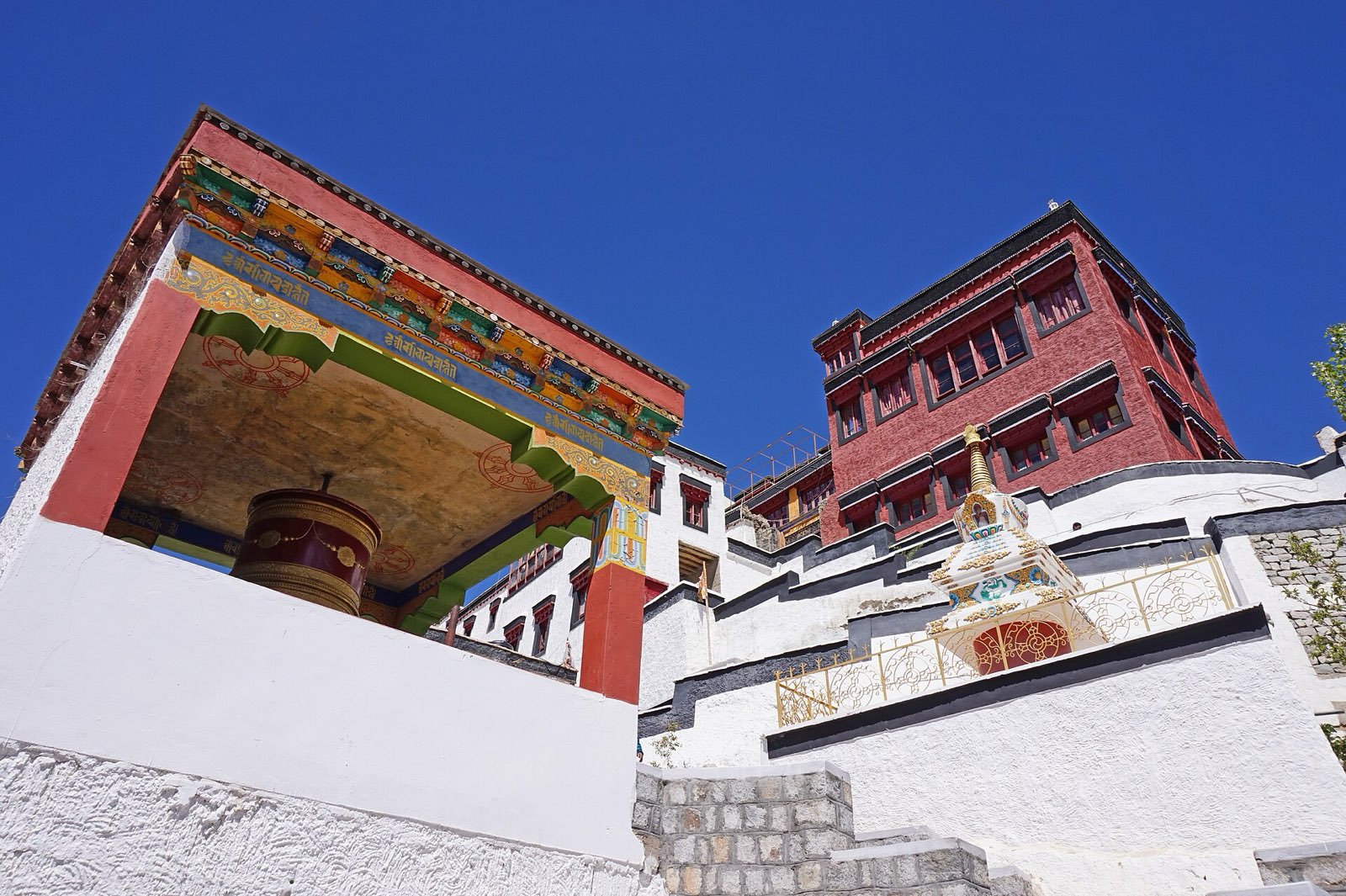
Thiksey Monastery, Ladakh: A Built Mountain of Earth on the Roof of the World
How the Buddhists of the high Himalayan desert raised a whitewashed monastery-town that climbs a hill in twelve tiers — the sacred set highest, all of it built from sun-dried earth, in the architecture of Tibet transplanted to India's far north
This series has followed Buddhist architecture from the stupa at Sanchi through the rock-cut halls of Ajanta, the tower at Bodh Gaya and the monastic university of Nalanda — but all of those belong to the Buddhism that flourished and then faded in the Indian plains more than a thousand years ago. In the far north of India, high in the cold desert mountains of Ladakh, Buddhism never faded; it lives on in a completely different form — Tibetan Buddhism — and it has produced a completely different architecture. Thiksey monastery, climbing a bare hill above the Indus valley, is its most spectacular Indian example: a whitewashed monastery-town rising in twelve tiers, so like the great Potala Palace of Lhasa that it is often called the "little Potala." It is the architecture of Tibet, built on Indian soil, and it is a world away from everything else in this collection.
A monastery that climbs a hill
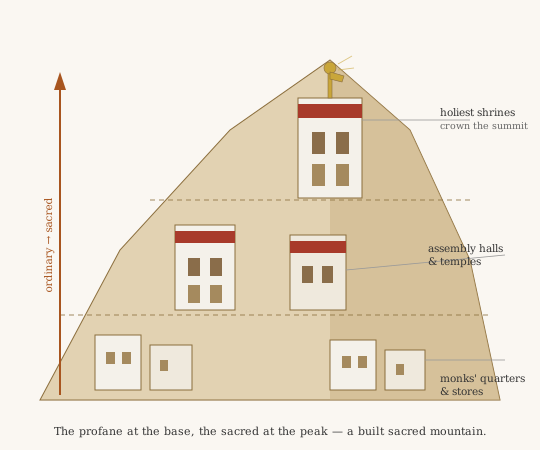
The first thing to understand about Thiksey is that it is not a building but a town — a self-contained monastic community — and that it is organised vertically, up the side of a hill.
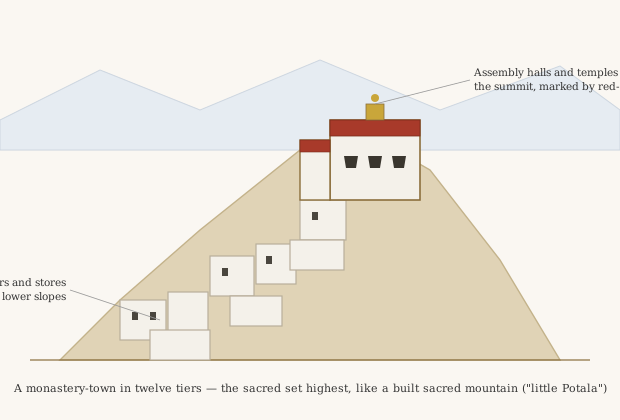
The monastery rises through some twelve storeys of building stacked up the slope, and the arrangement is a hierarchy in space. Lower down the hill are the more everyday buildings: the quarters of the monks, storerooms, kitchens, the ordinary fabric of a living community. Higher up come the sacred buildings — the dukhang or assembly halls where the monks gather to chant, the temples, and the shrine of the great Maitreya (the Buddha of the future). And crowning the very summit are the holiest structures, marked out by bands of deep red-ochre against the white walls and by gilded roof-ornaments flashing in the thin mountain sun. So the whole complex reads as a built sacred mountain: the profane at the base, the sacred at the peak, the eye and the pilgrim drawn upward from the world toward the shrines at the top. It is the same instinct we saw inverted in the South Indian temple-town — there the holy is buried at the dark centre; here it is raised to the bright summit — but the idea, of using architecture to stage a journey from the ordinary to the sacred, is the same.
Inside, Thiksey holds the treasures of a great Gelug-school monastery: a two-storey temple built around a colossal seated figure of the Maitreya Buddha some fifteen metres high, richly painted assembly halls hung with silk thangka paintings, libraries of scriptures, and courtyards where the masked cham dances are performed at festival time. It is a living monastery, home to a community of monks, its rituals continuing unbroken as they have for centuries.
Built of earth for the roof of the world
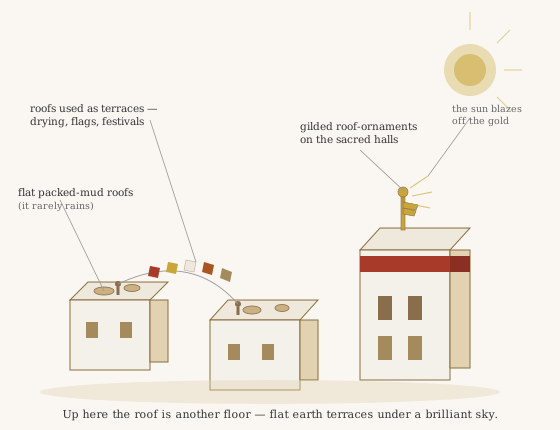
The second wonder of Thiksey is its material, and it is the key to its whole appearance. Ladakh is a high, cold, almost rainless desert, above 3,000 metres, where timber and fired brick are scarce but earth is everywhere — and so, like Tibet, Ladakh built in sun-dried mud brick.
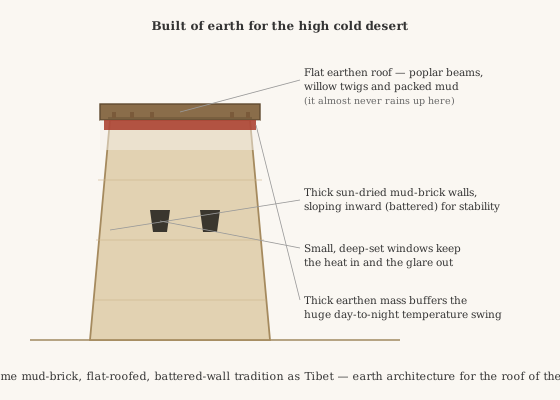
Every feature of the architecture answers the environment. The walls are thick masses of sun-dried mud brick or rammed earth, and they slope gently inward as they rise — a "batter" that makes the tall earthen walls stable and gives Tibetan and Ladakhi buildings their characteristic, subtly pyramidal, fortress-like solidity. They are whitewashed brilliant white, both to protect the earth and to blaze against the brown mountains, with the sacred buildings picked out in bands of red and ochre. The roofs are flat — earthen platforms of poplar beams, willow twigs and packed mud — because in a place where it almost never rains, there is no need for a pitched roof to shed water, and a flat roof gives usable terrace space and holds the sun's warmth. The windows are small and deep-set, often framed in black trapezoidal surrounds, to keep the precious heat in through the bitter nights and the fierce high-altitude glare out by day. And the sheer thickness of the earthen walls provides thermal mass, buffering the enormous swing between blazing day and freezing night that is the daily reality of the high desert.
This is the opposite architectural strategy to the snow-shedding steep roofs of Kashmir just to the west, and a cousin to the massive dry-stone mass of Kedarnath — three different Himalayan environments, three different building answers. Ladakh's answer is earth: flat-roofed, battered, whitewashed mud-brick, the same tradition that built the monasteries of Tibet, perfectly evolved for a land of cold, sun and dust.
Why Thiksey matters
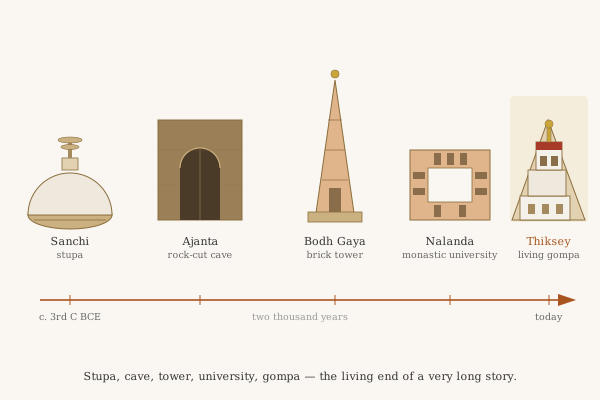
Thiksey earns its place in this series for two reasons. First, it completes the great arc of Buddhist architecture that this collection has traced across two thousand years — from the solid stupa, through the cave, the tower and the university of ancient India, to the living Buddhism of the Himalayan north and its utterly distinct architecture of the tiered earthen monastery. Buddhism largely left the Indian plains, but it never left the mountains, and Thiksey is the proof, still chanting on its hill.
Second, it is one of the purest examples in India of an architecture shaped almost entirely by a harsh environment and a humble material. There is no marble here, no carved sandstone, no soaring stone tower — only earth, whitewash, timber and paint, raised by a community's own hands into a monastery-town that climbs its mountain with real grandeur. It reminds us, one last time in this collection, that the wonders of architecture are not only the works of emperors in precious stone, but also the works of a people building wisely, and beautifully, from the ground beneath their feet.
Stand in the Indus valley at dawn and watch the sun strike the white tiers of Thiksey climbing toward the red-banded temples at its summit, the gilded roofs catching fire against the bare brown peaks, and you understand that the roof of the world has its own architecture — made of earth, built upward toward the sky, alive with the same faith that first raised a mound at Sanchi two thousand years ago.
Part of the Architectural Wonders series. Follow the Buddhist thread through the Great Stupa at Sanchi, the caves of Ajanta and the university of Nalanda; and for other Himalayan answers to a harsh climate, Kedarnath and the Martand temple of Kashmir.
Hero photograph: “Thiksey Monastery, Ladakh” by Bernard Gagnon, via Wikimedia Commons, licensed under CC BY-SA 4.0.
Export this guide
Related Guides — Deep-dive reading
Somapura Mahavihara: The Buddhist University Hidden Inside a Hill
Twelve hundred years ago in Bengal, a Pala emperor built one of the largest monasteries the Buddhist world had ever seen — a walled quadrangle a fifth of a mile across, ringed by 177 monks' cells, with a great cross-shaped, terraced temple rising from its courtyard. For four centuries scholars came from as far as Tibet to study here; then it was abandoned, and slowly buried, until villagers knew it only as Paharpur — 'the hill-town.'
Architectural WondersVernacular Architecture of Ladakh: Building Warmth in a Cold Desert
How thick earthen walls, a south-facing rabsal sun-room, a layered flat roof and the heat of stabled animals turn a -30°C Trans-Himalayan desert into a warm home.
Vernacular ArchitectureThe Mahabodhi Temple, Bodh Gaya: A Building Raised Over the Exact Spot of Enlightenment
How the holiest place in the Buddhist world produced one of India's strangest towers — a straight-sided brick pyramid built not to house a god but to mark a single point of ground beneath a tree
Architectural WondersRelated Tools — Try Free
Cross-Ventilation Analyzer
Estimate airflow and air changes per hour (ACH) from room size, window areas, layout, and local wind — with NBC 2016 Part 8 compliance check.
Ventilation CalculatorWindow Orientation Planner
Pick the best window type, glass and shading by wall direction — north, east, south and west.
Window ToolFull-Room BOQ — Living, Bedroom, Kitchen, Bath
Room-wise BOQ across living, bedrooms, kitchen, utility, and bathrooms with line-item pricing.
Full-Room BOQ