
Somapura Mahavihara: The Buddhist University Hidden Inside a Hill
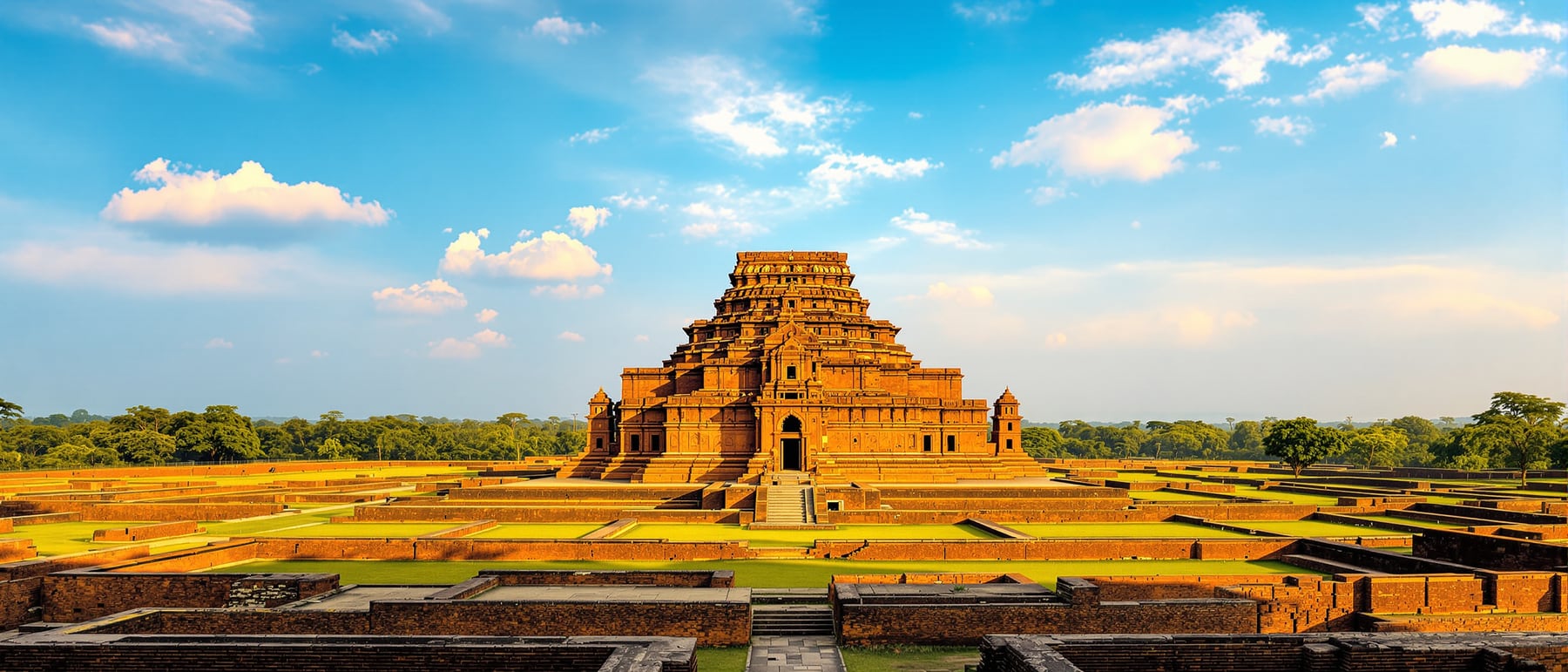
Twelve hundred years ago in Bengal, a Pala emperor built one of the largest monasteries the Buddhist world had ever seen — a walled quadrangle a fifth of a mile across, ringed by 177 monks' cells, with a great cross-shaped, terraced temple rising from its courtyard. For four centuries scholars came from as far as Tibet to study here; then it was abandoned, and slowly buried, until villagers knew it only as Paharpur — 'the hill-town.'
The builders of the Newark Earthworks left no writing at all — their genius survives only in the shape of the ground. Now we come to almost the opposite kind of sacred place: one of the great centres of writing, learning and scholarship in the medieval world — a Buddhist university. In what is now northern Bangladesh stand the ruins of the Somapura Mahavihara, the "Great Monastery of Somapura," at a village called Paharpur. Where Newark is a landscape of earth open to the sky, this was a walled world of brick, filled for four centuries with the murmur of hundreds of monks reading, debating and copying manuscripts.
This is the fifty-ninth article in our Architectural Wonders series, and the twelfth in our chapter on the great temples and sacred places of the world.
It is one of the great treasures of Bengal, and a monument that many people outside South Asia have never heard of — which is a pity, because in its day it was a beacon whose light reached across the Himalayas to Tibet and, some scholars believe, across the sea to the temple-builders of Southeast Asia. And its story ends with one of the quietest, strangest fates a great building can meet: it simply turned into a hill, and was forgotten.
1. A monastery the size of a fortress
Begin with the scale, because it is the first thing that astonishes you.
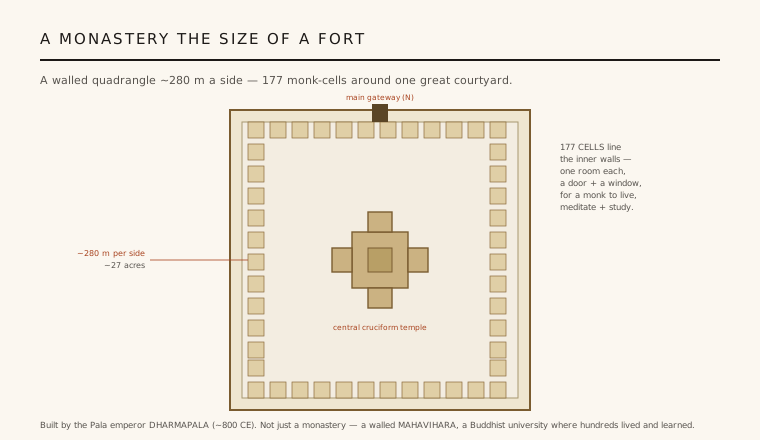
The Somapura Mahavihara was built around 800 CE by Dharmapala, the second and one of the greatest emperors of the Pala dynasty — the Buddhist rulers under whom Bengal became a centre of the Buddhist world. (We know he built it because excavators found clay seals stamped with his name.) And it is huge: a great quadrangle roughly 280 metres on each side, enclosing about 27 acres — one of the largest Buddhist monasteries ever raised in the Indian subcontinent. Its high outer walls are lined, on the inside, by 177 small monastic cells — a room apiece, each with a door and a window, where a monk could sleep, meditate and study. There was essentially one great gateway, on the north. From the outside it would have looked less like a temple than a fortress or a walled town. And that is the key to understanding it: this was a mahavihara — literally a "great monastery," but in practice a self-contained monastic university, a walled city of learning where hundreds of monks lived a common life devoted to the study of the Dharma.
2. The cross at the heart
Rise above the walls and look into the courtyard, and you see the thing that makes Somapura architecturally famous.
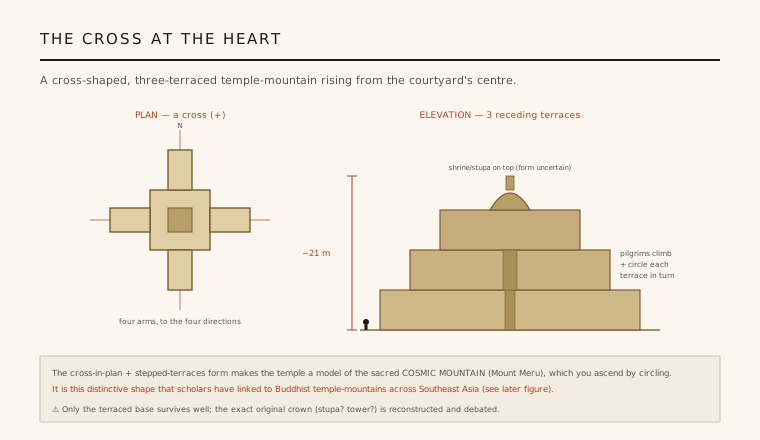
Rising from the centre of that vast courtyard is a single monumental temple, and its form is remarkable. Seen from above, its plan is a cross — four projecting arms reaching out to the four cardinal directions from a central mass. Seen from the side, it climbs in three receding square terraces, each smaller than the one below, like a stepped pyramid, to a height of about 21 metres, once crowned by a shrine or stupa at the summit. A pilgrim could climb it and walk around each terrace in turn, circling the sacred centre as they ascended. This cross-in-plan, mountain-in-profile shape is not decoration; it is cosmology made solid — a model of the sacred cosmic mountain (Mount Meru, the axis of the Buddhist universe), the same idea we will meet again, on a colossal scale, at Angkor Wat. (One honest caution: the lower terraces survive, but the exact original crown — was it a soaring stupa? a tower? — is uncertain, and reconstructions of the full height are informed guesses.)
3. A wall of terracotta
Come close to the brick, and the monument tells you something unexpected — not about gods, but about people.
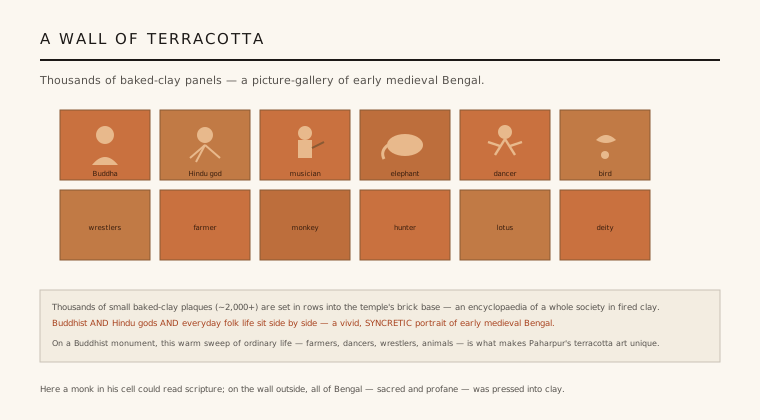
The temple's brick base is studded with thousands of terracotta plaques — small baked-clay panels, set in long rows, that together form a kind of picture gallery running around the monument. What makes them extraordinary is their range. You would expect, on a Buddhist temple, images of the Buddha — and they are here. But beside them sit Hindu gods (Krishna, Shiva and others), and, most delightfully of all, ordinary life and nature: farmers and hunters, musicians and dancers, wrestlers mid-grapple, elephants and monkeys and birds and flowering vines. It is not the solemn, filtered imagery of a purely religious monument; it is the whole warm, crowded world of early medieval Bengal, sacred and everyday together, pressed into clay — the same appetite for depicting all of life that fills the painted walls of the Buddhist Ajanta Caves far to the west. That the plaques mix Buddhist, Hindu and folk subjects so freely is itself a lesson: this was a syncretic culture, where the boundaries between faiths were far softer than we often imagine. A monk could sit in his cell reciting scripture while, on the wall outside, all of Bengal — its gods, its work and its play — was modelled in fired earth.
4. A beacon of learning, and a shape that travelled
Somapura's true importance was never only its architecture. It was a powerhouse of ideas — and both its teachings and its temple-form travelled far.
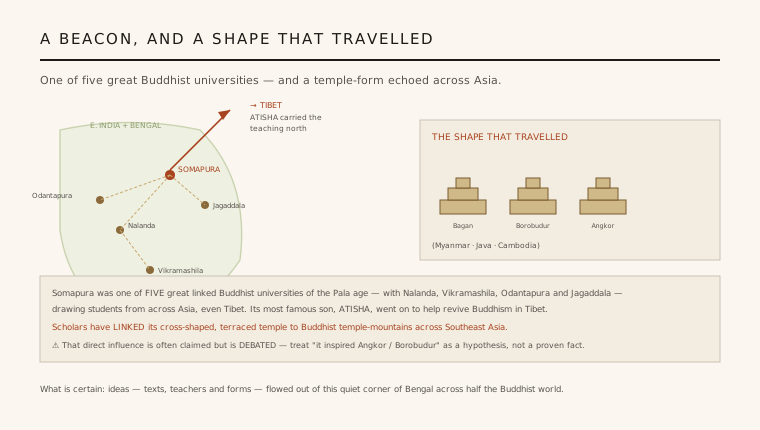
Under the Palas, eastern India held a constellation of great Buddhist universities — Somapura, Nalanda, Vikramashila, Odantapura and Jagaddala — that functioned almost as a linked network of higher learning, drawing students and teachers from across Asia. From this world came one of the most important figures in Buddhist history: Atisha (Atiśa Dīpaṃkara), a Bengali master associated with Somapura, who in the eleventh century travelled to Tibet and helped revive Buddhism there — so that a thread runs directly from these quiet brick cells to the living Buddhism of the Himalayas today, whose monuments include the great stupa of Boudhanath in Kathmandu. And the monument's very shape may have travelled too: scholars have drawn links between Somapura's distinctive cross-shaped, terraced temple and later Buddhist temple-mountains across Southeast Asia — in Myanmar (Bagan), Java (Borobudur) and Cambodia. Here, though, we must be careful and honest: that influence is often claimed but genuinely debated, and you should treat "Somapura inspired Angkor Wat and Borobudur" as an intriguing hypothesis, not a settled fact. What is certain is that ideas — texts, teachers and forms — flowed out of this corner of Bengal across half the Buddhist world.
5. The hill that hid a university
The last chapter of Somapura's story is a slow fading, and then a long sleep.
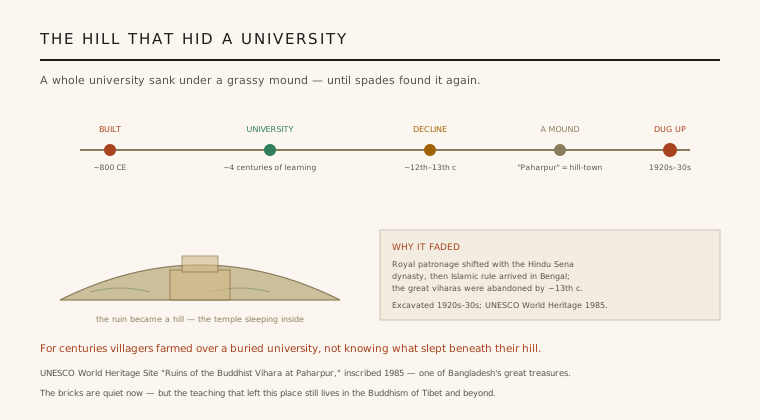
Somapura flourished for roughly four centuries. Then, from around the twelfth and thirteenth centuries, it declined: royal patronage shifted as the Hindu Sena dynasty replaced the Buddhist Palas, and then Islamic rule arrived in Bengal, and the age of the great Buddhist viharas came to an end. The monks left; the monastery emptied; the brick began to fall. And then something quietly remarkable happened. Over the centuries, the collapsing building, mantled in earth and vegetation, slowly grew into a large mound — so that the people who farmed around it came to know the place not as a lost university but simply as Paharpur, "the hill-town." A whole civilisation's centre of learning had become, to all appearances, a grassy hill. It was only in the 1920s and 1930s that archaeologists dug into that hill and found the great monastery sleeping inside it. In 1985, the ruins were inscribed as a UNESCO World Heritage Site — the "Ruins of the Buddhist Vihara at Paharpur." The bricks are quiet now. But the teaching that once poured out of this place still lives, half a world wide, in the Buddhism of Tibet and beyond.
6. What a modern architect can learn from Somapura Mahavihara
- Design the community, not just the monument. Somapura's genius is not one building but a whole way of living made architecture: 177 private cells and one shared sacred centre, a self-contained world for study. The deepest architecture shapes how people live together, not merely what they look at.
- A plan can be a philosophy. The quadrangle — private cells around a common temple — physically embodies the monastic ideal of solitude and community. A good plan makes a set of values inhabitable.
- Let the humble and the sacred share a wall. The terracotta plaques put farmers and dancers beside the Buddha, Hindu gods beside Buddhist ones. There is a generosity in that — an architecture confident enough to hold the whole of ordinary life alongside the holy.
- The most powerful export is an idea. What made Somapura matter across a continent was not its bricks but the teachers and texts that left it. Buildings can be engines of ideas — and those ideas can travel further, and last longer, than the walls.
- Even greatness can be forgotten — so record and protect it. A university became an anonymous hill for seven centuries. What is not remembered and cared for can vanish completely — a reminder of why the patient work of scholars and conservators matters.
- Honour the softness of real history. Buddhist, Hindu and folk; Pala, Sena and Sultanate — the true story here is one of blended, overlapping cultures, not neat separate boxes. Good design, like good history, resists the urge to oversimplify who a place belonged to.
References & further reading
1. UNESCO World Heritage Centre — Ruins of the Buddhist Vihara at Paharpur (inscribed 1985). https://whc.unesco.org/en/list/322/
2. Encyclopaedia Britannica — Somapura Mahavihara. https://www.britannica.com/topic/Somapura-Mahavira
3. Banglapedia (National Encyclopedia of Bangladesh) — Paharpur / Somapura Mahavihara. https://en.banglapedia.org/index.php/Paharpur
4. World History Encyclopedia — The Pala Empire and Bengal Buddhism. https://www.worldhistory.org/Pala_Empire/
5. UNESCO / World Heritage Journeys of Buddha — Somapura Mahavihara. https://visitworldheritage.com/en/buddha/somapura-mahavihara/93e425f7-17ee-4577-a40e-3ea5c12cf1f1
6. Archaeological Survey of India — K. N. Dikshit, Excavations at Paharpur, Bengal (Memoirs of the ASI, 1938). https://asi.nic.in/
*Last verified 2026-07-04. Figures follow UNESCO, Britannica, Banglapedia, and the excavation record (K. N. Dikshit, ASI), and are given as widely cited approximations that vary by source. Somapura Mahavihara ("Great Monastery of Somapura") is at Paharpur, Badalgachhi, Naogaon District, Rajshahi Division, northern Bangladesh (historic Varendra/Bengal). It was built by the Pala emperor Dharmapala (r. c. 781–821 CE), c. 800 CE, confirmed by inscribed clay seals; a Mahayana/Vajrayana Buddhist monastery, one of the largest in the subcontinent. It is a quadrangle ~280 m per side (~27 acres) with 177 monastic cells lining the inner walls and a single main (north) gateway. The central temple is cruciform in plan (four projecting arms) and rises in three receding terraces to ~21–22 m, once crowned by a shrine/stupa (the exact original superstructure is uncertain/reconstructed). Its base carries thousands of terracotta plaques (~2,000+) depicting Buddhist, Hindu (Brahmanical) and everyday/folk subjects — a syncretic art of early medieval Bengal — plus stone sculptures. As a "mahavihara" it was a monastic university, one of a linked group of Pala-era Buddhist universities (with Nalanda, Vikramashila, Odantapura, Jagaddala); the scholar Atisha (Atiśa Dīpaṃkara) is associated with it and later helped revive Buddhism in Tibet. The cross-shaped terraced temple form has been LINKED by scholars to Buddhist monuments in Southeast Asia (Bagan, Borobudur, Cambodia), but this direct influence is DEBATED and should not be stated as established fact. It declined c. 12th–13th c. (shift of patronage under the Sena dynasty; the coming of Islamic rule) and was abandoned, gradually burying into a mound (hence "Paharpur," hill-town). Excavated by the ASI (notably K. N. Dikshit) in the 1920s–30s. UNESCO World Heritage Site "Ruins of the Buddhist Vihara at Paharpur," inscribed 1985.
Export this guide
Related Guides — Deep-dive reading
Nalanda: The Brick City of Learning That the World Forgot
How Buddhist India built one of the earliest great residential universities — rows of monastery-colleges and towering brick stupas where thousands of monks from across Asia lived, studied and debated for seven hundred years
Architectural WondersBorobudur: The Mountain You Climb to Reach Enlightenment
In the volcano-ringed heart of Java, around 1,200 years ago, Buddhist kings built the largest Buddhist monument on Earth — not a temple you enter but a solid stone mountain you climb: a three-dimensional map of the universe, wrapped in 2,672 carved panels and 504 Buddhas, that turns the path to enlightenment into a walk you take with your feet. Then it was abandoned, buried under ash and jungle, and rebuilt, stone by million-stone, in our own age.
Architectural WondersThe Mud Mosques of Timbuktu: The University Made of Earth
On the edge of the Sahara, a city that Europe turned into a byword for the middle of nowhere was in truth one of the great centres of learning in the medieval world — with a university of 25,000 students and libraries of hundreds of thousands of manuscripts. Its three great mosques are built entirely of mud, bristling with wooden beams, and must be re-plastered by the whole community every single year — which is exactly why, after seven centuries, they still stand.
Architectural WondersRelated Tools — Try Free
Window Orientation Planner
Pick the best window type, glass and shading by wall direction — north, east, south and west.
Window ToolCross-Ventilation Analyzer
Estimate airflow and air changes per hour (ACH) from room size, window areas, layout, and local wind — with NBC 2016 Part 8 compliance check.
Ventilation CalculatorBuilding Bylaw Checker
Check FAR, setbacks, and height limits for 12 Indian cities (BBMP, CMDA, BMC, DDA, and more).
ArchitectAI