
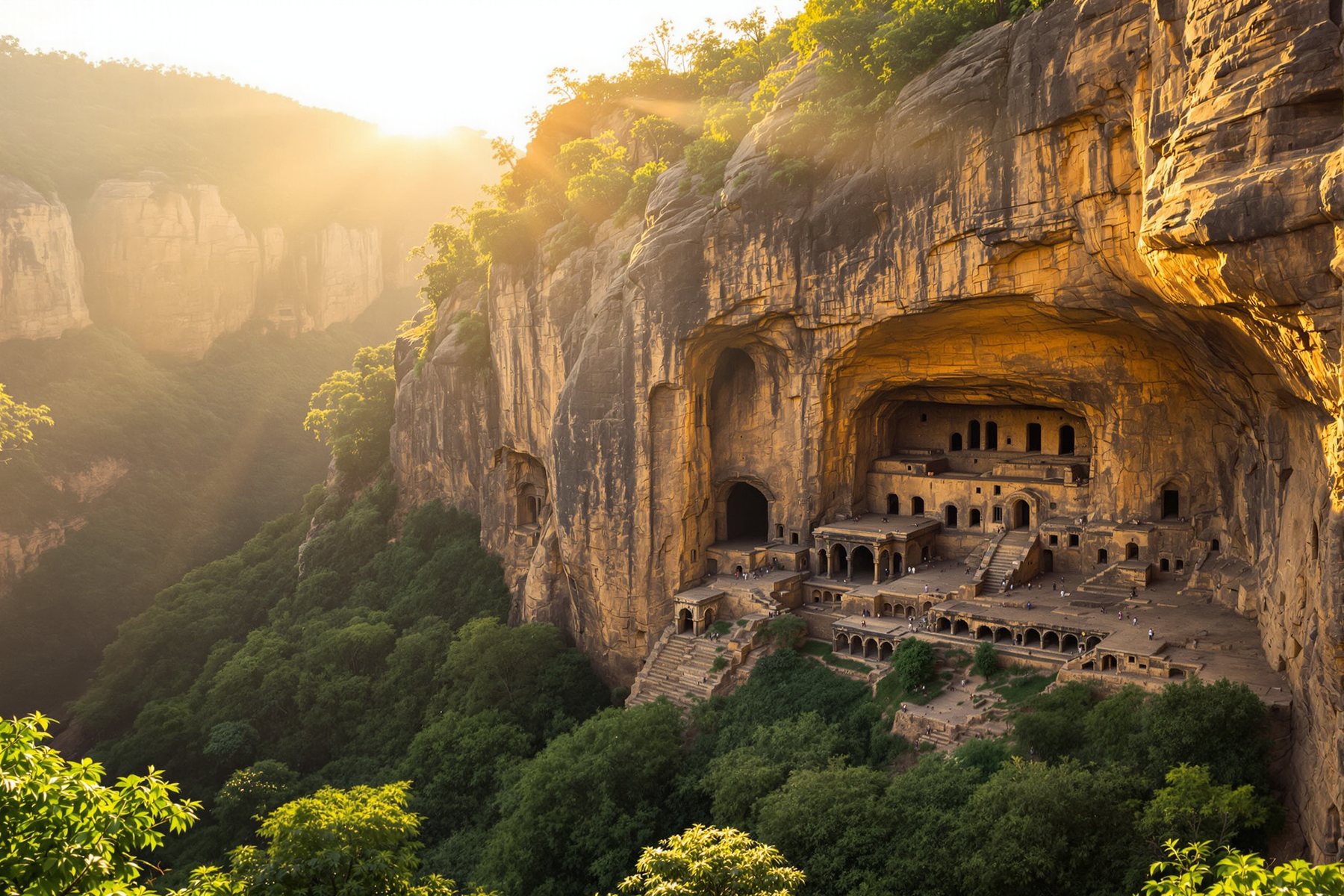
Ajanta: The Architecture Carved from Within
How ancient Buddhist monks hollowed thirty halls, monasteries and shrines out of a solid basalt cliff — from the top down, with no scaffolding — and painted, by lamplight, some of the greatest pictures of the ancient world. The rock-cut method, the murals, and the lesson.
Every wonder in this series so far has been something _added to_ the world — stone stacked at Konark and Thanjavur, a city raised from boulders at Hampi, a facade released from a cliff at Petra. Ajanta is the purest example of the opposite art. Here, thirty Buddhist halls, monasteries and shrines were not built at all. They were carved out of a mountain — hollowed from the living basalt of a cliff, from the top downward, until entire painted rooms stood where there had been only solid rock.
And then, on the walls of that excavated darkness, ancient artists painted by lamplight some of the most beautiful pictures the world has ever produced.
This is the fifth article in our Architectural Wonders series, and it completes a circle the series opened with Petra. Petra carved the outside of the rock — magnificent facades, with plain chambers behind. Ajanta carved the inside — where the carved-out room itself, and the surface that wraps you, _is_ the whole work of art.
1. A crescent of caves in a cliff
The Ajanta Caves are cut into the inner face of a horseshoe-shaped cliff of basalt — the hard, dark volcanic rock of the Deccan — curving high above a bend of the Waghora river, in what is now the Chhatrapati Sambhajinagar (Aurangabad) district of Maharashtra. There are about thirty caves in all, strung in a long row along the gorge wall and reached by a path that follows the curve of the cliff.
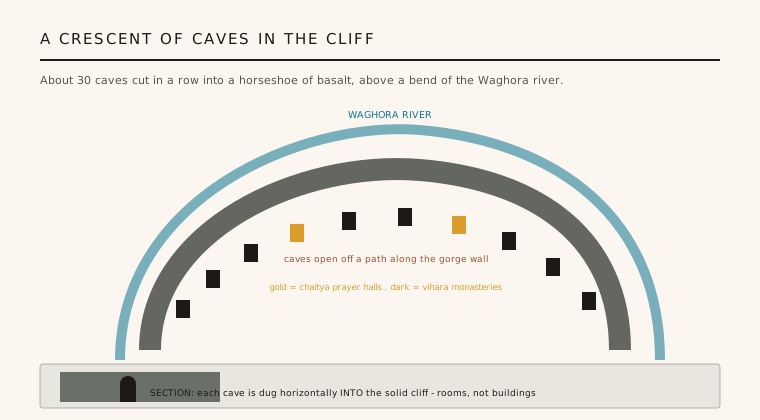
They are Buddhist monastic works — places where monks lived, studied, taught and worshipped — and they were made across two very different ages, separated by centuries, which we will come to. But the thing that unites all of them, early and late, is the radical method by which they were made.
2. Architecture by subtraction, from the inside
Almost all building is additive: you bring material to a site and assemble it upward, part on part, from the ground. A rock-cut cave is the reverse. It is subtractive: nothing is brought, nothing is assembled, and nothing stands up. The makers began with solid rock and removed everything that was not the building, leaving the floor, the columns, the ceiling, the benches and the shrine all carved from one continuous piece of the cliff.
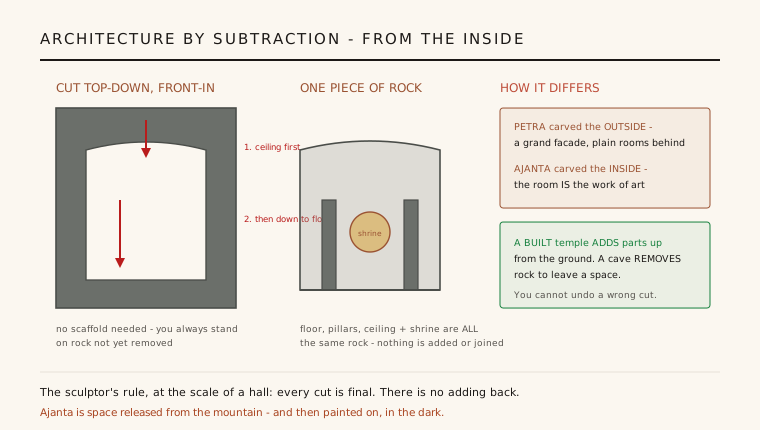
The sequence is the key to it, and it is beautifully logical. The carvers started at the top — cutting the ceiling first — and worked downward and inward, so that they were always standing on rock that had not yet been removed. No foundations were dug, because nothing rests on the ground. No scaffolding was raised, because the un-cut stone _was_ the scaffold. And because the whole thing is one solid mass, there are no joints to fail — which is why these rooms have survived, essentially intact, for fifteen centuries and more.
It also imposes the sculptor's discipline at the scale of a building: every cut is final. A mason who lays a bad stone can lift it out. A carver who removes the wrong rock has no way to put it back. An entire hall had to be visualised, perfectly, in solid stone, and then released from it — once, correctly, with no second draft.
3. The two kinds of cave: chaitya and vihara
Ajanta's caves come in two clear architectural types, and learning to tell them apart unlocks the whole site.
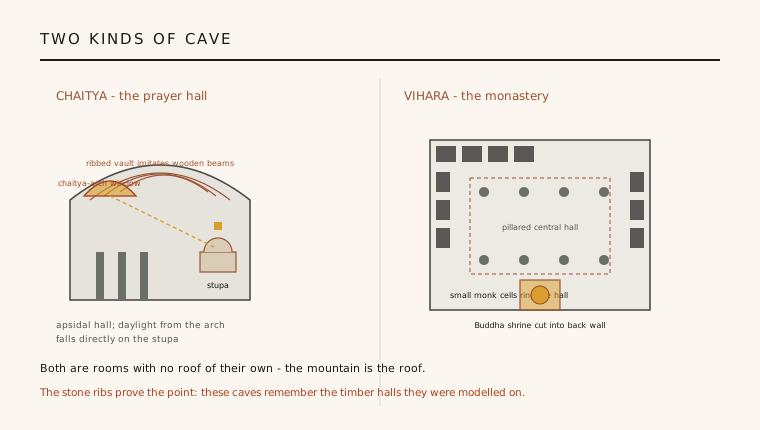
The chaitya is the prayer hall. It is apsidal — a long hall with a rounded end, like the inside of a bullet — lined with a colonnade that leads the eye to a carved stupa (a dome-shaped relic monument) standing at the curved far end. Over the whole hall arches a ribbed barrel vault, and over the entrance opens a great horseshoe-shaped window — the famous chaitya-arch — positioned so that daylight pours through it and falls directly on the stupa at the back. It is one of the oldest and loveliest pieces of deliberate daylighting in architecture: the building is shaped to deliver light to the one thing it wants you to see.
The vihara is the monastery. It is a roughly square hall with a pillared centre, ringed on three sides by a row of small cells — the monks' rooms, each just big enough for a bed cut from the rock — and, in the later caves, with a Buddha shrine carved into the back wall facing the entrance. The viharas are where the monks lived; the chaityas are where the community gathered to worship.
Look up in a chaitya and you will see the deepest clue to how this architecture was born. The stone is carved with ribs, exactly as if timber beams were holding up the roof — but they hold up nothing; the mountain is the roof. These are skeuomorphs: stone memories of the wooden halls these caves were modelled on. The rock-cut tradition began by faithfully copying carpentry it no longer needed, the way the earliest cast-iron columns imitated stone. Architecture often carries its own ancestry like this, in details that have lost their original job but kept their meaning.
4. Painting in the dark
If Ajanta were only rock-cut halls it would already be a wonder. What lifts it into the very first rank of human achievement is what covers its walls: murals — among the greatest paintings to survive from the ancient world, and the finest record we have of how ancient India looked, dressed, loved and worshipped.
Basalt will not hold paint, so the artists first built a smooth skin over the rough rock. The wall was chiselled to give grip, then coated with a thick layer of mud plaster mixed with sand, rice husk and plant fibre, then finished with a thin coat of lime polished smooth. On that ground the outlines were drawn in red ochre, and then the colours were laid on in a tempera technique — mineral pigments bound with glue, applied to the dry surface.
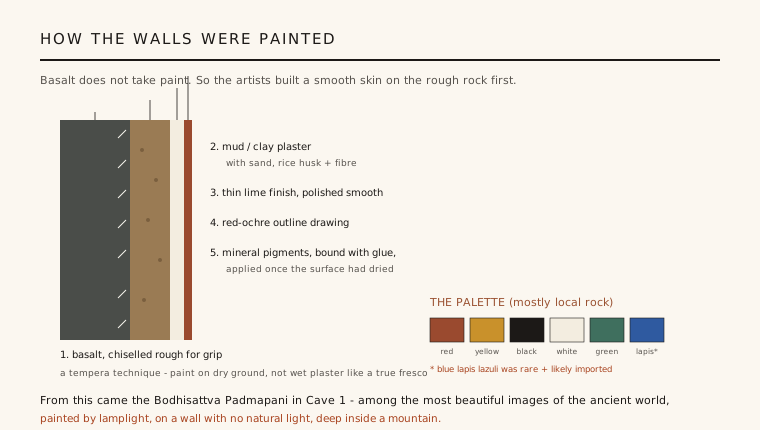
The palette came mostly from the local volcanic earth — red and yellow ochre, lamp-black, white, green earth — with precious blue lapis lazuli, rare and probably imported, saved for the most special passages. The subjects are the life of the Buddha and the Jataka tales (stories of his previous lives), woven through with an entire living society of princes and dancers, animals and lovers, courts and forests.
The most famous of all is the Bodhisattva Padmapani — "the one who holds the lotus" — in Cave 1: a figure of such tenderness and inward calm that it has become the single image the world pictures when it thinks of Ajanta. (The same graceful painting tradition travelled south: the celestial "cloud maidens" high on the rock of Sigiriya, in Sri Lanka, are Ajanta's kin.) And here is the detail to hold onto: these masterpieces were painted on walls with no natural light, deep inside a mountain, by the flicker of oil lamps. The serenity in Padmapani's face was achieved by an artist who could never step back and see the whole picture in daylight.
5. Two ages, a long silence, and a tiger hunt
Ajanta was not made in one campaign. It was built in two distinct bursts, separated by some four centuries of silence.
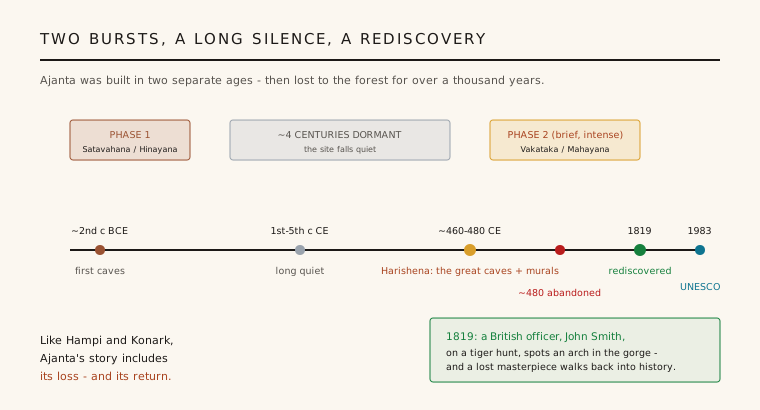
The first phase, in the Satavahana era (around the 2nd century BCE to the 1st century CE), produced the earliest chaityas and viharas — sober, early Buddhist work. Then the site fell quiet for roughly four hundred years. The second phase came in a sudden, dazzling rush in the late 5th century CE, around 460–480 CE, under the patronage of the Vakataka king Harishena and his court. Nearly all the great painted caves belong to this brief, brilliant window — a few decades in which the finest artists of the age worked at full stretch. And then, almost as abruptly, with Harishena's dynasty fading, the work stopped. Around 480 CE Ajanta was abandoned, half-finished chisel marks still on some walls.
The forest closed over it, and for some thirteen centuries the caves were simply lost. Then, in 1819, a British officer named John Smith, out on a tiger hunt above the gorge, glimpsed the arch of a cave mouth through the trees — and one of the supreme achievements of human art walked back into the world. The Ajanta Caves were inscribed as a UNESCO World Heritage Site in 1983.
Like Konark and Hampi, Ajanta carries loss inside its story. But its loss is also its preservation: it was precisely because the caves were forgotten, sealed by jungle and untouched by centuries of use, repainting and "improvement," that their fifteen-hundred-year-old pictures survived for us to find at all.
6. What a modern architect can learn from Ajanta
- Space is the material. Ajanta is the clearest lesson in architecture there is: the building is not the stone, it is the void carved into it. Architecture is fundamentally the shaping of space and light, not the piling of matter — and at Ajanta the matter is simply what was left behind.
- Measure twice; you cannot un-cut. A subtractive process is unforgiving in a way an additive one is not. It rewards complete visualisation _before_ the first move — the discipline of knowing exactly what you intend before anything irreversible happens. (It is the mindset our planning and structural guides keep returning to.)
- Design the light, not just the room. The chaitya window that lands daylight on the stupa is a thousand-year argument that light is a building material to be aimed, not an accident to be managed afterwards.
- A building can be a total environment. At Ajanta architecture, sculpture and painting are not three trades laid side by side — they are one continuous act, from the cut of the hall to the last brushstroke on its wall. The most powerful spaces are designed whole.
- Sometimes survival is a gift of neglect. Ajanta endured because it was left alone. Not every act of care helps a building live; sometimes the kindest thing is to touch it lightly, and let it be what it is.
References & further reading
1. UNESCO World Heritage Centre — Ajanta Caves (inscribed 1983). https://whc.unesco.org/en/list/242/
2. Encyclopaedia Britannica — Ajanta Caves. https://www.britannica.com/topic/Ajanta-Caves
3. Archaeological Survey of India — Ajanta Caves, Aurangabad. https://asi.nic.in/
4. Asian Art Museum (Education) — Buddhist Caves at Ajanta. https://education.asianart.org/resources/buddhist-caves-at-ajanta/
Last verified 2026-06-30. Dates, cave counts and the two-phase chronology follow standard archaeological and ASI reference sources and are given as widely accepted approximations; the account of the 1819 rediscovery follows the well-established historical record.
Export this guide
Related Guides — Deep-dive reading
Nalanda: The Brick City of Learning That the World Forgot
How Buddhist India built one of the earliest great residential universities — rows of monastery-colleges and towering brick stupas where thousands of monks from across Asia lived, studied and debated for seven hundred years
Architectural WondersSigiriya: The Sky Palace a Guilty King Built on a Rock
Fifteen hundred years ago in Sri Lanka, a king who had murdered his way to the throne fled his own guilt and fear to the top of a sheer 200-metre rock, and there built one of the most breathtaking places on Earth: symmetrical water gardens whose fountains still run, a cliff painted with celestial maidens, a gateway shaped as a colossal lion, and a pleasure-palace in the clouds. A paradise built out of terror. The seventh article in our chapter on the palaces and pleasures of worldly power.
Architectural WondersSomapura Mahavihara: The Buddhist University Hidden Inside a Hill
Twelve hundred years ago in Bengal, a Pala emperor built one of the largest monasteries the Buddhist world had ever seen — a walled quadrangle a fifth of a mile across, ringed by 177 monks' cells, with a great cross-shaped, terraced temple rising from its courtyard. For four centuries scholars came from as far as Tibet to study here; then it was abandoned, and slowly buried, until villagers knew it only as Paharpur — 'the hill-town.'
Architectural WondersRelated Tools — Try Free
Cross-Ventilation Analyzer
Estimate airflow and air changes per hour (ACH) from room size, window areas, layout, and local wind — with NBC 2016 Part 8 compliance check.
Ventilation CalculatorFalse Ceiling Cost Estimator
Live ₹/sqft across 8 ceiling types — POP, gypsum, designer, metal, PVC, wooden — with cove and spot lighting for 20 Indian cities.
Cost CalculatorHome Colour Studio
Colour every room — living, bedroom, dining, kitchen, bathroom — surface by surface in any HEX/RGB/CMYK colour, or from 80+ curated Indian shades.
Colour Studio