
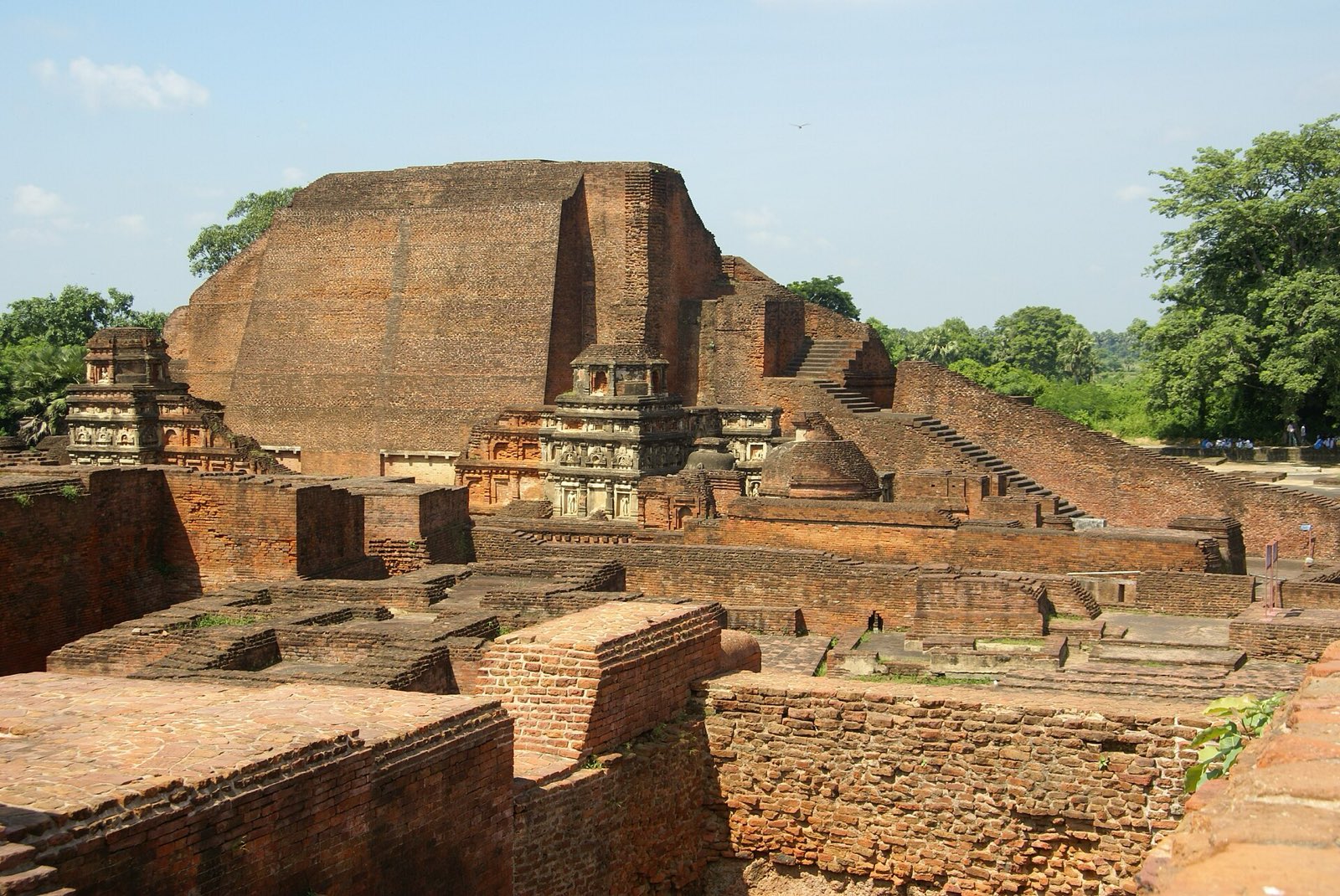
Nalanda: The Brick City of Learning That the World Forgot
How Buddhist India built one of the earliest great residential universities — rows of monastery-colleges and towering brick stupas where thousands of monks from across Asia lived, studied and debated for seven hundred years
Among all the wonders in this series, Nalanda is the one that is mostly gone — and yet what remains is enough to reveal something no other monument here can: an entire architecture of learning. For some seven hundred years, from around the fifth to the twelfth century, Nalanda in Bihar was one of the greatest centres of knowledge in the world, a vast Buddhist monastic university where thousands of monks and students from across Asia — from Tibet, China, Korea, Central Asia and Southeast Asia — came to live, study and debate. It was, in a real sense, one of the first residential universities on earth, older than Oxford or Bologna by many centuries, and its ruins are a diagram in brick of how a civilisation housed the life of the mind.
The word for such a place is mahavihara — "great monastery" — and that name holds the key to the architecture, because Nalanda was built not from a single plan but from the repetition and accumulation of one powerful building type: the vihara, the monastery-college. To understand Nalanda is to understand the vihara, and to see how a whole university was made by lining them up, one after another, along a sacred avenue.
The vihara: a college built as a courtyard of cells
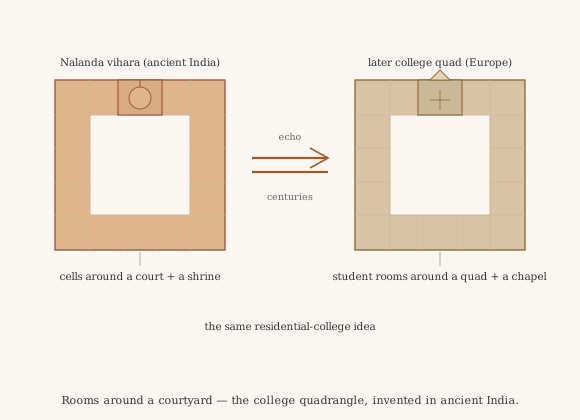
Start with the single monastery, because Nalanda is essentially many of them side by side.
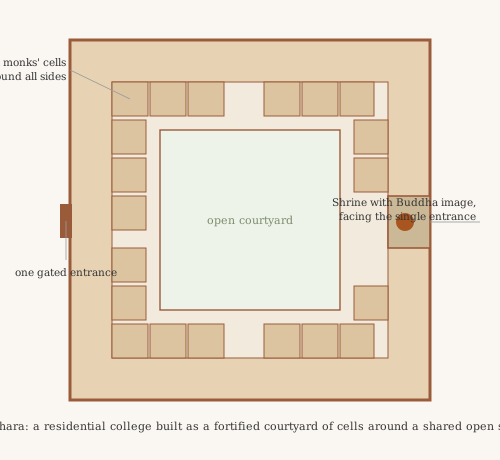
A vihara is a square building of fired brick enclosing an open central courtyard. Around all four sides of that courtyard runs a verandah, and opening off the verandah is a continuous row of small, identical cells — each one the room of a single monk, a plain brick chamber for sleeping, study and meditation. On the side directly opposite the single gated entrance stands a shrine, holding an image of the Buddha, so that a monk crossing the courtyard from the gate looks straight across to the sacred figure at the far end. There is usually just one entrance, which could be secured, making the whole monastery a self-contained, defensible, inward-turning residential world.
This is one of the great building types of Asia, and its logic is beautifully clear: it is residential architecture for a community of celibate scholars, combining private cells for individual study, a shared open court for gathering and air, and a single shrine to focus the whole on the Buddha. It is, in essence, the ancestor of the college quadrangle — the same idea that would reappear, many centuries and continents later, in the courtyard colleges of Oxford and Cambridge: rooms around a quad, with a chapel or hall as the shared heart. At Nalanda this idea was built in brick at enormous scale and repeated again and again.
The campus: monasteries facing temples along an avenue
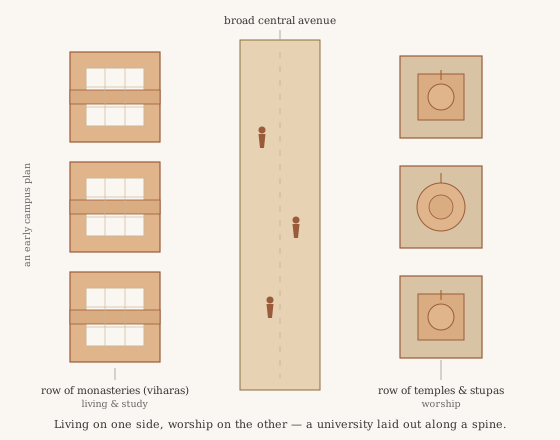
The genius of Nalanda's plan is what happens when you multiply the vihara. The excavated site reveals a strikingly ordered layout: a long row of these monasteries stands along one side of a broad central avenue running north-south, and facing them, across the avenue, stands a row of temples and stupas — the sacred monuments. So the campus separates the two halves of monastic life along a single axis: the living and studying on one side, in the residential viharas, and the worship on the other, in the shrines and stupas, with the great avenue between them like the spine of the university. Monks would step out of their cells, cross the avenue, and worship at the temples opposite. It is urban planning in the service of a way of life — one of the earliest and clearest campus plans anywhere.
Nalanda grew by accretion over centuries, endowed by the Gupta emperors and later, especially, by the Pala kings of eastern India (the same dynasty that endowed the sister-mahavihara of Somapura in Bengal), each ruler adding monasteries and rebuilding shrines, so that the site is layered with construction from many reigns. At its height it is said to have housed many thousands of monks and teachers and an immense library; the Chinese pilgrim-scholar Xuanzang, who studied here in the seventh century, left an awestruck description of its towers, its pavilions "wreathed in morning mist," and its rigorous intellectual life.
The great stupa: a mountain of brick
The most spectacular structure to survive is the great stupa-temple at the heart of the site, and it shows the other face of Nalanda's architecture — not the plain repetition of the cells, but the monumental brick shrine.
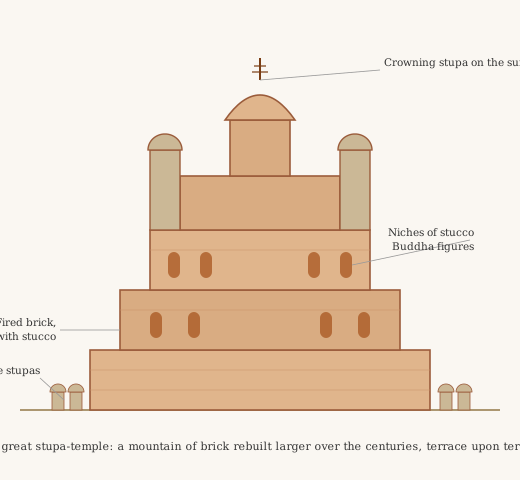
This great monument is not a single building but a series of structures built one on top of and around another, each larger than the last, so that the present mass encases earlier, smaller shrines within it like the rings of a tree — a stupa rebuilt bigger by successive generations of the faithful. It rises in stepped terraces of fired brick, with staircases climbing to the summit, corner towers, and rows of niches that once held stucco and terracotta figures of the Buddha. Around its base cluster dozens of small votive stupas, each one an offering left by a pilgrim. The whole is built of brick faced with lime stucco, the same Gupta-and-after brick tradition that produced the tower of the Mahabodhi temple at Bodh Gaya not far away — for eastern India, lacking easy building stone, became a land of superb brick architecture, and Nalanda is its greatest surviving campus.
The end, and the rediscovery
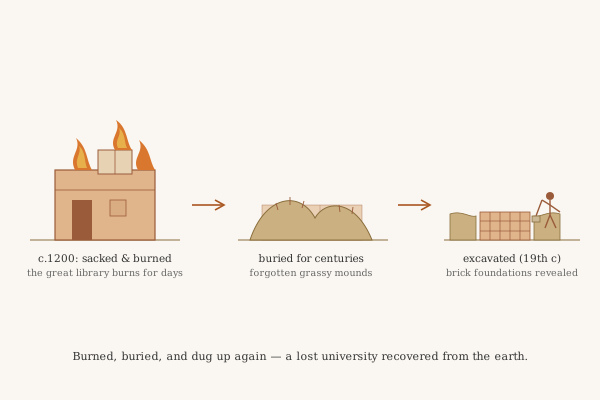
Nalanda's story has a tragic close that is part of its meaning. Around 1200, the mahavihara was sacked and burned by the armies of Bakhtiyar Khalji during the Turkish conquest of eastern India; its monks were killed or scattered, and its great library is said to have burned for days. Buddhism, already declining in the land of its birth, largely vanished from India, and Nalanda was abandoned and slowly buried, its brick mounds forgotten for six centuries until nineteenth-century archaeologists identified and excavated the site. What you walk through today is that excavation: the roofless foundations and lower walls of the monasteries and temples, the cells still countable, the great stupa still rising, the plan of a lost university laid bare.
That ruined, recovered quality is precisely why Nalanda belongs in this series. It is the counterpart to the living temples and the inhabited forts elsewhere in this collection — a monument whose life ended, and whose value now is as evidence, an archaeological diagram of a civilisation's intellectual ambitions. And it completes the Buddhist thread we have followed from the stupa at Sanchi, through the rock-cut monasteries of Ajanta, to the tower at Bodh Gaya: here, at last, is the architecture not of a single shrine but of the great monastic institution, the university, where Buddhist thought was preserved, argued and taught for seven hundred years.
Walk the long avenue between the rows of monasteries and temples, look into cell after identical cell where a monk once studied, and climb the terraces of the great brick stupa, and you feel the particular power of Nalanda: not the awe of a soaring tower or a jewelled dome, but the quieter, deeper awe of standing inside the plan of a place built entirely for the life of the mind — a city of learning that flourished for centuries, was destroyed in a season, and lay lost under the earth until we dug it up to remember what it had been.
Part of the Architectural Wonders series. Follow the Buddhist thread from the Great Stupa at Sanchi and the rock-cut halls of Ajanta to the Mahabodhi temple at Bodh Gaya, whose brick tradition Nalanda shares.
Hero photograph: “Nalanda archaeological site” by Sarah Jamerson, via Wikimedia Commons, licensed under CC BY-SA 2.0.
Export this guide
Related Guides — Deep-dive reading
Somapura Mahavihara: The Buddhist University Hidden Inside a Hill
Twelve hundred years ago in Bengal, a Pala emperor built one of the largest monasteries the Buddhist world had ever seen — a walled quadrangle a fifth of a mile across, ringed by 177 monks' cells, with a great cross-shaped, terraced temple rising from its courtyard. For four centuries scholars came from as far as Tibet to study here; then it was abandoned, and slowly buried, until villagers knew it only as Paharpur — 'the hill-town.'
Architectural WondersThe Mahabodhi Temple, Bodh Gaya: A Building Raised Over the Exact Spot of Enlightenment
How the holiest place in the Buddhist world produced one of India's strangest towers — a straight-sided brick pyramid built not to house a god but to mark a single point of ground beneath a tree
Architectural WondersBorobudur: The Mountain You Climb to Reach Enlightenment
In the volcano-ringed heart of Java, around 1,200 years ago, Buddhist kings built the largest Buddhist monument on Earth — not a temple you enter but a solid stone mountain you climb: a three-dimensional map of the universe, wrapped in 2,672 carved panels and 504 Buddhas, that turns the path to enlightenment into a walk you take with your feet. Then it was abandoned, buried under ash and jungle, and rebuilt, stone by million-stone, in our own age.
Architectural WondersRelated Tools — Try Free
Circadian Light Meter
Patient-centric circadian lighting visualizer for Indian healthcare design — time-of-day × intensity → CCT, melanopic lux (EML / mEDI), melatonin suppression, and an alertness curve. Calibrated against WELL v2 L03 Circadian Lighting Design, CIE S 026:2018, Brainard 2001, and Lucas et al. 2014.
Circadian ToolInterior Layout Planner — Printable Graph Grid
Printable graph grid to sketch room layouts to scale before committing to furniture placement.
Layout ToolWindow Orientation Planner
Pick the best window type, glass and shading by wall direction — north, east, south and west.
Window Tool