
STP Full Form & Meaning: What Does STP Stand For?
STP stands for Sewage Treatment Plant. Here is what that means in plain language, why Indian buildings are required to have one, and how an STP differs from an ETP and a septic tank — a clear beginner's entry point.
If you have bought a flat, read a building brochure, or sat through a society meeting in India in the last decade, you have almost certainly met the letters STP — usually attached to a line item in the maintenance budget or a corner of the basement nobody wants to talk about. So let us settle the most common question first, plainly.
STP full form is Sewage Treatment Plant.
That is it. Three words. But the three words hide a genuinely useful piece of infrastructure, and understanding what each part means tells you almost everything about what the machine actually does and why your building has one.
An STP is not a storage tank and it is not a filter. It is a small, engineered ecosystem that uses living microbes to eat the pollution in wastewater until the water is clean enough to reuse.
Breaking down the full form
Read the three words in order and the purpose becomes obvious.
- Sewage — the used, dirty water a building produces: the water from toilets, kitchens, bathrooms, and washing. It is not rainwater and it is not drinking water. It is the specific, contaminated wastewater of daily life.
- Treatment — the active part. The plant does not merely hold or move the sewage; it cleans it, removing the organic waste, solids, and germs through a series of physical and biological stages.
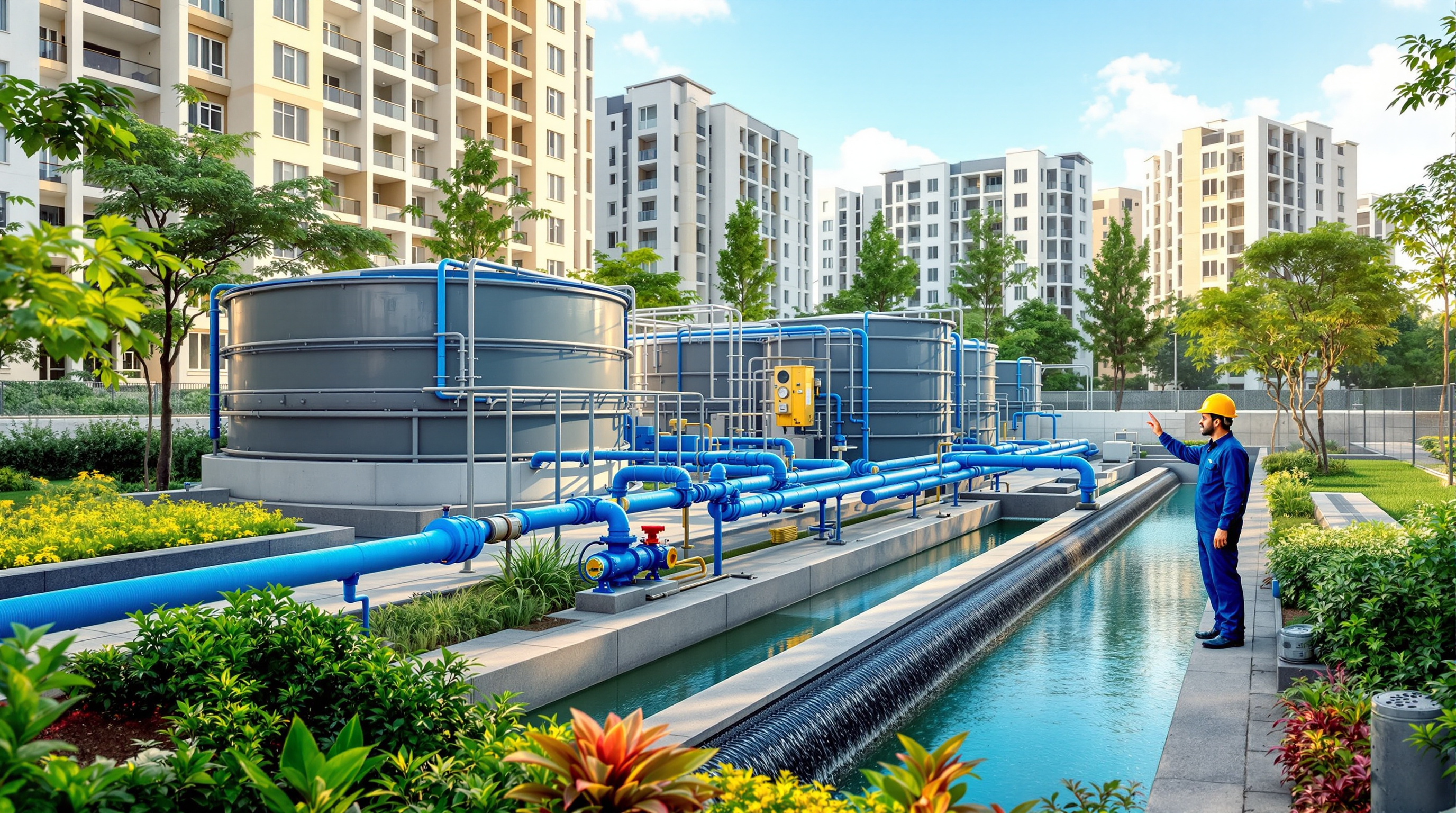
- Plant — as in a facility or installation, the way we say "power plant" or "manufacturing plant." It is a fixed system of tanks, pumps, blowers, and filters, usually sitting in the basement or a corner of the plot.
Put together: a Sewage Treatment Plant is an on-site facility that receives a building's raw sewage and treats it, stage by stage, until the water meets a legal quality standard and can be reused or safely discharged.
What an STP actually does
The clean, one-line version: an STP takes foul water in at one end and puts clear, odourless, reusable water out at the other, leaving behind a small amount of solid waste called sludge.
The treated water it produces is called effluent, and in a typical Indian building it is piped back for toilet flushing, garden irrigation, cooling towers, common-area washing, and groundwater recharge. A well-run plant recovers roughly 80–85% of the water a building consumes — water the society does not then have to buy in by tanker.
If you want the full stage-by-stage story of screens, aeration tanks, clarifiers, and disinfection, the companion guide What is a Sewage Treatment Plant? walks through it with no engineering background assumed, and How Does an STP Work? goes a level deeper into the process.
Why the letters keep appearing
STP has crept into everyday Indian property vocabulary for three concrete reasons.
1. It is now legally required. India's pollution-control authorities — the CPCB at the national level and the State Pollution Control Boards — require on-site sewage treatment for most medium and large developments. Apartment projects above a threshold size, and virtually all hotels, hospitals, IT parks, and commercial buildings, must install an STP and prove the treated water meets discharge norms to get their approvals. The STP is a condition of being allowed to open.
2. It saves water and money. Recovered water offsets a large chunk of a building's freshwater demand. For a large complex that can mean lakhs of litres a month, and a visibly smaller tanker bill.
3. It shows up on your maintenance bill. Someone has to run the blowers, dose the chemicals, cart away the sludge, and pay the electricity. That recurring cost is why "STP" appears in society budgets and why residents end up asking what it stands for in the first place.
Sizing, cost, and the numbers behind the letters
Once you know the full form, the next questions are always "how big?" and "how much?" Two units come up constantly:
- KLD — kilolitres per day, i.e. thousands of litres treated in 24 hours. It is the standard way STP capacity is quoted. A plant sized for a mid-size apartment block might be 100–200 KLD.
- Rs per KLD — how the capital and running cost of a plant is compared, so a 150 KLD plant can be benchmarked fairly against a 400 KLD one.
You can turn your building's headcount into a required capacity with the STP Capacity Calculator, estimate the build cost with the STP Cost Estimator, and sense-check the power draw against the Energy Benchmark Calculator. For the reasoning behind the rupee figures, see STP Cost per KLD in India.
STP vs ETP vs septic tank — clearing up the confusion
The single most common mix-up is between three abbreviations that all deal with dirty water but mean quite different things.
| Term | Full form | Treats | Typical user |
|---|---|---|---|
| STP | Sewage Treatment Plant | Domestic sewage — homes, offices, hotels, hospitals | Apartments, commercial and institutional buildings |
| ETP | Effluent Treatment Plant | Industrial effluent with chemicals, dyes, heavy metals | Factories, dyeing units, pharma and chemical plants |
| Septic tank | (no abbreviation) | Household sewage, partially, by settling only | Individual homes without a sewer connection |
The distinctions that matter:
- A septic tank is passive. It settles and partially digests sewage but does not clean the water to a reusable standard — it is the low-tech ancestor of the STP. See STP vs Septic Tank for where each one fits.
- An STP is built for domestic sewage — the everyday, biologically degradable wastewater of people living and working.
- An ETP is built for industrial effluent, which carries contaminants a domestic STP is simply not designed to handle.
A hotel needs an STP; a textile dyeing unit needs an ETP; a remote village house might still rely on a septic tank. Getting this right is the first design decision a project makes.
A few related abbreviations you will meet
Once you are inside the STP world, more letters follow. A quick map so they do not surprise you:
- MBBR — Moving Bed Biofilm Reactor, a popular treatment technology. See MBBR explained.
- MBR — Membrane Bioreactor, a compact, high-quality option covered in MBR explained.
- UASB — Upflow Anaerobic Sludge Blanket, a low-energy process detailed in the UASB guide.
- BOD, COD, TSS — the numbers used to measure how polluted the water is going in and how clean it is coming out.
These are technologies and metrics inside an STP — not alternatives to it.
The bottom line
The STP full form is Sewage Treatment Plant, and the words themselves are the definition: a plant that provides treatment for sewage. It is the on-site system that takes a building's dirty water, feeds its pollution to hungry microbes, filters and disinfects what remains, and returns clean water for reuse — now a standard, legally required fixture in serious Indian buildings.
From here, the natural next step is What is a Sewage Treatment Plant? for the full picture, or the wider Sewage Treatment Plants guide library if you want to explore how these systems are designed, run, and paid for.
Export this guide
Related Guides — Deep-dive reading
How Does an STP Work? A Step-by-Step Explanation
Follow a single drop of sewage from the building drain to reusable water — through screening, settling, the living microbial heart of the plant, and final polishing — with every stage explained in plain language and no engineering background assumed.
Sewage Treatment PlantsWhat is a Sewage Treatment Plant (STP)? The Complete Beginner's Guide
What an STP actually is, why modern Indian buildings are required to have one, and how it turns dirty water clean — explained in plain language, stage by stage, with no engineering background assumed.
Sewage Treatment PlantsSTP vs Septic Tank: Which Is Better for Your Building?
A plain-language decision guide comparing a modern sewage treatment plant against a traditional septic tank — how each works, whether the water becomes reusable, and which one your building actually needs, from an isolated bungalow to a regulated apartment complex.
Sewage Treatment PlantsRelated Tools — Try Free
Rainwater Tank Sizer
How big should your rainwater tank be? Computes annual harvest, recommended tank capacity in litres, water-bill savings, and payback — for 10 Indian cities.
RWH CalculatorLandscape Cost Calculator
Estimate a garden's cost — hardscape, softscape, lawn, irrigation, lighting and annual upkeep — by area, tier and city.
Budget CalculatorApartment STP Planner
Plan an apartment complex sewage treatment plant from flats and occupancy — get population load, sewage flow, recommended STP capacity in KLD, treatment technology and approximate space.
Planner