
Shower Systems Guide India: Overhead, Rain, Hand Shower, Body Jets, Mixers & Water Pressure
The complete guide to shower systems for Indian bathrooms — overhead and rain showers, hand showers and body jets, the mixer and diverter that drive them, the hard truth about water pressure from overhead tanks, geyser sizing for hot water, and how to waterproof the shower zone. Choose the right system for your pressure and budget.
Most people choose a shower the way they choose a light fitting — by the pretty metal part on the wall. Then they move in, turn it on, and a wide rain head that looked glorious in the showroom produces a sad drizzle. The head was never the problem. A shower is a system: a water source at some pressure, a hot-water source, a mixer and diverter that blend and route the water, the outlets you stand under, and a waterproofed floor to carry it all away. Get the system right and even a modest head feels wonderful; get it wrong and the most expensive rain shower disappoints.
This is the shower pillar in the Studio Matrx bathroom hub — the overview that ties the whole family together. Read it alongside the bathroom design guide for India when laying out the room. From here, dive into the specific outlet or control you are choosing: the overhead shower guide, the rain shower guide, the hand shower guide, body jets, and the two "brain" upgrades — the thermostatic shower and the digital shower. For a full spa experience add the steam shower; to understand the valve buried in the wall, read the concealed diverter faucet guide.
A shower is only as good as its weakest link. In most Indian homes that link is water pressure, not the shower head — so diagnose your pressure before you spend on trim.
The five parts of every shower system
Before you compare products, understand what you are actually assembling. Every shower, from a ₹1,500 wall arm to a ₹2 lakh digital spa, is built from the same five parts.
- The water source and its pressure — usually an overhead tank on the terrace feeding by gravity, sometimes a pressure pump. This sets the ceiling on everything else.
- The hot-water source — an electric storage geyser (most common), a gas or instant heater, or a solar tank. Its capacity decides how long you can shower.
- The mixer — blends hot and cold to a chosen temperature. Wall-mounted exposed, or a concealed single-lever body behind the tiles.
- The diverter — routes the mixed water to one outlet at a time: overhead, hand shower or spout. Single, two-way or three-way.
- The outlets — what water actually leaves through: overhead/rain head, hand shower, body jets, waterfall spout.
The outlets — what you stand under
This is the part you choose with your eyes, but each type has real behaviour worth knowing.
- Overhead shower — a fixed head on a wall arm or ceiling drop, pointing straight down. The everyday workhorse. Smaller heads (100–150 mm) keep decent pressure even on gravity feed.
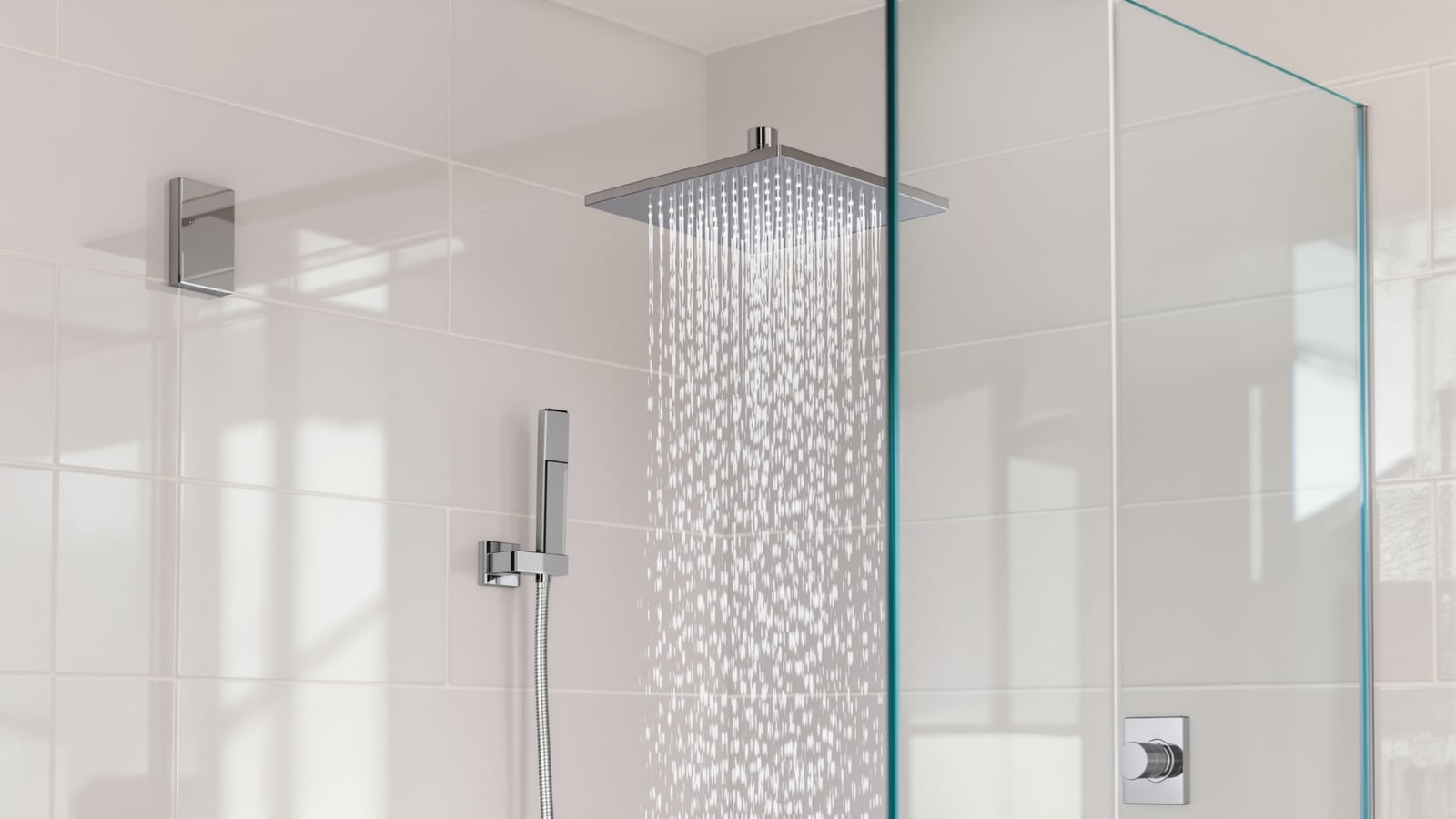
- Rain shower — a large flat overhead head, typically 200–300 mm square or round, ceiling or arm mounted, giving a soft, wide, low-velocity fall. Feels luxurious but is the most pressure-hungry outlet of all — it needs volume, not force, so weak gravity systems make it drizzle.
- Hand shower — a handheld head on a flexible hose and rail. The most practical outlet in an Indian bathroom: rinse the enclosure, wash hair, bathe a child, clean the dog. Almost every system should include one.
- Body jets — small nozzles set into the wall at hip and shoulder height that spray horizontally. Dramatic, but very demanding — a bank of jets needs high flow and usually a pump, so treat them as a premium add-on, not a starting point.
For most homes the sweet spot is an overhead (or modest rain) head plus a hand shower, controlled by a two-way diverter. Body jets and multiple heads come later, and only if your pressure can feed them.
The mixer and diverter — the part that decides how it feels
The outlets get the attention; the mixer and diverter decide whether the shower is a pleasure or a fight.
The mixer blends hot and cold. The cheapest is two separate taps you juggle by hand; the modern default is a single-lever mixer where one handle sets both flow and temperature. The premium upgrade is a thermostatic mixer, which holds the temperature steady so it does not swing when someone opens a tap elsewhere — covered in the thermostatic shower guide.
The diverter decides which outlet runs. You will meet three:
- Single (no diverter) — one control, one outlet. Fine for a plain overhead-only shower.
- Two-way diverter — switches between two outlets, e.g. overhead and hand shower. The most common concealed set-up in Indian homes.
- Three-way diverter — routes to three outlets, e.g. rain head, hand shower and body jets or a spout.
Both mixer and diverter come exposed (chunky body on the wall, cheaper, fully serviceable) or concealed (brass body buried behind the tile, only a slim plate showing). Concealed looks clean and hotel-like but must be planned before tiling and is harder to service — the full trade-off is in the concealed diverter faucet guide. The most advanced option is a digital shower, where a control panel and a hidden mixing box do the blending — see the digital shower guide.
Water pressure — the Indian reality nobody mentions in the showroom
This is where most disappointment is born. A rain head that dazzles on a showroom's pressurised supply will dribble on a top-floor flat fed by a terrace tank two metres above it.
Gravity pressure depends on head — the height of the water surface in the tank above the shower outlet. Roughly, every 1 metre of height gives about 0.1 bar. A rain shower ideally wants 1–1.5 bar; a small overhead head is happy at 0.5 bar or less. Do the maths before you buy.
| Supply type | Typical pressure | Good for | Weak for |
|---|---|---|---|
| Overhead tank, top floor (tank ~1–2 m above outlet) | 0.1–0.2 bar | Hand shower, small overhead head | Rain head, body jets |
| Overhead tank, lower floors (3–8 m head) | 0.3–0.8 bar | Most overhead heads, single rain head | Multiple outlets at once |
| Booster / shower pump added | 1.0–2.0 bar | Rain shower, thermostatic, two outlets | — |
| Pressure (constant-pressure) pump for whole flat | 1.5–3.0 bar | Rain + body jets, digital, multi-spray | — |
How to fix low pressure, cheapest first:
- Raise the tank or move the shower to a lower floor if you are still building — free pressure.
- Size the pipes right — a starved 15 mm feed throttles everything; run at least 20–25 mm to the shower and keep bends few.
- Fit a dedicated shower pump on the bathroom supply — an inline pump that lifts pressure only when the shower runs. The standard retrofit for a single luxurious shower.
- Fit a whole-flat pressure pump (constant-pressure/hydro-pneumatic) if several fittings need pressure. Check your society's rules — some ban pumps drawing directly off the common line.
Never specify a rain shower or body jets on a bare gravity system and hope. Confirm the pressure, or add a pump, first.
Hot water — sizing the geyser to the shower
The other half of a good shower is enough hot water that lasts. An electric storage geyser is the norm; size it to the outlet and the number of people.
| Shower type | Approx. flow | Geyser size (1–2 people) | Notes |
|---|---|---|---|
| Hand shower / small overhead | 6–9 litres/min | 10–15 litres | Instant/3 L geysers only suit a basin, not a shower |
| Standard overhead head | 9–12 litres/min | 15–25 litres | The everyday sweet spot |
| Rain shower | 12–20 litres/min | 25 litres + | Large heads drain a small tank fast |
| Rain + body jets / multi-spray | 20+ litres/min | Central 6–15 L gas/solar, or large tank | Storage geysers struggle; consider gas or solar |
A 15-litre geyser gives roughly one comfortable 6–8 minute shower before it needs to reheat. For two back-to-back showers, or a rain head, step up to 25 litres. Set the thermostat to about 60 degrees C so you mix down at the tap — it stores more usable hot water and keeps Legionella down. For a whole-home or spa set-up, a gas instant heater or solar tank with a booster beats a small electric tank.
The shower area and waterproofing — the part behind the tiles
A shower pours 40–60 litres of water onto one patch of floor every use. If that zone is not properly waterproofed and drained, the damage shows up months later as a damp patch on the ceiling below — and by then the tiles are already laid over the failure.
- Waterproof the whole wet zone, not just the floor — walls up to at least 1.8 m (shoulder height, ideally full height in the shower), with a liquid or cementitious membrane turned up and lapped. See the bathroom waterproofing guide.
- Grade the floor to fall about 1:80 to 1:100 toward the drain so nothing pools. A sunken/recessed shower floor or a linear channel drain does this cleanly.
- Contain the splash — a glass partition, a low kerb or a wet-and-dry split keeps the rest of the bathroom usable, a theme of the bathroom design guide.
- Pick anti-skid flooring in the wet zone — matt, textured or small-format tiles with more grout lines give grip on a wet floor.
Do this once, before tiling, or pay for it many times over.
How to choose — by pressure and by budget
Work in this order: pressure first, then hot water, then controls, then the pretty outlet. The decision tree below is the fastest way to land on a sensible system.
Here is the honest map.
| Budget band | Realistic shower system | Assumes |
|---|---|---|
| Entry (₹3,000–8,000) | Single-lever wall mixer + small overhead head + hand shower, two-way diverter | Gravity feed, 15 L geyser |
| Mid (₹10,000–30,000) | Concealed two-way diverter, 200 mm overhead or modest rain head + hand shower | 0.5 bar + / booster pump, 25 L geyser |
| Premium (₹40,000–1 lakh) | Thermostatic concealed mixer, rain head + hand shower + spout, three-way | Shower/pressure pump, 25 L + / gas |
| Luxury (₹1 lakh +) | Digital shower or full body-jet spa, steam option | Whole-flat pressure pump, gas/solar hot water |
Quick decision rules:
- Weak gravity pressure and no pump budget - stick to a small overhead head plus hand shower. Do not buy a rain head.
- Can add a pump - a rain shower plus hand shower on a thermostatic mixer is the reliable "hotel bathroom" combo.
- Two people, back-to-back showers - prioritise the geyser (25 L) over a fancier head.
- Building new - fix pressure and waterproofing now; upgrade the trim any time later.
Match the system to your water and your walls, not to the showroom lighting, and even a modest shower will feel like the best part of the day.
References
- National Building Code of India (NBC) 2016, Part 9 — Plumbing Services (water supply, drainage, and sanitation).
- IS 1172 — Code of Basic Requirements for Water Supply, Drainage and Sanitation.
- IS 2065 — Code of Practice for Water Supply in Buildings.
- CPHEEO Manual on Water Supply and Treatment, Ministry of Housing and Urban Affairs — pressure, demand and pipe-sizing guidance.
- IS 8931 / IS 10500 — Bureau of Indian Standards specifications for shower and pillar taps and drinking-water quality (hard-water context).
- IGBC Green Homes / GRIHA — water-efficiency benchmarks and low-flow fixture guidance.
Export this guide
Related Guides — Deep-dive reading
Body Jets Shower India: Body Spray Massage Systems, the Flow & Pressure They Really Need, and What It Costs (2026)
Wall-mounted horizontal body jets turn a shower into a spa massage — but every jet is a thirsty extra outlet. How many jets, at what heights, the big pump and geyser they force, the pipe sizing and concealed valves you must plan before tiling, the water and running cost, and exactly who it is worth it for.
BathroomsHow to Choose a Shower System in India: A Buyer's Guide by Water Pressure, Type & Budget
A buyer's decision guide to picking a shower system for an Indian bathroom — start by measuring your water pressure, then choose overhead, hand, combo or jets, pick concealed versus exposed, and buy the right finish, warranty and ₹ tier without getting sold a fake.
BathroomsConcealed Diverter Faucet India: In-Wall Body, Diverters, Cost & Servicing Guide
In-wall concealed faucets and diverters for Indian bathrooms — how the concealed body buried behind the tiles works with the exposed trim plate and lever, single, two-way and three-way diverters that route water to the overhead rain shower, hand shower and spout, why the hidden brass body is the part that really matters, and how to plan the rough-in before you tile.
BathroomsRelated Tools — Try Free
Shower Pump Calculator
Check whether your shower needs a pressure-boost pump and what size — available vs required pressure from your tank height or supply.
Bathroom CalculatorPlumbing Pressure-Test & Leak Checklist
Pre-closure pressure and leak test — 9 categories, 60+ checkpoints across water supply, drainage, fixtures, waterproofing, hot water, tanks.
Pre-Closure TestShower Water Flow Calculator
Shower water use per shower, day and month by head type, plus a pressure-adequacy check for your tank height or pump and low-flow savings.
Bathroom Calculator