
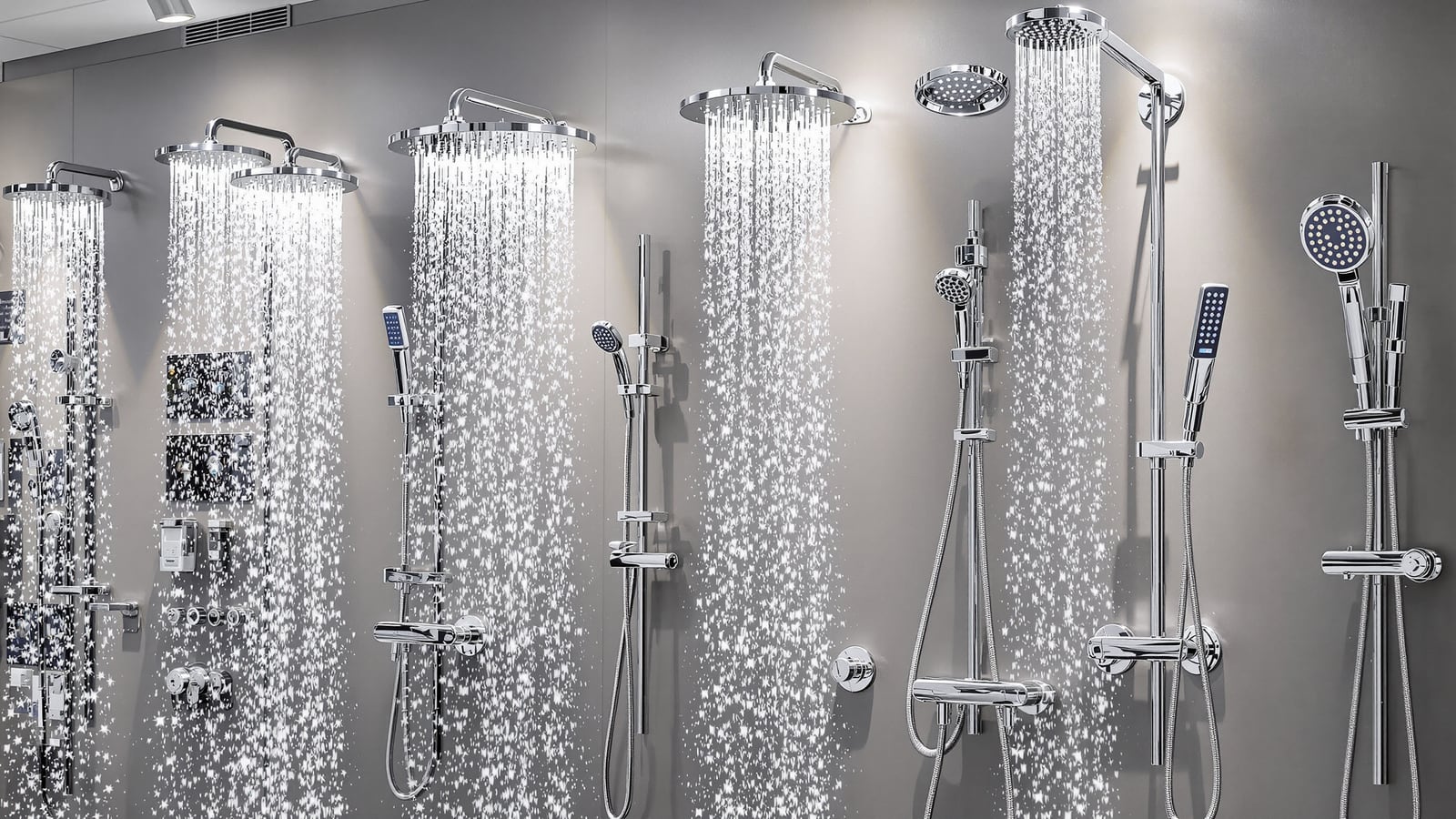
How to Choose a Shower System in India: A Buyer's Guide by Water Pressure, Type & Budget
A buyer's decision guide to picking a shower system for an Indian bathroom — start by measuring your water pressure, then choose overhead, hand, combo or jets, pick concealed versus exposed, and buy the right finish, warranty and ₹ tier without getting sold a fake.
Most shower purchases go wrong at the showroom, not the site. A wide rain head glints under the lights, the salesperson opens the tap on a mains-pressure display rig, and it feels magnificent. You buy it, install it under your third-floor overhead tank, and it produces a warm dribble. The head was never the issue — your water pressure was. That is why this buying guide refuses to start with the pretty metal part. It starts with the one measurement that decides what you are even allowed to buy.
This is a buyer's decision guide: how to choose and pay for a shower, not a re-explanation of how showers work. For the deep technical specs of each part, read the shower systems guide for India. For where a shower fits into the whole purchase plan, see the bathroom shopping guide for India.
Buy your shower in this order: pressure first, type second, valve body third, finish and warranty last. Do it in any other order and you will spend on trim that your water cannot drive.
Step 1 — Measure your water pressure before you shortlist anything
In most Indian homes water arrives by gravity from an overhead tank on the terrace. The pressure you get depends almost entirely on the height of the water level above the shower head — roughly 0.1 bar for every metre of drop. A tank one floor up gives you a gentle push; a tank on the same floor gives you almost nothing. A pressure pump changes the game entirely and lifts you into the range where rain heads and jets behave as advertised.
You do not need instruments. Do the bucket test: open the shower outlet fully and time how long a 10-litre bucket takes to fill.
| Bucket fill time | Rough flow | Pressure reality | What you can buy |
|---|---|---|---|
| Under 20 sec | Strong (>15 LPM) | Mains or pump-fed | Anything — rain heads, body jets, combos |
| 20-40 sec | Moderate (8-15 LPM) | One floor of gravity head | Standard overhead + hand shower; small rain head |
| Over 40 sec | Weak (<8 LPM) | Low gravity head | Hand shower or a pump — a big rain head will disappoint |
The rule that saves money: a large rain head spreads the same water over many holes, so it needs pressure to feel like rain rather than mist. If your bucket test is over 40 seconds, either budget for a water pressure booster pump before the rain head, or skip the rain head. Do not let a showroom sell you a 300 mm ceiling shower on gravity that fills a bucket in 50 seconds — read the honest verdict in the rain shower guide for India.
Step 2 — Choose the shower TYPE your pressure allows
Only after the bucket test do you pick what you stand under. There are four practical choices, in rising order of pressure hunger.
- Hand shower alone — the most forgiving. A single spray head on a flexible hose and rail. Works even on weak gravity, doubles as a bucket-filler and a cleaning tool, and suits elderly users and children. The safe default for low pressure. See the hand shower guide for spray types.
- Overhead shower — a fixed head on a wall arm or ceiling. Needs moderate pressure to feel good. A compact 150-200 mm head concentrates flow and copes with gravity better than a wide one.
- Combo (overhead + hand shower) — the sweet spot for most Indian homes. A diverter switches between a fixed overhead for daily use and a hand shower for flexibility. Buy this if you can only buy one thing.
- Rain head and body jets — the luxury tier, and the most pressure-hungry. A wide rain head or wall jets need pump-fed or strong mains pressure. Beautiful when driven properly, a disappointment on bare gravity. Read the body jets guide before committing.
Step 3 — Concealed vs exposed: buy a good concealed BODY
This is the decision buyers most often get backwards. An exposed shower mixer sits on the wall surface — easy to buy, easy to replace, and every working part is reachable. A concealed system buries the mixer and diverter body inside the wall, leaving only a slim plate and lever visible. It looks premium and is what showrooms photograph.
The catch: the concealed body is behind your tiles forever. If it leaks or the cartridge fails, you break tiles to reach it. So the money logic inverts what most people assume — with concealed, spend on the buried body, not the visible plate.
With a concealed shower, buy a branded, serviceable concealed body from a maker whose cartridges you can still get in ten years — the trim plate is cosmetic and cheap to change; the body is a wall demolition to change.
- Choose concealed only if you trust the brand's spares availability and your plumber's waterproofing.
- Insist on a body with a serviceable cartridge accessible from the front without breaking tiles.
- On a tight budget or a rental, buy exposed — it is honest, cheaper and repairable.
Step 4 — Nozzles, finish and the specs that survive Indian water
Two things wreck showers in India: hard water and cheap plating. Buy for both.
- Anti-clog / rub-clean nozzles — hard water deposits lime scale that blocks spray holes within months. Choose heads with flexible silicone nozzles you can rub clean with a thumb. This single feature outlasts any styling.
- Finish — chrome over brass is the durable standard; look for a genuine CP (chrome-plated) brass body, not painted zinc alloy. Matte black and brushed finishes look great but scratch and water-spot more in hard water; keep them for lower-splash areas.
- Flow rating — a shower rated for lower flow (around 8-9 LPM) saves water and heating cost, but on weak gravity you may want an unrestricted head. Match the flow to your pressure.
- Warranty — the real signal of quality. Serious brands warranty the cartridge and finish for years. Read what is actually covered.
A quiet detail that decides long-term happiness is spare-part availability. A ₹40,000 imported spa head is worthless the day its proprietary cartridge is discontinued and no local plumber can source one. For a shower you keep for a decade, a mid-priced fitting from a brand with a dense Indian service network — Jaquar, Hindware, Cera and Kohler all qualify as neutral examples — is often a smarter buy than a flashier import you cannot service. Match the ambition of the fitting to the reality of your pressure and your city's spares supply, not to the showroom lighting.
Step 5 — Good / better / best budget tiers
Prices are indicative 2026 Indian retail for the shower fittings (head, arm, diverter/mixer), excluding the geyser, pump and plumbing labour.
| Tier | Typical ₹ (fittings) | What you get | Best for |
|---|---|---|---|
| Good | ₹2,000 - ₹6,000 | Exposed single-lever or 2-in-1 diverter, standard overhead + hand shower, CP brass | Rentals, secondary baths, weak pressure |
| Better | ₹6,000 - ₹18,000 | Concealed body with serviceable cartridge, anti-clog rain head, branded finish, multi-year warranty | Main family bathroom |
| Best | ₹18,000 - ₹80,000+ | Thermostatic or digital control, wide rain head + body jets, premium finish, long warranty — pair with a pump | Master bath, spa build, pump-fed homes |
What to check before you pay
- The box, not just the display piece. Confirm a warranty card, the brand hologram/serial, all washers and the wall arm are inside. Loose fittings in a plastic bag are a red flag.
- Brass, not zinc. A CP brass body has real weight and is non-magnetic. If a magnet sticks strongly, it is likely zinc alloy that will corrode and flake.
- Serviceable cartridge — ask to see how the cartridge is replaced, especially on a concealed body.
- Is installation included? Fittings are usually supplied only; plumbing and tiling are separate. Get that in writing.
- After-sales — where is the nearest service centre, and are spare cartridges stocked?
Red flags and fakes — a real India problem
Counterfeit CP fittings are widespread. Protect yourself:
- "Same as Jaquar/Kohler, half the price" — the classic mis-sell. Genuine branded bodies are not cheap because the brass and cartridge are not cheap.
- Suspiciously light metal, a painted rather than plated finish, or plating that shows tool marks — all signs of zinc or reject stock.
- No hologram, no serial, no warranty card, or a card that says "warranty at dealer discretion."
- Showroom rig pressure — the demo runs on mains or a hidden pump. Always ask what pressure the display is fed at, then map it to your bucket test.
- "Rain shower works on any pressure" — untrue. A wide head on weak gravity mists. Believe your bucket, not the pitch.
Questions to ask the vendor: What is the body material and is it IS 8931 marked? How long is the finish and cartridge warranty, and what voids it? Is this the current model with genuine spares? Can you show me it running at overhead-tank pressure, not mains? Online can be cheaper, but a showroom lets you feel the weight and confirm the hologram — worth it for a concealed body you will live with for a decade.
References
- National Building Code of India (NBC) 2016, Part 9 — Plumbing Services, water supply and pressure guidance for buildings.
- IS 8931 — Copper alloy single taps and stop valves for water services (CP fittings quality benchmark).
- IS 1172 — Code of basic requirements for water supply, drainage and sanitation.
- Bureau of Indian Standards (BIS) — ISI marking and product certification for sanitary fittings.
Export this guide
Related Guides — Deep-dive reading
How to Choose a Bathroom Faucet in India: A Buyer's Guide to Cartridges, Brass & Fakes (2026)
A buyer's decision guide to CP fittings — the ceramic-disc cartridge that decides life in hard water, the brass-vs-zinc weight test, finish durability, warranty, honest good/better/best rupee tiers, and how to spot the huge fake-faucet problem in the Indian market.
BathroomsShower Systems Guide India: Overhead, Rain, Hand Shower, Body Jets, Mixers & Water Pressure
The complete guide to shower systems for Indian bathrooms — overhead and rain showers, hand showers and body jets, the mixer and diverter that drive them, the hard truth about water pressure from overhead tanks, geyser sizing for hot water, and how to waterproof the shower zone. Choose the right system for your pressure and budget.
BathroomsConcealed Diverter Faucet India: In-Wall Body, Diverters, Cost & Servicing Guide
In-wall concealed faucets and diverters for Indian bathrooms — how the concealed body buried behind the tiles works with the exposed trim plate and lever, single, two-way and three-way diverters that route water to the overhead rain shower, hand shower and spout, why the hidden brass body is the part that really matters, and how to plan the rough-in before you tile.
BathroomsRelated Tools — Try Free
Shower Pump Calculator
Check whether your shower needs a pressure-boost pump and what size — available vs required pressure from your tank height or supply.
Bathroom CalculatorShower Water Flow Calculator
Shower water use per shower, day and month by head type, plus a pressure-adequacy check for your tank height or pump and low-flow savings.
Bathroom CalculatorMonsoon-Readiness Checklist
Pre-rain home audit across 9 categories — terrace, drains, waterproofing, electrical, HVAC, pest, vehicles, documents.
Seasonal Audit