
Steam Shower India: Generator Sizing, Steam-Tight Enclosure & Cost Guide
A practical guide to home steam showers in India — how to size the steam generator by cubic volume, build a fully sealed and tanked steam-tight enclosure, plan seating, power and water, and understand real running costs and rupee budgets.
A steam shower turns a routine wash into a genuine wellness ritual — you step into a sealed enclosure, press one button, and within a few minutes warm vapour rises to envelop you at 40 to 45 degrees Celsius and near-total humidity. Done right, it is the single most spa-like thing you can add to an Indian home. Done wrong, it is a leak factory: escaping vapour finds every unsealed joint, saturates ceilings, corrodes fittings and blooms mould. The difference is almost entirely in the engineering — the generator sizing, and above all a fully sealed, tanked, vapour-proof enclosure.
This is the steam-shower component guide of the Studio Matrx bathroom hub. It focuses on the hardware and the build. For where a steam bath sits in a whole-room wellness scheme, read the spa bathroom design guide and the luxury bathroom design guide. For the surrounding water delivery — rain heads, hand showers, thermostatic control and diverters — see the shower systems guide for India. Because a steam enclosure is usually walled in glass, the glass bathroom walls guide covers the panels, hinges and sealing that keep vapour in.
A steam shower is a small pressure vessel for humidity. Everything above your head and behind the tiles must be built as if it will be permanently wet — because it will be. Get the tanking and the sloped ceiling right and the rest is comfort. Get them wrong and no fitting will save you.
What a home steam shower actually is
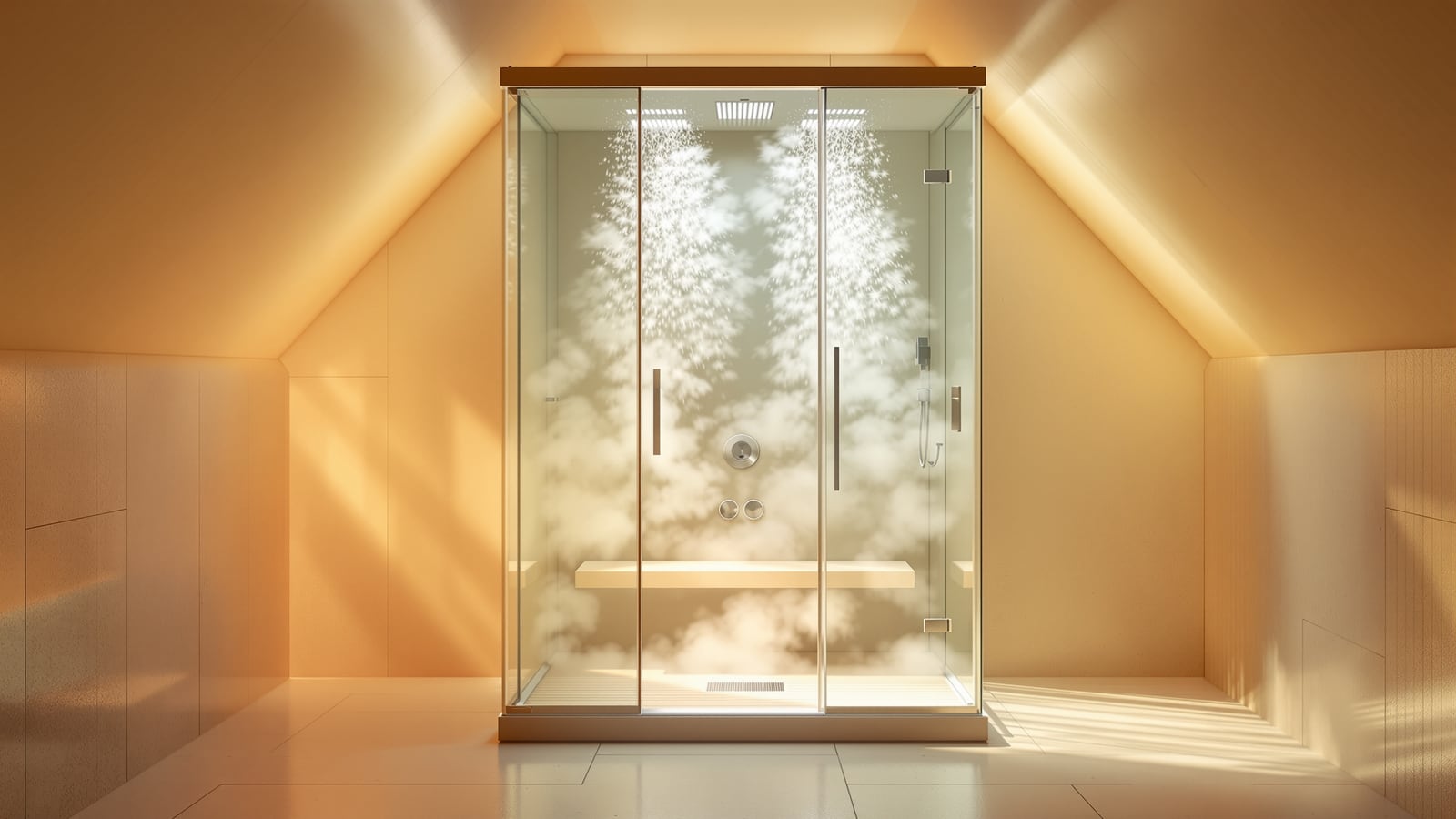
A steam shower is an ordinary shower enclosure made airtight and vapour-tight, fed by an electric steam generator mounted nearby — under a vanity, in a utility niche or a ventilated cupboard within about 4.5 m of the enclosure. The generator boils cold water into pure steam and pushes it through an insulated pipe to a steam head low on the wall, near the floor, where it rises naturally. A digital controller inside sets temperature, run time and, on better units, aroma-oil dosing and chromotherapy lighting.
Two things separate it from a normal shower. First, the enclosure must be completely closed — glass all the way to the ceiling, a full-height door with a sweep, and no open transom for vapour to escape. Second, the ceiling must be sloped so condensate runs to a wall and drips down rather than raining cold droplets onto your head.
Sizing the steam generator by cubic volume
The generator is sized to the volume of air it must saturate, not the floor area. Calculate length x width x height in metres to get cubic metres, then apply adjustments for materials and heat loss. This is the single most common mistake in Indian installs — people buy on price and end up with a unit that takes fifteen minutes to reach temperature and never quite holds it.
Start from the raw volume, then add capacity for the factors that steal heat:
- Ceramic or porcelain tile on cement board is the baseline.
- Natural stone (marble, granite, kota) is a heat sink — add roughly 20 to 25 percent capacity because the mass must be warmed before the air will hold temperature.
- An exterior wall or a large glass roof loses heat — add about 10 to 15 percent.
- A high ceiling above 2.4 m adds volume directly; keep steam ceilings low (2.1 to 2.3 m) where you can.
| Enclosure (L x W x H) | Approx. volume | Tile-lined generator | Stone-lined generator |
|---|---|---|---|
| 0.9 x 0.9 x 2.1 m | ~1.7 m3 | 3.0 kW | 4.0 kW |
| 1.2 x 1.2 x 2.2 m | ~3.2 m3 | 4.5 kW | 6.0 kW |
| 1.5 x 1.2 x 2.2 m | ~4.0 m3 | 6.0 kW | 7.5 kW |
| 1.8 x 1.5 x 2.3 m | ~6.2 m3 | 7.5 kW | 9.0 kW |
Treat these as a starting point and confirm against the manufacturer's own sizing chart — Indian and imported units (Jaquar, Kohler, Steamist, Tylo and others exist only as examples) publish kW-per-cubic-metre tables. When in doubt, size up one step: an oversized generator reaches temperature faster and cycles less, whereas an undersized one runs flat out and wears early.
The steam-tight enclosure — the part that must not fail
This is where money and care belong. A normal shower loses splashes; a steam shower pushes hot vapour at pressure into every gap for the whole cycle, and vapour penetrates far more aggressively than liquid water. Build the enclosure like a tank.
- Waterproof the whole box, not just the tray. Walls and ceiling both need a continuous membrane behind the tile. Bring the waterproofing up and over the ceiling — treat the ceiling exactly like a wet floor. A liquid-applied or cementitious membrane over cement backer board (not gypsum) is standard.
- Slope the ceiling. A flat ceiling drips condensate straight down. Fall the ceiling at least 2 degrees (roughly 40 to 50 mm per metre) toward a wall so condensate runs to the tile and down, not onto the bather. A vaulted or single-pitch ceiling both work.
- Glass to the ceiling, sealed door. No open gap at the top. Panels meet a channel at the ceiling; the door is full height with a drop seal or magnetic sweep. The glass walls guide details the toughened-glass thickness (10 to 12 mm) and hardware.
- Vapour-proof the surround. Any recessed light, speaker or fan inside the enclosure must be an IP65-rated, steam-rated fitting. Junctions are sealed; no unsealed penetrations.
- Insulate the back of the enclosure where it abuts an external wall so the surface stays warm and condensation forms inside on the tile, not inside the wall build-up.
| Element | Steam-tight requirement | Common failure if skipped |
|---|---|---|
| Ceiling waterproofing | Membrane over cement board, no gypsum | Ceiling saturates, paint peels, mould |
| Ceiling slope | Min 2 deg fall to a wall | Cold condensate drips on bather |
| Glass height | Full height to ceiling channel | Vapour escapes into the room |
| Door seal | Drop seal + full-height sweep | Steam loss, long warm-up, damp floor |
| Lights/fans inside | IP65 steam-rated only | Corrosion, electrical fault |
| Steam head position | Low on wall, away from seat/legs | Scalding risk, uneven heat |
Seating, power and water
Seating. A steam bath is meant to be taken sitting. Build a fixed bench 400 to 450 mm high and at least 400 mm deep in tiled stone or solid-surface — never timber, which will not survive the humidity. Position it away from the steam head so rising vapour does not scald the legs. In a small enclosure, a fold-down solid-surface seat works.
Electrical. Steam generators from about 4.5 kW upward usually need a dedicated circuit — commonly a 20 to 32 A supply, and larger units may need a three-phase feed. Follow IS 732 for the wiring, provide a dedicated RCBO, and keep the generator itself outside the wet enclosure in a dry, ventilated space. Confirm your society or building has the spare load before you commit; a 9 kW generator is a serious draw and load-shedding mid-cycle simply resets the session.
Water supply. The generator needs a cold-water feed (typically a 15 mm line) and a drain for its auto-flush cycle. India's hard water is the generator's main enemy — scale builds on the heating element and shortens its life. Fit a softener or at least an inline scale filter on the feed, and choose a unit with an automatic drain-and-flush that clears mineral sludge after each use. A shut-off valve and a serviceable union make descaling and element replacement far easier.
Prefab steam cubicle versus custom enclosure
There are two routes to a home steam bath in India, and the right one depends on space, budget and how the room reads.
- Prefab steam cubicle. A self-contained acrylic pod — walls, roof, bench, glass door, steam head and generator arrive as a factory-sealed unit you plumb and wire in. The waterproofing is built into the moulding, so leak risk is low and installation is fast, which makes it ideal for a retrofit or a tight apartment bathroom. The trade-offs are fixed sizes, an acrylic aesthetic that reads more gym than spa, and panels that are awkward to repair if cracked.
- Custom tiled enclosure. You build the box in tile or stone, waterproof and slope it yourself, and add a separate generator and controller. This gives any size, a proper stone bench and a genuine spa look — but it lives or dies by the tanking and the sloped ceiling. A custom steam shower is only as good as its waterproofer.
Wellness benefits and running cost
Used sensibly, a steam bath opens pores, eases muscle tension after a workout or a long commute, helps clear the sinuses, and is a powerful de-stress ritual — the reason it anchors most home spa schemes. Sessions of 15 to 20 minutes are plenty; hydrate before and after, and skip it if you have uncontrolled blood pressure or heart conditions without a doctor's nod.
Running cost is modest and often over-feared. A generator draws its full kW only while heating; once it reaches temperature it cycles. A 6 kW unit over a 20-minute session that runs perhaps half the time uses roughly 1 unit of electricity — a few rupees at typical Indian tariffs. The real long-run costs are descaling (element life in hard-water cities) and eventual element replacement, which is why a softener and auto-flush pay for themselves.
| Item | Prefab cubicle | Custom tiled enclosure |
|---|---|---|
| Enclosure + build | ₹1.2 – 3.5 lakh (unit) | ₹1.5 – 5 lakh (tanking, tile, glass, labour) |
| Steam generator (4.5 – 9 kW) | usually included | ₹45,000 – 2.5 lakh |
| Controls, aroma, chromotherapy | basic to mid | ₹15,000 – 1 lakh add-ons |
| Softener / scale filter | ₹8,000 – 40,000 | ₹8,000 – 40,000 |
| Indicative total | ₹1.5 – 4 lakh | ₹2.5 – 8 lakh+ |
| Running cost / session | a few rupees | a few rupees |
Ranges vary widely with brand, imported versus domestic generators, stone selection and city labour rates; treat them as planning brackets, not quotes.
References
- NBC 2016 (National Building Code of India) — bathroom ventilation, dampness and services provisions.
- IS 732 — Code of practice for electrical wiring installations; dedicated circuits, earthing and RCBO for high-load appliances.
- IS 2556 — Sanitary appliances; relevant for shower and enclosure fittings.
- IS 1172 — Basic requirements for water supply, drainage and sanitation.
- CPHEEO Manual on Water Supply and Sanitation — Ministry of Housing and Urban Affairs guidance on plumbing and water quality.
- IGBC / GRIHA — green-building references for water efficiency and softening where hard water is a concern.
Export this guide
Related Guides — Deep-dive reading
Shower Niche India: Building a Recessed Wall Shelf That Holds Shampoo Without Ever Leaking
A shower niche is a shelf you carve into the wall instead of screwing onto it. Done right it is invisible and dry for decades; done wrong it is the single most common source of seepage into the room behind. Here is how to size it, which wall you may cut, and how to waterproof, slope and tile the recess so it never leaks.
BathroomsBathroom Planning for New Homes in India: Get It Right Before You Build
The bathroom decisions you cannot undo once the slab is cast — location and stacking, sunken vs non-sunken slabs, waterproofing, and the plumbing, electrical and ventilation you must coordinate with the civil work, stage by stage.
BathroomsShower Systems Guide India: Overhead, Rain, Hand Shower, Body Jets, Mixers & Water Pressure
The complete guide to shower systems for Indian bathrooms — overhead and rain showers, hand showers and body jets, the mixer and diverter that drive them, the hard truth about water pressure from overhead tanks, geyser sizing for hot water, and how to waterproof the shower zone. Choose the right system for your pressure and budget.
BathroomsRelated Tools — Try Free
Electrical Safety & Load Audit
Home electrical audit — 10 categories, 65+ checkpoints across earthing, RCCB, MCB, wiring, switchboards, appliance circuits, DG/inverter backup.
Safety AuditFalse Ceiling Cost Estimator
Live ₹/sqft across 8 ceiling types — POP, gypsum, designer, metal, PVC, wooden — with cove and spot lighting for 20 Indian cities.
Cost CalculatorAcoustic Privacy (STC) Visualizer
Indian healthcare acoustic visualizer — compare wall assemblies and noise sources, see received SPL after STC attenuation, and check FGI 2018 / IS 1950 / NABH speech-privacy compliance with live dual-canvas waveform.
Acoustic Tool