
Rain Shower India: Overhead Drench Heads, the Pressure Truth & What They Cost (2026)
The big flat rainfall head looks like a hotel dream — but on a gravity-fed Indian tank it can dribble. This guide is honest about pressure and flow, ceiling vs wall-arm mounting, head sizes, LED and rainfall modes, water use, pairing with a hand shower and real rupee ranges.
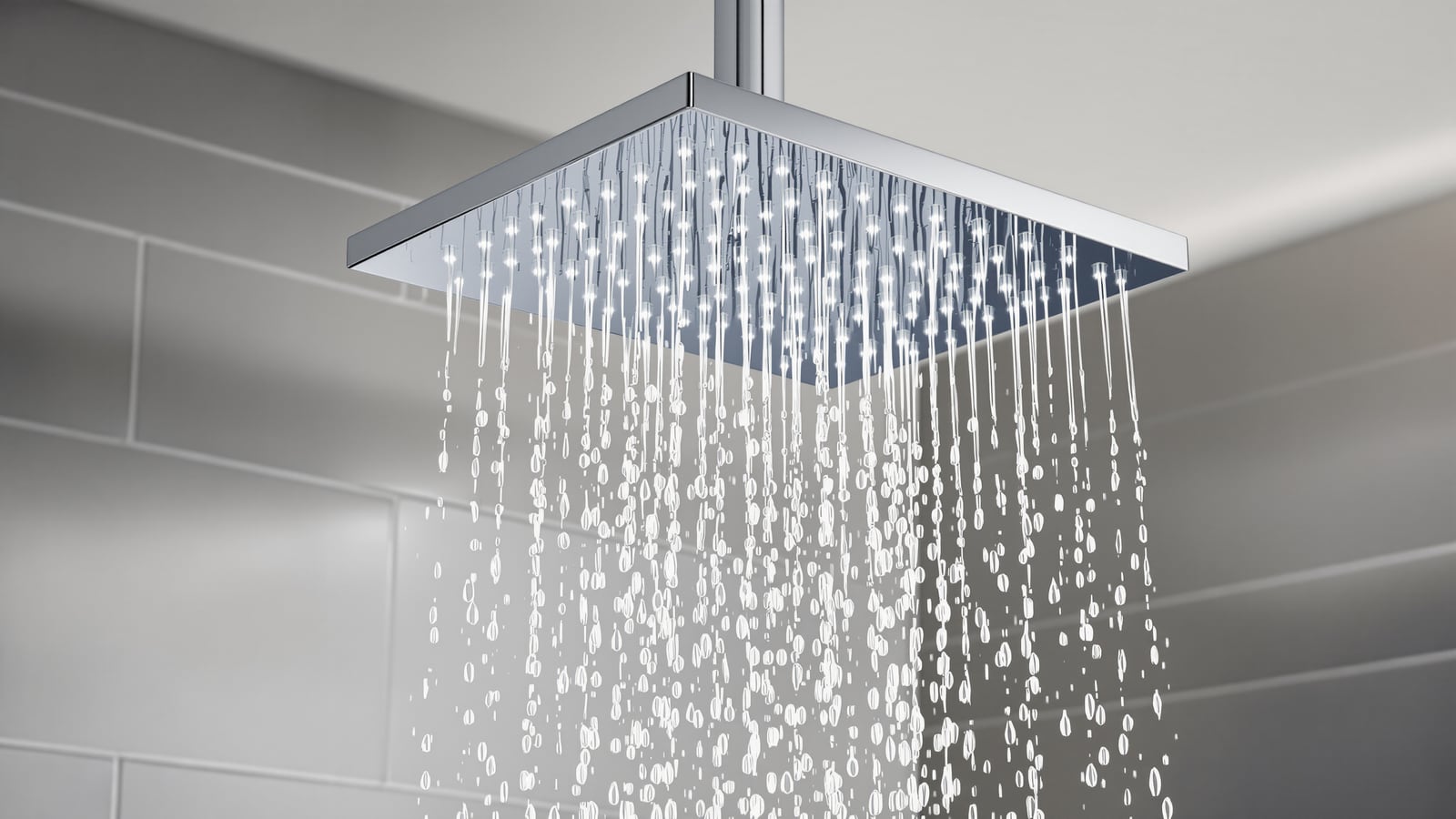
A rain shower is the head everyone points to in a hotel bathroom: a wide, flat disc — usually mounted overhead — that drops water straight down over you like warm monsoon rain instead of firing it at you in a jet. It is the single most requested "make my bathroom feel like a spa" upgrade in Indian homes. It is also the single most common disappointment, because a rainfall head lives or dies on pressure and flow, and most Indian homes are fed by an overhead tank two floors up with barely enough head to wet the tiles. Get the water supply right and it is sublime; ignore it and you have paid ₹15,000 for a beautiful ceiling ornament that dribbles.
This guide is deliberately honest about that pressure problem first, then walks through mounting, sizes, features, water use and cost — all India-first. Read it up to the shower systems guide for India for the whole shower picture, and alongside overhead shower selection for India if you are choosing between rain and conventional heads.
A rain shower is a flow device, not a pressure device. It needs volume falling gently, not force. If your supply cannot deliver the litres per minute a wide head demands, fix the supply — a pressure pump — before you buy the head, or downsize the head.
Why a rain shower NEEDS good pressure and flow
Here is the physics most showrooms will not tell you. A normal shower head is small and its nozzles are angled, so even weak pressure produces a satisfying jet. A rain shower spreads the same water over a disc that may be 200–300 mm across, with dozens or hundreds of straight-down nozzles. To feel like rain rather than a leaking ceiling, every one of those nozzles needs water pushed through it at the same time.
Two things matter, and people confuse them:
- Pressure (bar) is the push. Manufacturers typically quote a minimum working pressure — commonly 1.0–1.5 bar, and sometimes as high as 2–3 bar for large heads. One bar is roughly the pressure from a tank about 10 metres (three floors) above the outlet.
- Flow (litres per minute) is the volume. A 200 mm head wants 12–18 LPM to run full; a 300 mm head can want 20+ LPM. A thin supply pipe or a half-choked stopcock strangles this even if pressure looks fine.
On a typical Indian overhead-tank supply, the tank sits perhaps 3–5 metres above a first-floor bathroom, giving 0.3–0.5 bar — a third of what a rain head expects. That is why the honest #1 India disappointment is a rainfall head that produces a limp, uneven, chilly drizzle. The fix is almost always a pressure booster pump.
The India pressure fix: booster pumps
If you are on a gravity-fed overhead tank and want a proper rain shower, budget for a pump from the start.
| Supply situation | Typical pressure | Rain shower result | Fix |
|---|---|---|---|
| Overhead tank, 1st floor, thin pipe | 0.3–0.5 bar | Dribble, uneven, cold | Booster / pressure pump |
| Overhead tank, top floor (near tank) | Under 0.3 bar | Barely wets | Pump essential; consider small head |
| Multi-storey with hydro-pneumatic system | 1.5–3 bar | Excellent | None — ideal |
| Instant/pressurised municipal + pump | 1.5–2.5 bar | Very good | Maintain filters |
- A single-bathroom pressure booster pump (0.5–1 HP) costs roughly ₹6,000–15,000 plus fitting. It senses flow and switches on automatically when you open the shower.
- For a whole house, a hydro-pneumatic pressure system with a pressure vessel (₹40,000–1,20,000+) gives even, pump-fed pressure to every outlet — the right answer for a villa or a serious luxury bathroom design in India.
- Never run a rain shower off an instant geyser alone unless the geyser is rated for the flow — high-flow heads can outrun a 3-litre instant heater and run cold. A storage geyser (15–25 L) feeding a pumped line is the safe combination.
Ceiling mount vs wall-arm mount
A rain head can reach the ceiling two ways, and the choice changes your civil work.
- Wall-arm (shower arm) mount. The head sits on a horizontal arm projecting from the wall, usually 300–400 mm long, fed by the same riser as a normal shower. Easiest retrofit — no ceiling work — and the arm can be angled. The head sits a little forward of the wall, so you stand slightly out from it.
- Ceiling mount. The head drops from the slab on a short stub or a 100–200 mm drop pipe, positioned directly over where you stand — the true "standing in rain" feel. But the supply pipe must run inside the ceiling/false ceiling before tiling, so it is a new-build or full-renovation decision, not a weekend swap. Plan it with your spa bathroom design in India layout so the head lands over the drench zone, not the door.
| Factor | Wall-arm mount | Ceiling mount |
|---|---|---|
| Civil work | Minimal — wall point only | Concealed slab/ceiling pipe |
| Best for | Retrofit, tight budgets | New build, luxury, walk-in |
| Feel | Slightly angled rain | Straight-down drench |
| Head size suited | Up to ~250 mm | Any, incl. 300 mm+ |
| Repair access | Easy | Needs ceiling access panel |
Head size, shape and materials
- Size. Common sizes are 200 mm (8"), 250 mm (10") and 300 mm (12"). Bigger is not automatically better — a 300 mm head over a small 0.5 bar supply is the classic mistake. Match head size to available flow: 200 mm for pumped-but-modest supply, 250–300 mm only with a strong pump or hydro-pneumatic system.
- Shape. Round or square is pure aesthetics; square reads more contemporary and pairs with rectangular basins and mirrors. Slim (8–12 mm) heads look premium; thick heads are usually cheaper ABS.
- Material. Stainless steel or brass heads resist Indian hard water better than chrome-plated ABS plastic. Look for silicone/rubber anti-clog nozzles you can rub clean with a thumb — essential where scaling furs up brass nozzles within months. Match finish (chrome, matte black, brushed gold) across the whole bathroom faucets guide for India family so nothing clashes.
LED, rainfall modes and "smart" heads
Feature heads are everywhere online; treat them with caution.
- Multi-function heads offer rain + mist + waterfall + massage modes. Genuinely useful — but each extra mode splits the flow, so they need more pressure, not less.
- LED heads light up by temperature (blue/green/red) or run on a tiny turbine — no wiring, no battery. Fun, but the turbine and coloured plastics are a maintenance liability in hard water; treat as a novelty, not a spa essential.
- Air-injection / aerating heads mix air into the water so each drop feels fatter — this is the honest water-saver, giving a full-feeling drench at 8–10 LPM instead of 18. Best of both worlds for India: a big feel without a huge pump.
Water use — be realistic
A rain shower can be a water hog. A full 300 mm head at 20 LPM uses 200 litres in a 10-minute shower — as much as two bucket baths for a whole family. For an eco-friendly bathroom in India, choose an air-injection or flow-limited head (8–10 LPM), and check the fitting carries a sensible flow rating. NBC 2016 and CPHEEO water-efficiency guidance both push low-flow fittings; a flow regulator (aerator disc) inside the arm caps consumption without ruining the feel.
Pair it with a hand shower — always
A rain head alone is a mistake in an Indian bathroom, for three reasons: you cannot rinse the WC area or the floor, you cannot wash a child or wet only your body without soaking your hair, and you cannot clean the shower itself. The standard, correct setup is a rain head + hand shower on a diverter:
- A diverter (2-way or 3-way) switches flow between the overhead rain head and a hand shower on a slide rail or wall hook.
- The hand shower doubles as the practical Indian workhorse — rinsing, cleaning, filling buckets during low-pressure hours.
- Many "shower systems" sell this as one kit (overhead + hand shower + diverter + riser). Buying the kit guarantees the finishes and threads match.
What it costs in India
| Item | Budget (₹) | Mid (₹) | Premium (₹) |
|---|---|---|---|
| Rain head only (200–250 mm) | 1,500–4,000 | 5,000–12,000 | 15,000–40,000+ |
| Full system (head + hand shower + diverter + riser) | 6,000–12,000 | 15,000–35,000 | 45,000–1,50,000+ |
| Booster / pressure pump (single bath) | 6,000–10,000 | 10,000–15,000 | — |
| Ceiling concealment + arm fitting labour | 1,500–3,000 | 3,000–6,000 | 6,000+ |
Budget ABS heads (Jaquar, Hindware, Cera entry ranges) are fine on a pump; premium stainless heads (Kohler, Grohe and the top Jaquar lines) justify their price on finish durability and anti-clog nozzles in hard water. Whatever you spend on the head, do not skip the pump budget — a ₹40,000 head on 0.4 bar performs worse than a ₹4,000 head on 2 bar.
Quick selection checklist
- Measure or estimate your supply pressure first. Under ~1 bar? Plan a pump before you shop.
- Pick head size to match flow: 200 mm modest supply, 300 mm only with a strong pump.
- Retrofit? Wall-arm. New build/renovation? Ceiling mount, piped before tiling.
- Choose stainless/brass with silicone anti-clog nozzles for hard water.
- Always add a hand shower on a diverter.
- Want to save water without losing the feel? Air-injection head at 8–10 LPM.
References
- National Building Code of India (NBC) 2016, Part 9 (Plumbing Services) — water supply, minimum pressures and fixture flow.
- IS 1701 — specification for mixing and shower fittings for sanitary appliances.
- IS 1172 — code of basic requirements for water supply, drainage and sanitation (per-capita water and fixture demand).
- CPHEEO Manual on Water Supply and Treatment, Ministry of Housing and Urban Affairs — service pressure and demand guidance.
- BIS product standards for sanitary fittings and IGBC/GRIHA water-efficiency credits for low-flow shower fittings.
Export this guide
Related Guides — Deep-dive reading
How to Choose a Shower System in India: A Buyer's Guide by Water Pressure, Type & Budget
A buyer's decision guide to picking a shower system for an Indian bathroom — start by measuring your water pressure, then choose overhead, hand, combo or jets, pick concealed versus exposed, and buy the right finish, warranty and ₹ tier without getting sold a fake.
BathroomsBody Jets Shower India: Body Spray Massage Systems, the Flow & Pressure They Really Need, and What It Costs (2026)
Wall-mounted horizontal body jets turn a shower into a spa massage — but every jet is a thirsty extra outlet. How many jets, at what heights, the big pump and geyser they force, the pipe sizing and concealed valves you must plan before tiling, the water and running cost, and exactly who it is worth it for.
BathroomsWater Pressure Booster Pump India: Fix Weak Shower Flow Before You Buy a Rain Head (2026)
Gravity from an overhead tank cannot run a rain shower or body jets — especially on the top floor. This is the honest India-first guide to pressure booster pumps: pressure-switch vs flow-switch, single-fixture vs whole-house sizing by head and LPM, dry-run protection, noise, mounting, electricals and real rupee ranges.
BathroomsRelated Tools — Try Free
Monsoon-Readiness Checklist
Pre-rain home audit across 9 categories — terrace, drains, waterproofing, electrical, HVAC, pest, vehicles, documents.
Seasonal AuditShower Pump Calculator
Check whether your shower needs a pressure-boost pump and what size — available vs required pressure from your tank height or supply.
Bathroom CalculatorRainwater Tank Sizer
How big should your rainwater tank be? Computes annual harvest, recommended tank capacity in litres, water-bill savings, and payback — for 10 Indian cities.
RWH Calculator