
Concealed Diverter Faucet India: In-Wall Body, Diverters, Cost & Servicing Guide
In-wall concealed faucets and diverters for Indian bathrooms — how the concealed body buried behind the tiles works with the exposed trim plate and lever, single, two-way and three-way diverters that route water to the overhead rain shower, hand shower and spout, why the hidden brass body is the part that really matters, and how to plan the rough-in before you tile.
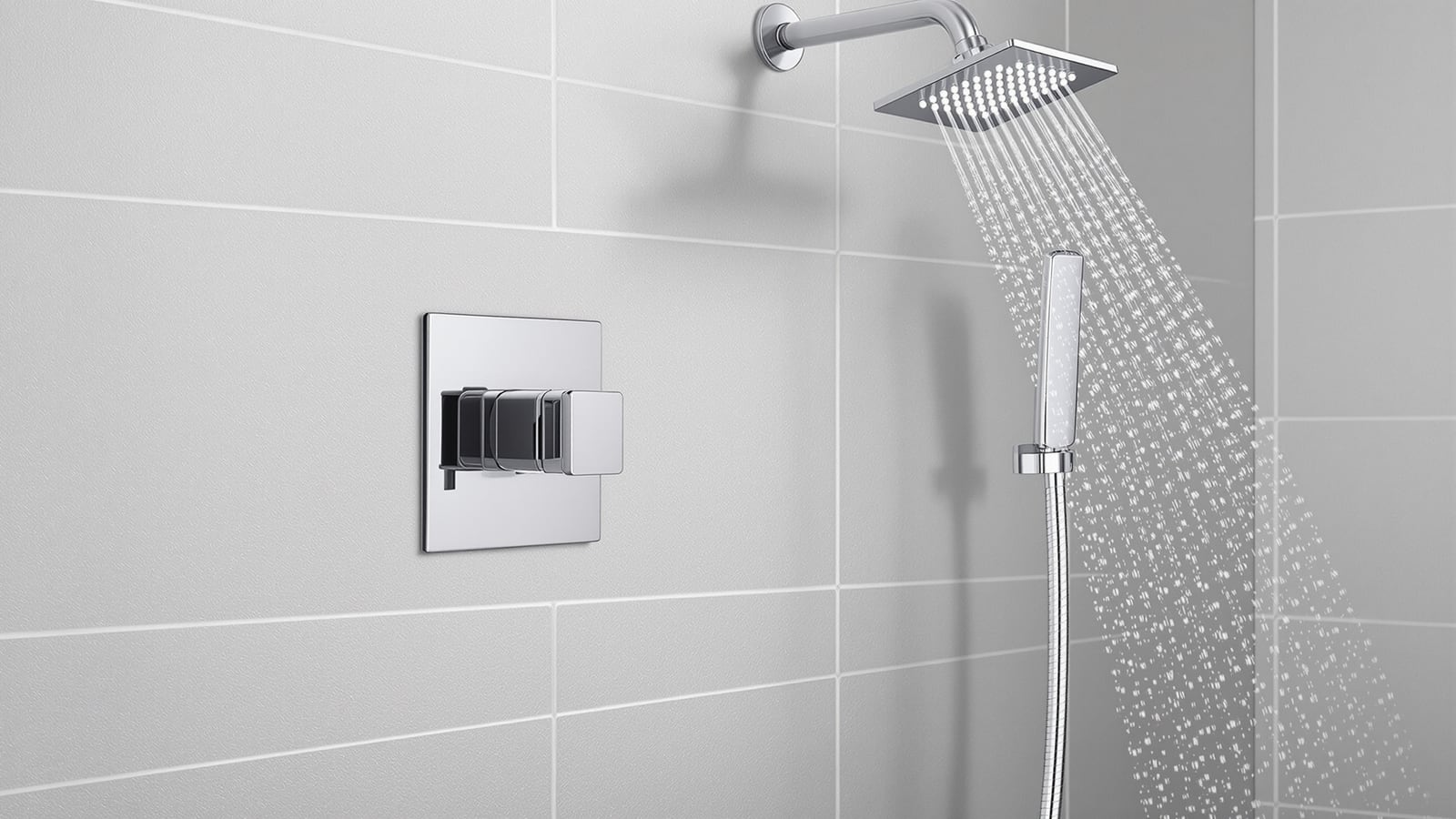
Look at any modern Indian shower that feels calm and hotel-like, and the reason is usually what you cannot see. Instead of a chunky wall-mixer with two taps and an exposed spout, there is just a flat plate and a lever set flush into the tiles. Behind that plate, buried inside the wall, sits the real machine — a concealed body of brass that mixes hot and cold and routes the water to wherever you want it. This is the concealed, or in-wall, faucet, and for showers especially it is now the default choice in well-designed Indian bathrooms.
The appeal is obvious: clean walls, easy cleaning, no exposed pipework to catch limescale. The catch is equally real: the working part is sealed behind tiles for the life of the bathroom, so getting the body and the rough-in right before you tile matters more than almost any other decision in the room. This is the concealed-faucet guide in the Studio Matrx bathroom hub. Read it alongside the bathroom faucets guide for India for the full family of taps, and compare it with the simpler wall-mounted faucet guide if you are still deciding between exposed and concealed. When you are laying out the shower zone itself, keep the bathroom design guide and, for new builds, the bathroom planning guide open beside this one.
The trim you see is the cheap, replaceable part. The concealed body you cannot see is the expensive, permanent part — so spend your money on the body, not the finish.
What a concealed faucet actually is
A concealed faucet is a two-part fitting. The concealed body (also called the concealed part, in-wall body or rough-in) is a solid brass block with the inlet ports for hot and cold, the mixing cartridge or the diverter mechanism, and the outlet ports. It is plumbed into the wall pipes and then plastered and tiled over, leaving only a threaded spigot or protective cap proud of the finished tile line.
The exposed trim (also called the finishing part or wall plate) is what you buy for looks — the escutcheon plate, the lever or knob, and the extension pieces that bridge from the buried body out to the tile face. The trim screws onto the body after tiling and can be swapped later for a new finish without touching the wall.
In a shower you will usually meet two kinds of concealed body:
- Concealed stop cock / diverter — controls flow and direction only. Temperature is set at a separate mixer or the geyser. A single lever or knob turns the water on and sends it to one or more outlets.
- Concealed single-lever mixer or diverter — mixes hot and cold and diverts, so one plate can control both temperature and which outlet runs. This is what most premium shower "trim kits" use.
Below is the anatomy of a typical concealed shower assembly.
Diverters: how the water gets routed
The diverter is the heart of a concealed shower. It is the valve that decides which outlet runs. In India you will see three grades, described by how many outlets they can feed:
- Single-way (on/off) diverter — one inlet, one outlet. It is really just a concealed stop cock. Use it where a wall has only one thing to feed, such as a single hand shower, a bath spout or a health-faucet supply.
- Two-way (2-in-1) diverter — one lever routes water to two outlets, typically the overhead shower and the hand shower. The most common choice for a normal Indian shower niche.
- Three-way (3-in-1) diverter — routes to three outlets: overhead rain shower, hand shower and a body jet or wall spout. This is the luxury spa set-up and needs the plumbing planned for all three lines.
An important distinction: most Indian diverters are routing diverters, meaning water goes to one outlet at a time, not all at once. If you want the rain shower and body jets running together, you need a different device — a flow-divider / multi-function valve or separate stop cocks per outlet — because a single diverter cannot serve two full-flow outlets simultaneously without starving both. Decide this before you buy the body.
| Diverter type | Outlets it feeds | Typical Indian use | Concealed body (₹, brand-neutral) |
|---|---|---|---|
| Single-way stop cock | 1 | Health faucet, single spout | ₹1,200 – ₹3,500 |
| Two-way diverter | 2 (overhead + hand) | Standard shower niche | ₹3,500 – ₹8,000 |
| Three-way diverter | 3 (overhead + hand + jet/spout) | Spa / luxury shower | ₹7,000 – ₹18,000 |
| Concealed single-lever mixer + diverter | Mix + 2/3 outlets | Premium one-plate control | ₹9,000 – ₹28,000 |
Prices are indicative for the buried body only; the exposed trim/finish kit is usually a separate line item of ₹2,000 – ₹15,000 depending on finish (chrome, matte black, brushed gold, rose gold).
Why the concealed body brand and quality matters most
Here is the rule that trips up most homeowners: you can always change the trim, but you can almost never change the body. The plate, lever and finish sit on the outside and unscrew in minutes. The body is set in cement and hidden under tiles — replacing it means breaking the wall, re-waterproofing and re-tiling. So the body is where quality has to live.
What "good body" means in Indian conditions:
- Solid forged brass, not zinc alloy or thin cast metal. Brass resists the dezincification and pitting that our hard water causes. A cheap body may work for two years, then seize or leak internally where you can never reach it.
- A serviceable cartridge/spindle you can pull from the front. The best systems let a plumber remove the working cartridge through the wall plate opening — no wall breaking. Confirm this before buying.
- A generous, adjustable rough-in depth. Tile plus adhesive plus stone cladding can add 20–40 mm; the body must sit at a depth that still lets the trim reach the finished face. Good bodies come with extension sleeves.
- A pressure-tested, warrantied body carrying an IS / BIS conformity mark. Ask for the cartridge warranty (often 7–15 years on premium brass bodies) separately from the finish warranty.
Buy the body from a brand you trust (Jaquar, Kohler, Hindware, Cera and similar all sell dedicated concealed ranges), even if you choose a cheaper trim finish, because the body is the part you are marrying to the wall for 20 years.
Planning the rough-in before you tile
Concealed fittings are unforgiving because the sequence is fixed: plumb, test, plaster, waterproof, tile, then trim. Every dimension is locked once the tiles go on.
Practical rough-in numbers for an Indian shower:
- Diverter / mixer plate height: 1000–1200 mm above finished floor (reachable without stepping into the spray).
- Overhead shower arm: 2000–2100 mm, or ceiling-drop for a rain head.
- Hand shower rail / outlet: 900–1100 mm.
- Wall / tub spout: 150–200 mm above the tub rim, or ~600 mm for a bucket-fill spout.
- Inlet lines: run hot on the left, cold on the right, 150 mm apart on standard bodies — confirm the specific body's template.
Because the shower wall gets soaked daily, the concealed body sits inside your wet-zone waterproofing. Detail it carefully — see the bathroom design guide for wet/dry zoning and the site waterproofing guide for sealing around penetrations.
Concealed vs exposed: honest pros and cons
| Concealed / in-wall | Exposed / wall-mounted | |
|---|---|---|
| Looks | Clean, flush, premium | Functional, visible pipework |
| Cleaning | Easy — one flat plate | More edges, catches limescale |
| Servicing | Front-serviceable if body allows; else wall-breaking | Fully accessible, easy swap |
| Upfront cost | Higher (body + trim + labour) | Lower |
| Change finish later | Easy — swap trim only | Replace whole fitting |
| Risk if body is poor | High — hidden leak, hard repair | Low — visible, reachable |
| Best for | New builds, planned showers | Renovations, rentals, quick fixes |
The takeaway: concealed is the right call when you are building or fully renovating and can plan the rough-in, and when you buy a serviceable, forged-brass body. Exposed remains the smarter, safer choice for a quick change, a rental, or any wall you cannot open up cleanly. If you are still weighing the two for a shower or basin, the wall-mounted faucet guide covers the exposed side in full, and the bathroom faucets guide sets both in the context of every tap in the house.
Living with a concealed faucet in Indian conditions
Once it is in the wall, a good concealed set asks for very little — but a few Indian realities are worth planning for.
- Hard water is the silent killer. The same limescale that furs up a kettle will crust the internal seat of a diverter you can never see. A whole-bathroom or overhead sediment/softening filter pays for itself by protecting the buried cartridge. Choose a body whose cartridge is a standard, stocked part so a plumber can replace it years later.
- Low or fluctuating pressure is common in independent Indian homes on overhead tanks. A three-way diverter splitting flow between a rain head and jets can feel weak on gravity feed; if your static head is under about 6–8 metres, plan for a pressure pump before you commit to a spa set-up.
- Keep the trim template. File the paperwork and the model number of the body somewhere safe — matching a replacement trim to a ten-year-old body is far easier with the exact reference than by guesswork.
- Test the diverter every few months. Cycle the lever through each outlet. A diverter that starts weeping to the "off" outlet is warning you the cartridge is wearing, and catching it early means a front-serviced swap instead of a wall repair.
Do this and a concealed shower set will comfortably outlast the tiles around it, which is exactly the point of hiding it there in the first place.
References
- National Building Code of India (NBC) 2016, Bureau of Indian Standards — Part 9 water supply, drainage and plumbing provisions relevant to concealed pipework and fittings.
- IS 8931 — Copper alloy fancy single taps, combination tap assembly and stop valves (diverter and stop-cock bodies).
- IS 781 — Cast copper alloy screw-down bib taps and stop valves for water supply.
- IS 1172 — Code of basic requirements for water supply, drainage and sanitation.
- CPHEEO Manual on Water Supply and Treatment, Ministry of Housing and Urban Affairs — pressure and pipe-sizing guidance behind shower supply lines.
- IGBC Green Homes / GRIHA — water-efficiency credits for flow-rated shower and diverter fittings.
Export this guide
Related Guides — Deep-dive reading
Body Jets Shower India: Body Spray Massage Systems, the Flow & Pressure They Really Need, and What It Costs (2026)
Wall-mounted horizontal body jets turn a shower into a spa massage — but every jet is a thirsty extra outlet. How many jets, at what heights, the big pump and geyser they force, the pipe sizing and concealed valves you must plan before tiling, the water and running cost, and exactly who it is worth it for.
BathroomsConcealed vs Exposed Plumbing India: Which Bathroom Fittings Are Better?
A fair head-to-head on concealed (in-wall) versus exposed bathroom plumbing and fittings for Indian homes — how each looks, what each costs to fit, and the one trade-off that decides it: a hidden concealed leak means breaking tiles, while exposed stays reachable.
BathroomsWall Mounted Basin Tap India: Spout Projection, Concealed Plumbing, Height & Cost
A practical, India-first guide to wall-mounted basin faucets — where the spout emerges from the wall above a countertop or vessel basin, plumbing hidden in the wall. Spout projection and height over the basin, why it must be planned before tiling, pros and cons versus deck-mounted taps, servicing, and rupee costs.
BathroomsRelated Tools — Try Free
Plumbing Pressure-Test & Leak Checklist
Pre-closure pressure and leak test — 9 categories, 60+ checkpoints across water supply, drainage, fixtures, waterproofing, hot water, tanks.
Pre-Closure TestRainwater Tank Sizer
How big should your rainwater tank be? Computes annual harvest, recommended tank capacity in litres, water-bill savings, and payback — for 10 Indian cities.
RWH CalculatorShower Water Flow Calculator
Shower water use per shower, day and month by head type, plus a pressure-adequacy check for your tank height or pump and low-flow savings.
Bathroom Calculator