
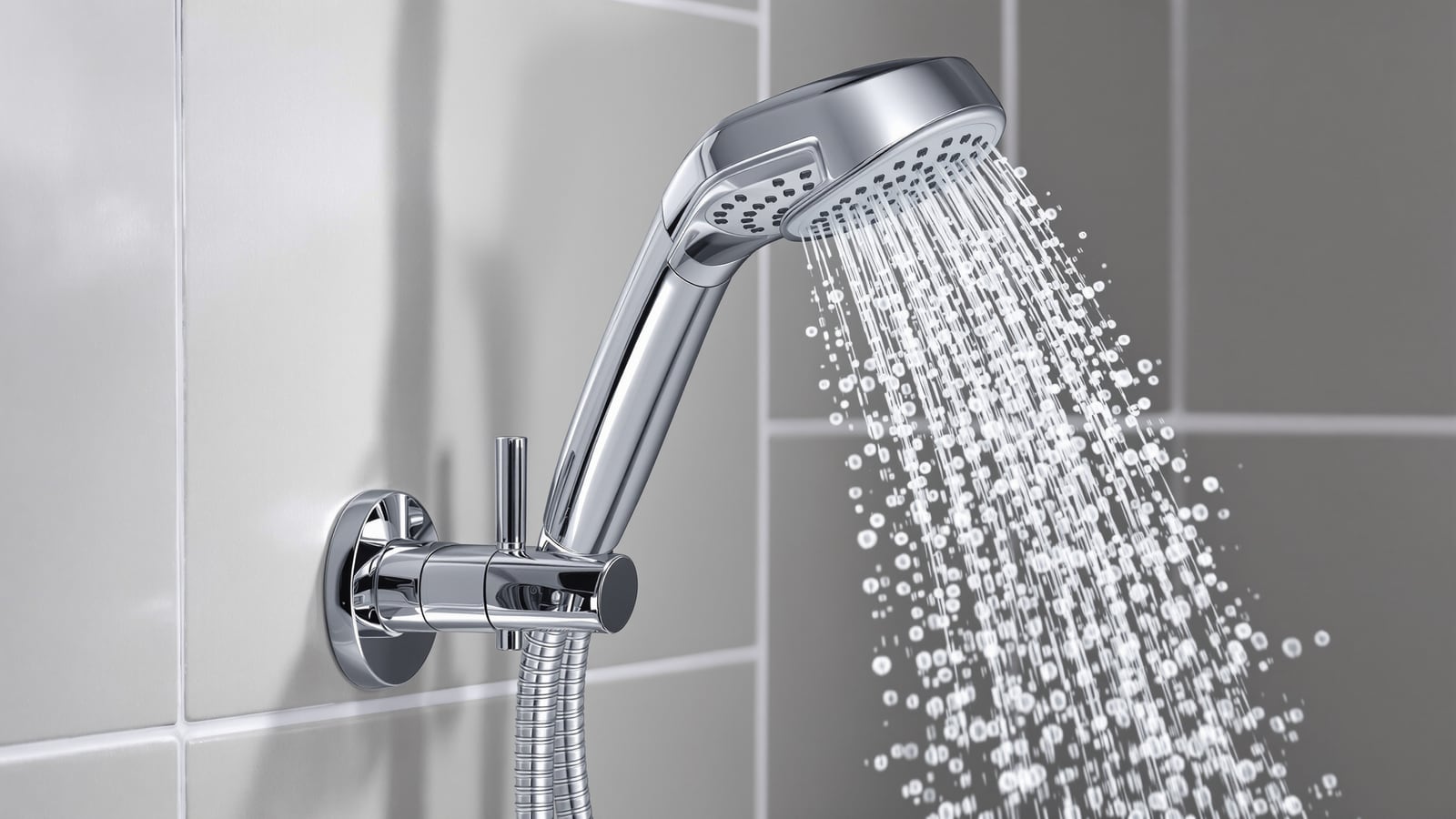
Hand Shower India: Handheld Shower Sets, Spray Modes & Riser Rails (2026)
Why a handheld hand shower is the most practical fixture in an Indian bathroom — spray modes, flow rates, wall bracket vs sliding riser rail, working at low pressure and off a geyser, pairing with an overhead, and honest rupee costs.
Ask an Indian family which shower fitting they actually use every day and the answer is almost never the big overhead rose — it is the hand shower, the handheld spray head on a flexible hose. It fills a bucket during a low-pressure hour, rinses shampoo out of a toddler's hair, lets an elderly parent wash while seated, and hoses down the floor after. No other bathroom fixture does so many jobs for so little money. This guide explains how to choose one, what the spray modes and flow numbers really mean, whether to hang it on a plain wall bracket or a sliding riser rail, and how it pairs with an overhead shower.
It sits under the shower pillar — read it alongside the shower systems guide for India for the full picture, the overhead shower guide for the fixed rain rose it pairs with, and, because a handheld is central to safe and easy bathing for both ends of the age range, the elderly friendly bathroom guide and the children's bathroom design guide.
In most Indian homes the overhead shower is the showpiece and the hand shower is the workhorse. If you can only fit one, fit the hand shower — it does everything the overhead does and a dozen things it cannot.
Why the hand shower is the Indian favourite
The handheld earns its place not through luxury but through sheer usefulness in real Indian conditions:
- It works at low pressure. When the overhead tank is nearly empty or a booster pump is off, a fixed rain rose dribbles — but you can hold a hand shower close to your body and still rinse properly. Bring the head to the water rather than waiting for the water to fall.
- It fills buckets. Bucket-and-mug bathing is still the norm in a huge share of Indian households, especially during load-shedding or water-supply hours. A hand shower fills a bucket in seconds and controls splashing far better than an open tap.
- It rinses kids, elders and pets. Directed water at the height you choose is safer and gentler than a fixed overhead stream for a nervous child, a seated senior, or the family dog.
- It cleans the bathroom. People routinely use the hand shower to rinse the WC, the floor, the walls and a potty. That double duty is why it is on virtually every shower wall.
- It is cheap and serviceable. A good handset with hose and bracket costs a few hundred to a couple of thousand rupees, and every part unscrews for descaling or replacement.
The trade-offs are minor: you hold it (a brief job, not a hands-free rain soak), the hose and seals are wear parts, and hard water blocks the spray face if you never clean it. None of this dents its value.
Spray modes — and which ones matter
Cheap hand showers give one spray pattern; mid and premium ones let you rotate the face or push a button to switch. The common modes:
- Rain / normal. A soft, wide full-face spray for everyday bathing. This is the one you will use 90% of the time.
- Massage / jet. Fewer, stronger pulsing jets for a shoulder-loosening rinse. Feels good, uses more directed force.
- Mist / aerated. A fine, air-mixed spray that feels fuller while using less water — kind to skin and to your bill.
- Bucket-fill / spray-off boost. Some heads give a concentrated stream that fills a bucket faster, useful in Indian routines.
More modes are not automatically better. A two- or three-function head covers almost everyone; the eight-mode heads add cost and more small holes to clog in hard water. Prioritise a rub-clean silicone nozzle face (you wipe limescale off with a thumb) over a high mode count — in Indian hard water that single feature saves the spray from dying within a year.
Flow rate, geysers and low pressure
Flow is measured in litres per minute (LPM). It is set by the head's holes and by your supply pressure. Two Indian realities shape the choice:
- Low incoming pressure. Gravity-fed overhead tanks on lower floors give weak pressure. A hand shower wins here because you close the gap physically — hold it near you. Avoid heavily flow-restricted or "pressure-boost" aerated heads if your line is already weak; they can starve at low pressure.
- Geyser (water heater) compatibility. Most Indian storage geysers are fine with a normal hand shower. The caution is instant/tankless gas or electric geysers, which often need a minimum flow to fire and can struggle if a very low-flow head or a nearly closed mixer drops flow below that trigger. If you run an instant heater, do not pick the most aggressively water-saving head, and open the mixer enough to keep the burner lit.
A 6–8 LPM head is a sensible water-saving target for a home on a decent supply; families who bucket-fill often prefer a freer 9–12 LPM so buckets fill fast. If saving water is a priority across the bathroom, read it with the wider shower systems guide, which covers overhead and diverter flow together.
| Spec | Typical range (India) | What to look for |
|---|---|---|
| Flow rate | 6–12 LPM | 6–8 LPM to save water; 9–12 for fast bucket-fill |
| Spray modes | 1–8 | 2–3 covers everyone; more clogs faster |
| Hose length | 1.0–1.75 m | 1.5 m suits a seated/elderly user reaching down |
| Hose type | PVC or steel-braided | Steel-braided (double-lock brass nuts) lasts far longer |
| Handset body | ABS chrome or brass | Brass for hot lines and longevity; ABS for value |
| Nozzle face | Silicone rub-clean or fixed | Silicone rub-clean is essential in hard water |
| Working pressure | 0.5–3 bar | Confirm the head is rated for your low-pressure supply |
Wall bracket vs sliding riser rail
The hose end goes into either a simple wall bracket (a fixed cradle) or a sliding riser rail (a vertical bar the handset clips onto and slides up and down). The choice is about who uses the shower.
- Wall bracket / cradle. Cheapest, simplest, one fixed height. Great for a compact bathroom, a guest toilet, or where a hand shower supplements an overhead. Drill one or two holes and done.
- Sliding riser rail. A vertical bar (typically 600–900 mm) with a clamp that adjusts height. You can bathe hands-free at your height, then drop it low for a child or a seated elder. This is the single best fitting for a multi-generational Indian household — tall adults, short kids and seniors on a shower stool all share one shower comfortably. Some rails double as a grab feature, but a riser rail is not a certified grab bar; for genuine support install a rated grab bar per the elderly friendly bathroom guide.
For a children's bathroom, a riser rail set low, plus a mist/rain mode and a thermostatic or good mixer to cap temperature, turns a scary overhead soak into a manageable, kid-controlled rinse.
Pairing with an overhead shower
The best Indian shower setup is usually both: a fixed overhead shower for a hands-free daily soak and a hand shower for everything else. They are joined by a diverter — either a lever on the mixer or a three-way diverter that sends water to the overhead, the hand shower or a spout. Points to plan:
- Feed the hand shower from the same mixer via the diverter so both share one hot/cold control — cleaner than two separate taps.
- Mount the hand shower outlet at about 1.1–1.2 m so the hose reaches the floor and a seated user, while the overhead sits at 2.0–2.2 m.
- On a thermostatic or good pressure-balanced mixer, the hand shower holds a safe, steady temperature — worth it for kids and elders.
- If budget forces one only, choose the hand shower on a riser rail; add the overhead later off the same diverter.
Buying and maintenance checklist
- Buy the head, hose and bracket as a matched set or confirm the hose nuts are standard 1/2 inch so parts interchange.
- Insist on a steel-braided hose with brass connectors — PVC hoses kink and split first.
- Choose a silicone rub-clean nozzle face; in hard water it is the difference between a spray that lasts years and one that clogs in months.
- Keep modes to two or three unless you truly want more; each mode is more holes to descale.
- Descale periodically — unscrew the face and soak in dilute citric acid or vinegar to clear Indian hard-water limescale.
- Fit a good two-way or three-way angle valve so you can isolate and service the hand shower without shutting the bathroom.
References
- National Building Code of India (NBC 2016) — Part 9 Plumbing Services: water supply, angle valves, mixers and shower fitting connections.
- IS 15758 — Sanitary fittings: specification for single-lever mixers and shower fittings (health taps, hand showers and hoses).
- IS 1172 — Code of basic requirements for water supply, drainage and sanitation (fixture water demand relevant to shower flow).
- IS 2065 — Code of practice for water supply in buildings (pressure and pipe sizing that governs shower performance).
- CPHEEO Manual on Water Supply and Sanitation (Ministry of Housing and Urban Affairs) — plumbing and water-conservation practice.
- BIS — Bureau of Indian Standards, for current sanitary-fitting standard numbers and revisions.
Export this guide
Related Guides — Deep-dive reading
Bathroom Water Supply India: Cold & Hot Feed, Pipe Sizing, Pressure & Booster Pumps (2026)
How water actually reaches your fixtures in an Indian home — gravity-fed cold from the overhead tank, hot from the geyser, the pipe sizes that decide whether your shower gushes or dribbles, isolation valves at every fixture, booster pumps and hard-water protection, all mapped to IS 1172.
BathroomsBody Jets Shower India: Body Spray Massage Systems, the Flow & Pressure They Really Need, and What It Costs (2026)
Wall-mounted horizontal body jets turn a shower into a spa massage — but every jet is a thirsty extra outlet. How many jets, at what heights, the big pump and geyser they force, the pipe sizing and concealed valves you must plan before tiling, the water and running cost, and exactly who it is worth it for.
BathroomsShower Systems Guide India: Overhead, Rain, Hand Shower, Body Jets, Mixers & Water Pressure
The complete guide to shower systems for Indian bathrooms — overhead and rain showers, hand showers and body jets, the mixer and diverter that drive them, the hard truth about water pressure from overhead tanks, geyser sizing for hot water, and how to waterproof the shower zone. Choose the right system for your pressure and budget.
BathroomsRelated Tools — Try Free
Shower Water Flow Calculator
Shower water use per shower, day and month by head type, plus a pressure-adequacy check for your tank height or pump and low-flow savings.
Bathroom CalculatorShower Pump Calculator
Check whether your shower needs a pressure-boost pump and what size — available vs required pressure from your tank height or supply.
Bathroom CalculatorChild & Elder Home-Safety Audit
Room-by-room safety audit for households with children or seniors — 10 categories, 70+ checkpoints tagged by audience.
Safety Audit