
Thermostatic Shower India: Set-Temperature Valves, Anti-Scald Safety & What They Cost (2026)
How a thermostatic shower holds your temperature when someone opens a tap, the balanced hot-and-cold pressure it needs, geyser vs instant-heater compatibility in India, exposed vs concealed valves, pairing with rain, hand and body jets, and the real rupee premium.
You are mid-shower, perfectly comfortable, when someone flushes the WC or opens the kitchen tap. On an ordinary shower the water lurches — suddenly scalding as the cold is stolen, or icy as the hot is drawn away. You flinch, jump clear, and re-fiddle the handle. In an Indian home fed by an overhead tank, a small booster pump and a geyser, this tug-of-war happens several times an hour. It is merely annoying for a fit adult. For a toddler or an 80-year-old — whose skin burns faster and who cannot leap out of the stream in time — it is genuinely dangerous.
A thermostatic shower ends it. You set a temperature; the valve holds that temperature to within a degree or two no matter what the pressure does behind the wall. This guide is India-first: the plumbing you actually have, the water-heater realities that decide whether it works brilliantly or disappoints, and the rupee ranges you will actually be quoted. Read it up to the shower systems guide for India for the full overhead, hand and jet picture, and alongside the thermostatic mixer guide, which goes deeper into the wax-cartridge valve itself.
A thermostatic shower is a safety device first and a comfort device second. If children, elderly parents or anyone with reduced sensation use the bathroom, treat scald protection as non-negotiable, not a luxury upgrade.
What makes a shower "thermostatic"
An ordinary shower mixer blends hot and cold in a fixed ratio set by the handle. It has no idea what temperature is coming out: if the cold pressure drops, the blend runs hot; if the hot runs out, it runs cold. A thermostatic shower valve controls the outlet temperature directly. You dial, say, 40 degrees; a heat-sensitive element inside continuously measures the blended water and re-adjusts the hot:cold mix many times a second to keep it there. If the cold supply fails completely, a good valve does the critical safety act — it shuts the flow off within a second or two rather than delivering a scalding jet.
Two behaviours define a quality unit:
- A preset anti-scald limit. Most thermostatic valves ship with a safety stop around 38 degrees C and a button you must deliberately press to override and go hotter. That stop is the anti-scald feature.
- A fast fail-safe cut-off. On loss of cold supply the outlet must not overshoot dangerously; the valve throttles or closes. This is what protects a child who cannot react.
The underlying technology is the TMV (thermostatic mixing valve) — the same principle used in hospitals and care homes, scaled to a domestic shower.
The one thing that decides success: balanced pressure
Here is the caveat every Indian buyer must understand before spending. A thermostatic valve works by trading hot for cold on the fly — so it needs both a hot and a cold supply at roughly comparable pressure. If the two sides are wildly mismatched, the valve cannot balance them and either hunts, dribbles, or refuses to reach temperature.
This is where the Indian water-heater choice becomes make-or-break:
- Storage geyser (electric or gas storage tank). Ideal. The geyser is fed from the same overhead tank as the cold line, so both sides sit at the same gravity head — naturally balanced. Thermostatic showers are designed for exactly this.
- Instant / instantaneous heater (small on-demand heater or gas instant geyser). Risky. These need a minimum flow to fire, and they impose their own pressure drop. A thermostatic valve constantly modulating flow can drop the hot side below the heater's ignition threshold, so the burner cuts out and you get cold water — the exact opposite of what you paid for. Many instant heaters are simply not compatible with thermostatic mixing. Check the heater's minimum activation flow (litres/min) against the valve before buying.
- Direct municipal cold + geyser hot. Watch out — municipal cold can arrive at high mains pressure while the geyser hot is only at tank-head pressure. This mismatch is a classic reason a thermostatic shower disappoints. A pressure-reducing valve on the cold, or feeding both from the tank, fixes it.
| Water-heating setup | Thermostatic shower fit | What to check / add |
|---|---|---|
| Overhead tank → storage geyser (both gravity-fed) | Excellent — the intended case | 1–2 m head min; a booster pump helps low floors |
| Instant / on-demand heater | Often poor | Heater's minimum flow to fire; many are incompatible |
| Mains cold + geyser hot | Poor unless balanced | Add pressure-reducing valve on cold, or feed cold from tank |
| Low overhead tank, top floor, no pump | Weak flow | Add a pressure pump; target ~1–2 bar balanced |
Before you buy a thermostatic shower, confirm two things: your hot source is a storage geyser (not an instant heater), and your hot and cold arrive at similar pressure. Get these right and the valve is flawless; get them wrong and no brand will save it.
For a minimum-flow point of view, most domestic thermostatic valves want roughly 1 bar (about 10 m head) of balanced pressure to perform well, though many will work down to around 0.5 bar. A small pressure pump feeding both hot and cold equally is the standard Indian fix for upper floors.
Exposed vs concealed
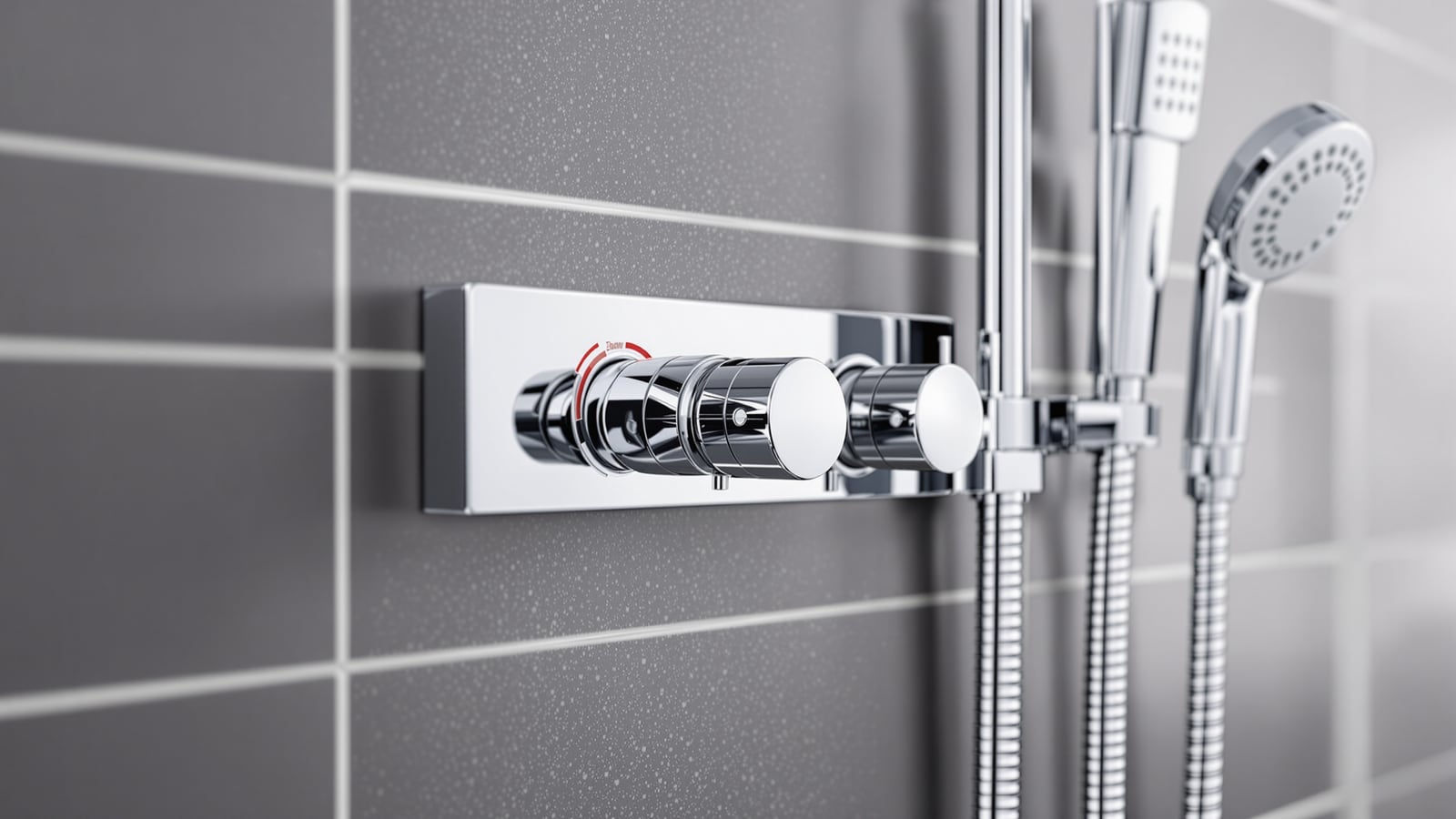
- Exposed thermostatic shower. The valve body sits on the wall, pipes visible or in a bar riser. Easy to retrofit, easy to service, no wall-breaking. The go-to for renovations, rented flats and second bathrooms. Bar-mixer versions combine the thermostatic valve with a slide rail and hand shower in one unit.
- Concealed thermostatic shower. The valve body is buried in the wall; only the dials and plates show. Clean, premium, spa-like — and it pairs naturally with an overhead rain head. But it must be planned before tiling, needs an access provision for service, and a leak behind the tiles is expensive. Insist on a valve with a serviceable cartridge from the front, and photograph the rough-in before waterproofing.
Whichever you choose, coordinate it with your bathroom waterproofing and the wall build-up — a concealed valve is set into the same wet wall your membrane protects.
Pairing with rain, hand and body jets — outlets and diverters
A thermostatic shower rarely feeds just one head. The valve regulates temperature; a diverter then sends that safe-temperature water to whichever outlet you pick. This is where "1-way / 2-way / 3-way" ratings matter.
Two things about jets specifically: they are thirsty. Six body jets can demand more litres per minute than an overhead tank on gravity can deliver, which starves the valve and collapses temperature control. A jet-heavy system almost always needs a pressure pump and generously sized (usually 20 mm / 3/4-inch) supply pipes. Run only the outlets your flow can support at once — a diverter that lets you run rain and hand shower and jets together is only useful if your supply can feed all three.
| Outlet combination | Typical flow demand | Supply reality in India |
|---|---|---|
| Single rain head | Moderate–high | Needs good head; low tanks disappoint |
| Rain + hand shower (2-way) | Moderate if used one at a time | Works on most tank+pump setups |
| Rain + hand + body jets (3-way) | High | Needs pump + 20 mm pipes; not for weak supply |
What it costs — the premium
A thermostatic valve costs meaningfully more than a plain mixer because of the precision cartridge inside. Indicative 2026 India ranges (valve/system only, brand-neutral, excluding overhead heads and installation):
| Item | Indicative range (₹) | Notes |
|---|---|---|
| Exposed thermostatic bar mixer (with rail + hand shower) | ₹12,000 – ₹35,000 | Easiest retrofit; all-in-one |
| Concealed thermostatic valve (2-way) | ₹18,000 – ₹55,000 | Add overhead + hand kit separately |
| Concealed thermostatic (3-way, jets-ready) | ₹35,000 – ₹1,20,000+ | Premium; pump usually required |
| Pressure pump (if needed) | ₹6,000 – ₹20,000 | Often the difference between works / doesn't |
| Overhead rain head (300–400 mm) | ₹4,000 – ₹40,000 | Separate line item |
Against a good non-thermostatic mixer at ₹3,000–₹10,000, the premium is real. It is easiest to justify where safety matters most — see the elderly-friendly bathroom guide — and it pairs naturally with app or push-button control, covered in the digital shower guide.
Hard water, humidity and maintenance
India's hard water is the thermostatic cartridge's enemy: scale furs the sensing element and moving parts, so the valve slowly loses accuracy and can stick. To keep it healthy:
- Fit an inline strainer / filter on the supply and clean it periodically.
- Exercise the valve across its full range occasionally so parts do not seize.
- Choose a unit with a front-serviceable, replaceable cartridge — a concealed valve you cannot open without breaking tiles is a future headache.
- Consider water softening or anti-scale treatment if your area is severely hard.
Do / don't
| Do | Don't |
|---|---|
| Feed both hot and cold from the same tank for balance | Pair with an instant heater without checking min-flow |
| Confirm a storage geyser before buying | Bury a non-serviceable cartridge behind tiles |
| Add a pump for upper floors and jet systems | Expect jets and rain to run together on weak gravity |
| Set the anti-scald stop at ~38°C for kids/elders | Assume any mixer marked "hot/cold" is thermostatic |
| Leave a concealed-valve access provision | Skip the inline strainer in hard-water areas |
References
- National Building Code of India (NBC) 2016, Part 9 (Plumbing Services) — water supply, hot-water and sanitary installation provisions.
- IS 1701 — Mixing valves for ablutionary and domestic purposes (thermostatic mixing valve reference).
- IS 1172 — Code of basic requirements for water supply, drainage and sanitation.
- CPHEEO Manual on Water Supply and Treatment, Ministry of Housing and Urban Affairs — design flows and pressures for domestic supply.
- Bureau of Indian Standards (BIS) — sanitaryware and plumbing fittings standards (product marking and quality).
Export this guide
Related Guides — Deep-dive reading
Thermostatic Mixer India: Anti-Scald Showers, Set-Temperature Valves & What They Really Cost (2026)
How a thermostatic mixer holds one safe temperature no matter what happens to the pressure — the wax cartridge explained, why it needs balanced hot and cold supply, geyser vs instant-heater realities, exposed vs concealed, rupee ranges, and exactly who should pay the premium.
BathroomsShower Systems Guide India: Overhead, Rain, Hand Shower, Body Jets, Mixers & Water Pressure
The complete guide to shower systems for Indian bathrooms — overhead and rain showers, hand showers and body jets, the mixer and diverter that drive them, the hard truth about water pressure from overhead tanks, geyser sizing for hot water, and how to waterproof the shower zone. Choose the right system for your pressure and budget.
BathroomsBathroom Water Supply India: Cold & Hot Feed, Pipe Sizing, Pressure & Booster Pumps (2026)
How water actually reaches your fixtures in an Indian home — gravity-fed cold from the overhead tank, hot from the geyser, the pipe sizes that decide whether your shower gushes or dribbles, isolation valves at every fixture, booster pumps and hard-water protection, all mapped to IS 1172.
BathroomsRelated Tools — Try Free
Shower Pump Calculator
Check whether your shower needs a pressure-boost pump and what size — available vs required pressure from your tank height or supply.
Bathroom CalculatorMonsoon-Readiness Checklist
Pre-rain home audit across 9 categories — terrace, drains, waterproofing, electrical, HVAC, pest, vehicles, documents.
Seasonal AuditPlumbing Pressure-Test & Leak Checklist
Pre-closure pressure and leak test — 9 categories, 60+ checkpoints across water supply, drainage, fixtures, waterproofing, hot water, tanks.
Pre-Closure Test