

Rainwater Harvesting Regulations Across India
Where harvesting rain is the law, not just a good idea: city-by-city rules, thresholds, penalties and how to get signed off
In most of India, harvesting rainwater is not just a nice green gesture you can do if you feel like it. In a large number of states and cities it is a legal requirement that your building must meet before it is allowed to be occupied. If you are building a new house, adding a floor, or buying a recently built property, rainwater harvesting (RWH) is very likely something the local rules expect to see in place, and in several cities you will be billed extra every month if it is missing.
This guide explains the law side of rainwater harvesting in plain language: who has to do it, when the rule kicks in, what "compliance" actually looks like on the ground, and how it varies wildly from one city to the next. We will name real rules and bodies where we are confident, give honest ranges instead of made-up exact numbers, and keep pointing you back to the one source that truly governs you: your own municipal corporation or state water board.
This is the legal companion to our practical rainwater harvesting for Indian homes (the how-to). Read this one to understand what you are obliged to do; read that one to understand how to actually build it.
1. Why a government can force you to harvest rain
The first thing to understand is why this is a rule at all, because it explains how the rules are written and enforced.
India's cities sit on top of groundwater that has been pumped out far faster than the rain can refill it. In many urban areas the water table has dropped by metres over a couple of decades. At the same time, when a city paves over its open ground with roads, parking and concrete, rain that used to soak in now rushes off into drains, causing the urban flooding you see every monsoon. So a single litre of rooftop rainwater is solving two problems at once: it recharges the aquifer underneath you, and it does not add to the flood in the street.
Because the benefit is shared by everyone, governments treat RWH the way they treat fire safety or structural stability: as a public-interest condition attached to the permission to build. That is the key mental model. RWH compliance is usually bolted onto the building approval process, not run as a separate scheme you opt into.
2. The two moments where the rule bites
For a homeowner, the regulation shows up at two specific points. Knowing them tells you exactly when you need to be ready.
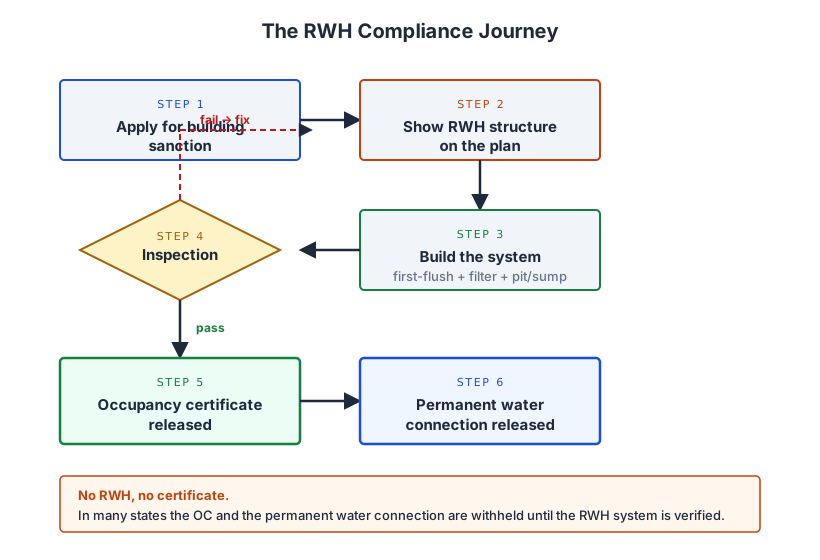
The first is at building sanction, when you apply for permission to build. Many cities require the RWH structure to be shown on your sanctioned plan. The plan approval authority (your municipal corporation or development authority) is meant to refuse the plan if RWH is not provided.
The second is at the occupancy or completion certificate stage. This is the more important one to know about. The occupancy certificate (OC), sometimes called a completion certificate, is the document that legally allows people to live in the building. In many states the OC will not be issued, and crucially the permanent water and sewer connection will not be released, until the authority is satisfied the RWH system actually exists. In other words, "I will add it later" does not work, because the certificate that lets you move in is held back until it is done.
To understand how RWH fits into the wider approval machinery, see understanding building bye-laws and how urban regulations shape cities.
3. How the requirement scales with your plot and roof
You will rarely find a rule that says "every shed needs a recharge pit". Instead, the obligation almost always scales, and it scales on two measurements.
The first is plot area, the size of your land. Most rules switch on above a threshold plot size. Below it, you may be exempt or only encouraged; above it, RWH is compulsory.
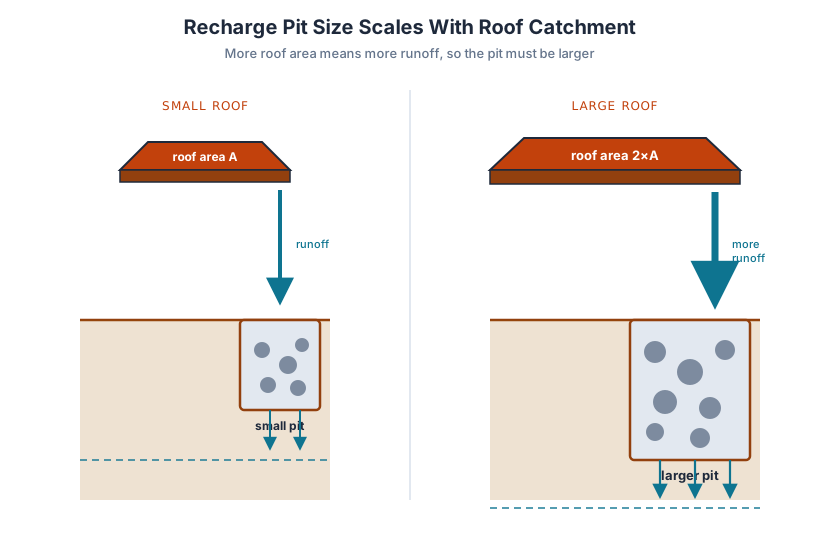
The second is catchment area, which mostly means your roof area, plus paved areas in larger plots. This drives the size of what you must build, because the more roof you have, the more rain runs off it, and the bigger the pit or tank needs to be to handle that runoff.
So the typical rule has this shape: if your plot is bigger than some threshold, you must provide RWH sized in proportion to your roof and paved area. The exact threshold and the exact sizing formula are where cities differ enormously, which is the whole point of the next section. You can estimate the storage and recharge volume your own roof produces with our rainwater tank sizer tool.
4. City by city: the same idea, very different numbers
This is the part where you must be careful, because the rules genuinely differ and they change over time. The table below describes the shape of the rule in some well-known cities. Treat every number as illustrative and verify it against the live municipal or water-board source before you rely on it.
| City / state | Lead body | Rough trigger (illustrative, verify) | How it is enforced |
|---|---|---|---|
| Tamil Nadu (statewide) | Municipal authorities under the 2003 ordinance | All buildings, public and private; larger non-residential buildings sized to roof | No NOC / no water-sewer connection without RWH |
| Chennai | Chennai Metro Water (CMWSSB) + CMDA | Effectively all premises, building on the statewide 2003 mandate | Plan sanction and connection tied to RWH |
| Bengaluru | BWSSB | Larger sites (illustratively newer plots above roughly 30x40 ft, older above roughly 40x60 ft) | Monthly penalty added to the water bill for non-compliance |
| Delhi | Delhi Jal Board (DJB) | New buildings above a smaller plot size; existing buildings above a larger one | Rebate for compliance; higher tariff for large non-compliant plots |
| Many other cities | Municipal corporation / development authority via bye-laws | Often above a plot threshold in the few-hundred-square-metre range | Tied to plan approval and OC |
A few of these deserve a closer look.
5. Tamil Nadu and Chennai: the pioneer
Tamil Nadu is the landmark case. In 2003, through a state ordinance amending the municipal laws, Tamil Nadu made rainwater harvesting compulsory for buildings across the state, with a famously short deadline. Chennai had already been moving in this direction by amending its development control rules and building bye-laws around 2001.
What made the Tamil Nadu rule powerful was the enforcement hook: authorities were directed not to issue the certificates and clearances a building needs, and the water and sewer connection could be withheld, unless RWH was provided. The widely reported result was a measurable recovery in groundwater levels and quality in the years after, which is exactly why so many other states copied the model. If you build in Tamil Nadu, assume RWH is non-negotiable and is checked at sanction.
6. Bengaluru: the cautionary tale of the monthly penalty
Bengaluru shows what happens when a city decides to enforce with money rather than paperwork alone. Under the Bangalore Water Supply and Sewerage Board (BWSSB) rules, RWH was made mandatory for buildings above a size threshold, with the threshold set lower for buildings constructed after the rule came in and higher for older ones.
The teeth are in the water bill. Owners who fail to provide a working RWH structure face an additional charge added to their water and sanitary charges, reported in the range of an extra quarter of the bill at first and rising to half, continuing until the system is built. Bengaluru has been collecting these penalties from tens of thousands of homes month after month. The lesson for a homeowner is blunt: in a penalty city, skipping RWH is not a one-time risk, it is a recurring bill you pay forever until you comply.
7. Delhi: carrot as well as stick
Delhi, through the Delhi Jal Board (DJB), combines penalty and reward. New buildings above a relatively small plot size and existing buildings above a larger one are expected to have rooftop RWH. The notable feature here is the rebate: a household with a working RWH system can earn a discount on its water bill, with a further discount if waste-water recycling is also in place. On the other side, large plots without a functional RWH system can attract an enhanced tariff. So in Delhi the financial logic runs both ways, and a compliant home is rewarded, not merely spared a fine.
8. The national backbone: bye-laws, the water board, and CGWB
Behind all this city-level variation sits a national framework that explains why the rules look similar even when the numbers differ.
The central Model Building Bye-Laws, which states and cities adapt into their own bye-laws, recommend RWH provisions above a plot threshold, which is why so many municipal bye-laws carry an RWH clause. Separately, the Central Ground Water Board (CGWB) publishes the technical guidance and artificial-recharge manuals that engineers use to size pits and design recharge structures, and the CGWB also regulates groundwater extraction, which is the other half of the same water-security picture. RWH is the recharge side; groundwater regulation is the withdrawal side.
This is also why RWH increasingly travels alongside other green-building mandates. For the energy equivalent of the same idea, see solar energy mandates in buildings, and for the bigger map of which regulation applies where, the India Regulatory Atlas.
9. What compliance physically means
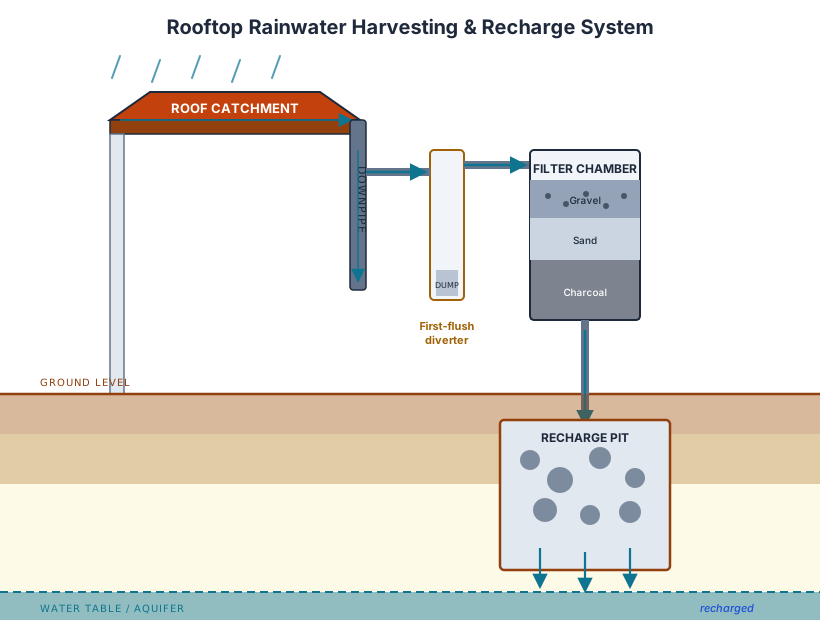
When the inspector signs off, what are they actually looking for? Whatever the city, a compliant home system has the same handful of parts, and it helps to know them so you can confirm yours is real and not just drawn on paper.
There is a catchment, which is your roof, and the downpipes that carry its water down. There is a first-flush diverter, a simple device that throws away the dirty first wash of rain that carries dust and bird droppings off the roof, so it does not contaminate what you store or recharge. There is filtration, typically a chamber with layers of gravel, sand and charcoal that cleans the water. And then there is the destination, which is either a storage sump or tank if you intend to use the water, or a recharge pit or recharge well if the goal is to send it into the ground to lift the water table.
Sizing is driven by your roof area and your local rainfall. The larger the roof and the heavier the rain, the bigger the pit or tank. Cities publish their own minimum sizes, so treat any single figure you read online as a starting point, not the law.
10. How to check your obligation and get it signed off
Here is the practical sequence for a homeowner who wants to do this right and avoid trouble later.
Start by finding your governing body. If your city has a dedicated water board (BWSSB, DJB, CMWSSB and so on), that board usually owns the RWH rule. Otherwise it lives in your municipal corporation or development authority bye-laws. Search for the current RWH rule on that body's official website rather than trusting a third-party summary, because thresholds and penalties get amended.
Next, check whether your plot crosses the trigger. Note both the plot-area threshold and any roof-area sizing formula. If you are near a threshold, treat yourself as covered and design for it anyway, since the cost of a recharge pit is small against the cost of a withheld occupancy certificate.
Then put RWH on your sanctioned plan from the start. Your architect or licensed building professional should include the RWH structure in the drawings submitted for approval, because retrofitting after the slab is poured is harder and more expensive.
Finally, get it inspected and documented. Keep photographs and any completion proof, because the OC and the permanent water connection often depend on it. If you are buying a recently built home, ask the seller for proof of the RWH system and check it physically, so you do not inherit someone else's penalty.
What this means for you
If you are building or buying in urban India, assume rainwater harvesting is mandatory until you have confirmed otherwise from your own municipal or water-board source. The rule almost always switches on above a plot-size threshold, scales with your roof area, and is enforced at the moment that matters most, when your occupancy certificate and water connection are issued. In penalty cities like Bengaluru it becomes a recurring monthly charge if you skip it, and in cities like Delhi you can actually earn a rebate for getting it right.
The exact numbers in this guide are illustrative on purpose, because they differ city to city and change with each amendment. The shape of the rule, however, is remarkably consistent across India, and so is the smart move: design RWH into your plan from day one, size it to your roof, build it properly with a first-flush diverter and filtration, and keep the proof. Use the rainwater tank sizer tool to estimate your volumes and the how-to guide to build it.
Sources
- Centre for Science and Environment (CSE), Legislation on Rainwater Harvesting: https://www.cseindia.org/legislation-on-rainwater-harvesting-1111
- Central Ground Water Board (CGWB), rainwater harvesting and artificial recharge guidelines: https://cgwb.gov.in/
- Bangalore Water Supply and Sewerage Board (BWSSB), rainwater harvesting rules: https://bwssb.karnataka.gov.in/
- Delhi Jal Board, rainwater harvesting and rebate provisions: https://delhijalboard.delhi.gov.in/
- Chennai Metro Water Supply and Sewerage Board (CMWSSB): https://chennaimetrowater.tn.gov.in/
- Ministry of Housing and Urban Affairs, Model Building Bye-Laws: https://mohua.gov.in/
Always confirm the current threshold, sizing and penalty against your own municipal corporation or state water board before you rely on any figure here.
Export this guide
Related Guides — Deep-dive reading
Rainwater Harvesting Rules in India: When RWH Is Mandatory & How to Comply
A plain-English guide to India's mandatory rainwater-harvesting rules for homeowners — why so many states and cities require RWH for buildings above a certain size, how it becomes a condition for plan sanction and completion certificate, and why the exact trigger, structure and rebate always come from your own local bye-laws.
PlumbingRooftop Rainwater Harvesting Rules in India: Where It's the Law
In much of India, a rooftop rainwater harvesting system is not a green extra — it is a condition of your building sanction, completion and occupancy certificate. What the rule typically requires, the standard it points to (IS 15797), who designs and certifies it, and why the exact threshold, rebate and penalty are set by your city, not the country.
RoofingRooftop Rainwater Harvesting
The rain that lands on your roof is a free water supply and, in most Indian cities, a legal duty. What a rooftop rainwater harvesting system is, the two paths (store it for reuse or recharge the groundwater), the parts that make it work, how much a roof can actually collect, and the maintenance that keeps it honest. Plain language, India-grounded.
RoofingRelated Tools — Try Free
Rainwater Tank Sizer
How big should your rainwater tank be? Computes annual harvest, recommended tank capacity in litres, water-bill savings, and payback — for 10 Indian cities.
RWH CalculatorProperty Tax Calculator — 10 Indian Cities
Estimate annual municipal property tax across BBMP / MCD / MCGM / GHMC / GCC / KMC / PMC / AMC / TMC / PCMC — with self-occupied, tenanted, and age-rebate adjustments.
Property TaxRecharge Pit Size Calculator
Size a rainwater recharge pit from catchment area, rainfall intensity and detention time, with a suggested footprint.
Plumbing Calculator