
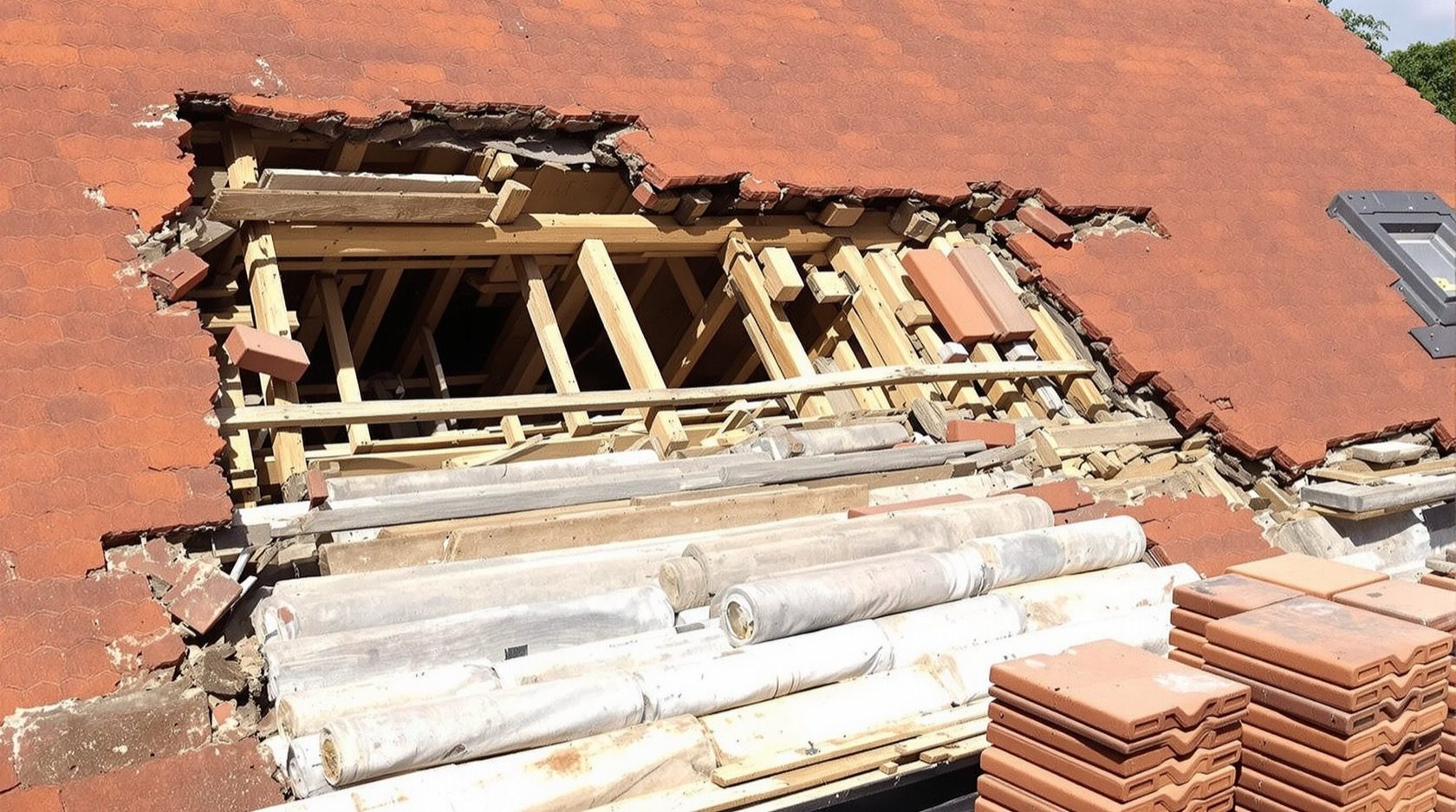
Roof Replacement Cost & When to Replace
What it really costs to replace a roof in India in 2026, and how to know when it is time — the repair-vs-replace call, indicative cost ranges by roof type, the hidden costs that surface when the old roof comes off, why to re-roof before solar, and how to control cost without cutting corners. Plain language, India-grounded.
Sooner or later the buckets come out. The waterproofing that was fresh fifteen years ago has gone brittle, the terrace ponds every monsoon, and the patch you paid for last year is leaking again. At some point repairing an old roof stops being thrift and starts being throwing money into a hole — and the honest question becomes not "how do I fix this again?" but "what does it cost to replace, and is it time?"
This is the money guide of the Roofing Knowledge Hub, and the budgeting companion to the Ultimate Guide to Roofing Systems and the practical Roof Renovation & Replacement Guide. It will not turn you into a quantity surveyor, and it will never hand you a single "the roof costs ₹X" number — because no honest number exists. What it will do is let you make the repair-vs-replace call, read a quote with understanding, know the indicative 2026 ranges, spot the costs that only surface once the old roof comes off, and control the bill without cutting the corners that make a roof fail.
Scope & safety. This guide helps you understand, plan, budget and judge a roof replacement. Structural assessment, load calculation, waterproofing application and any working-at-height are qualified professional work for a structural engineer and a licensed roofing contractor. A roof that sags, cracks or spalls is a possible structural warning — do not walk or load it, and get an engineer before anyone works on it. Every price here is an indicative 2026 range that varies by city, quality, brand, scale and market; nothing here replaces a site-specific quote.
When is it time to replace?
Replacement is a decision, not a verdict — and the money is won or lost here. Patch too eagerly and you pay again and again; replace too eagerly and you spend lakhs you did not need to. The honest way to decide balances four things, worked in order: is the structure sound, how widespread is the damage, how much life is left, and how do the repeated repairs add up.
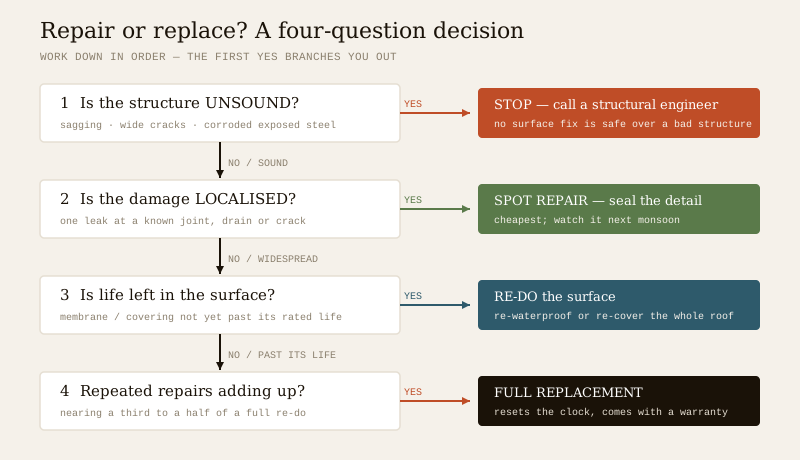
1. Is the structure sound? Deep spalling with corroded steel, structural cracks or real sagging means no surface repair is safe or lasting — and only a structural engineer can make this call. This decides everything.
2. How widespread is the damage? One leak at a known joint is a spot repair. Water soaking through over large areas, brittle membrane everywhere, chronic ponding — that is a whole-system problem, and patching it is throwing good money after bad.
3. How much life is left? A membrane or covering near the end of its rated life that is failing in one place is usually failing everywhere; re-doing it once beats five annual patches.
4. What do the numbers say? As a rough rule, when the cumulative cost of repairs over a few years starts to approach a third to a half of a full re-do, replacement is the better value — and it resets the clock with a warranty.
| Situation | Sensible response |
|---|---|
| Single leak at a known joint, drain or crack; rest sound | Spot repair — seal the detail, watch it |
| Waterproofing brittle / blistered across the terrace; structure sound | Re-waterproof the whole surface |
| Widespread damp, ponding, membrane long past its life | Full replacement — re-slope, re-do, re-finish |
| Sagging, structural cracks, corroded exposed steel | Stop — call a structural engineer first |
| Sloping roof: a few slipped or broken tiles | Spot repair — replace tiles, check battens |
| Sloping roof: widespread rust, rot or repeated leaks | Re-roof — new covering, likely new underlay |
The mindset that keeps you honest: repair a fault, renovate a system, replace a structure. For reading the warning signs themselves — and for chasing down a single stubborn leak before you assume the whole roof is finished — see the renovation guide and the roof leakage diagnosis and repair guide.
What replacement costs in 2026 — indicative ranges
Here is the honest health warning before a single figure: there is no fixed price for replacing a roof. The same terrace can be re-done for wildly different sums depending on the city, the system chosen, the amount of stripping and structural repair, the access, and the scale of the job. Treat every number below as an indicative 2026 range that moves with the market — a starting frame for a conversation, never a quote. Then get two to three local quotes and sanity-check them against the Roof Cost Calculator.
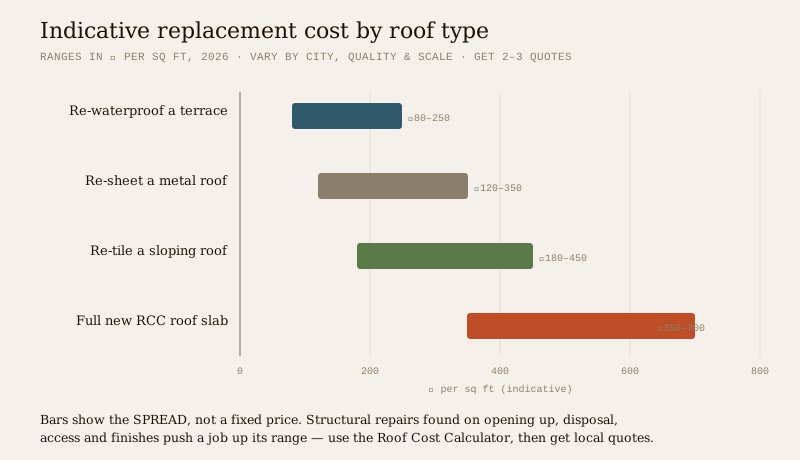
| Replacement job | Indicative ₹/sq ft | Indicative ₹/m² | What sets the level |
|---|---|---|---|
| Re-waterproof a terrace (strip & re-do the surface) | ₹80–250 | ₹850–2,700 | System (acrylic vs membrane vs PU), stripping, re-sloping |
| Re-sheet a metal roof (new sheets on sound frame) | ₹120–350 | ₹1,300–3,800 | Sheet grade & coating, insulation, span, height |
| Re-tile a sloping roof (re-cover, new underlay) | ₹180–450 | ₹1,900–4,850 | Tile type, battens, underlay, pitch, structural repair |
| Full new RCC roof slab (tear-off & recast) | ₹350–700 | ₹3,800–7,500 | Slab thickness, steel, shuttering, span, finishes |
Indicative 2026 ranges only — they change with the market and vary by location, brand, quality and scale. Prices per sq ft usually fall as the area grows (fixed setup and access spread over more roof). Always get 2–3 local quotes.
Two things the table cannot show. First, a small job carries a fixed setup and access cost — getting a crew, materials and a bit of scaffolding to a 30 m² terrace costs almost as much to mobilise as for a 100 m² one, so the per-unit rate on a tiny roof looks alarming. Second, the biggest swings come not from the covering but from what is found underneath, which is the next section.
What actually drives the cost
The headline "re-do the surface" is only part of a replacement bill. Much of the money goes on things that never appear in a glossy brochure — and the parts a suspiciously cheap quote quietly drops are exactly the ones that make the job last.
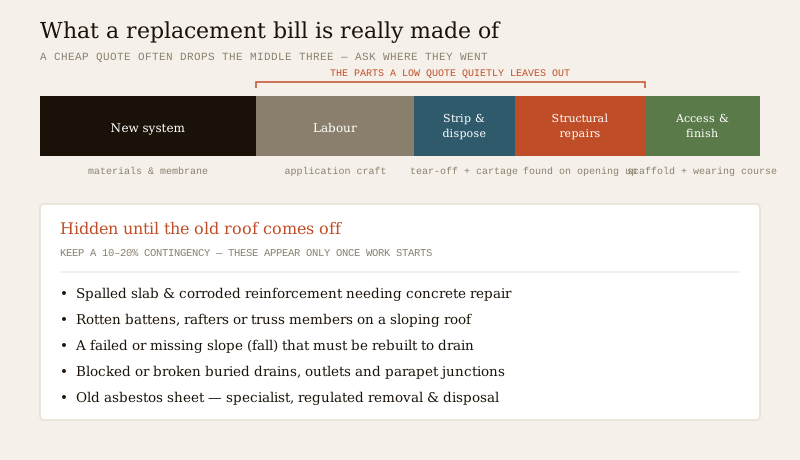
- Stripping and disposing of the old roof. Tearing off failed waterproofing, old tiles or a rusted sheet, and carting the debris away, is real labour and real cartage — and old asbestos-cement sheet is a regulated, specialist removal that costs far more than a normal tear-off. A quote with no line for strip-out has either hidden it or plans to skip it.
- Structural repairs found on opening up. This is the great unknown. Once the surface is off, a contractor may find a spalled slab with corroded steel, rotten battens or rafters, or a slope that was never built to drain. These repairs — often the single largest line — simply cannot be priced accurately until the roof is open, which is why an honest quote carries a contingency and a provisional sum rather than a false certainty.
- Access and height. A ground-floor extension roof and a fourth-floor terrace over a tight lane are different jobs. Scaffolding, hoisting, safety measures and slow manual carrying all add cost the taller and tighter the site.
- Scale. Bigger roofs cost more in total but usually less per unit, as setup, access and mobilisation spread over more area.
- The system and the finish. A basic acrylic coating, a torch-applied membrane and a premium polyurethane system sit at very different price points and lifespans; a plain screed finish and reflective tiles or a cool-roof surface are different lines again.
The practical takeaway: keep a 10–20% contingency for what the tear-off reveals, and be far more suspicious of a quote that promises a fixed, all-in, no-surprises price on an old roof than of one that is honest about the unknowns.
Re-roof before you go solar
One piece of timing saves more money than almost any other: if your roof is near the end of its life, replace it before you put solar on it, not after. A rooftop solar array is designed to last 25 years and is bolted, ballasted or bonded to the roof surface. If the waterproofing or covering underneath it fails in year four, you now have to remove the panels, replace the roof, and reinstall the panels — paying twice for the de-mount and re-mount, and risking new leaks around every fixing.
So before committing to solar on an ageing roof, ask the honest question: how many years of life are left in the surface under the panels? If the answer is fewer than the panels' life, re-roof first — and do it as a solar-ready replacement, with the loads, fixings and cable routes planned in while the roof is open. It feels like spending more today; it is almost always cheaper across the twenty-five years than the alternative.
Controlling cost without cutting corners
There is a right way and a wrong way to save money on a roof. The wrong way — dropping the surface preparation, the coats, the flood-test or the structural repair — buys a cheap job that fails inside a monsoon or two and costs you the whole sum again. The right way protects the things that make a roof last and trims the things that do not:
- Get itemised, like-for-like quotes. Insist each quote breaks out surface preparation, the system and number of coats, strip-out and disposal, any structural provisional sum, the finish and the warranty. Only then can you compare, and only then can you see where a cheap quote has quietly deleted a line.
- Fix the cause, not just the symptom. Paying to re-do a surface without correcting a bad slope or a blocked drain guarantees you pay again. Getting the drainage and fall right is cheaper than a second replacement.
- Right-size the intervention. Do not let a scare-tactic push you into a full tear-off when a re-waterproofing would do — and do not let a low price talk you into a patch when the whole surface is finished. Match the fix to the decision above.
- Combine jobs while the roof is open. Adding insulation, a cool finish or solar-readiness during a replacement is far cheaper than opening the roof again later for each one.
- Buy lifespan, not headline price. A system that lasts 15 years at a higher upfront cost usually beats a cheap coating redone every three — which is the whole point of the next section.
- Time it for the dry season. Replacing a roof in the pre-monsoon dry window avoids weather delays, rushed curing and emergency-job premiums.
Whole-life cost — think in decades, not the first cheque
The cheapest quote is rarely the cheapest roof. The only number that really matters is the whole-life cost: the price of the replacement spread across the years it actually lasts, plus the maintenance and the leaks avoided along the way.
Consider two terrace re-waterproofings. A bargain acrylic coat at the bottom of its range might need re-doing every three or four years; a quality membrane system near the top of its range might run fifteen. Divide each by its life and the "expensive" system is often the cheaper roof per year — before you even count the ruined ceilings, repainting and disruption the cheap one causes each time it fails. The same logic runs across coverings: a light, well-detailed metal roof or a properly re-done RCC terrace bought for its lifespan beats a cut-price job replaced twice in the same period.
So when you weigh quotes, do not ask only "what does it cost?" Ask "what does it cost per year it will last, and what does a failure cost me?" Run the sums against the Roof Cost Calculator, keep a contingency for what the tear-off reveals, and let whole-life value — not the lowest number on the page — make the call.
The one-line answer
There is no fixed price for replacing a roof: 2026 costs run roughly ₹80–250 per sq ft to re-waterproof a terrace, ₹120–350 to re-sheet a metal roof, ₹180–450 to re-tile a sloping roof and ₹350–700 for a full new RCC slab — all indicative ranges that vary by city, quality, scale and market, so get 2–3 local quotes and check them against the Roof Cost Calculator. Decide when to replace by working four questions in order: is the structure sound, is the damage localised, is there life left in the surface, and are repeated repairs nearing a third to a half of a re-do. The bill is driven less by the covering than by strip-out and disposal, the structural repairs found on opening up, access and scale — so keep a 10–20% contingency and distrust a quote that promises no surprises on an old roof. Re-roof before you go solar, control cost by protecting preparation and lifespan rather than cutting them, and judge every quote on whole-life cost per year — not the lowest figure on the page.
Where to go next
- Start with the whole subject: Ultimate Guide to Roofing Systems.
- The hub map: Roofing Knowledge Hub.
- Fix, renovate or replace an old roof: Roof Renovation & Replacement Guide.
- Chase a leak before you replace: Roof Leakage Diagnosis & Repair Guide.
- Pick the right roof for the job: How to Choose a Roof.
- Run the numbers: Roof Cost Calculator.
References
- National Building Code of India (SP 7), Bureau of Indian Standards — Part 6 (Structural Design) & Part 3 (Development Control, Building Services); verify the current edition via the BIS catalogue.
- IS 875 (Part 2): Design Loads (imposed loads) for Buildings and Structures — relevant when assessing an existing roof before adding solar or other load — Bureau of Indian Standards.
- IS 456: Plain and Reinforced Concrete — Code of Practice (RCC slab, crack and spalling repair), Bureau of Indian Standards.
- Cost figures are indicative 2026 market ranges compiled from typical Indian residential practice; there is no single price authority. Rates change constantly and vary by city, brand, quality and scale — always obtain 2–3 local quotes and verify any standard's current status via the BIS catalogue: https://www.services.bis.gov.in/
This is an educational overview, not a quotation. Every price is an indicative 2026 range that varies by location, quality, scale and market and changes over time. Structural assessment, load calculation, waterproofing application and any work at height are qualified professional work — engage a structural engineer and a licensed roofing contractor, get 2–3 local quotes for your project, and verify any standard's current status via the BIS catalogue before relying on it.
Export this guide
Related Guides — Deep-dive reading
Waterproofing Failures Explained: Why Systems Fail and How to Spot It
Why waterproofing so often leaks again within a year or two — the weak links in the system, the junctions that really fail, the flood test everyone skips, and how to tell a real repair from a cosmetic patch.
Structural SafetyRoof Leak Diagnosis & Repair
The homeowner's most common roofing crisis, calmly explained — how to read the signs (stains, damp, efflorescence, peeling paint, drips, a musty smell), why the leak is almost never right above the stain, where roofs actually leak, how leaks are traced, and the honest line between what you can safely check yourself and what needs a professional. India-grounded, monsoon-tested.
RoofingBathroom Waterproofing Failure in India: Causes, Diagnosis & Fixes (2026)
Why bathroom waterproofing fails in Indian homes — poor surface prep, thin coats, missed junctions, no membrane turn-up, damage during tiling — how to read the symptoms, and whether a surface fix or a full redo is the right remedy.
BathroomsRelated Tools — Try Free
Monsoon-Readiness Checklist
Pre-rain home audit across 9 categories — terrace, drains, waterproofing, electrical, HVAC, pest, vehicles, documents.
Seasonal AuditWindow Replacement Cost Calculator
Estimate the cost to replace existing windows — material, glass, removal and floor access.
Window CalculatorRenovation vs New Build Calculator
Compare renovating vs building new interiors city-wise across 13 work scopes with GST and per-sqft rates.
Cost Comparison