

Residential Elevator Standards in India (2026): IS 17900, NBC and What Governs a Home Lift
The consolidated standards map for a home lift — IS 17900 (mandatory since 22 December 2025), IS 17515, NBC 2016 Part 8 Section 5, the RPwD/CPWD accessibility rules, the state Lift Acts and the EN 81-20/50 / ISO 8100 lineage, and which one governs what.
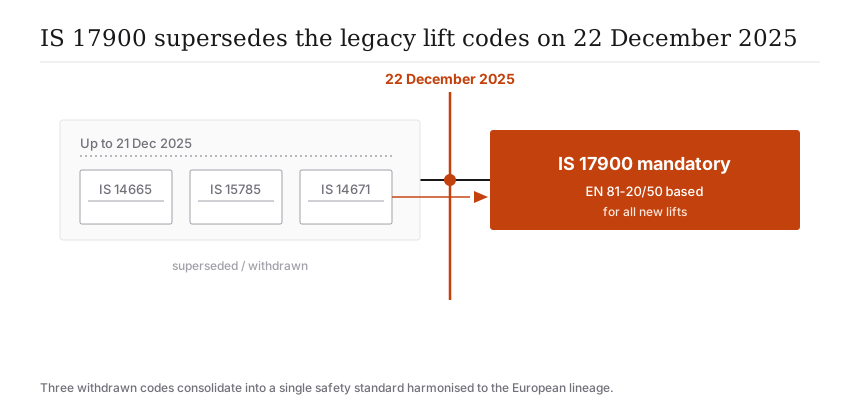
If you are buying or building a home lift in India in 2026, one fact changes everything you were told even two years ago: IS 17900, the new Bureau of Indian Standards (BIS) lift safety code, became mandatory for all new lift installations on 22 December 2025. It is modelled on the European safety norms EN 81-20 and EN 81-50, and it superseded the older Indian codes IS 14665, IS 15785 and IS 14671, which were withdrawn on the same date.
This is the standards map for the whole regulations cluster — the single page that tells you which rule governs which part of your lift, what changed in December 2025, and where to go deeper. It is written for a homeowner who wants to understand and verify compliance, not for an engineer. Read it first, then follow the cross-links into the approvals, building-codes and safety-standards guides for the detail.
A working rule before we start: standards and dates here are indicative and current as of mid-2026. Lifts are regulated state-by-state in India, and adoption of new codes is uneven. Always confirm the current rule with BIS, your state Lift Inspectorate, and a licensed lift contractor before you sign anything.
The one update that reframes everything: IS 17900
For roughly two decades, the reference standard for an Indian lift was IS 14665 (electric traction lifts), with IS 15259 for hydraulic lifts. You will still see IS 14665 quoted in older brochures, on lifts installed before 2026, and in many guides written earlier. That is not wrong as history — but it is no longer the governing standard for a new lift.
From 22 December 2025, BIS made IS 17900 mandatory for all new lift installations. The headline points:
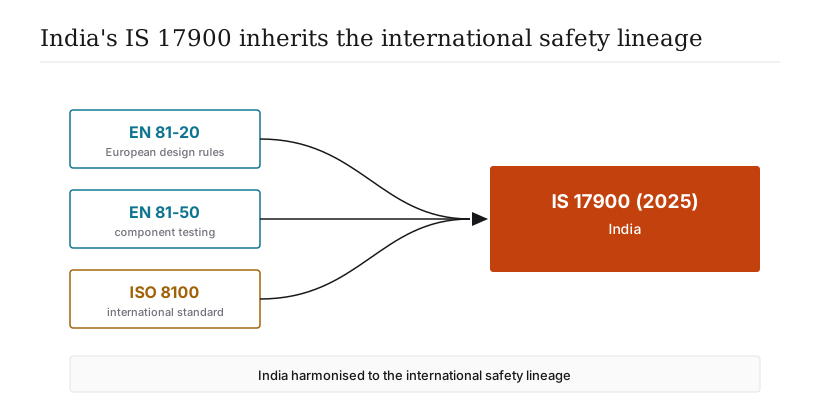
- IS 17900 is the current mandatory lift safety code. It is a multi-part standard (covering safety rules, components, inspection and related areas) and is built on the European EN 81-20 / EN 81-50 framework — the same lineage that governs lifts across Europe.
- It withdrew and replaced IS 14665, IS 15785 and IS 14671. So while older lifts and documents reference IS 14665, the standard your new home lift must be built to is IS 17900.
- It brings new, stronger safety requirements that EN 81-20/50 introduced. The most important for a homeowner to recognise:
- ACOP — Ascending-Car Overspeed Protection. If a control failure makes the car run too fast upward, a protective device stops it. (The classic overspeed governor and safety gear already protected against a falling car; ACOP closes the upward gap.)
- Verified door closure before any movement, plus the established door interlocks, buffers, overspeed governor and safety gear.
Why this matters even if your state has no lift law. Adoption is state-by-state. As of mid-2025, roughly 15 states and one Union Territory had incorporated IS 17900 into their Lift Acts — including Maharashtra, Gujarat, Tamil Nadu, Karnataka, Kerala, West Bengal, Assam, Himachal Pradesh, Haryana, Delhi and Jammu and Kashmir (UT). In a state with no lift act, there is no central legal obligation, and a lift could legally be built to an old standard or no standard at all. In that situation, insisting on IS 17900 compliance is the homeowner's own safeguard — it is the difference between a lift that meets the current safety benchmark and one that merely meets the price.
The full standards map: which standard governs what
A home lift is not governed by a single document. Four different kinds of rule apply at once, and they overlap. Keeping them straight is the whole point of this guide.
- IS 17900 governs the lift itself — its safety design and components.
- IS 17515 governs the lift's energy performance.
- NBC 2016 Part 8 Section 5 governs the building — when and where a lift is required, the shaft, fire and structural provisions.
- RPwD Act 2016 + the CPWD / MoHUA Harmonised Guidelines govern accessibility — the cabin and controls a wheelchair user needs.
- The state Lift Act governs licensing — permission to install, register and operate.
- EN 81-20/50 and ISO 8100 are the international lineage that IS 17900 is built on.
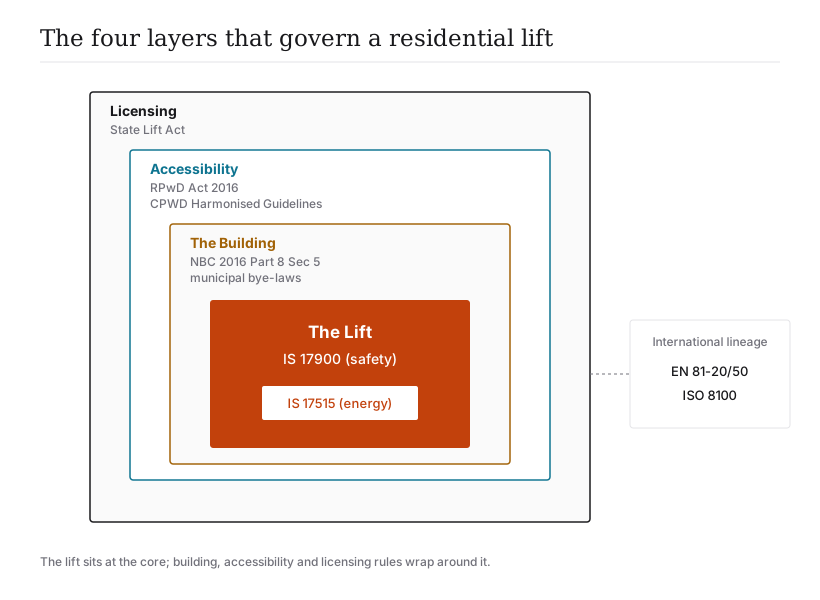
Here is the same picture as a table — the reference you will come back to.
| Standard / law | What it governs | Status in 2026 | Who enforces it | Go deeper |
|---|---|---|---|---|
| IS 17900 (2025) | Lift safety design and components — UCMP, ACOP, interlocks, governor + safety gear, buffers | Mandatory for new lifts since 22 Dec 2025; EN 81-20/50 based | BIS; state Lift Inspectorate | This guide; safety standards, safety components |
| IS 14665 / IS 15259 / IS 15785 / IS 14671 (legacy) | Older lift safety / dimensions / hydraulic codes | Superseded — IS 14665, IS 15785, IS 14671 withdrawn 22 Dec 2025; still seen on older lifts | Historical reference | Mentioned for context only |
| IS 17515 | Energy performance rating of lifts, escalators, moving walks | Current Indian Standard | BIS (efficiency rating) | Building codes guide |
| NBC 2016 Part 8, Section 5 | Building installation of lifts — when a lift is required, shaft, fireman's lift, fire and structural provisions | National code; made mandatory through local bye-laws | Municipal / building-plan authority | Building codes guide |
| RPwD Act 2016 + CPWD Harmonised Guidelines | Accessibility — door width, car size, handrail, dwell time, Braille, audio-visual | Binds public buildings; best practice for homes | MoHUA / local authority | Accessibility standards guide |
| State Lift Act (e.g. Maharashtra 2017, Karnataka 2015) | Licensing — install permission, registration, periodic inspection | Mandatory in ~15 states + 1 UT; absent elsewhere | State Electrical / Lift Inspectorate | Approvals and regulations guide |
| EN 81-20 / EN 81-50, ISO 8100 | International lift safety lineage | The basis IS 17900 is harmonised to | European / international bodies | This guide |
The simplest way to hold this in your head: IS 17900 governs the lift, NBC + bye-laws govern the building, the accessibility standards govern the cabin a wheelchair user needs, and the state Lift Act governs the paperwork. They work together, not in competition.
What each standard actually covers
IS 17900 — the lift's safety (the headline standard)
This is the document your vendor must build to. As a homeowner you do not read it; you ask for the IS 17900 compliance declaration or test certificate and you check that the safety features in the specification reflect it: door interlocks, UCMP, overspeed governor with safety gear, ascending-car overspeed protection, buffers, a light curtain or door sensors, an emergency alarm with two-way communication, and — essential in India given power cuts — an Automatic Rescue Device (ARD) that brings the car to the nearest floor and opens the doors on a power failure. The deep treatment of these features lives in the safety standards for homeowners and elevator safety components guides.
IS 17515 — the lift's energy
A separate, newer Indian Standard that rates the energy performance of lifts, escalators and moving walks. For a home lift this affects running cost rather than safety. Machine-room-less (MRL) traction and screw-driven lifts are typically efficient; a pneumatic vacuum lift draws more power on the way up (it descends under controlled gravity). Energy performance is part of the building-side picture, covered in the building codes guide.
NBC 2016 Part 8 Section 5 — the building
The National Building Code (NBC 2016), Part 8 (Building Services), Section 5, covers the Installation of Lifts, Escalators and Moving Walks — the building's side of the equation. Its commonly cited triggers (which you must verify against your local bye-laws, because they vary by state):
- A lift is generally required where building height exceeds about 13 m, with a six-person lift from the ground floor as the usual baseline.
- A fireman's lift is generally required above 15 m (some residential rules set 30 m): a car of about eight persons / 544 kg, roughly 1100 by 1400 mm so it can take a stretcher, serving the full building height with backup power.
- The number of lifts is computed from occupancy and traffic.
NBC is a code / recommendation; local municipal bye-laws and development-control rules make parts of it mandatory and add city-specific requirements, checked at building-plan approval. The building codes guide works through the triggers.
RPwD Act 2016 + CPWD Harmonised Guidelines — accessibility
The Rights of Persons with Disabilities Act 2016 (Sections 40, 44, 45) legally binds public buildings to accessibility standards; private homes are not legally compelled, but the standards are the right best-practice benchmark for any home you want to be usable for life. The accessible-lift essentials from the CPWD / MoHUA Harmonised Guidelines — door clear width 900 mm or more, a car about 1100 by 1400 mm, a handrail 800–1000 mm above the floor, a lift lobby of about 1800 by 1800 mm, automatic door dwell of at least 5 seconds, Braille / tactile buttons, audio and visual indicators, and a rear mirror — are detailed in the accessibility standards guide.
EN 81-20/50 and ISO 8100 — the international lineage
You will see EN 81-20 and EN 81-50 named in vendor literature, especially from global brands. These are the European lift safety norms; ISO 8100 is the international family. IS 17900 is harmonised to this lineage, which is the whole significance of the December 2025 change: an Indian home lift built to IS 17900 is now built to essentially the same safety logic as a European one.
The standards timeline at a glance
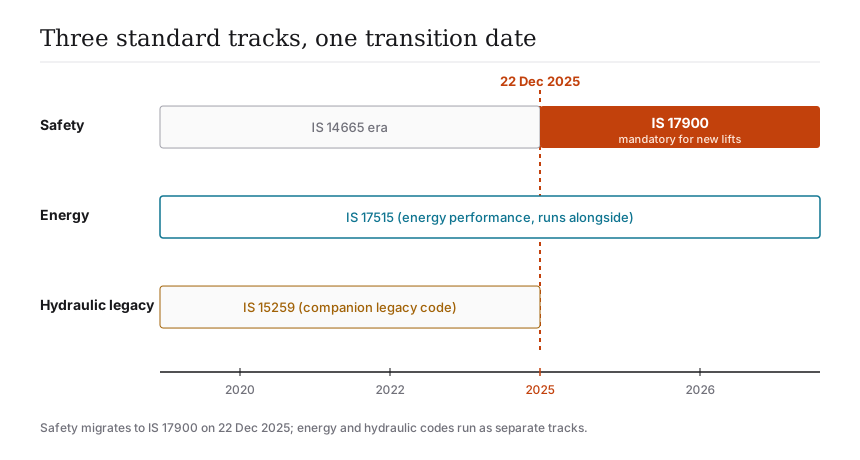
| Period | Governing safety standard | Notes |
|---|---|---|
| Up to 21 Dec 2025 | IS 14665 (traction), IS 15259 (hydraulic), IS 15785, IS 14671 | The long-standing references; still on older lifts and documents |
| From 22 Dec 2025 | IS 17900 (EN 81-20/50 based) | Mandatory for all new installations; old codes withdrawn |
| Alongside | IS 17515 | Energy-performance rating, separate from safety |
How to verify compliance as a homeowner
You cannot read the standards, but you can check that the right ones were applied. A quick verification matrix:
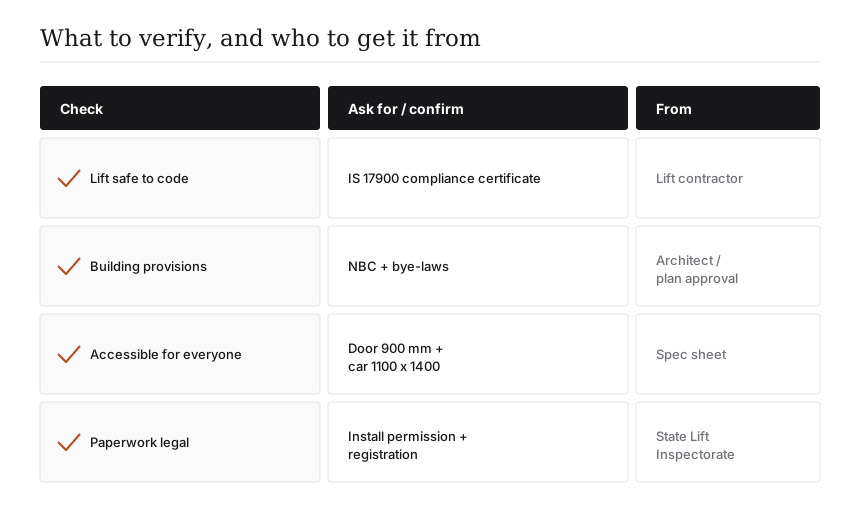
| You are checking | Ask for / confirm | From |
|---|---|---|
| The lift is safe to current code | IS 17900 compliance declaration / test certificate; the safety-feature list (UCMP, ARD, governor, interlocks) | Your lift contractor |
| The building provisions are right | That the shaft, fire and (if required) fireman's-lift provisions meet NBC + local bye-laws | Your architect / building-plan approval |
| It is usable for everyone | Door 900 mm+, car ~1100 x 1400 mm, dwell 5 s+, accessible controls | Spec sheet; accessibility guide |
| The paperwork is legal | Installation permission, registration / operating licence, periodic inspection — if your state has a Lift Act | State Lift Inspectorate; approvals guide |
Inspection in regulated states is carried out by government-appointed inspectors, not the lift company. If a vendor offers to "handle the inspection," they mean facilitating the government process — not certifying it themselves.
Where this fits in the cluster
This guide is the map. The detail lives in its siblings:
- Home lift approvals and regulations in India — the state-by-state licensing workflow: installation permission, registration, inspection, renewal.
- Building codes for residential elevators in India — NBC 2016 Part 8 Section 5, the height triggers, fireman's lift and bye-laws.
- Lift safety standards for homeowners in India — what IS 17900 requires in plain terms and how to verify it.
- Accessibility standards for residential lifts in India — the RPwD / CPWD cabin and control rules.
- Elevator safety components in India — the actual hardware behind the standard.
And the wider library: the residential elevator buyer's guide (the pillar), the lift specification checklist, the home lift cost guide for 2026, the home lift safety guide, and for professionals, the architect's residential elevator handbook.
The bottom line
For a new home lift in 2026, build to IS 17900 — it is mandatory since 22 December 2025 and it replaced IS 14665, IS 15785 and IS 14671. Treat IS 14665 as history you will still see quoted. Around the lift, NBC 2016 Part 8 Section 5 and your local bye-laws govern the building, the RPwD / CPWD standards govern accessibility, IS 17515 governs energy, and your state Lift Act governs licensing. Whether or not your state legally requires it, asking for an IS 17900 compliance certificate is the single most useful thing a homeowner can do. Confirm every date and requirement with BIS, your state Lift Inspectorate and a licensed lift contractor before you commit.
References
- IS 17900 — BIS lift safety standard (EN 81-20/50 based), mandatory from 22 December 2025; superseded IS 14665, IS 15785, IS 14671. See industry coverage: Elevator World, "India's Elevator Revolution — Why IS 17900 Is the Biggest Market Opportunity Since EU Harmonization": https://elevatorworld.com/article/indias-elevator-revolution-why-is-17900-is-the-biggest-market-opportunity-since-eu-harmonization/
- IS 17900 accreditation — TUV SUD / NABCB accreditation for IS 17900 lift safety: https://www.industrialautomationindia.in/news/tuv-sud-achieves-nabcb-accreditation-for-is-17900-lift-safety-standard
- IS 17515 — Energy performance of lifts, escalators and moving walks (Elevator World): https://elevatorworld.com/article/new-indian-standard-is-17515-on-energy-performance-of-lifts-escalators-moving-walks/
- IS 14665 Part 1 (legacy, electric traction lifts — outline dimensions), BIS: https://law.resource.org/pub/in/bis/S05/is.14665.1.2000.pdf
- IS 14665 Part 2 (legacy, code of practice — installation, operation, maintenance), BIS: https://law.resource.org/pub/in/bis/S05/is.14665.2.1-2.2000.pdf
- National Building Code of India 2016 (Part 8, Section 5 — Installation of Lifts, Escalators and Moving Walks), BIS: https://www.bis.gov.in/standards/technical-department/national-building-code/
- BIS Guide for Using NBC 2016: https://www.bis.gov.in/wp-content/uploads/2022/08/Booklet-Guide-for-Using-NBC-2016.pdf
- RPwD Act 2016 (Rights of Persons with Disabilities Act, full text): https://ssepd.odisha.gov.in/sites/default/files/2024-01/RPWD%20ACT.pdf
- DEPwD (Department of Empowerment of Persons with Disabilities): https://depwd.gov.in/en/faqs-4/
- CPWD / MoHUA Harmonised Guidelines and Space Standards for a Barrier-Free Built Environment: https://www.cpwd.gov.in/Publication/Harmonisedguidelinesdreleasedon23rdMarch2016.pdf
- State Lift Acts (examples): Maharashtra Lifts, Escalators and Moving Walks Act 2017; Karnataka Lifts, Escalators and Passenger Conveyors Act 2015; Delhi Lifts and Escalators Act 2007; Tamil Nadu Lifts Act 1997. Maharashtra licence-to-operate portal: https://services.india.gov.in/service/detail/maharashtra-license-to-operate-lift
- Lift rules and regulations in India (overview): https://www.99acres.com/articles/faqs-about-lift-rules-and-regulations-in-india.html and https://www.99acres.com/articles/know-all-about-the-lift-regulations-in-india.html
Export this guide
Related Guides — Deep-dive reading
Lift Safety Standards Every Homeowner Should Know (India)
The plain-language homeowner digest of what IS 17900, mandatory since 22 December 2025, actually requires on your new home lift, and the four pieces of compliance proof you can verify or ask your vendor for.
Home Lifts & AccessibilityBuilding Codes for Residential Elevators (India): NBC 2016 and Local Bye-Laws
How NBC 2016 Part 8 Section 5 and your municipal building bye-laws decide when a home lift is required, where its shaft goes, and how it must be built and fire-protected.
Home Lifts & AccessibilityWheelchair Accessible Home Lifts (India): Cabin Size, Doors and RPwD Standards
The exact cabin, door, control and lobby spec that makes any home lift wheelchair-ready under RPwD and IS 17900.
Home Lifts & AccessibilityRelated Tools — Try Free
Accessibility Compliance Calculator
Check a planned lift against the CPWD and RPwD accessible-lift benchmarks for a score.
Lift CheckerHome Lift Cost Calculator
All-in home lift cost by floors, type, capacity and city — equipment, civil, GST and AMC, with a drive-type comparison.
Lift CalculatorLift Safety Audit Checklist
Interactive checklist that scores your home lift on safety devices, compliance and upkeep.
Checklist