
Wheelchair Accessible Home Lifts (India): Cabin Size, Doors and RPwD Standards
The exact cabin, door, control and lobby spec that makes any home lift wheelchair-ready under RPwD and IS 17900.
A home lift only earns the word "accessible" when a wheelchair user can roll in, turn or reverse, reach the buttons, read the floor by sound and sight, and roll back out without anyone's help. That is not a single product you buy off a shelf. It is a specification that any full-cabin lift — hydraulic, traction, screw or pneumatic — can be built to meet, if you ask for the right numbers before you sign.
This guide is the dedicated wheelchair-accessibility brief for an Indian home lift: the exact cabin size, door type, dwell time, handrail, controls and lobby you must specify, and how it maps to RPwD and the BIS standards now in force.
A handrail and a Braille panel do not make a lift accessible. The car size, the door width and a flush threshold do. Get those three wrong and no accessory can fix it.
How this differs from the lift type and whole-home guides
Accessibility is a spec, not a drive type — so it is easy to confuse with two close cousins. Here is the clean split:
- Platform lifts for seniors covers a lift type — the lowest-cost, short-rise vertical platform lift for senior mobility. This guide instead covers the wheelchair-accessibility spec that a full-cabin lift on any drive can be built to meet.
- Accessible home design is the whole-home barrier-free view — ramps, door widths, bathrooms, switch heights across the house. This guide zooms in on the lift cabin alone.
- The types of home lifts comparison pillar helps you pick the drive; come here afterwards to make whichever drive you chose wheelchair-ready.
The non-negotiable cabin specification
The CPWD/MoHUA Harmonised Guidelines and the RPwD framework converge on a clear set of numbers. Treat the first three rows as pass/fail.
| Element | Accessible requirement | Why it matters |
|---|---|---|
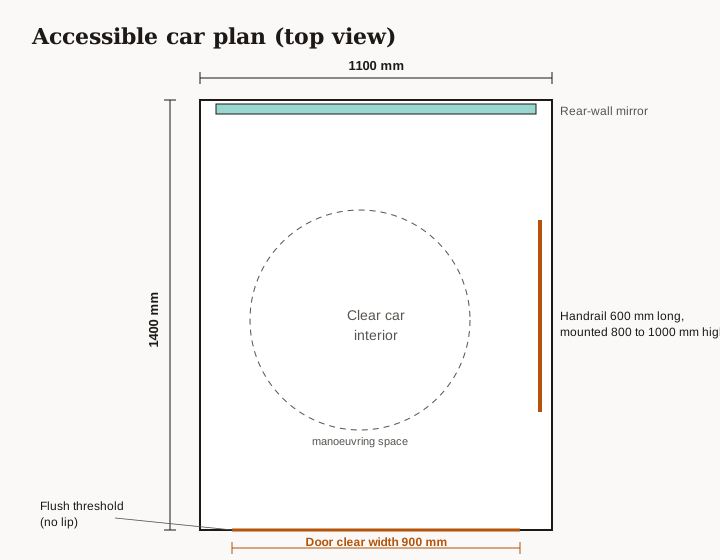
| Car size (chair plus attendant) | greater than or equal to 1100 x 1400 mm | Lets a carer ride alongside and a chair sit square |
| Car size (chair alone, minimum) | approx. 880 x 1465 mm | Absolute floor for a self-propelled chair, no attendant |
| Door clear width | greater than or equal to 900 mm | A standard chair plus hand-rims needs this to pass |
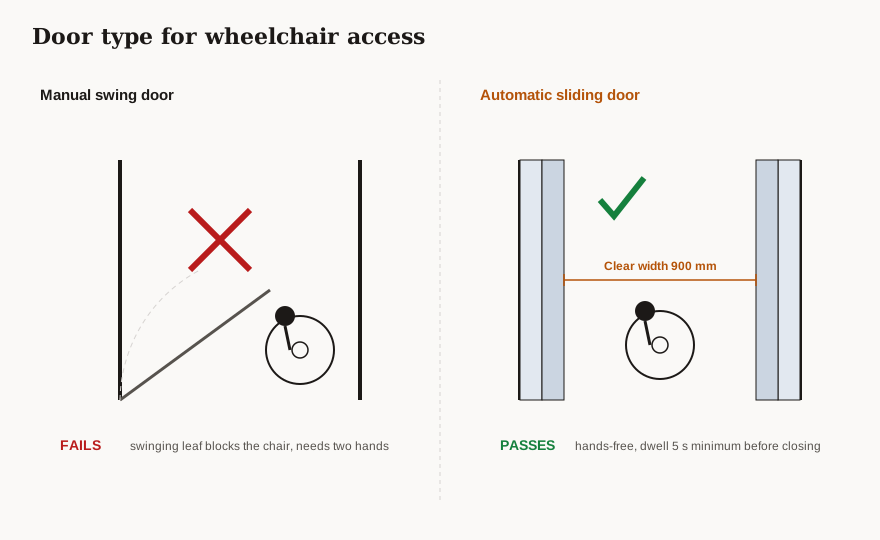
| Door type | Automatic telescopic or sliding | Manual swing doors fail — a seated user cannot pull them |
| Auto-door dwell | greater than or equal to 5 seconds | Time to clear the threshold before the door closes |
| Handrail | greater than or equal to 600 mm long, at 800 to 1000 mm height | Grab support near the control panel |
| Controls | Braille and tactile buttons, reachable height | Usable seated and by blind users |
| Indicators | Audio plus visual floor indicators | Voice and lit display at every floor |
| Rear wall mirror | Full-height on the back wall | Lets a user reverse the chair out safely |
| Threshold | Level (flush) car-to-landing | No lip to catch a castor |
| Lift lobby | approx. 1800 x 1800 mm clear | Room to turn a chair before and after the ride |
Why manual swing doors are an automatic disqualification
This is the single most common mistake. A manual swing or collapsible-shutter door is cheaper, and many home-lift quotes default to it. But a wheelchair user seated in the doorway cannot reach out, grip and swing a door against themselves while clearing it. Automatic telescopic or sliding doors are not an upgrade here — they are a requirement. Budget for them from the start.
The shaft you need to plan for
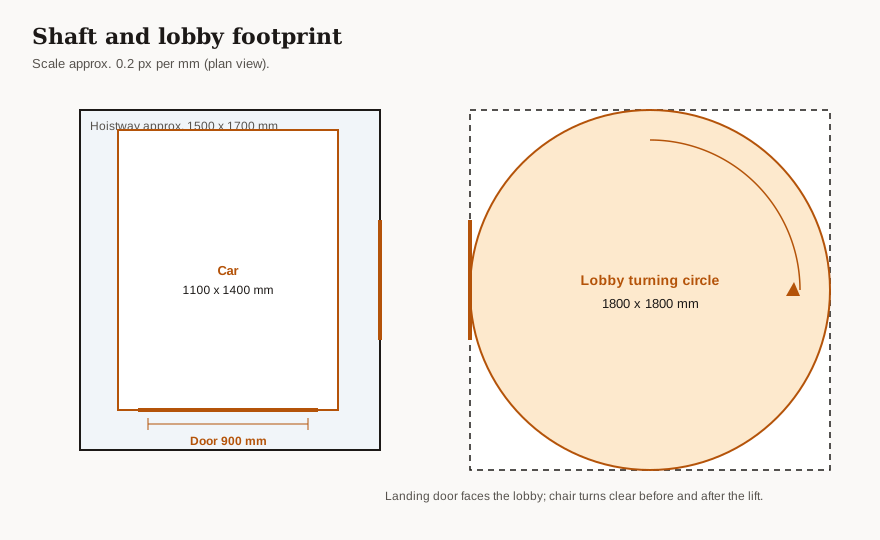
The 1100 x 1400 mm figure is the clear internal car, not the shaft. The hoistway must add the car walls, door pocket, guide rails and running clearances, so plan for a noticeably larger shaft and budget the lobby separately.
| Zone | Indicative clear dimension | Notes |
|---|---|---|
| Car interior | 1100 x 1400 mm | Chair plus attendant |
| Hoistway (typical) | approx. 1500 x 1700 mm and up | Varies by drive and door pocket — get the vendor's GA drawing |
| Door clear opening | greater than or equal to 900 mm | Automatic, centre or side opening |
| Lobby in front | approx. 1800 x 1800 mm | Wheelchair turning circle |
| Pit and headroom | Per chosen drive type | Hydraulic and screw need shallow pits; flush threshold needs careful sill detailing |
Use the lift shaft size calculator to translate the accessible car into a buildable shaft before you finalise the masonry, and the home lift comparison tool to check which drive types can deliver a 1100 x 1400 mm car at your floor count.
Which drive types can carry the accessible spec
Wheelchair-accessibility rides on top of a drive type — but not every drive reaches 1100 x 1400 mm comfortably.
| Drive | Reaches 1100 x 1400 mm car? | Accessibility notes |
|---|---|---|
| Hydraulic (₹8 to 20 lakh) | Yes | Shallow pit eases a flush threshold; smooth and quiet for low rise |
| Traction MRL (₹10 to 25 lakh plus) | Yes | Best for 3 plus floors; specify automatic doors and level landings |
| Screw / winding-drum (₹14 to 30 lakh) | Yes | Self-supporting, low pit; can hold the accessible load |
| Pneumatic vacuum / PVE (₹11 to 22 lakh) | Usually no | Cylindrical 2 to 3 person cabin rarely meets 1100 x 1400 mm or a 900 mm flat door — verify before relying on it |
All prices are indicative for June 2026 — confirm with itemised quotes from a licensed lift contractor. GST at 18 percent applies, and civil work plus installation are extra.
If accessibility is the goal, a hydraulic, traction or screw drive with a properly sized rectangular car is the safe road. A narrow panoramic capsule may look the part and still fail the door-width test.
The standards that bind this
The headline standard is now IS 17900, the BIS lift series that became mandatory on 22 December 2025 for all new installations, safety components and major modernisations. It is aligned to EN 81-20 and EN 81-50, and it adds protections such as UCMP (unintended car movement protection, so the car cannot move with the doors open — critical while a chair is half in) and ACOP (ascending car overspeed protection). Crucially, the IS 17900 series added special-lift parts covering home lifts and lifts for persons with disabilities, which folds in the older IS 14671 (lifts for persons with disabilities) and the traction standard IS 14665 — both now superseded.
The accessibility dimensions themselves come from the CPWD/MoHUA Harmonised Guidelines and Space Standards for a Barrier-Free Built Environment, and the legal weight comes from the RPwD Act 2016 — Section 40 sets accessibility standards, Section 44 lets authorities refuse building permission where plans do not meet accessibility norms, and Section 45 requires existing public buildings to be made accessible. Private homes are not legally compelled, but the Harmonised Guidelines are the right benchmark for a home you want to age in.
Non-compliance with IS 17900 carries real teeth on the building side: rejected occupancy certificates and invalidated insurance. Lifts are also state-regulated, so an installation and operation licence plus periodic inspection by your State Lift Inspectorate may apply.
Compliance checklist
Walk the finished lift against this before you accept handover. Every row should be a yes.
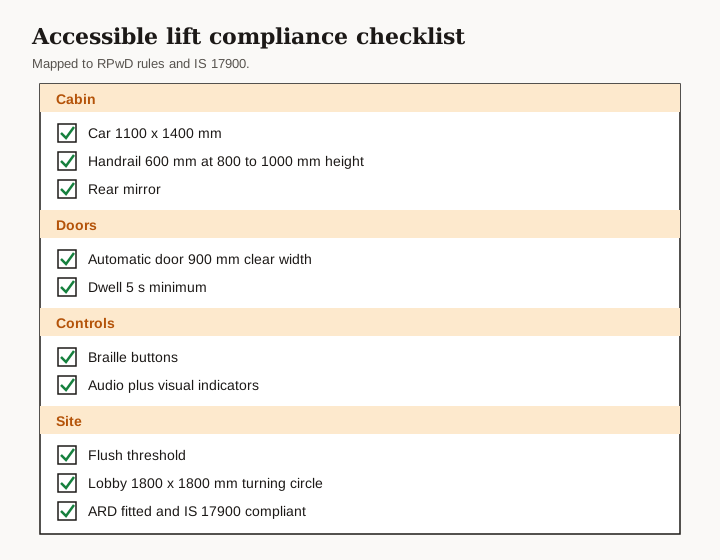
| Check | Pass condition |
|---|---|
| Car size | 1100 x 1400 mm (or at least 880 x 1465 mm for a chair alone) |
| Doors | Automatic sliding or telescopic, clear width greater than or equal to 900 mm |
| Door dwell | Stays open at least 5 seconds |
| Threshold | Flush car-to-landing, no lip |
| Handrail | At least 600 mm long, 800 to 1000 mm height, near the panel |
| Buttons | Braille and tactile, at reachable seated height |
| Indicators | Audio announcement plus visual floor display |
| Rear mirror | Full mirror on the back wall to reverse out |
| Lobby | About 1800 x 1800 mm clear turning space at each landing |
| ARD | Automatic Rescue Device fitted — essential given Indian power cuts |
| Standard | Installed to IS 17900, with state licence and inspection where required |
The buyer pitfalls that quietly defeat accessibility
- Accepting the default manual door to save money — it fails the spec outright.
- Sizing the car to fit the shaft the mason already built, instead of sizing the shaft to a 1100 x 1400 mm car.
- Forgetting the lobby. A compliant cabin opening onto a 900 mm corridor with nowhere to turn is still inaccessible.
- A raised threshold of even 20 to 30 mm — enough to jam a front castor.
- No ARD battery backup, leaving a chair user stranded between floors during an outage.
- Treating Braille and a handrail as the whole job while the car is too small to turn in.
Bringing it together
If you are choosing a drive first, start at the types of home lifts comparison pillar, then return here to lock the accessible spec onto it. For the broader picture beyond the lift — doorways, ramps and bathrooms — read accessible home design; for a low-rise, lower-cost route for senior mobility specifically, see platform lifts for seniors.
Studio Matrx DesignAI can sketch the lift core, the 1800 x 1800 mm landing turning circle and the surrounding rooms together, so the accessible cabin lands where a wheelchair can actually reach it.
References
- IS 17900 mandatory since 22 December 2025 (EN 81-20/50, UCMP, ACOP): https://elevatorworld.com/article/indias-elevator-revolution-why-is-17900-is-the-biggest-market-opportunity-since-eu-harmonization/
- IS 14671 (1999), lifts for persons with disabilities (now superseded): https://law.resource.org/pub/in/bis/S05/is.14671.1999.pdf
- CPWD Harmonised Guidelines for a Barrier-Free Built Environment: https://www.cpwd.gov.in/Publication/Harmonisedguidelinesdreleasedon23rdMarch2016.pdf
- RPwD Act 2016 (full text): https://ssepd.odisha.gov.in/sites/default/files/2024-01/RPWD%20ACT.pdf
- Department of Empowerment of Persons with Disabilities (DEPwD): https://depwd.gov.in/en/faqs-4/
Export this guide
Related Guides — Deep-dive reading
Accessible Bathroom Standards India: CPWD Harmonised Guidelines & NBC 2016 (2026)
The regulatory reference for barrier-free bathrooms in India — the CPWD Harmonised Guidelines and Standards for Universal Accessibility, NBC 2016 Part 3, the RPwD Act 2016 mandate, and the working dimensions for turning circles, grab bars, WC height, roll-in showers and door widths.
BathroomsHome Lift Planning Checklist (India): Everything to Decide Before You Buy
A printable, ten-stage checklist that takes you from the first family conversation to a signed handover.
Home Lifts & AccessibilityTypes of Home Lifts in India (2026): Complete Comparison and How to Choose
All seven home-lift options on one comparison table, plus a five-question decision framework to pick the right one
Home Lifts & AccessibilityRelated Tools — Try Free
Accessibility Compliance Calculator
Check a planned lift against the CPWD and RPwD accessible-lift benchmarks for a score.
Lift CheckerLift Shaft Size Calculator
Required hoistway, pit and headroom dimensions for a home lift by capacity and drive type.
Lift CalculatorHome Lift Comparison Tool
Compare hydraulic, traction, pneumatic vacuum and screw lifts side by side for your home.
Lift Comparison