

Home Lift Approvals and Regulations in India: Licences, Registration and Inspection
The homeowner's permits playbook — installation permission, government inspection, operating licence and annual renewal for a residential lift, state by state
A home lift is not just a machine you buy and switch on. In much of India it is a regulated installation that needs government permission before you install it, an inspection after you commission it, and an operating licence or registration before you legally run it — followed by annual inspections and renewals for as long as it carries people. This guide is the homeowner's permits playbook: the approvals and licensing path for a residential lift, who issues what, and what to do if your state has no lift law at all.
One point to settle first, because it shapes everything below: there is no single central lift law in India. Lifts are regulated state by state. A central Model Lift Bill has guided many states to write their own Lift Acts, but adoption, paperwork and even whether registration is mandatory differ across the country. So the honest framing throughout is: this is the typical workflow in a regulated state — confirm the current rule with your state Lift Inspectorate, BIS and a licensed lift contractor before you commit.
This guide covers the approvals and licensing process. For the underlying standards, see the residential elevator standards guide; for the building-side triggers, the building codes guide; for the safety provisions you can verify, the lift safety standards guide. The deeper regulatory frame for professionals sits in the architect's residential elevator handbook, and the regulation section of the buyer's guide is the pillar this consolidates.
The 2026 currency you must know: IS 17900
Before the permits, the standard. As of 22 December 2025, IS 17900 is the mandatory Bureau of Indian Standards lift safety code for all new lift installations in India. It is modelled on the European norms EN 81-20 / EN 81-50 and it supersedes the older codes IS 14665, IS 15785 and IS 14671, which were withdrawn on the same date.
This matters for approvals because a regulated state's inspectorate will increasingly expect your new lift to be built and certified to IS 17900 — not the legacy IS 14665 you may still see quoted in older brochures and on existing lifts. As of mid-2025, about 15 states plus 1 Union Territory had already incorporated IS 17900 into their Lift Acts. So when you choose a vendor, the single most useful filter is: can they supply an IS 17900 compliance declaration and test certificate? If yes, you are aligned with both the standard and the direction every state inspectorate is moving in.
The homeowner compliance workflow, step by step
In a regulated state, the path runs in a fixed order. The critical thing many homeowners get wrong is timing: the installation permission must come BEFORE you install, not after. Inspection happens before you operate. Get the sequence wrong and you can be told to stop and re-apply.
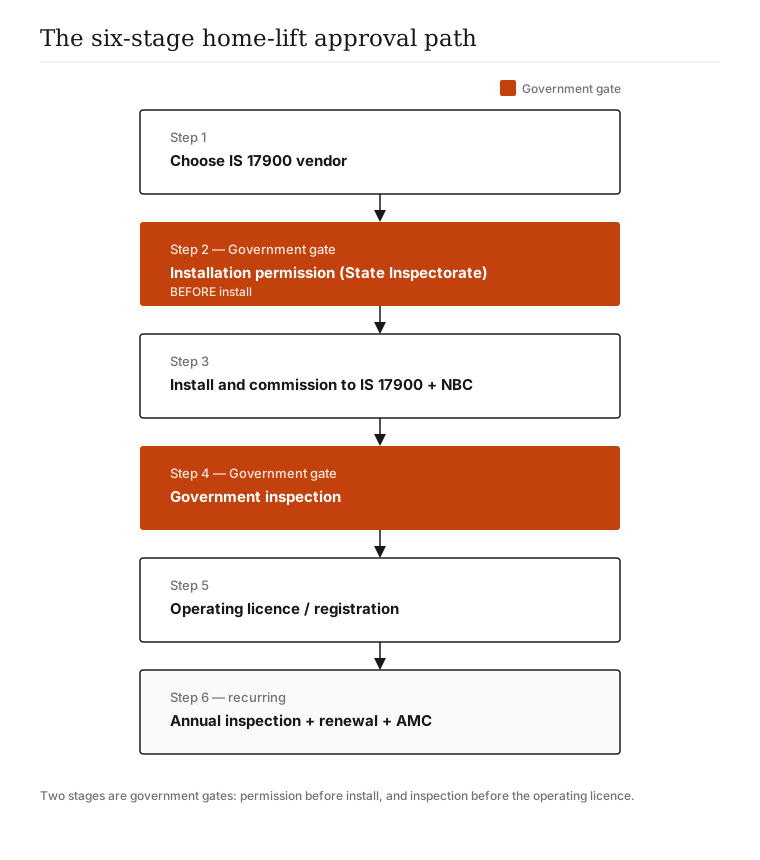
| Step | What happens | Who is involved | When |
|---|---|---|---|
| 1. Choose an IS 17900 vendor | Pick a lift and contractor who can certify compliance to IS 17900 and NBC 2016 | You + licensed lift contractor | At buying stage |
| 2. Installation permission / licence | Apply to the State Electrical or Lift Inspectorate for permission to install, submitting plans and specifications | You / vendor on your behalf -> State Inspectorate | BEFORE installation begins |
| 3. Install and commission to standard | The lift is installed and commissioned to IS 17900 and NBC 2016 Part 8 Section 5 | Licensed contractor | After permission granted |
| 4. Government inspection | A government-appointed inspector examines the installation and witnesses safety tests | State Inspectorate (not a private firm) | After commissioning |
| 5. Operating licence / registration | On a passing inspection, you receive the licence to operate or registration certificate | State Inspectorate -> you | Before you legally run the lift |
| 6. Annual inspection + renewal + AMC | Periodic (usually annual) safety inspection, licence renewal, and an Annual Maintenance Contract running alongside | State Inspectorate + your AMC vendor | Every year, ongoing |
A few practicalities worth knowing. Inspection is by government-appointed inspectors, not private companies — your vendor cannot self-certify the operating licence, even though the vendor usually files the paperwork for you. The installation licence and the operating licence are two separate approvals: one gates installation, the other gates operation. And the running obligation never ends — the lift stays legal only while its registration is current and its inspections are passing, which is why the AMC (typically 12 monthly preventive visits a year, roughly ₹20,000–38,500/yr for a small residential lift) is part of the compliance picture, not just maintenance hygiene. For what the AMC and inspections actually test, see the lift safety standards guide and the lift specification checklist.
Which states regulate lifts — and which do not
Roughly 15 states plus 1 UT have lift legislation that brings home lifts into a licensing regime. The list below names the main ones and the headline Acts; treat it as indicative because states amend their Acts and add IS 17900 references on a rolling basis.
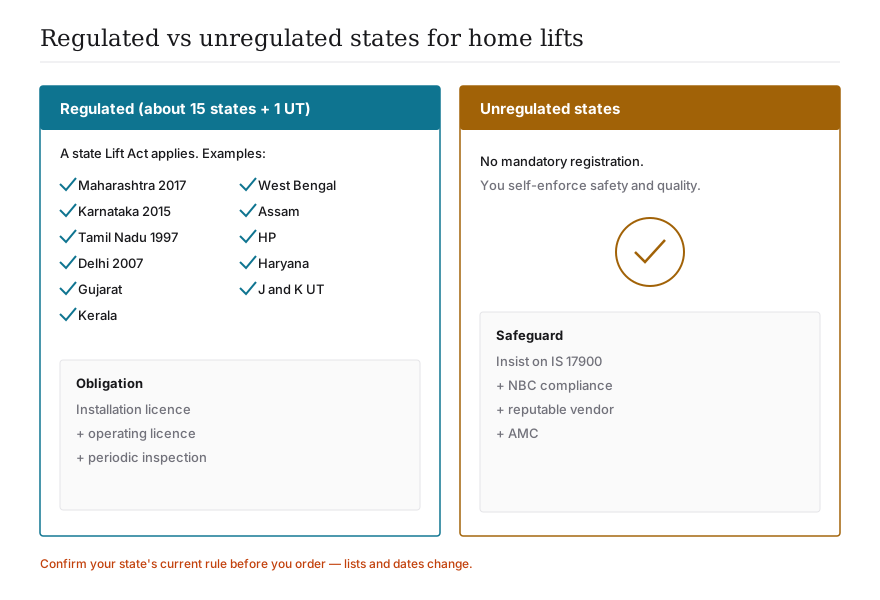
| State / UT | Lift Act (where named) | Typical homeowner obligation |
|---|---|---|
| Maharashtra | Lifts, Escalators and Moving Walks Act, 2017 | Installation licence + operating licence + periodic inspection |
| Karnataka | Lifts, Escalators and Passenger Conveyors Act, 2015 | Installation + operation licence + inspection |
| Tamil Nadu | Tamil Nadu Lifts Act, 1997 | Installation + operation licence + inspection |
| Delhi | Delhi Lifts and Escalators Act, 2007 | Installation + operation licence + inspection |
| Gujarat | State Lift Act | Licensing + inspection |
| Kerala | State Lift Act | Licensing + inspection |
| West Bengal | State Lift Act | Licensing + inspection |
| Assam | State Lift Act | Licensing + inspection |
| Himachal Pradesh | State Lift Act | Licensing + inspection |
| Haryana | State Lift Act | Licensing + inspection |
| Jammu and Kashmir (UT) | State/UT Lift Act | Licensing + inspection |
| Others (rolling adoption) | Various, many adding IS 17900 | Confirm locally |
Why the list keeps changing: more states are incorporating IS 17900 into their Acts as part of aligning with the new mandatory standard. A state that was not on a licensing list two years ago may be now. This is exactly why you must verify YOUR state's current position rather than rely on any published list, including this one.
If your state has no lift act
If you live in a state without a lift act, there is no central legal obligation to register your home lift, and a lift can legally be built to old or no standard. That is not a reason to relax — it shifts the responsibility entirely onto you. The responsible course in an unregulated state is:
- Insist on IS 17900 compliance in writing, with a vendor declaration and test certificate, even though no inspector will demand it. This is your main safeguard.
- Build to NBC 2016 Part 8 Section 5 and your municipal building bye-laws for the shaft, structure and fire provisions.
- Choose a reputable vendor with a local service presence — see the brand landscape in the buyer's guide.
- Sign a proper AMC with periodic safety tests, since no government inspector will be checking the governor, safety gear or ARD for you.
In short: in a regulated state the inspectorate enforces a floor of safety; in an unregulated state you have to enforce it yourself, and the tool you use is IS 17900 plus a serious vendor and AMC.
Who issues what: the inspectorate map
A recurring source of confusion is which authority signs which paper, because three different regimes touch your lift at different moments.
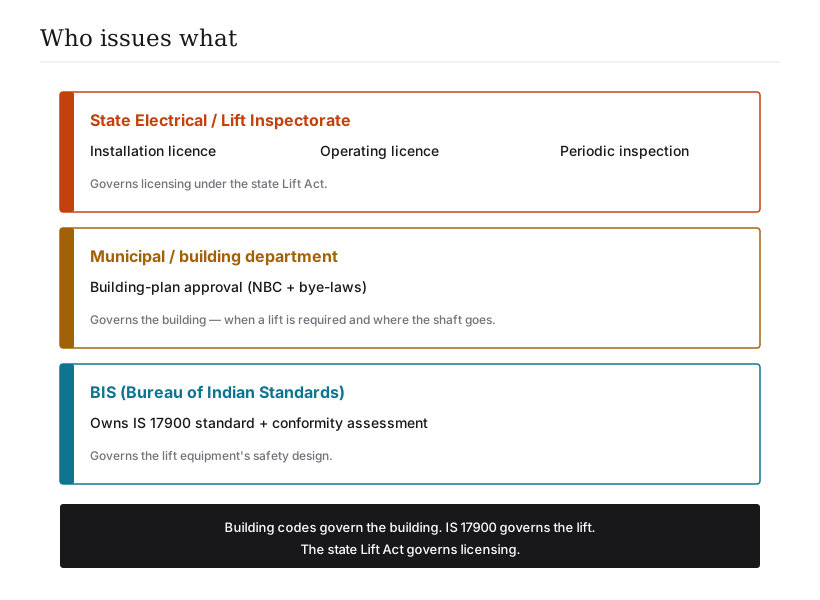
- The State Electrical / Lift Inspectorate issues the installation licence and the operating licence/registration, and conducts the periodic safety inspections. This is the lift-licensing authority under the state Lift Act.
- The municipal authority / local building department handles building-plan approval, where the building codes (NBC plus local bye-laws) decide whether and where a lift is required in the first place. This is a building-side approval, separate from the lift licence — covered in the building codes guide.
- BIS (Bureau of Indian Standards) owns the standard itself (IS 17900); certification and conformity assessment under it are handled through accredited bodies, not by the homeowner directly.
The clean mental model: building codes govern the building and when a lift goes in; IS 17900 governs the lift itself; the state Lift Act governs the licensing. Three layers, three authorities, working together. Your vendor coordinates most of it, but the operating licence is the one the government must sign.
Your compliance checklist
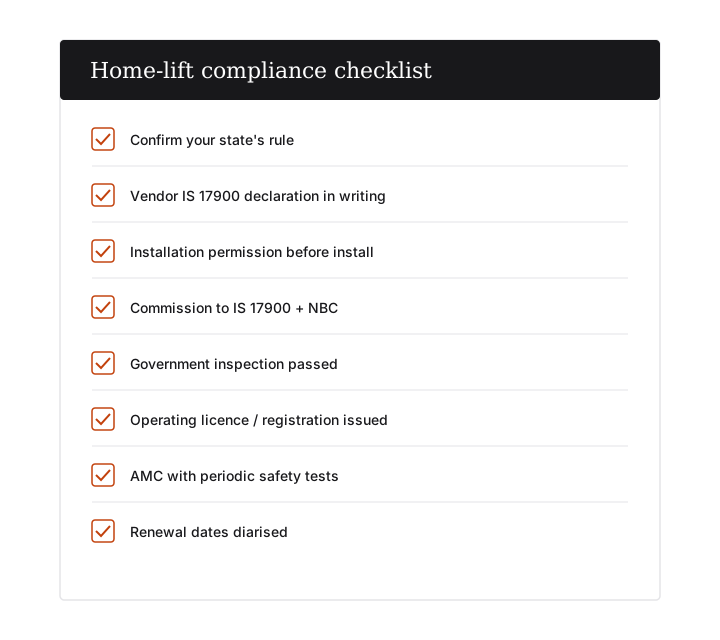
Before you sign, and before you operate, walk this list:
- Confirm your state's current rule — is there a lift act, and what does it require this year? Ask the State Lift Inspectorate or your contractor.
- Vendor IS 17900 declaration — obtained in writing, with a test certificate.
- Installation permission — applied for and granted BEFORE installation, if your state requires it.
- Commissioning to standard — installed to IS 17900 and NBC 2016 Part 8 Section 5.
- Government inspection — booked and passed; safety tests witnessed.
- Operating licence / registration — issued before you run the lift.
- AMC in place — comprehensive or non-comprehensive, with periodic governor, safety-gear and ARD tests.
- Renewal diarised — annual inspection and licence renewal dates noted so the lift never lapses.
Bottom line: in a regulated state, treat the operating licence as non-negotiable and the installation permission as a before-not-after task. In an unregulated state, make IS 17900 plus a reputable vendor and a real AMC your self-imposed equivalent. Either way, confirm the current rule with your state Lift Inspectorate, BIS and a licensed lift contractor — the dates and lists here are indicative and the law varies by state.
How this guide relates to its siblings
This is the approvals and permits lane. The companion guides cover the other three faces of the same compliance picture, and they cross-link so you never have to repeat the journey:
- Residential elevator standards in India — the full standards map (IS 17900, legacy IS 14665, IS 17515, EN 81-20/50).
- Building codes for residential elevators — when and where a lift is required (NBC, bye-laws, fireman's lift triggers).
- Lift safety standards for homeowners — the safety provisions (UCMP, ACOP, ARD) you can verify.
- Accessibility standards for residential lifts and elevator safety components — the deeper cousins on accessibility and hardware.
- Home lift cost in India 2026 and the home lift safety guide — budget and safety basics.
References
- IS 17900 (2025) — current mandatory BIS lift safety code (EN 81-20/50 based), mandatory from 22 December 2025; superseded IS 14665, IS 15785, IS 14671.
- EN 81-20 / EN 81-50 — European lift safety norms on which IS 17900 is modelled.
- IS 14665 (legacy, electric traction lifts) — IS 14665 Part 1: https://law.resource.org/pub/in/bis/S05/is.14665.1.2000.pdf ; Part 2: https://law.resource.org/pub/in/bis/S05/is.14665.2.1-2.2000.pdf
- IS 17515 — Indian Standard on energy performance of lifts, escalators and moving walks.
- NBC 2016, Part 8 (Building Services), Section 5 — Installation of Lifts, Escalators and Moving Walks — BIS: https://www.bis.gov.in/standards/technical-department/national-building-code/ ; Guide for Using NBC 2016: https://www.bis.gov.in/wp-content/uploads/2022/08/Booklet-Guide-for-Using-NBC-2016.pdf
- RPwD Act 2016 (accessibility, public buildings) — full text: https://ssepd.odisha.gov.in/sites/default/files/2024-01/RPWD%20ACT.pdf ; DEPwD FAQs: https://depwd.gov.in/en/faqs-4/
- CPWD / MoHUA Harmonised Guidelines and Space Standards for a Barrier-Free Built Environment — https://www.cpwd.gov.in/Publication/Harmonisedguidelinesdreleasedon23rdMarch2016.pdf
- State Lift Acts — Maharashtra Lifts, Escalators and Moving Walks Act 2017; Karnataka Lifts, Escalators and Passenger Conveyors Act 2015; Delhi Lifts and Escalators Act 2007; Tamil Nadu Lifts Act 1997; and others. Maharashtra licence to operate a lift (Govt services portal): https://services.india.gov.in/service/detail/maharashtra-license-to-operate-lift
- IS 17900 / EN 81 harmonisation — Elevator World: https://elevatorworld.com/article/indias-elevator-revolution-why-is-17900-is-the-biggest-market-opportunity-since-eu-harmonization/
- NABCB accreditation for IS 17900 — TUV SUD: https://www.industrialautomationindia.in/news/tuv-sud-achieves-nabcb-accreditation-for-is-17900-lift-safety-standard
- Lift rules and regulations in India — 99acres: https://www.99acres.com/articles/know-all-about-the-lift-regulations-in-india.html and https://www.99acres.com/articles/faqs-about-lift-rules-and-regulations-in-india.html
Standards, dates and state lists here are indicative as of June 2026 and change frequently. Always confirm the current rule with BIS, your state Lift Inspectorate and a licensed lift contractor before you install or operate a home lift.
Export this guide
Related Guides — Deep-dive reading
Residential Elevator Standards in India (2026): IS 17900, NBC and What Governs a Home Lift
The consolidated standards map for a home lift — IS 17900 (mandatory since 22 December 2025), IS 17515, NBC 2016 Part 8 Section 5, the RPwD/CPWD accessibility rules, the state Lift Acts and the EN 81-20/50 / ISO 8100 lineage, and which one governs what.
Home Lifts & AccessibilityBuilding Codes for Residential Elevators (India): NBC 2016 and Local Bye-Laws
How NBC 2016 Part 8 Section 5 and your municipal building bye-laws decide when a home lift is required, where its shaft goes, and how it must be built and fire-protected.
Home Lifts & AccessibilityLift Safety Standards Every Homeowner Should Know (India)
The plain-language homeowner digest of what IS 17900, mandatory since 22 December 2025, actually requires on your new home lift, and the four pieces of compliance proof you can verify or ask your vendor for.
Home Lifts & AccessibilityRelated Tools — Try Free
Accessibility Compliance Calculator
Check a planned lift against the CPWD and RPwD accessible-lift benchmarks for a score.
Lift CheckerLift Safety Audit Checklist
Interactive checklist that scores your home lift on safety devices, compliance and upkeep.
ChecklistHome Lift Cost Calculator
All-in home lift cost by floors, type, capacity and city — equipment, civil, GST and AMC, with a drive-type comparison.
Lift Calculator