
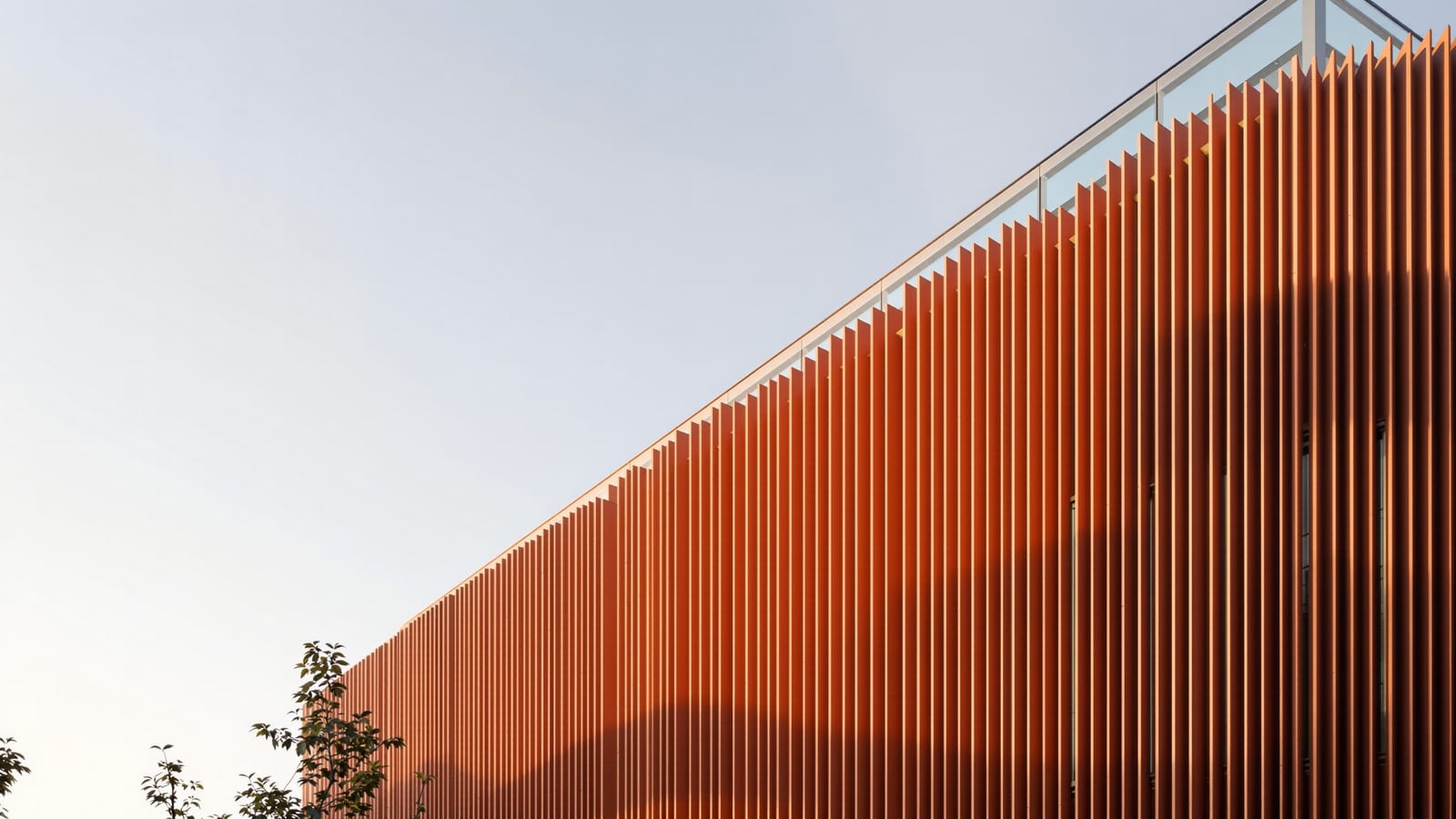
Renzo Piano Façade Design: Terracotta Rainscreens, Lightness, and the Crafted Detail
How Renzo Piano turned fired clay into a contemporary ventilated rainscreen, filtered harsh daylight with crafted leaves, and built façades of refined high-tech lightness — and which of those ideas India should borrow.
There is a particular feeling you get standing in front of a Renzo Piano building, and it is not the feeling of being impressed. It is the feeling of being reassured. The skin is warm. The detail is so resolved that nothing looks accidental. The structure seems to weigh less than it should, as if the architect had quietly negotiated with gravity and won a small concession. Where most "high-tech" architecture wants to show you its muscles, Piano shows you its hands — the façade as a thing that was made, piece by careful piece, by people who cared.
For us at Studio Matrx, one Piano idea matters more than all the others, and it is hiding in plain sight on the warm clay-coloured walls of his housing in Paris and his offices in Berlin and London. Piano took terracotta — fired clay, the oldest building material in the subcontinent — and turned it into a contemporary, high-performance, ventilated façade. Not heritage. Not nostalgia. A breathing, durable, colour-stable rainscreen for the twenty-first century. India has more terracotta tradition than almost anywhere on earth, and a climate that punishes sealed glass boxes. Piano is, quite simply, the global proof that the right answer for our walls was sitting in our brick kilns all along.
This is part of our Building Façades series — specifically our Masters of the Façade set, where we study how one great architect designed façades in particular. For Renzo Piano's life, his Genoa roots, the Renzo Piano Building Workshop (RPBW) and the 2008 Pritzker, read our biography at Renzo Piano. Here we stay narrowly on the wall. Read this alongside our deep guides on the terracotta rainscreen façade (essential — Piano is its patron saint), the double-skin and ventilated façade, the brise-soleil and louvre façade, the glass curtain-wall façade (for The Shard), and the instructive contrast with Norman Foster — both masters of high-tech, but Piano is the warmer, craftier one.
1. Refined high-tech: muscles, but warm
High-tech architecture is the movement, born in the 1970s, that celebrates a building's structure and services as its architecture — steel, glass, exposed bones, the machine made beautiful. Piano was present at its violent birth (the Centre Pompidou, below) but he spent the next fifty years softening it. Critics call his mature manner refined high-tech: the engineering rigour stays, but it is wrapped in craft, in natural materials, in restraint. A Norman Foster façade can feel like flawless industrial product. A Piano façade feels like something a very good workshop assembled by hand — which, increasingly, it was. That word, "workshop," is in his firm's name on purpose.
2. Lightness and transparency
If Piano has a one-word obsession it is lightness — not just visual delicacy but a genuine campaign to make buildings weigh less and seem to float. Roofs hover. Glass walls dissolve. Steel is drawn down to the thinnest section the engineer will allow. This is not decoration; it is an ethic. A light building uses less material, lands more gently on its site, and lets in more of the sky. Transparency is its partner — the desire to let a building breathe light and view, to connect inside and out rather than wall it off. Hold this thought, because in India lightness and transparency need a translation layer: our sky is not gentle, and unfiltered transparency is a heat trap. Piano knew this too, which is why his best façades are not bare glass but filtered skins.
3. The crafted component: pezzo per pezzo
Piano trained among builders and began his career collaborating with engineers rather than drawing pretty pictures — he is, by temperament, a maker. His façades are built pezzo per pezzo, piece by piece: the wall is conceived as an assembly of refined, repeatable, often hand-resolved components. A single terracotta baguette, a single ferro-cement leaf, a single bracket — designed once, perfected, then multiplied across the elevation. This is the secret of why his buildings read as both modern (industrial repetition) and humane (each piece is a considered object). It is also the most transferable discipline he offers any architect: design the one good detail, then repeat it honestly.
4. The controlled roof and the daylight filter
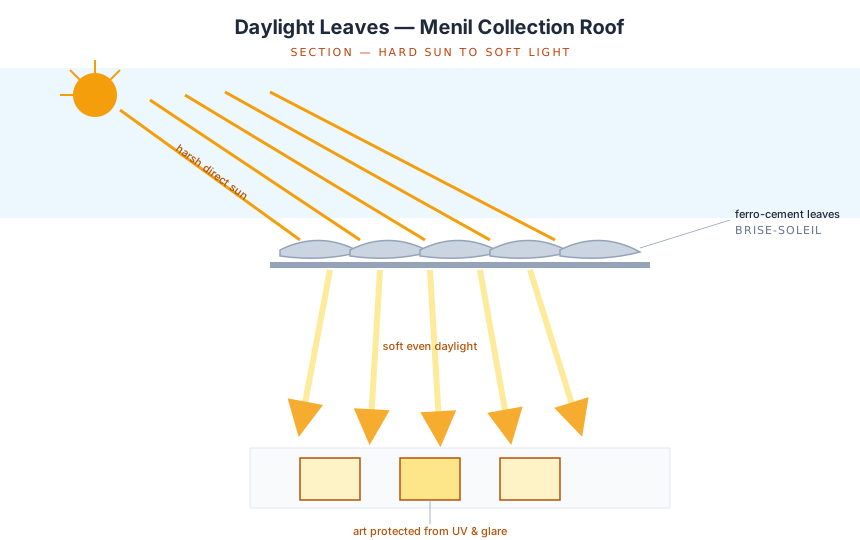
Piano's other lifelong subject is daylight — specifically, how to bring it indoors without the glare and heat that direct sun carries. His signature device is the brise-soleil (literally "sun-break": a fixed shading element of louvres, fins or blades that intercepts direct sun while letting diffuse light through) elevated into architecture. At the Menil Collection he invented a curved ferro-cement leaf — ferro-cement being thin, strong cement reinforced with layered steel mesh, the material he had used to build his own boat — that both holds up the roof and bends harsh Texas sun into soft, even, north-ish gallery light. The roof, in his hands, is a giant light-conditioning machine. For India, where the problem is never too little sun, this is the most directly useful half of his thinking.
The terracotta rainscreen: Piano's gift to the warm-climate façade
This is the technical heart of the guide, and the reason an Indian architect should care about Piano above almost any other master.
A ventilated rainscreen is a façade built in two layers. An outer skin — here, fired-clay tiles or rods — is hung off a metal sub-frame a short distance in front of the real, weatherproofed structural wall, leaving a continuous air cavity between the two. The outer skin takes the sun and sheds the bulk of the rain (hence "rainscreen"); the cavity behind it is open top and bottom so air rises through it by convection, carrying away heat and any moisture that gets past. The actual waterproofing and insulation live on the inner wall, kept dry and shaded. It is, in essence, a parasol and a raincoat hung in front of your house with a breathing gap behind.
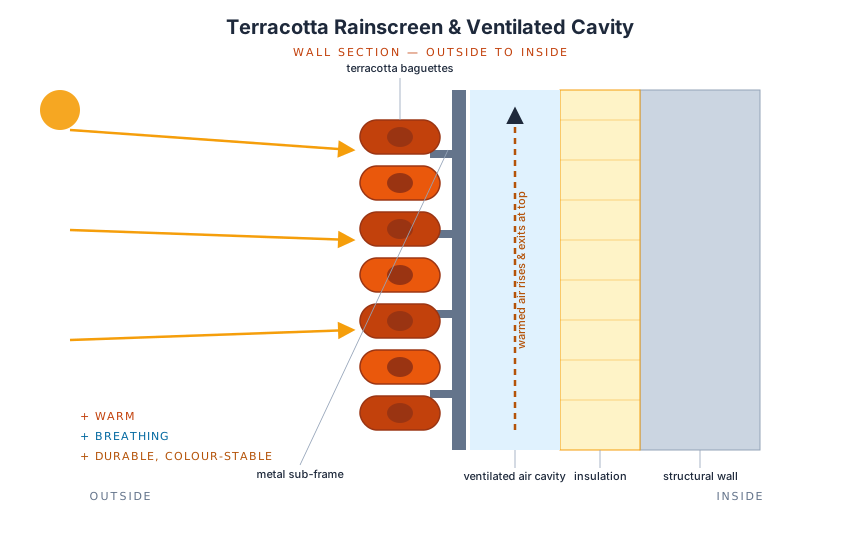
Piano's stroke of genius was the material of the outer skin. Instead of stone or aluminium, he used terracotta — extruded, kiln-fired clay, shaped either as flat tiles or as the slender hollow rods the trade now calls terracotta baguettes. Fired clay is dimensionally stable, fireproof, and — crucially — its colour is through-body and locked in by firing, so it does not fade, chalk or streak under ultraviolet light and decades of rain the way a painted or coated surface does. It develops a quiet patina rather than degrading. A terracotta rainscreen is therefore warm to look at, breathing by design, extraordinarily durable, and colour-stable in exactly the two conditions India serves up in abundance: ferocious UV and lashing monsoon.
He proved it across a famous sequence of buildings. At the IRCAM extension in Paris (1990) the terracotta elements were set in steel frames standing forward of the concealed structure — an early, explicit rainscreen. At the Rue de Meaux housing in Paris (1991) he wrapped social housing in a quiet skin of terracotta tiles and panels set in a precast frame, demonstrating that this was a material for everyday buildings, not just monuments. At Potsdamer Platz in Berlin (the Debis tower and surrounding blocks, 1998) he scaled terracotta up the side of a high-rise, with the clay rods doubling as a sunshade in front of the glass. And at Central Saint Giles in London (2010), his first UK building, he set the whole thing singing in colour — roughly 121,000 glazed ceramic tiles in light green, yellow, red and orange to the street and two greys to the courtyard, all hung as weatherproof rainscreen elements. Same system, infinite warmth.
Read our full technical treatment in the terracotta rainscreen façade guide; Piano is the reason that page exists. For the cavity physics he relies on, see double-skin and ventilated façades.
5. The served / inside-out façade
The opposite pole of Piano's career is the building that wears its insides on the outside. The served (or inside-out) building pushes structure and services — ducts, pipes, lifts, escalators — onto or outside the façade, so the interior is left as one uninterrupted, flexible, column-free "served" space. The Centre Pompidou is the manifesto for this idea. It is brilliant, radical, and — we will say it plainly — almost entirely wrong for India. Exposed pipes and escalator tubes in Mumbai dust and Kerala monsoon are a maintenance nightmare. We study it for its honesty about flexibility, then we leave the theatre at the door.
6. Engineering as a partner, not a servant
Piano's façades are unthinkable without his engineers, above all the late Peter Rice, with whom he developed both the Pompidou's cast-steel gerberettes and the Menil leaves. The lesson is cultural: at RPBW the wall is solved by architect and engineer together, from the first sketch, so that the structural logic and the visible craft are the same thing. The thinness, the float, the resolved bracket — none of it survives a process where engineering is bolted on afterward to make the architect's pretty drawing stand up.
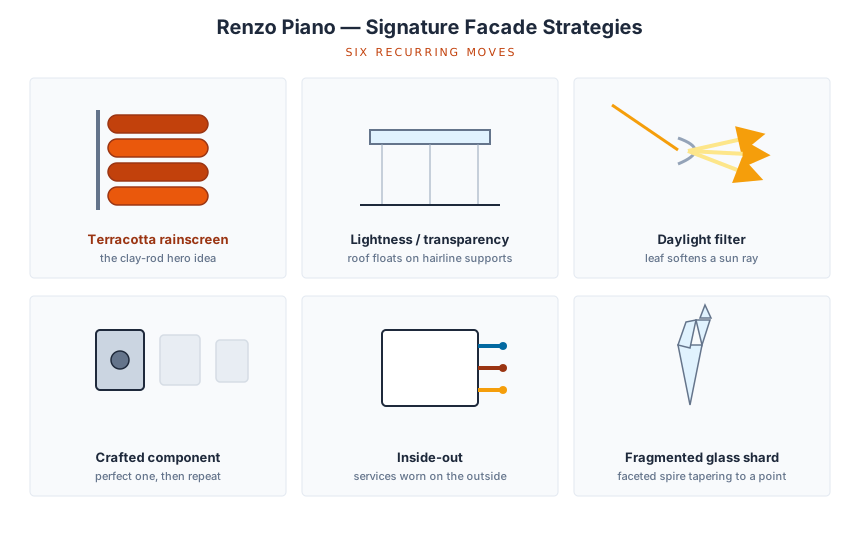
7. Signature façade strategies at a glance
| Strategy | What it is | Building | Why it works | India lesson |
|---|---|---|---|---|
| Terracotta rainscreen | Fired-clay tiles/baguettes hung on a sub-frame over a ventilated air cavity | Rue de Meaux, Potsdamer Platz, Central Saint Giles | Warm, breathing, durable, colour-stable in UV and rain | Borrow wholesale — local clay, climate-perfect, the headline idea |
| Daylight-filtering roof | Curved ferro-cement "leaves" / brise-soleil that diffuse direct sun | Menil Collection | Soft, even, glare-free interior light without heat | Borrow — exactly right for harsh Indian sun |
| Lightness and transparency | Minimal steel, floating roofs, delicate glass | The Shard, many | Buildings that touch the ground and sky gently | Borrow the discipline; filter the glass for our climate |
| Crafted repeatable component | One perfected detail, multiplied (pezzo per pezzo) | All works | Modern repetition with a human, hand-made quality | Borrow — design one good detail, repeat it honestly |
| Living / green roof | Undulating planted roof as the building's fifth façade | California Academy of Sciences | Insulation, cooling, ventilation, ecology | Borrow cautiously — needs irrigation and upkeep |
| Inside-out / services on façade | Structure and ducts pushed outside to free the interior | Centre Pompidou | Maximum interior flexibility | Leave it — impractical in dust and monsoon |
| Fragmented tapering glass | Faceted glass "shards" that don't quite meet, dissolving at the top | The Shard | Reflects the changing sky, lightens a tall tower | Glass-heavy; use only with serious solar control |
Real buildings, not renders
Centre Pompidou, Paris (1977, with Richard Rogers). The inside-out building. Structure, the famous coloured ducts and the glass escalator tube are all pushed outside, so the gallery floors inside are vast and column-free. Thousands of tonnes of steel, including the cast gerberettes engineered with Peter Rice, define the elevation. The façade is the services. Radical, beloved, and a maintenance philosophy India should admire from a safe distance.
Menil Collection, Houston (1987). A low, modest building "small on the outside, big on the inside." Its roof is lined with around 300 curved ferro-cement leaves, each only a few centimetres thick, doubling as the bottom chord of the roof truss and as a daylight filter. Direct Texas sun is intercepted and bent into soft, even gallery light that shifts as clouds pass. This is Piano's daylight thinking at its purest — and the single most India-relevant building in his catalogue.
Terracotta sequence — Rue de Meaux (1991), Potsdamer Platz (1998), Central Saint Giles (2010). The through-line. Rue de Meaux proved terracotta could clad ordinary housing; Potsdamer Platz ran it up a Berlin high-rise as cladding-cum-sunshade; Central Saint Giles exploded it into around 121,000 glazed tiles in greens, yellows, reds, oranges and greys. Same ventilated rainscreen logic, escalating warmth and colour.
The Shard, London (2012). A 310 m mixed-use spire of eight sloping, faceted glass shards that fragment its bulk and deliberately do not quite meet at the top, so the spire dissolves into the sky. Piano's extra-white glass and a naturally ventilated double-skin façade with automatic internal blinds give it a lightness and a constantly changing relationship to the London weather.
California Academy of Sciences, San Francisco (2008). Its fifth façade is a 2.5-acre undulating living roof planted with native species, draped over the domed exhibits below — providing insulation, cooling and natural ventilation, and helping make it one of the world's largest LEED Platinum public buildings.
What it teaches India
Let us be honest about which Piano to import and which to admire from afar.
Borrow the terracotta rainscreen — without hesitation. This is genuinely brilliant for India and it is the headline of this entire guide. Fired clay is one of our oldest and most widely available materials; we have brick and tile traditions in every state and the kilns to make baguettes locally. A ventilated terracotta rainscreen gives us a warm, breathing wall that sheds rain, ventilates away heat, and — because the colour is fired into the body of the clay — stays colour-stable through monsoon and merciless UV when paint and coatings would have chalked and streaked. Piano is the global proof that terracotta is a contemporary, high-performance façade, not a heritage motif. For most warm-climate Indian buildings it is a better answer than a sealed glass curtain wall, full stop.
Borrow the daylight control. The Menil leaf and the brise-soleil are exactly the right instinct for a country where the design problem is always too much sun, never too little. Filtering and diffusing direct light into soft interior daylight, with a shading layer doing real work in front of the glass, should be the default — not the exception.
Borrow the discipline. Piano's lightness, his transparency-with-restraint, and above all his obsession with the one crafted, repeatable component are aspirational standards. Design one good detail; perfect it; repeat it honestly across the elevation.
Leave the rest. His work is bespoke, high-craft and high-budget — beautiful, but not a costing model for everyday Indian construction; take the principle of the resolved detail, not the bespoke price tag. And the inside-out Centre Pompidou — services and structure paraded on the façade — is, for our dust and our monsoon, a maintenance trap. Admire its honesty about flexibility; never put your ducts outside in Delhi.
So: steal the terracotta and the daylight control, execute them robustly with locally-fired clay and a properly detailed cavity, and leave the exposed-services theatre in Paris.
What this means for you
If you are building anywhere in India's hot, sunny, monsoon-washed majority — which is to say almost anywhere in India — Renzo Piano hands you a near-perfect façade strategy that also happens to honour your own material heritage. Specify a ventilated terracotta rainscreen of locally-fired clay over a properly detailed air cavity, and you get a warm, breathing, durable, colour-stable wall that will look better in twenty years than a glass box looks in two. Layer in real shading — fins, louvres, a brise-soleil, a daylight-filtering roof — so the sun is intercepted before it ever reaches the glass. Hold yourself to Piano's standard of the one perfected, repeated detail. And gently decline the temptation of the all-glass tower and the exposed-services spectacle: gorgeous in a magazine, miserable in a Chennai June.
The single most important thing you can take from Renzo Piano is permission — permission to treat terracotta not as nostalgia but as one of the most advanced, climate-correct, beautiful façade materials available to you. He spent a career proving it. We should spend ours using it. Start with the terracotta rainscreen façade guide, and contrast Piano's warm craft with Norman Foster's cooler precision to find your own balance.
Sources
- Renzo Piano Building Workshop (RPBW) — official project pages for the Menil Collection, The Shard / London Bridge Tower, California Academy of Sciences and Rue de Meaux Housing (rpbw.com).
- The Pritzker Architecture Prize, 2008 Laureate: Renzo Piano (pritzkerprize.com).
- Centre Pompidou — "Our building," Centre Pompidou official site; and Dezeen, "Centre Pompidou: high-tech architecture's inside-out landmark."
- The Menil Collection — Fondazione Renzo Piano project page and the Architectural League of New York (on the ~300 ferro-cement daylight leaves and Peter Rice collaboration).
- Central Saint Giles — NBK Architectural Terracotta project page and project documentation (glazed terracotta rainscreen, tile count and colours).
- IRCAM Extension and Rue de Meaux Housing — Arquitectura Viva and façade-engineering references on Piano's early ventilated terracotta cladding.
- The Shard — RPBW and ArchDaily, "The Shard / Renzo Piano Building Workshop" (faceted glass shards, double-skin ventilated façade).
- California Academy of Sciences — Dezeen and designboom, on the 2.5-acre living roof and LEED Platinum rating.
- Studio Matrx in-house: Renzo Piano biography, terracotta rainscreen façades, double-skin and ventilated façades, brise-soleil and louvre façades.
Export this guide
Related Guides — Deep-dive reading
Norman Foster's Façade Signature: The High-Tech Glass Diagrid and the Engineered Skin
How Norman Foster turned the building envelope into structure, climate machine and civic statement — the diagrid crystal, the breathing double-skin, the glazed gridshell — and what his glass towers really demand in Indian heat.
Building FacadesLouis Kahn's Façade Signature: Wrapping Ruins, Brick Arches, and Monumental Light
How Louis Kahn shaded the glass behind giant geometric screen walls, asked the brick to be an arch, and built monumental façades of fair-faced concrete and light — and what that hot-climate logic teaches Indian builders today.
Building FacadesCharles Correa's Façade Signature: How India's Master Made the Climate-Correct Wall
How Charles Correa eroded the flat sealed wall into deep, shaded, porous layers — verandahs, terraces, pergolas and open-to-sky courts — so the Indian façade filters sun and drives air instead of sealing it out.
Building FacadesRelated Tools — Try Free
Brise-Soleil Visualizer
Interactive horizontal-louvre cut-off angle calculator — sun altitude, louvre depth, and spacing inputs with a live shadow preview. Computes θ = arctan(spacing/depth) for façade shading, ECBC envelope compliance, hospital daylight design, and tropical sun-control detailing.
Sun Shading ToolCross-Ventilation Analyzer
Estimate airflow and air changes per hour (ACH) from room size, window areas, layout, and local wind — with NBC 2016 Part 8 compliance check.
Ventilation CalculatorSun Path Analyzer
See the sun's exact path across your home or plot in AR — sunrise, sunset, solar noon, solstices.
AR Analyzer