
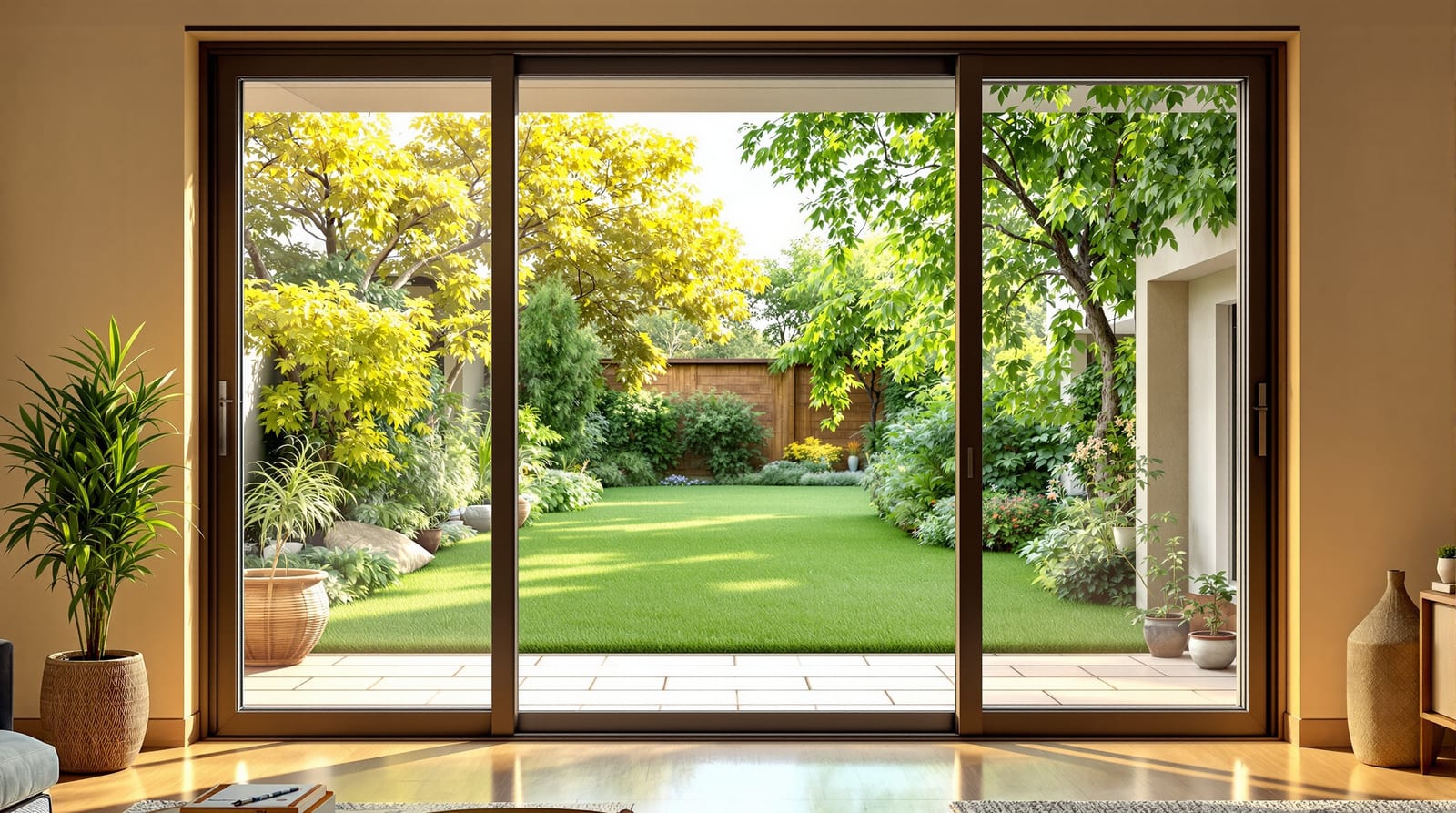
Patio Doors in India: Sliding, French, Bi-Fold & Lift-Slide to Your Garden (2026)
How to pick a patio door that opens your living room to a balcony, terrace or garden — weather-sealing for the monsoon, threshold drainage, security and indicative ₹ for each type.
A patio door is the seam where your living room ends and the open air begins — the balcony, the terrace, the back garden, the courtyard. Get it right and the room breathes: light floods in, the boundary between inside and outside softens, and on a clear evening you simply slide the wall away. Get it wrong and you inherit a different story — driving monsoon rain pooling on the floor, a salt-stiffened track that grates, mosquitoes the moment you crack it open, and a glazed panel that a determined intruder treats as the softest way in. This guide is about choosing a patio door that earns its place in an Indian home: the four door types worth considering, how each handles the rain and the bugs, what threshold and drainage detail keeps water out, and what each costs in rupees.
What counts as a patio door
"Patio door" is a function, not a single product. It is any door designed to open a habitable room onto an adjoining outdoor space — and because that space is meant to be enjoyed, the door is usually large, heavily glazed, and engineered for frequent use. In Indian homes the same opening is variously called a balcony door, a terrace door, a garden door or a courtyard door; the hardware question is identical. Four configurations dominate:
- Sliding glass — leaves run on a track, one fixed and one (or more) sliding. The everyday workhorse: no swing into the room, good light, simple to operate.
- French (hinged double) — two leaves hinged at the jambs that swing open from the centre. Classic, full opening at the threshold, but each leaf needs swing clearance.
- Bi-fold — multiple narrow leaves hinged together that concertina to one side, opening up to ~90% of the aperture. The "disappearing wall" effect.
- Lift-and-slide — a heavy-duty sliding system where turning the handle 180° lifts the leaf off its seals onto rollers; lower the handle and it drops back down, clamping tight against the weather gaskets. The premium choice for very large, very well-sealed openings.
If you want the deep mechanics of each, the dedicated pillars go further: sliding doors, French doors, bi-fold doors, and for multi-panel stacking systems, stacking sliding doors. For the narrower single-leaf case, see the balcony door and terrace door guides. This page is the chooser that sits above them.
The four types compared
The right pick depends on three things you should decide before you talk to a fabricator: how wide an opening you want clear when it is fully open, how much you care about a flush, sealed weather barrier, and your budget. The table below is for an aluminium or uPVC framed, double-glazed or 12 mm toughened glass patio door — the common premium spec. Costs are supply-and-fit indicative ranges per square foot of opening (frame, leaves, glass, hardware, basic fly screen extra), inclusive of nothing — add 18% GST and fitting labour; they vary widely by city, brand and glass spec.
| Patio door type | Max clear opening | Threshold & weather seal | Security (as bought) | Indicative ₹/sq ft (supply+fit) |
|---|---|---|---|---|
| Sliding glass (2-track) | ~50% of aperture | Good with brush + gasket; low track possible | Moderate — needs multipoint + anti-lift | ₹650–1,400 |
| French (hinged double) | ~100% of aperture | Excellent — compression seals all round | Moderate–good — multipoint + hinge-side bolts | ₹900–2,200 |
| Bi-fold | ~85–90% of aperture | Good — but many leaves = many seals to maintain | Moderate — shoot-bolts top/bottom needed | ₹1,400–3,500 |
| Lift-and-slide | ~50% (huge panels) | Excellent — clamps onto seals when closed | Good — heavy leaf + multipoint, hard to lever | ₹2,200–6,000+ |
A few notes the table cannot hold. Sliding doors give you the least drama and the least maintenance, but they never open more than half the wall and a basic slider is the easiest patio door to defeat. French doors give a full, romantic opening and seal beautifully, but you sacrifice the floor and wall area into which the leaves swing — awkward on a small balcony. Bi-folds are the showpiece for a wide terrace where you genuinely want the wall gone, but every additional leaf adds a hinge, a seal and a potential rattle. Lift-and-slide is the engineer's answer to "big, airtight and smooth" — the lifting action means the leaf glides with no seal-drag and then clamps shut weather-tight, which is exactly what you want facing a monsoon-side garden, at a price that reflects the German-style hardware (Hettich, Hafele, Schüco-class systems) it usually rides on.
Sealing against monsoon-driven rain
This is the detail that separates a patio door you love from one you quietly resent. A south-west or west-facing opening takes wind-driven rain straight at the glass for weeks. Three things keep that water outside.
Compression vs brush seals. Hinged French and lift-and-slide doors close onto continuous EPDM compression gaskets — rubber that squashes flat when the leaf is shut, giving a near-airtight, near-watertight barrier. Conventional sliders rely on brush-pile seals that wipe against the leaf as it moves; they are good against insects and draughts but only fair against horizontal rain. If your slider faces serious weather, specify double brush pile plus a centre interlock gasket, or step up to lift-and-slide.
The threshold and its drainage. Water that beats against the glass runs down and collects at the sill. A good patio sill is a chambered aluminium section with weep holes (drainage slots) on the outer face so trapped water escapes outward, never inward. The frame should sit on a continuous bed of sealant over a slightly outward-falling sub-sill, so gravity works for you. For accessibility you want a low threshold (NBC and the RPwD Harmonised Guidelines 2021 favour a sill ≤12 mm so wheelchairs and trolleys roll over it), but a flush threshold and heavy rain fight each other — the compromise is a low, ramped, weep-drained sill rather than a dead-flat one on an exposed elevation.
Frame material. uPVC frames are inherently water- and corrosion-proof and seal well, making them a strong patio choice in coastal and high-rainfall locations; thermally broken aluminium is stiffer for very large panels but must be properly anodised or powder-coated, especially within a few kilometres of the sea where salt attacks raw aluminium. Avoid an untreated timber patio door on an exposed elevation — the cyclic monsoon swelling and dry-season shrinkage will rack the frame and break the seals within a few seasons. If you love a timber look, use a clad system (aluminium outside, timber inside).
Security — the soft entry point
A patio door is, by design, a big sheet of glass leading directly into your living space, often at the back of the house away from the street and out of neighbours' sight. Treat it as a primary security point, not an afterthought. Four measures matter:
1. Multipoint locking. A single centre latch on a wide leaf is trivial to lever. Specify a multipoint lock that throws bolts or hooks at several points up the frame (top, centre, bottom) when you lift the handle — standard on good French, bi-fold and lift-and-slide systems, and available as an upgrade on sliders. See multipoint locking doors for how these work.
2. Anti-lift blocks on sliders. The classic slider attack is to lift the leaf off its track and out. Anti-lift devices (top-track blocks) and a leaf with a deep top-rail overlap stop this. Add a simple patio door bar or foot-bolt for nights and holidays.
3. The glass itself. Specify laminated glass (a tough interlayer that holds together when struck) for the leaf you can reach from outside, or at minimum toughened (IS 2553) glass which shatters into blunt granules rather than daggers. Laminated is the genuine security upgrade — it resists being smashed through.
4. A grill or mesh second line. Many Indian homes pair a patio door with an outer safety grill or a mesh/insect door so the glass can stay open for breeze while a locked secondary barrier stands guard. The grill-plus-glass combo also lets you sleep with airflow. See safety grill doors and mosquito mesh doors for that pairing, and main door security checklist for a broader hardening list.
Insect screens and thermal comfort
A patio door you cannot open in mosquito season is half a door. Three screening approaches suit the four types:
- Roller/retractable mesh — a fine pleated or roll-down mesh that pulls across the opening and disappears into a side cassette when not needed. Best for sliders and French doors; keeps the clean glazed look.
- Sliding mesh leaf — an extra mesh-panel track running parallel to the glass leaves; simple, robust, common on aluminium sliders.
- Magnetic mesh curtains — the budget retrofit; fine for a back terrace, less elegant for a front-facing living room.
On thermal comfort, a large glazed patio door is also a large heat path. Double-glazed (insulated glass unit) leaves cut both summer heat gain and AC loss, and a low-E coating helps further in hot zones; this matters more the more west or south sun the door takes. The dedicated energy-efficient doors guide covers glazing build-ups, and soundproof doors covers the related acoustic gains if the garden faces a road.
Large-opening options and Vastu notes
If your brief is genuinely "remove the wall," bi-fold and stacking systems are the answer — a 4- or 5-leaf bi-fold folds back to leave ~85–90% of the aperture open, while a multi-track stacking slider parks its leaves behind one another. Both want a strong, level structural opening and a robust top track that can carry the weight; this is a fabricator-and-site-engineer conversation, not a DIY one. For very large terraces a lift-and-slide with two big panels is often calmer to live with than six small bi-fold leaves.
On Vastu, a garden- or terrace-facing patio door reads as a secondary opening rather than the main entrance, so the strict main-door rules are relaxed — but the common traditional preferences still apply where you want to honour them: an opening to the north or east is considered auspicious, the door is kept clean and unobstructed, and you avoid a back door directly aligned with the main door (dwar vedha). Frame these as tradition and good sense — a well-lit, well-ventilated north/east opening is genuinely pleasant — and see main door direction Vastu and entrance Vastu for the deeper treatment.
To put rough numbers against your own opening, the door cost calculator and door size calculator help; the door material comparison tool weighs uPVC vs aluminium vs timber for your climate.
Frequently asked questions
Which patio door is best for a monsoon-facing wall?
A lift-and-slide or a French door, because both close onto continuous compression seals that clamp watertight. A standard slider can work on an exposed wall if you specify double brush-pile seals, a centre interlock gasket, and a chambered, weep-drained threshold — but it is the harder type to make truly rain-proof on the worst elevation.
Are patio doors a security risk?
They can be, because they are large glazed panels often at the rear of the house. Reduce the risk with a multipoint lock, anti-lift blocks (on sliders), laminated or at least toughened (IS 2553) glass, and an outer safety grill or mesh door as a second locked barrier. Treated this way, a patio door is as secure as a good main door.
What does a patio door cost in India?
Indicatively, supply-and-fit per square foot of opening: sliding ₹650–1,400, French ₹900–2,200, bi-fold ₹1,400–3,500, and lift-and-slide ₹2,200–6,000+ — before 18% GST and excluding any outer grill or premium fly screen. A typical 8 ft × 7 ft living-room slider therefore lands roughly in the low-to-mid five figures; bi-fold and lift-and-slide of the same size cost multiples of that. Prices vary widely by city, brand and glass spec — treat these as starting points.
Can I get a wheelchair-friendly low threshold and still keep rain out?
Yes, with a compromise: a low, gently ramped sill (aiming for the ≤12 mm step the RPwD Harmonised Guidelines 2021 favour) combined with a chambered, weep-drained threshold section that drains water outward. A perfectly flush, dead-level sill on a heavily exposed monsoon wall is hard to keep watertight, so a ramped low sill is usually the sensible middle ground. See accessible doors for the standards.
Sliding or bi-fold for a small balcony?
For a small balcony, a 2-track slider almost always wins: it needs no swing clearance, has fewer seals to maintain, and costs least. Bi-fold and French doors shine when you have a genuinely wide opening onto a terrace or garden where you want most of the wall to disappear and you have the floor space for leaves to fold or swing.
Export this guide
Related Guides — Deep-dive reading
Stacking Sliding Doors for Indian Homes: Multi-Panel Open-Wall Guide (2026)
How 3-6 panel stacking sliders create a near-full open wall to your balcony or garden, the multi-track aluminium systems, weight and glass limits, weather seals, costs, and how they compare to bi-folds.
Home Doors & EntrancesFrench Doors for Indian Homes: Glazing, Security, Cost & Monsoon Sealing
The double-leaf glazed door that opens a living room to a balcony or garden - where it works, how to specify the glass, frame and seals, what it costs, and how it stacks up against sliding and bi-fold.
Home Doors & EntrancesBalcony Door Design for Indian Homes (2026): Sliding, Mesh & Grill Combos
How to choose a weather-tight, secure, view-friendly balcony door for flats and independent houses — sliding glass, mosquito mesh, safety grill, French and bi-fold options with Indian costs.
Home Doors & EntrancesRelated Tools — Try Free
Cross-Ventilation Analyzer
Estimate airflow and air changes per hour (ACH) from room size, window areas, layout, and local wind — with NBC 2016 Part 8 compliance check.
Ventilation CalculatorDoor Cost Calculator
Estimate the all-in cost of a door — leaf, frame, hardware, fitting and GST — by type, material and size.
Door CalculatorMonsoon-Readiness Checklist
Pre-rain home audit across 9 categories — terrace, drains, waterproofing, electrical, HVAC, pest, vehicles, documents.
Seasonal Audit