
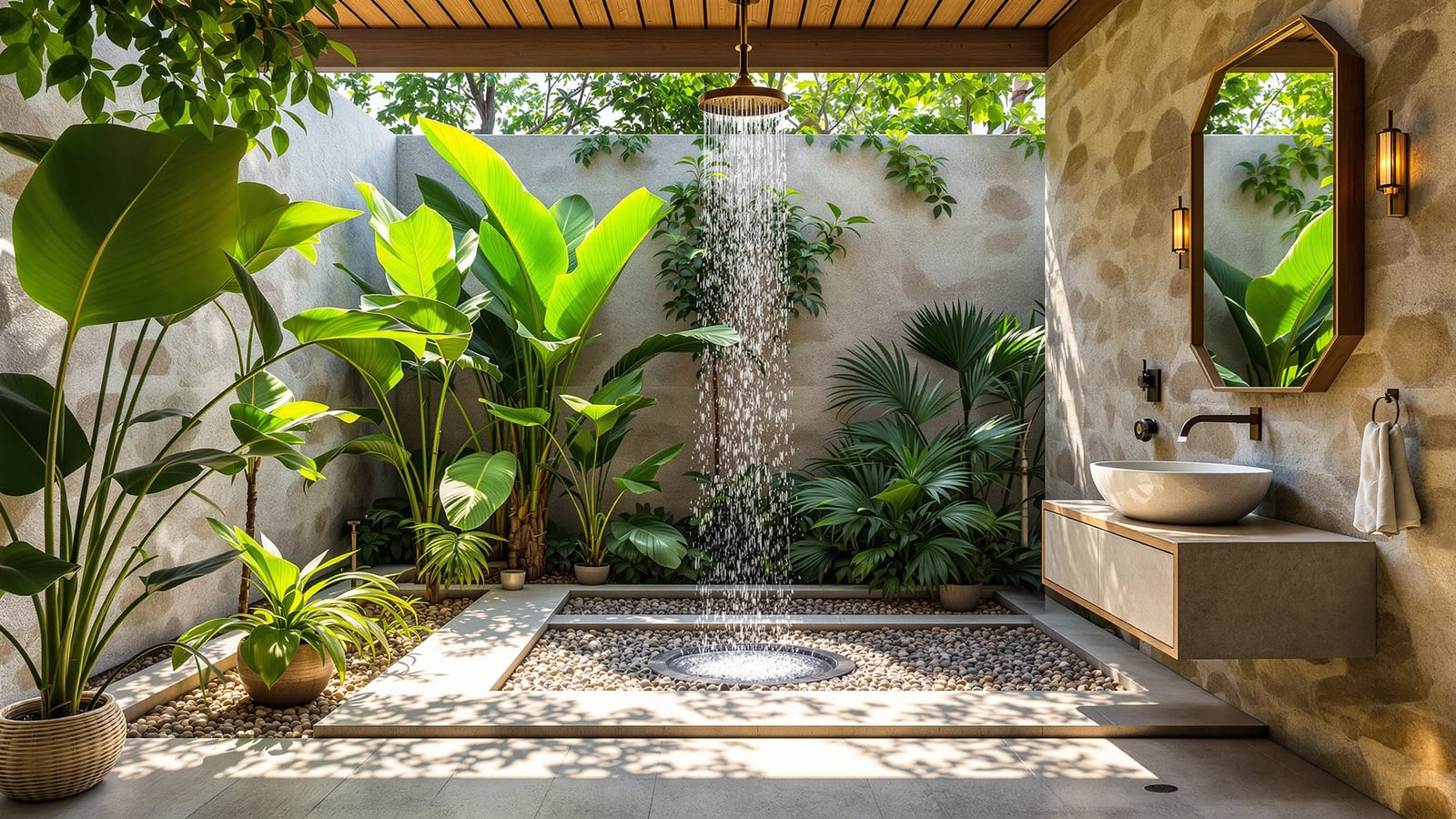
Outdoor Bathroom Design India: Garden, Pool-Side & Open-Air Baths
How to design a weatherproof outdoor bathroom in India — garden showers, pool-side changing rooms and open-air baths — covering siting and privacy, drainage and slope, corrosion-proof materials, protected plumbing and IP-rated electrics, with real rupee budgets.
An outdoor bathroom is one of the most enjoyable spaces you can add to an Indian home — a garden shower after gardening, a pool-side rinse before you step inside, an open-air soak under the stars at a farmhouse. It is also one of the most abused, because everything you build is exposed to full sun, driving monsoon rain, salt or chlorine, and India's notoriously hard water. Get the engineering right and it becomes a low-maintenance pleasure; get it wrong and you have rusted fittings, standing water and a mould problem within one wet season.
This guide sits inside the Studio Matrx bathroom hub. Read it alongside the complete bathroom design guide for India for the codes and fundamentals, and the bathroom layout planning guide for clearances and circulation that still apply outdoors. Outdoor baths pair naturally with a villa bathroom, a wet room and a spa bathroom.
Outdoors, the finish is the easy part. Spend your effort on siting, slope-to-drain, corrosion-proof metal and protected plumbing — the invisible decisions that decide whether the bathroom is a joy or a repair bill.
What counts as an outdoor bathroom
"Outdoor bathroom" covers a spectrum from a single wall-mounted shower to a fully plumbed open-air room. The right one depends on your plot, privacy and how enclosed you want it.
| Type | Typical use | Enclosure | Plumbing |
|---|---|---|---|
| Garden shower | Rinse after gardening or exercise | Screen wall or planting, no roof | Cold + optional hot, floor drain |
| Pool-side rinse + changing | Wash off chlorine, change clothes | Louvred screen, part-roofed | Cold/hot shower, WC optional |
| Open-air en-suite | Villa/farmhouse spa bath | Walled court, sky above shower | Full: WC, basin, shower |
| Utility/service wash | Pets, muddy shoes, wash area | Low wall, open | Cold, coarse drain |
A garden shower can be a weekend job; a fully plumbed open-air en-suite is a proper build with waterproofing, drainage and a septic or sewer connection, and should be planned exactly like an indoor wet room — just with harsher exposure.
Siting, privacy and drainage
Three things decide where an outdoor bathroom goes: privacy, drainage fall and plumbing reach.
- Privacy first. Screen sightlines from neighbours, upper floors and the street. Use masonry walls, louvred timber/aluminium screens, or dense evergreen planting at least 1.8–2.0 m high. In apartment or gated-society plots, check bye-laws and boundary setback rules before you build any structure.
- Slope everything away from the house. The finished floor must fall 1:80 to 1:50 (roughly 12–20 mm per metre) toward a drain, and the whole platform should sit slightly proud of surrounding earth so rainwater runs off, not in.
- Drain generously. Outdoor floors take shower water plus rain, so oversize the drainage. A 100 mm linear channel drain or a large trapped gully clears water far faster than a single 50 mm point drain and clogs less with leaves. Every drain must have a water seal trap to block smells and mosquitoes.
- Connect to the right place. Grey shower water can often feed a soak pit, planting bed or rainwater-harvesting recharge, but any WC waste must go to the sewer or septic tank. Never let black water run into the garden.
- Keep plumbing runs short. The farther the outdoor bath from the main stack and geyser, the longer you wait for hot water and the more pipe you expose. Site it near an existing wet wall where you can.
Weatherproof materials and finishes
The single biggest failure in Indian outdoor bathrooms is choosing indoor fittings and watching them corrode. Specify for exposure from the start.
| Element | Choose | Avoid |
|---|---|---|
| Floor | Anti-skid natural stone (leather-finish granite, Kota, sandstone), R11-rated porcelain | Polished/vitrified glossy tile, smooth marble |
| Walls | Stone cladding, exterior-grade porcelain, cement plaster + exterior paint | Gypsum, MDF, untreated plywood |
| Metal fittings | 316-grade stainless steel, powder-coated aluminium, solid brass | Chrome-on-zinc, mild steel, cheap CP alloys |
| Timber | Teak, thermally-modified wood, treated hardwood, WPC decking | Untreated softwood, ordinary MDF/ply |
| Roof/screen | Pergola, louvres, GI/aluminium with drip edge | Fabric that traps damp, rusting mild-steel frame |
Key rules for India's climate:
- Anti-slip is non-negotiable. Wet stone plus algae in the monsoon is dangerous. Use textured, riven or flamed surfaces rated R11 or higher, and lay slabs with a slight fall, not dead flat.
- 316 stainless or solid brass only for exposed taps, shower arms and grab rails. Standard chrome-plated bathroom fittings — fine indoors — pit and flake outdoors within a year or two, faster near a chlorinated pool or the coast.
- UV and marine grade for anything plastic or coated. Ordinary PVC yellows and cracks in direct sun; specify UV-stabilised.
- Let it breathe and drain. Slatted timber decks and open joints dry quickly; sealed junctions trap water and rot. Waterproof the substrate (see the waterproofing guide) and choose slip-safe flooring rated for wet exterior use.
Protecting the plumbing
Outdoors, pipes face two enemies India rarely worries about indoors: sun and, in the north and hills, winter cold.
- Bury or lag the lines. Run supply pipes below the finished floor or inside insulated conduit. Exposed metal pipe gets scalding hot in summer and, above roughly 1,500 m or in a northern winter, can freeze and burst. Lag exposed sections and add a drain-down valve at the low point so you can empty the line in a cold snap.
- Isolate for the off-season. Fit a stop valve indoors so the whole outdoor bathroom can be shut off and drained when unused for months — common at farmhouses and holiday homes.
- Plan hot water realistically. Long runs waste water while you wait. Either place a dedicated compact geyser or instant heater close to the outdoor shower, or run insulated hot lines. Solar water heating suits sunny outdoor showers especially well — align this with the eco-friendly bathroom guide.
- Hard-water defence. India's hard water scales up shower heads and cartridges quickly outdoors where they also bake in the sun. Choose rub-clean silicone-nozzle rain heads and accessible ceramic-disc cartridges you can descale.
- Traps and vents. Every fixture needs a trap and, for a WC, proper venting to the stack so smells and gases do not vent into an open-air space where you sit.
Electrical and lighting safety
Water plus open weather plus electricity demands care beyond an indoor bathroom.
- IP-rated everything. Use luminaires rated IP65 or higher for direct-spray zones and at least IP44 elsewhere; India follows IS/IEC 60529 for these ratings. Ordinary indoor fittings are unsafe outdoors.
- RCD/RCBO protection. Protect every outdoor circuit with a 30 mA residual current device, in line with IS 732 wiring practice, and earth all metalwork.
- Weatherproof accessories. Switches, sockets and geyser isolators must be outdoor-rated with gasketed covers, mounted away from spray and rain, ideally under the roofed zone.
- Low, warm light. Shielded LED downlights in the pergola, a warm wall wash and low bollard lighting give a spa feel without glare or attracting insects into a bright box.
Costs in India
Outdoor bathrooms range from a modest garden shower to a full open-air en-suite. Indicative 2026 turnkey ranges, materials plus labour:
| Scope | Rough cost (₹) | Notes |
|---|---|---|
| Simple garden shower | 40,000 – 1,20,000 | Cold/hot shower, drain, screen, no roof |
| Pool-side rinse + changing | 1.2 – 4 lakh | Part-roofed, bench, hot water, better finishes |
| Open-air en-suite (WC, basin, shower) | 4 – 12 lakh+ | Full plumbing, waterproofing, stone, drainage |
Corrosion-proof fittings, proper waterproofing and drainage are where the money should go — skimping there is what forces an early rebuild. For higher-end open-air spa baths, cross-read the luxury bathroom guide.
Maintenance and the monsoon
- Before the monsoon: clear drains and channel gratings of leaves, check the floor fall still runs true, and reseal any stone or timber.
- During: expect algae on shaded stone — a stiff brush and a mild cleaner keep it slip-safe. Keep gullies clear so water never ponds and breeds mosquitoes.
- Winter (north/hills): drain down and isolate the supply if the space is unused, to avoid frozen, burst pipes.
- Year-round: rinse salt or chlorine off fittings near pools and the coast, and descale shower heads on India's hard water.
Designed for its exposure, an outdoor bathroom is one of the lowest-maintenance luxuries in an Indian home — and one of the most used.
References
- National Building Code of India (NBC 2016), Bureau of Indian Standards — Part 9 Plumbing Services (water supply, drainage and sanitation) and general siting provisions.
- IS 2556: Vitreous China Sanitary Appliances — specification for WCs and basins, Bureau of Indian Standards.
- IS 1172: Code of Basic Requirements for Water Supply, Drainage and Sanitation, Bureau of Indian Standards.
- IS 15622: Pressed Ceramic Tiles — classification and slip/wear specification, Bureau of Indian Standards.
- IS 732: Code of Practice for Electrical Wiring Installations, Bureau of Indian Standards — RCD protection and earthing for outdoor circuits.
- IS/IEC 60529: Degrees of Protection Provided by Enclosures (IP Code) — ingress-protection ratings for outdoor luminaires and accessories.
- CPHEEO Manual on Water Supply and Sanitation / Sewerage, Ministry of Housing and Urban Affairs — greywater reuse and soak-pit guidance.
- IGBC Green Homes and GRIHA rating criteria — water efficiency, greywater and solar water-heating benchmarks.
Export this guide
Related Guides — Deep-dive reading
Bathroom Planning for New Homes in India: Get It Right Before You Build
The bathroom decisions you cannot undo once the slab is cast — location and stacking, sunken vs non-sunken slabs, waterproofing, and the plumbing, electrical and ventilation you must coordinate with the civil work, stage by stage.
BathroomsBathroom Plumbing India: The Complete Guide to Water Supply, Drainage, Traps & Pipes
The whole plumbing picture for an Indian bathroom in one place — the two systems (cold and hot water supply, and waste/soil drainage with its vented SWV stack), traps and the floor trap, slopes and gradients, concealed vs exposed pipework, pipe materials (CPVC/UPVC/PEX/GI) and the overhead-tank pressure reality — with the coordination that must happen before any civil work starts.
BathroomsAnti Slip Flooring for Bathroom and Wet Areas in India: R-Ratings, Finishes and Genuinely Safe Tile Choices
How to choose genuinely safe flooring for bathrooms, kitchens, balconies, pools, entrances and elderly- or child-friendly homes — the R-rating system, finishes that grip wet feet, anti-skid natural stone, slope to drains and the tiles to avoid.
Flooring & SurfacesRelated Tools — Try Free
Rainwater Tank Sizer
How big should your rainwater tank be? Computes annual harvest, recommended tank capacity in litres, water-bill savings, and payback — for 10 Indian cities.
RWH CalculatorCross-Ventilation Analyzer
Estimate airflow and air changes per hour (ACH) from room size, window areas, layout, and local wind — with NBC 2016 Part 8 compliance check.
Ventilation CalculatorDoor Material Comparison Tool
Compare 2–4 door materials on cost, durability, maintenance, security and moisture resistance.
Comparison Tool