
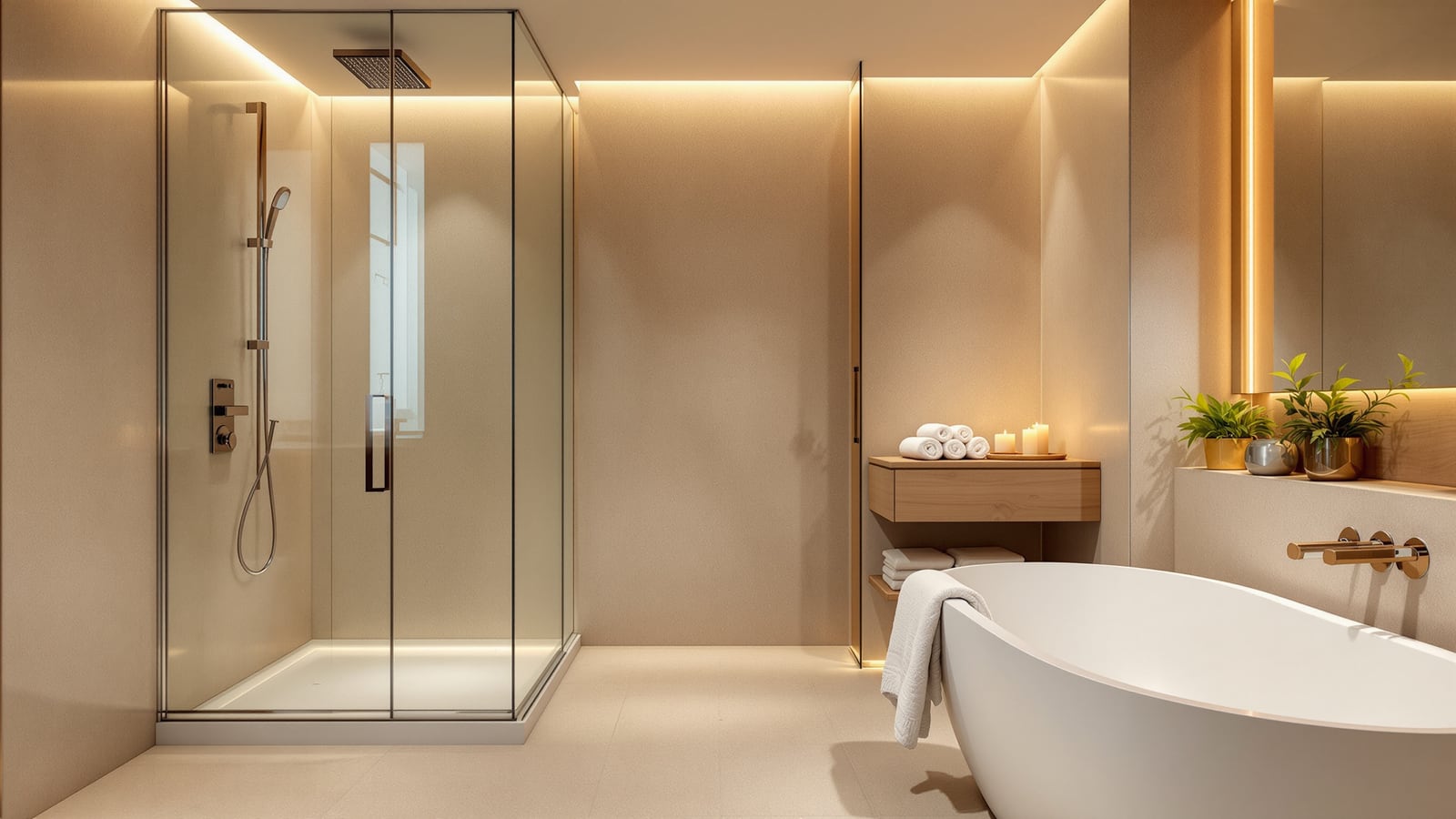
Spa Bathroom India: Home-Spa Design, Steam, Rain Shower & Soaking Ritual
How to turn an ordinary Indian bathroom into a calming home spa — the steam, rain shower, soaking tub, aromatherapy, quiet materials and low warm light that make a daily ritual feel restorative, on any budget.
A spa bathroom is not about how much you spend — it is about how the room makes you feel. A luxury bathroom impresses; a spa bathroom relaxes. The two overlap, but the goal is different: a spa is a designed experience of calm, built by controlling what you feel, hear, smell and see the moment you step inside. That experience can be created in a compact metro apartment bathroom as convincingly as in a villa, because it is driven by the senses, not the price tag.
This is the spa-experience guide of the Studio Matrx bathroom hub. It stays deliberately focused on how a home spa should feel and the rituals it supports. For the materials engineering, premium fittings and honest rupee budgets, read the luxury bathroom design guide — this guide will not repeat it. Start from the complete bathroom design guide for India for codes and fundamentals, and plan the room with the bathroom layout planning guide.
A spa bathroom is an experience, not a shopping list. Design what the body feels — warm water, warm floor, soft light, quiet air, a familiar scent — and the room becomes restorative on any budget.
What actually makes a bathroom feel like a spa
Walk into a good spa and, before you notice a single fixture, you feel a change: the air is warm and still, the light drops, sound softens, and there is a scent you associate with calm. A home spa recreates that by treating the bathroom as a sensory environment rather than a set of appliances. Five things do most of the work.
- Temperature. Warm air, warm water on demand and, ideally, a warm floor underfoot. Cold tiles and a cold draught break the spell instantly.
- Sound. Quiet extraction, no clattering pipes, and the soft, even hiss of a rain head rather than a sharp jet.
- Scent. A single, consistent aroma — eucalyptus, lavender, vetiver — carried by steam or a diffuser.
- Light. Low, warm, layered and dimmable. Never one bright ceiling tube.
- Touch and view. Smooth stone, warm timber, thick towels, and an uncluttered sightline with something calm to rest your eyes on.
None of these depends on a large room. A 1.5 x 2.1 m Indian bathroom can deliver all five; a badly lit 9 sq m one delivers none.
The spa ritual: design the sequence, not just the room
Spas work because they guide you through a sequence — arrive, warm up, cleanse, soak, cool down, rest. A home spa bathroom should support a shorter version of the same arc so a fifteen-minute wash becomes a genuine reset.
- Arrive. A clear, uncluttered entry with hooks, a low light already on, and warm air. Hidden storage matters here: visible clutter is the enemy of calm.
- Warm and cleanse. Step into a rain shower or a brief steam to open up and unwind before you actually wash.
- Soak (optional). Sink into a soaking tub for the deep-relaxation phase — the signature spa moment where you have nothing to do.
- Cool and rest. A cooler rinse, a heated towel, a moment seated. A simple bench or a wide tub edge turns "finished washing" into "rested".
You do not need every stage. Even choosing two — a proper rain shower and a heated towel rail, say — and giving them room and good light delivers most of the feeling.
The core spa experiences
Four features carry most of the spa feeling. Each is defined below by the experience it gives and the essentials to make it work in an Indian home; the fitting choices, costs and slab-loading detail live in the luxury guide.
Rain shower
The rain head is the most accessible spa upgrade. A wide 200–300 mm ceiling or arm-mounted head delivers a soft, enveloping fall rather than a sharp spray. The experience depends on two things Indian homes often forget: enough hot water to run it comfortably (a larger geyser or a good instant heater) and steady pressure (a pump if your overhead tank sits low). Pair it with a hand shower on a slide bar so you keep the health-faucet practicality alongside the ritual.
Steam
A short steam is the deepest relaxation-per-rupee in a home spa. A steam generator sized to the shower-cabin volume turns a glazed wet zone into a steam room. The experience needs a sealed, vapour-tight enclosure with a sloped ceiling so condensation runs off rather than dripping, and a bench to sit. Because steam and India's monsoon humidity both attack finishes, treat ventilation as part of the pleasure, not an afterthought.
Soaking tub
The soak is the signature spa moment — the phase where you simply stop. A deep Japanese-style soaking tub (shorter but deeper than a Western bath) suits Indian bathrooms and uses less water for a fuller immersion. Placed by a frosted window with a ledge for a candle and a cup of tea, it becomes the emotional centre of the room. Confirm floor loading and give it breathing space so it reads as a calm object, not a squeezed-in fixture.
Aromatherapy and sound
Scent and sound are the cheapest, most powerful spa layers. A eucalyptus or lavender diffuser, or aromatic oils dropped into a steam inlet, complete the sensory picture. A quiet, humidity-sensing exhaust fan protects the calm as much as the ceiling; a discreet moisture-safe speaker for slow music does the rest.
| Sensory layer | Spa feature | What creates the feeling |
|---|---|---|
| Warmth | Rain shower, steam, heated towel rail | Ample hot water, warm still air, warm floor |
| Sound | Rain head, quiet extraction | Soft even flow, silent humidity-sensing fan |
| Scent | Aromatherapy | Single consistent aroma via steam or diffuser |
| Immersion | Soaking tub | Deep tub, breathing space, a ledge to rest things |
| Sight | Low warm light, calm palette | Dimmable layers, uncluttered sightlines |
The fastest route to "spa" is not a bigger tub — it is warm water on demand, a warm floor, low light and a single scent. Fix those first; add features after.
Calm materials and a quiet palette
Spa calm comes from a restrained, natural, tactile palette — the visual opposite of a busy tiled bathroom. Keep the number of materials and colours low and let texture do the talking.
- Natural, muted tones. Stone greys, warm off-whites, sand and soft greens read as calm; high-contrast patterns and glossy bright tiles read as busy.
- Warm timber accents. A timber slatted bench, a tub deck or a duckboard adds warmth and a sauna-like touch. Use moisture-tolerant teak or a good marine-grade equivalent, sealed for humidity.
- Matte over gloss. Matte or honed stone and porcelain, and matte-black or brushed fittings, reduce glare and feel more restful than mirror-shine chrome.
- Continuity. Running the same floor material into the wet zone, and floor-to-ceiling tiles behind the tub, makes a small room feel calm and seamless.
- Greenery and softness. A humidity-loving plant, folded thick towels and a stone or timber stool soften the hard surfaces every bathroom otherwise has.
Because natural stone and metal finishes must survive hard water and monsoon humidity, specify sealing and quality coatings as covered in the design and luxury guides — sanitaryware to IS 2556 and tiles to IS 15622.
Light and air: the invisible spa
Nothing collapses a spa mood faster than a single cool-white ceiling light or a noisy fan. Two invisible systems set the whole atmosphere.
Lighting should be low, warm and layered, all on a dimmer:
- A soft ambient wash, ideally concealed in a cove, at a warm 2700–3000 K.
- A gentle glow around the tub or a backlit niche for the soak.
- Discreet, dimmable task light at the mirror for when you need it — bright when washing, dropped right down for the ritual.
- If you have a window or skylight, treat daylight as the best spa light of all, with a frosted or top-lit solution for privacy.
Air must be warm, still and fresh. A quiet, humidity-sensing exhaust clears steam without a roar, protects the calm materials from mould, and is genuinely part of the experience.
A spa experience on any budget
The spa feeling scales down far better than luxury does, because senses cost little to satisfy. The tiers below are about experience, not construction cost — see the luxury guide for full rupee budgets and the renovation guide to phase an upgrade.
| Tier | Do this | The experience it buys |
|---|---|---|
| Essential | Rain head, dimmable warm light, heated towel rail, one aroma diffuser, decluttered surfaces | 80% of the calm, in almost any existing bathroom |
| Mid | Glazed walk-in wet zone, quiet humidity-sensing fan, muted stone/timber palette, moisture-safe speaker | A quiet, seamless ritual with better air and sound |
| Full | Steam generator, deep soaking tub, warm floor, daylight/skylight, integrated scent and scenes | A complete arrive-warm-soak-rest sequence at home |
Two rules keep a home spa honest. First, subtract before you add — clutter, glare and noise destroy calm more surely than any missing fixture. Second, spend on what you feel every day — warm water, a warm floor and soft light — before the features you use occasionally.
This works in apartments too: a fixed plumbing shaft and society rules limit big moves, so a metro flat spa leans on the essential and mid tiers — see the apartment bathroom guide. A villa bathroom can take the full sequence, natural light on two sides and even an indoor-outdoor soak.
Bringing it together
A spa bathroom is the calmest, most personal room you can design — and it is built from feeling, not spending. Warm the water, the air and the floor; drop the light low and layer it; quiet the extraction; choose a single scent and a restrained natural palette; and give a rain shower, a steam or a soak the room to breathe. Get the fundamentals from the complete bathroom design guide, plan the room with the layout planning guide, specify the premium engineering with the luxury bathroom guide, and phase the work with the renovation guide. Do that, and a fifteen-minute wash becomes the most restorative part of your day.
References
- National Building Code of India (NBC 2016), Bureau of Indian Standards — Part 9 Plumbing Services and bathroom space, ventilation and sanitation provisions.
- IS 2556: Vitreous China Sanitary Appliances — specification for WCs, basins and sanitaryware, Bureau of Indian Standards.
- IS 15622: Pressed Ceramic Tiles — classification and specification for floor and wall tiles, Bureau of Indian Standards.
- IS 1172: Code of Basic Requirements for Water Supply, Drainage and Sanitation, Bureau of Indian Standards.
- IS 732: Code of Practice for Electrical Wiring Installations — safe wet-zone lighting, extraction and heating circuits, Bureau of Indian Standards.
- IGBC Green Homes and GRIHA criteria — water and energy efficiency benchmarks relevant to steam, heating and fixture selection.
Export this guide
Related Guides — Deep-dive reading
Soaking Tub India: Deep Japanese-Style Ofuro Baths, Geyser Sizing, Load & Real Costs (2026)
Why a deep soaking tub gives a full-immersion soak from a small footprint — ofuro ergonomics, the extra-deep water line, how much hot water and geyser capacity you actually need, heat-retention materials, the structural load of a filled tub, and honest rupee ranges for an Indian home.
BathroomsFreestanding Bathtub India: Materials, Floor Load, Concealed Plumbing & Cost (2026)
The statement centrepiece tub that stands free of every wall — how acrylic, stone-resin and cast-iron differ, the floor load a filled tub imposes, the concealed rough-in you must set out before the flooring goes down, the clear space it needs all around, drainage, and honest 2026 rupee costs.
BathroomsBathroom Planning for New Homes in India: Get It Right Before You Build
The bathroom decisions you cannot undo once the slab is cast — location and stacking, sunken vs non-sunken slabs, waterproofing, and the plumbing, electrical and ventilation you must coordinate with the civil work, stage by stage.
BathroomsRelated Tools — Try Free
Cross-Ventilation Analyzer
Estimate airflow and air changes per hour (ACH) from room size, window areas, layout, and local wind — with NBC 2016 Part 8 compliance check.
Ventilation CalculatorWindow Size Calculator
Get the right window size, glazing area and openable area for any room using NBC daylight rules.
Window ToolApartment vs Villa Interior Planning Guide
Compare ceiling height, structural flexibility, lighting, storage, and services between apartments and villas.
Planning Guide