
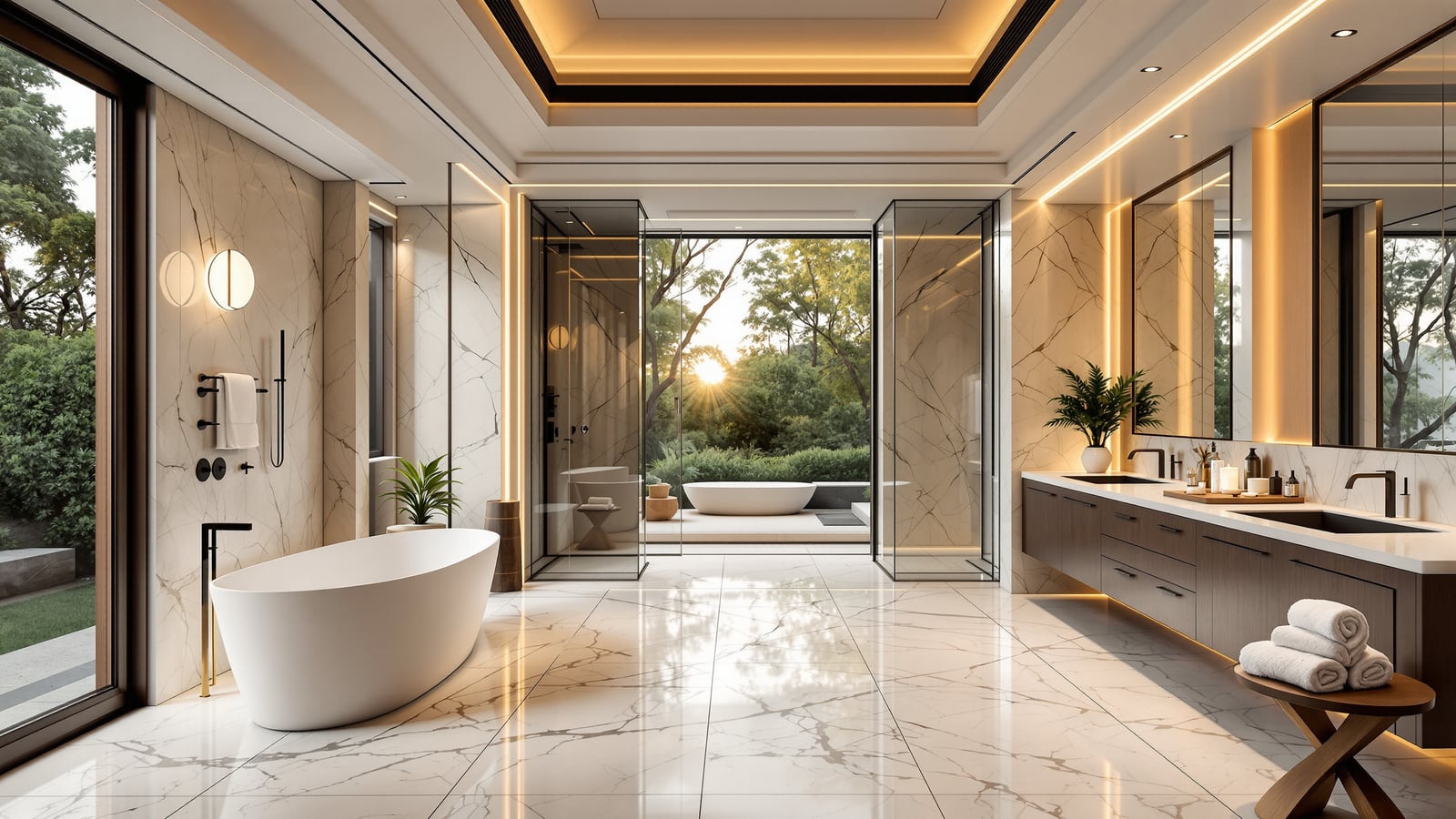
Luxury Bathroom Design India: Spa Bathrooms, Wellness & Automation
A grounded guide to designing a genuinely luxurious bathroom in India — spa and wellness zones, natural stone and premium fittings, layered lighting, automation and long-life engineering — with real per-bathroom rupee budgets from ₹8 lakh to ₹40 lakh and up.
Luxury in a bathroom is not a price tag — it is an experience. A ₹40 lakh bathroom crammed with gadgets can still feel cold, cramped and badly lit, while a calmly planned wet room in natural stone, warmed underfoot, with water that arrives instantly at exactly the right temperature, can feel like a private spa. Real luxury comes from three things working together: generous, well-zoned space; honest premium materials; and an experience that is effortless every single morning. Cost follows those decisions; it does not create them.
This is the luxury pillar of the Studio Matrx bathroom hub. Read it alongside the complete bathroom design guide for India, which sets the codes and fundamentals; the residential bathroom guide for room-by-room planning; the bathroom renovation guide if you are upgrading an existing home; and the smart bathroom guide for India for the automation detail this guide only summarises.
Luxury is space you can move in, materials that age beautifully, and an experience that never makes you think about the plumbing. Spend on those three, in that order.
What actually makes a bathroom "luxury"
Walk into any five-star spa bathroom and the first thing you feel is not the marble — it is the room to breathe. The National Building Code of India (NBC 2016) treats roughly 1.2–1.8 sq m as a functional bathroom. Luxury begins where you stop counting minimums: a master bath of 4.5–9 sq m or more, planned as distinct zones rather than fixtures squeezed against four walls.
Three ingredients separate luxury from merely expensive:
- Space and zoning. A wet room you can walk into, a soaking tub with air around it, a double vanity, and a separately compartmented WC. Circulation of 750–900 mm between fixtures, not the 550 mm you can just about survive.
- Honest materials. Natural stone, large-format porcelain, solid surface, real brass or matte-black CP finishes — surfaces that look better with age and repair rather than wearing out.
- Effortless experience. Instant hot water, thermostatic temperature control, warm floors, quiet extraction, light that flatters and calms. The engineering disappears; only the comfort remains.
Everything below serves those three ideas.
The spa and wellness bathroom
Wellness is where the biggest jump in perceived luxury happens, and it is also where planning matters most — every feature has a space and services cost that must be designed in early, never retrofitted.
The wet room and rain experience
A glazed wet room — a walk-in shower zone with a gentle floor fall and no lip — is the spine of a spa bathroom. Inside it you can layer: an overhead rain head (200–400 mm), a hand shower on a slide bar, and body jets set into the wall at shoulder and lumbar height. Body jets are thirsty: four to six jets can demand 20–30 litres per minute, so they need adequately sized supply lines (typically 20–25 mm) and, in most Indian homes, a pump and a large geyser or instant heater to sustain them.
Steam, sauna and the soaking tub
- Steam shower. A sealed, sloped-ceiling enclosure with a steam generator sized to the cabin volume. It needs a dedicated waterproofed cabin, a 240 V supply, drainage and a vapour-tight glass door.
- Freestanding / soaking tub. The signature luxury object. A cast-stone or acrylic freestanding tub needs floor loading checked (a filled stone tub plus water plus bather can exceed 500 kg — confirm the slab), a floor-mounted or wall spout, and clear space around it to read as sculpture.
- Sauna. A dry heat cabin in the ₹3–8 lakh range for a compact two-person unit; needs ventilation and a robust electrical supply, and is realistic only where you have a dedicated dry corner.
- Chromotherapy and aromatherapy. Colour-changing waterproof LEDs and scent diffusion built into showers or tubs — a modest add-on cost that meaningfully lifts the experience.
The table below maps each wellness feature to what it actually demands of the room, so you can decide early what your space and services can support.
| Spa feature | Space it needs | Services it needs | Typical add-on cost (₹) |
|---|---|---|---|
| Rain head + body jets | Walk-in wet zone, 1.2 m+ wide | 20–25 mm supply, pump, large geyser | 60,000–2,50,000 |
| Steam shower | Sealed cabin, sloped ceiling | 240 V, drain, vapour-tight glass | 1,50,000–4,50,000 |
| Freestanding soaking tub | 0.8 m clear on 2–3 sides | Checked slab loading, floor/wall spout | 1,20,000–6,00,000 |
| Sauna (2-person) | Dry corner, 1.2 x 1.2 m+ | Ventilation, dedicated power circuit | 3,00,000–8,00,000 |
| Chromotherapy + aroma | Integrated in shower/tub | Waterproof LED driver, diffuser | 20,000–90,000 |
Wellness features are cheap to imagine and expensive to retrofit. Decide steam, sauna and body-jet routing at the plumbing stage — not after tiling.
Premium materials that earn their place
Luxury materials read as luxury because they are natural, large, seamless, and beautifully detailed. In India they must also survive hard water and monsoon humidity, so specification is as much engineering as aesthetics.
- Natural marble and travertine. Statuario, Michelangelo, Botticino, Indian green — unmatched depth, but porous. In hard-water regions they must be sealed on installation and re-sealed periodically, and kept away from acidic cleaners. Reserve the most dramatic stone for the feature wall behind the tub or vanity.
- Large-format porcelain. 1200 x 2400 mm and larger slabs give the near-seamless look of stone with far better stain and scratch resistance — often the smarter luxury choice for floors and wet-zone walls.
- Book-matched stone. Adjacent slabs cut so the veining mirrors into a symmetrical pattern. This is the single most powerful luxury gesture in a bathroom — and it depends entirely on skilled cutting and dry-layout before fixing.
- Solid surface (Corian and equivalents). Seamless, thermoformed vanity tops and integrated basins with no dirt-catching joints — hygienic and quietly premium.
- Brass and matte-black CP fittings. Brushed brass, gold and matte-black finishes signal luxury, but insist on quality PVD coatings; cheap electroplating pits quickly under hard water. Sanitaryware should meet IS 2556 (vitreous china) and tiles IS 15622.
Because water quality makes or breaks premium finishes, treat a water softener or whole-house conditioner as part of the luxury bathroom budget, not an afterthought — it protects glass, chrome, stone and the mechanisms inside thermostatic valves.
Lighting: the most underrated luxury
Nothing separates a spa bathroom from an ordinary one faster than light. Luxury lighting is layered and controllable, never a single ceiling fixture.
- Task light at the mirror: vertical strips or a backlit mirror at face height so light falls evenly, with no shadows under the eyes. Aim for a warm-to-neutral 3000–4000 K.
- Ambient / cove light: concealed LED in a ceiling cove or under floating vanities for a soft, restful wash.
- Accent light: a discreet spot grazing the book-matched stone or washing the tub wall.
- Feature and mood: backlit niches, waterproof LED (rated IP65 in the wet zone) and chromotherapy for the bath.
All of it should sit on scene control — a "morning" scene bright and cool, a "bath" scene dim and warm — dimmable and ideally on the home automation system.
Automation: luxury that thinks
Automation is what turns premium fixtures into an effortless experience. The detail lives in the smart bathroom guide for India; here is the luxury shortlist:
- Smart WC / bidet. Heated seat, warm-water wash, auto lid, deodoriser and night light. India-appropriate because it pairs the health-faucet habit with hands-free hygiene.
- Digital / thermostatic showers. Set your exact temperature once; the valve holds it regardless of pressure swings — no more scalding when someone opens a tap elsewhere. Preset user profiles for each family member.
- Sensor and touchless faucets. Hygienic, water-saving and quietly high-end.
- Underfloor heating. Electric mats under stone or porcelain — a small daytime treat in Bengaluru or Pune winters, genuinely valued in Shimla, Dehradun or Kashmir. Keep it on a timer or automation scene.
- Motorised and integrated control. Motorised skylights or blinds, exhaust driven by a humidity sensor, and lighting scenes tied to the home system.
The luxury test for automation is simple: does it make a daily ritual effortless, or is it a demo you show guests once? Buy the first kind.
Sustainability at the luxury level
Luxury and responsibility are not opposites — the most refined bathrooms waste the least. IGBC and GRIHA rate water efficiency, and the fixtures that score well are also the ones that feel best.
- Efficient fixtures. Dual-flush WCs (6/3 or 4/2.5 litre, per IS 774), aerated 5–6 lpm faucets and pressure-compensating showers cut consumption without cutting the sensation of flow.
- Water recycling. Greywater from showers and basins, treated and reused for flushing and landscape, is realistic at villa scale and aligns with CPHEEO plumbing guidance.
- Hot-water efficiency. A well-insulated storage geyser or heat-pump water heater, plus scheduling, cuts the biggest energy load in the room.
- Quality that lasts. The most sustainable luxury is buying once. PVD-coated fittings, ceramic-disc cartridges and serviceable valves last decades instead of years — provided you plan service access: keep concealed cisterns and thermostatic valves reachable behind removable panels.
Engineering the luxury to last in India
A luxury bathroom that fails in three monsoons is not luxury — it is expensive disappointment. Indian conditions punish shortcuts, so build the invisible layers as carefully as the visible ones.
- Waterproofing and tanking. The wet room and tub zone must be fully tanked — a continuous membrane up the walls, into the shower niche and over the whole floor, with fillets at every junction. This is the one item never to value-engineer; specify a polyurethane or cementitious system with a documented warranty and flood-test it before tiling.
- Falls and drainage. Wet-room floors need a consistent 1:80 to 1:100 fall to a linear or point drain sized for high-flow rain-and-jet showers, so water never pools against stone. A generous 50 mm or channel drain avoids the puddling that cheap systems suffer.
- Hard water everywhere. Beyond the softener, choose ceramic-disc cartridges and PVD finishes that shrug off scale, and detail glass with a hydrophobic coating so shower screens stay clear rather than clouding with limescale.
- Humidity and ventilation. Monsoon damp and steam showers demand real extraction — a humidity-sensing exhaust fan sized to the room volume, plus openable ventilation where possible, protects joinery, mirrors and the marble from mould and efflorescence.
- Service access. Every concealed cistern, thermostatic valve, pump and steam generator must be reachable behind a removable panel or access hatch. Luxury fittings are serviceable by design; burying them in solid masonry turns a small repair into demolition.
In India the difference between luxury that lasts and luxury that leaks is entirely below the surface. Fund the waterproofing, the drainage and the service access first.
A realistic luxury budget
There is no single luxury number — a refined but restrained master bath in a metro apartment might land near ₹8 lakh, while a full villa spa with steam, sauna, book-matched stone and complete automation runs ₹40 lakh and beyond. The line items below are per-bathroom, at the luxury end of the market; they are indicative and move with city, brand and imported content.
| Element | Standard-luxury (₹) | High-luxury (₹) |
|---|---|---|
| Design + project management | 60,000–1,50,000 | 2,00,000–5,00,000 |
| Waterproofing + civil + tanking | 80,000–1,50,000 | 1,50,000–3,00,000 |
| Natural stone / large-format porcelain | 1,50,000–3,50,000 | 4,00,000–10,00,000 |
| Premium sanitaryware + brassware | 1,20,000–3,00,000 | 4,00,000–9,00,000 |
| Shower system (rain, jets, thermostatic) | 80,000–2,00,000 | 2,50,000–5,00,000 |
| Freestanding tub / steam / sauna | 1,00,000–3,00,000 | 5,00,000–12,00,000 |
| Vanity, solid surface, joinery | 80,000–2,00,000 | 3,00,000–6,00,000 |
| Lighting + scene control | 60,000–1,50,000 | 2,00,000–4,00,000 |
| Automation (WC, digital shower, UFH) | 70,000–2,00,000 | 3,00,000–7,00,000 |
| Water treatment + contingency | 50,000–1,50,000 | 1,50,000–3,00,000 |
| Indicative total | ₹8,00,000–20,00,000 | ₹28,00,000–64,00,000+ |
Two rules keep a luxury budget honest. First, do not spread thinly — a single beautifully executed wet room beats two half-luxury bathrooms. Second, spend where you touch and see every day — the shower valve, the floor underfoot, the mirror light — before the features you use occasionally.
Bringing it together
A luxury bathroom in India is an act of restraint as much as spend. Zone the space so it breathes; choose a few honest materials and detail them impeccably; layer the light; automate only what makes the daily ritual effortless; and engineer for hard water, humidity and service so the luxury lasts a decade, not a season. Get the fundamentals from the complete bathroom design guide, plan the room with the residential bathroom guide, phase an upgrade with the renovation guide, and specify the technology with the smart bathroom guide.
References
- National Building Code of India (NBC 2016), Bureau of Indian Standards — Part 9 Plumbing Services, sanitation and bathroom space provisions.
- IS 2556: Vitreous China Sanitary Appliances — specification and quality for WCs and basins, Bureau of Indian Standards.
- IS 774: Flushing Cisterns for Water Closets and Urinals — dual-flush volumes, Bureau of Indian Standards.
- IS 15622: Pressed Ceramic Tiles — classification and specification, Bureau of Indian Standards.
- IS 1172: Code of Basic Requirements for Water Supply, Drainage and Sanitation, Bureau of Indian Standards.
- IGBC Green Homes and GRIHA rating criteria — water efficiency and fixture benchmarks, Indian Green Building Council and GRIHA Council.
- CPHEEO Manual on Water Supply and Sanitation / Sewerage, Ministry of Housing and Urban Affairs — greywater and plumbing guidance.
- Manufacturer product standards and IP-rating guidance for wet-zone luminaires (IEC 60529 / IS 60529) for luxury bathroom lighting selection.
Export this guide
Related Guides — Deep-dive reading
Bathroom Planning for New Homes in India: Get It Right Before You Build
The bathroom decisions you cannot undo once the slab is cast — location and stacking, sunken vs non-sunken slabs, waterproofing, and the plumbing, electrical and ventilation you must coordinate with the civil work, stage by stage.
BathroomsLED Bathroom Mirror India: Backlit vs Front-Lit, Colour Temperature, Cost & The Point Behind the Glass
A practical India-first guide to LED and backlit bathroom mirrors — integrated shadow-free face lighting, 2700K-6500K colour temperature and tunable white, halo backlight versus sandblasted front strips, plus the concealed electrical point, IP rating, demister and driver access you must plan behind the mirror before you tile.
BathroomsSmart Toilet India: Electronic Bidet Seats, Washlets, Cost & The Point Beside the WC
A practical India-first guide to smart toilets and electronic bidet seats — warm-water wash, warm-air dryer, heated seat, auto lid, deodoriser and night light — plus the electrical point, water tapping and IP protection you must plan beside the WC, and how hard water and voltage swings decide whether yours lasts.
BathroomsRelated Tools — Try Free
Rainwater Tank Sizer
How big should your rainwater tank be? Computes annual harvest, recommended tank capacity in litres, water-bill savings, and payback — for 10 Indian cities.
RWH CalculatorCross-Ventilation Analyzer
Estimate airflow and air changes per hour (ACH) from room size, window areas, layout, and local wind — with NBC 2016 Part 8 compliance check.
Ventilation CalculatorApartment vs Villa Interior Planning Guide
Compare ceiling height, structural flexibility, lighting, storage, and services between apartments and villas.
Planning Guide