
Jaisalmer Stone Guide: Rajasthan's Golden Yellow Limestone — Looks, Prices & Uses (2026)
A buyer's guide to Jaisalmer yellow stone — the honey-gold fossil limestone behind Rajasthan's golden city — covering grades and finishes, the look, real prices per square foot, where to use it, how to seal and care for it, and how to source and ship it.
Jaisalmer stone is the warm golden-yellow limestone that gives Rajasthan's "Golden City" its glow — the same honey-coloured stone you see in Jaisalmer Fort, the carved havelis and the lattice jali screens of the Thar desert. It is a fine, dense limestone (not a true sandstone, though it is often loosely called yellow sandstone) that takes intricate carving beautifully, ages to a deep amber, and brings a soft, sun-lit warmth to floors, facades and screens that no tile can copy. This guide covers what it actually is, the grades and finishes you can buy, the look, real prices per square foot, where it works, and the one thing every buyer must respect: like all limestone, it is acid-sensitive and must be sealed.
What Jaisalmer stone actually is
Jaisalmer stone is a fine-grained, fossiliferous limestone quarried around Jaisalmer in western Rajasthan. Geologically it is a sedimentary carbonate rock laid down in a shallow ancient sea, which is why polished slabs often show faint fossil patterns — shell fragments, ammonite swirls and pale flecks frozen in the gold. In the trade it is frequently sold as "Jaisalmer yellow sandstone," but that is a marketing simplification: true sandstone is silica-grained and acid-resistant, whereas Jaisalmer stone is calcium-carbonate limestone, finer and denser, and it reacts to acids exactly the way marble does. That distinction matters for how you seal and clean it, so treat it as a limestone first and a "golden stone" second.
Because it is fine and compact, Jaisalmer stone carves cleanly into thin jali screens, brackets, columns and relief work — a property the desert masons exploited for centuries. It is durable in the dry Thar climate and ages gracefully, deepening from pale lemon-gold to a richer honey-amber as it weathers. The flip side of being a limestone is moderate porosity and acid sensitivity, which is why it belongs in the same care category as marble rather than the bulletproof category of granite. For the wider family of porous building stones, the sandstone flooring in India guide explains the sealing logic that applies here too.
The golden look — colour, finish and fossils
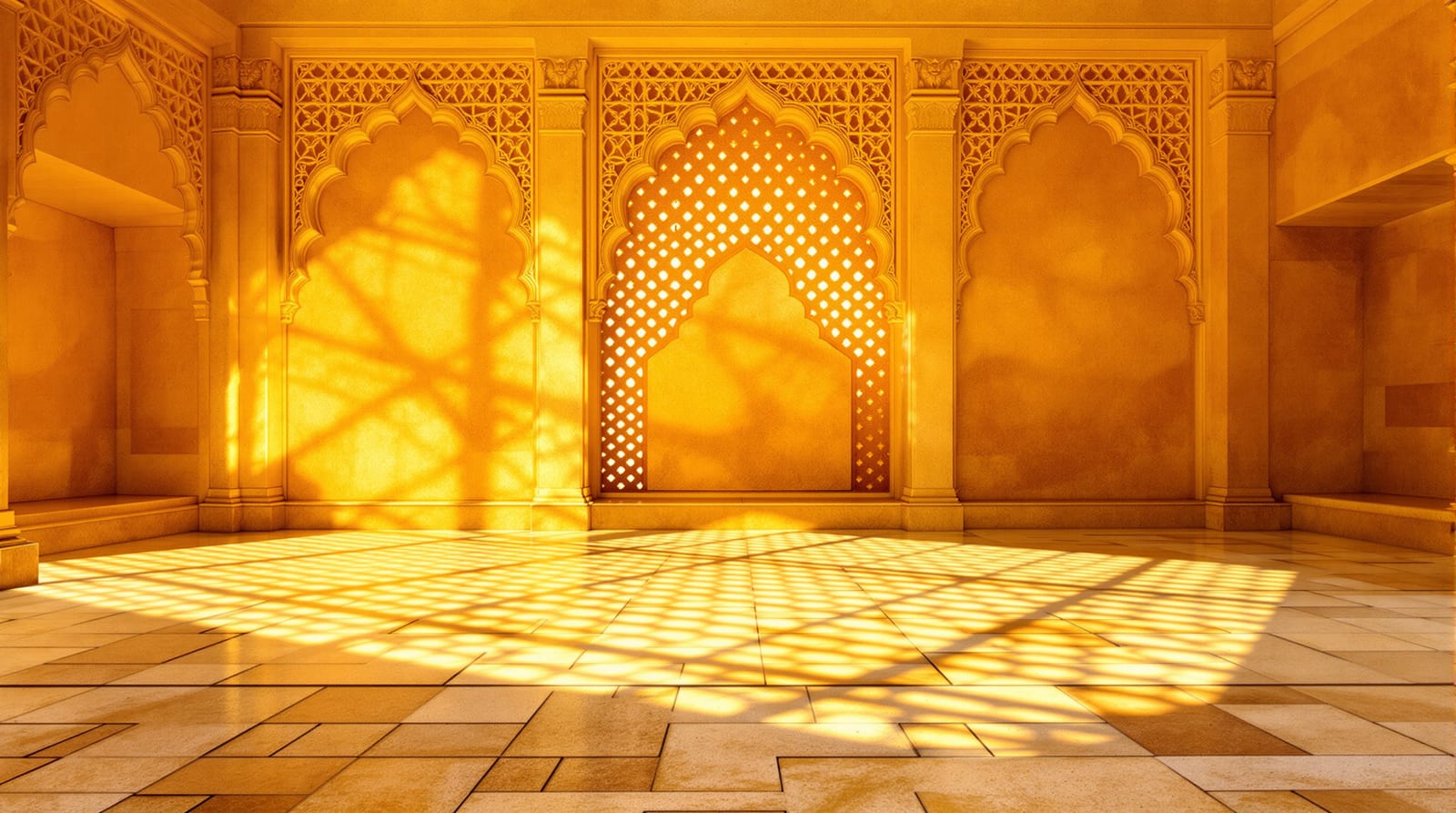
The signature of Jaisalmer stone is its colour: a warm, even golden-yellow ranging from pale lemon to deep honey, often with a fine grain and the occasional fossil shell or vein. Under warm light it almost seems to glow, which is why Jaisalmer's old city reads as a single golden mass at sunset. Compared with the cooler grey-brown of Kota stone or the red-pink of Jodhpur sandstone, Jaisalmer is unmistakably warm — it pairs naturally with terracotta, brass, dark wood and indoor plants, and it lifts a room with very little else.
How that gold reads depends entirely on finish, and finish also governs how slippery and how stain-prone the surface is. The same slab can look like glassy honey or matte desert-sand depending on how it is processed.
| Finish | Look | Best for | Slip & stain notes |
|---|---|---|---|
| Polished (machine) | Glossy, deepest colour, fossils most visible | Indoor floors, feature walls, reception areas | Slippery when wet; shows etch marks from acids fastest |
| Honed (matte) | Soft sheen, muted gold, smooth to touch | Living areas, bedrooms, low-traffic indoor floors | Better wet grip than polished; etches less obviously |
| Leather / brushed | Textured matte with subtle relief | Premium floors, vanity tops, accent walls | Good grip; hides minor wear and water spots |
| Natural / sawn (matte rough) | Raw, sandy, most "desert" character | Facades, courtyards, garden paving | Good grip; most absorbent, needs the most sealing |
| Sandblasted / bush-hammered | Coarse anti-slip texture | Ramps, steps, wet outdoor zones | Best grip; rougher to clean |
| Carved / jali | Pierced lattice and relief work | Screens, balustrades, temple and heritage work | Decorative, not a floor finish |
For an indoor floor most homeowners choose honed for its quieter, less slippery look; polished suits a grand entrance or feature where shine is wanted; natural and sandblasted finishes belong outdoors where grip beats gloss. Whichever you pick, the finish decision and the sealing decision are linked — a rougher, more open finish drinks more sealer.
Prices per square foot (2026, indicative)
Jaisalmer stone is mid-priced among Indian natural stones — dearer than basic Kota or grey sandstone, far cheaper than Italian marble. Prices below are indicative and vary by city, vendor, grade, slab size and finish; they are the rate for the stone before laying unless noted. Add laying labour, adhesive or mortar bed, skirting, grouting/pointing, transport and GST to reach an installed figure.
| Item | Material ₹/sq ft (indicative) | Notes |
|---|---|---|
| Jaisalmer stone, commercial grade (natural/honed) | ₹55–90 | Standard tiles/slabs, normal colour variation |
| Jaisalmer stone, select grade (even gold, fewer flaws) | ₹90–150 | Premium uniform colour, larger sound slabs |
| Polished Jaisalmer slabs (premium, gauged) | ₹130–220 | Higher polish + selection; floor-grade |
| Laying labour | ₹25–60 | Metros ₹35–60; tier-2 ₹20–40 |
| Sealing (penetrating sealer, material + application) | ₹8–25 | Per coat; budget two coats initially |
| Carved jali / relief work | Quoted per piece | Priced by carving labour, not sq ft |
| GST | Slabs/tiles 18%, raw blocks 12% | Ask for a GST invoice |
So a typical honed Jaisalmer floor, supplied and laid in a tier-2 city, often lands around ₹110–180/sq ft all-in before sealing; a premium polished floor in a metro can run ₹220–320/sq ft installed. Buying near the source in Rajasthan and shipping a full lot is usually cheaper than buying retail in a far metro, because transport from western Rajasthan adds a real per-square-foot cost to cities like Mumbai, Bengaluru or Kolkata. To pressure-test a quote against benchmarks, the flooring cost calculator and the natural stone slab calculator help you convert slab rates and wastage into an installed budget.
Where Jaisalmer stone works — uses
Jaisalmer stone is a genuine all-rounder: it floors, it clads, it carves and it screens. Its warmth makes it a favourite for heritage-style and contemporary-rustic Indian homes alike.
| Use | Why it suits | Finish to choose | Watch-outs |
|---|---|---|---|
| Indoor floors (living, bedrooms, lobbies) | Warm, seamless, ages well | Honed or polished | Seal; keep acids (lime, vinegar, harsh cleaners) off |
| Facades & elevations | Iconic golden cladding, weathers gracefully | Natural / honed | Seal exposed faces; design drainage to avoid staining |
| Jali screens & lattice | Carves into fine pierced patterns | Carved | Specify thickness for strength of the lattice |
| Columns, brackets, relief carving | Takes detail cleanly | Carved | Skilled mason work; priced per piece |
| Temples & heritage homes | Traditional, devotional warmth | Polished / carved | Match lots for large religious halls |
| Courtyards & verandahs | Cool underfoot, desert character | Natural / sandblasted | Anti-slip finish; reseal periodically |
| Vanity tops & feature walls | Luxe golden accent | Leather / honed | Seal; wipe spills (acidic cosmetics etch limestone) |
Two honest cautions. First, because it is a limestone, Jaisalmer stone is not the ideal choice for a busy kitchen platform where citrus, vinegar and oil land daily — granite handles that better — though a sealed honed Jaisalmer top is fine for a low-use vanity or bar. Second, in heavy-monsoon coastal homes a porous limestone needs diligent sealing; the logic in flooring for coastal humid homes in India applies. For broad context on how regional stones slot into Indian homes, see regional flooring traditions in India.
A Jaisalmer jali — why the stone earns its carving
The reason Jaisalmer stone is so loved for jali (pierced lattice screens) is that its fine, even grain lets a mason cut thin, repeating geometry without the stone crumbling. A jali filters harsh desert sun into soft patterned light, lets breeze through, and gives privacy — passive cooling and ornament in one element. The diagram below shows a simplified jali motif and how the stone is pierced.
Properties at a glance — and why sealing is non-negotiable
The single most important fact for a buyer is that Jaisalmer stone is a limestone, so it behaves like marble chemically, not like granite. Acids etch it: lemon, vinegar, tomato, wine, lime-based cleaners and many "all-purpose" household sprays will leave dull marks if they sit on an unsealed surface. The defence is simple and standard for natural stone — a penetrating (impregnating) sealer, applied at installation and refreshed over the years, plus pH-neutral cleaning.
| Property | Jaisalmer stone | What it means for you |
|---|---|---|
| Rock type | Fine fossiliferous limestone | Carves well; acid-sensitive; seal it |
| Colour | Warm gold to honey-amber | Glows in warm light; ages richer |
| Hardness (Mohs) | ~3–4 (limestone range) | Softer than granite; can scratch with grit |
| Water absorption | Moderate (porous; varies by grade) | Seal against stains and dampness |
| Acid resistance | Low (etches like marble) | Keep citrus/vinegar/harsh cleaners off |
| Carvability | Excellent | Ideal for jali, columns, relief |
| Weathering | Ages gracefully, deepens in tone | Great for facades in dry climates |
| Best companion finish | Honed indoors, natural/sandblasted outdoors | Match finish to grip and use |
Care, then, is a short routine: dust-mop or sweep daily so grit does not abrade the surface, clean with a pH-neutral stone cleaner (never acidic or harsh chemicals), wipe spills promptly, and reseal when water stops beading on the surface — typically every one to three years depending on traffic and finish. The full method, including how to test whether a floor needs resealing, is in the floor resealing guide for India. Because the chemistry is the same as marble, the polishing and etch-repair techniques in the marble-care literature apply directly to a dulled Jaisalmer floor.
Buying and sourcing Jaisalmer stone
The cheapest, widest choice is at or near the source: Jaisalmer district itself and the Jodhpur stone markets in western Rajasthan, where quarries and cutting units sell blocks, gauged tiles and cut-to-size slabs. Rajasthan's wider stone trade — including the giant Kishangarh marble market and the Rajasthan stone belt — also stocks Jaisalmer alongside marble, so a single Rajasthan sourcing trip can cover several stones. Outside Rajasthan, reputable natural-stone dealers in every metro carry it, but you pay a transport premium and see a narrower selection of grades and finishes.
A few practical buying rules for this specific stone:
- Inspect slabs in daylight for colour consistency (gold varies lot to lot), hairline cracks, open fossil voids and resin fills; buy from one lot plus 5–10% spare so the floor reads as one shade.
- Confirm grade and finish in writing — "select grade, honed, 18 mm gauged" — and verify the gauge with a vernier, since under-gauged slabs are a common way to shave a quote.
- For carved jali or columns, get a per-piece quote with thickness specified, and see a sample of the carver's work; carving quality varies enormously.
- Insist that the stone is genuine Jaisalmer limestone, not a paler look-alike sandstone relabelled as "Jaisalmer yellow"; ask the dealer to confirm origin.
- Compare an all-in ₹/sq ft — material + sealer + laying + skirting + pointing + transport + loading + GST — not just the slab rate, and ask for a GST invoice and an e-way bill for transported lots.
For the disciplined version of these checks across any natural stone, pair this with the natural stone standards in India guide, which turns IS codes (IS 1130 for marble, IS 1124 for water absorption) into questions you ask before paying. If you are weighing Jaisalmer against other Rajasthan options, the cool grey-brown of Kota stone is the budget workhorse, while polished white marble belongs in the Rajasthan marble guide.
Frequently asked questions
Is Jaisalmer stone a sandstone or a limestone?
It is a fine fossiliferous limestone, even though the trade often sells it as "Jaisalmer yellow sandstone." The distinction is practical, not pedantic: true sandstone is silica-based and resists acids, whereas Jaisalmer stone is calcium-carbonate limestone that etches with acids exactly like marble. Treat it as a limestone — seal it and keep citrus, vinegar and harsh cleaners off it.
What does Jaisalmer stone cost per square foot in 2026?
Indicatively, commercial-grade stone runs about ₹55–90/sq ft and select or polished grades ₹90–220/sq ft for material alone, before laying labour (₹25–60/sq ft), sealing, transport and GST. A typical honed floor lands around ₹110–180/sq ft installed in a tier-2 city and higher in metros. Prices vary by city, grade, finish and slab size, so always compare an all-in quote.
Can I use Jaisalmer stone in a bathroom or kitchen?
Use it with care. As a limestone it etches with acids and is porous, so a busy kitchen platform is better in granite. A sealed, honed Jaisalmer floor or a low-use vanity top is fine if you reseal it, wipe spills promptly and use pH-neutral cleaners. In bathrooms choose a honed or textured finish for grip and keep the sealing routine up; avoid glossy polished stone on wet floors.
How often does Jaisalmer stone need sealing?
Apply a penetrating sealer at installation (two coats), then reseal whenever water stops beading and starts darkening the surface — typically every one to three years depending on traffic, finish and exposure. Rough, natural finishes outdoors need resealing more often than honed indoor floors. The floor resealing guide explains a simple water-drop test to decide when.
Why is Jaisalmer stone so good for jali screens and carving?
Its fine, even, compact grain lets a mason cut thin, intricate, repeating lattice without the stone crumbling, which is why Jaisalmer's havelis and forts are famous for their pierced screens. The same property suits columns, brackets and relief carving. For floors that carvability is a bonus rather than the point, but it is the reason the stone dominates heritage and temple work across Rajasthan.
Export this guide
Related Guides — Deep-dive reading
Limestone Flooring India: Honed Matte Stone, Colours, Cost and Care
The soft sedimentary stone family — beige, grey, blue and cream limestone with an elegant honed matte look, cool underfoot — plus its porosity, sealing needs, ₹/sq ft cost and where it suits Indian homes.
Flooring & SurfacesGranite Bathroom Countertop India: Vanity Tops, Sealing, Finishes & Cost
A practical, India-first guide to granite vanity countertops for the bathroom — why granite is the durable, heat- and scratch-resistant budget favourite, how to seal a porous stone against hard water and staining, polished versus leather and honed finishes, edge profiles, basin cut-outs, thickness, and honest ₹ per sq ft versus quartz, marble and solid surface.
BathroomsHow to Clean Bathroom Tiles (India): Shine, Hard-Water Film & Soap Scum
A practical, India-first routine for cleaning bathroom tiles and keeping them glossy — the daily squeegee habit, weekly wash, monthly deep clean, and the safe cleaner for each tile type, including the golden rule that natural stone must never meet acid.
BathroomsRelated Tools — Try Free
Flooring Cost Calculator
Estimate the all-in cost of a floor — material, laying, wastage, skirting and GST — by area and material.
Flooring CalculatorCross-Ventilation Analyzer
Estimate airflow and air changes per hour (ACH) from room size, window areas, layout, and local wind — with NBC 2016 Part 8 compliance check.
Ventilation CalculatorFull-Room BOQ — Living, Bedroom, Kitchen, Bath
Room-wise BOQ across living, bedrooms, kitchen, utility, and bathrooms with line-item pricing.
Full-Room BOQ