
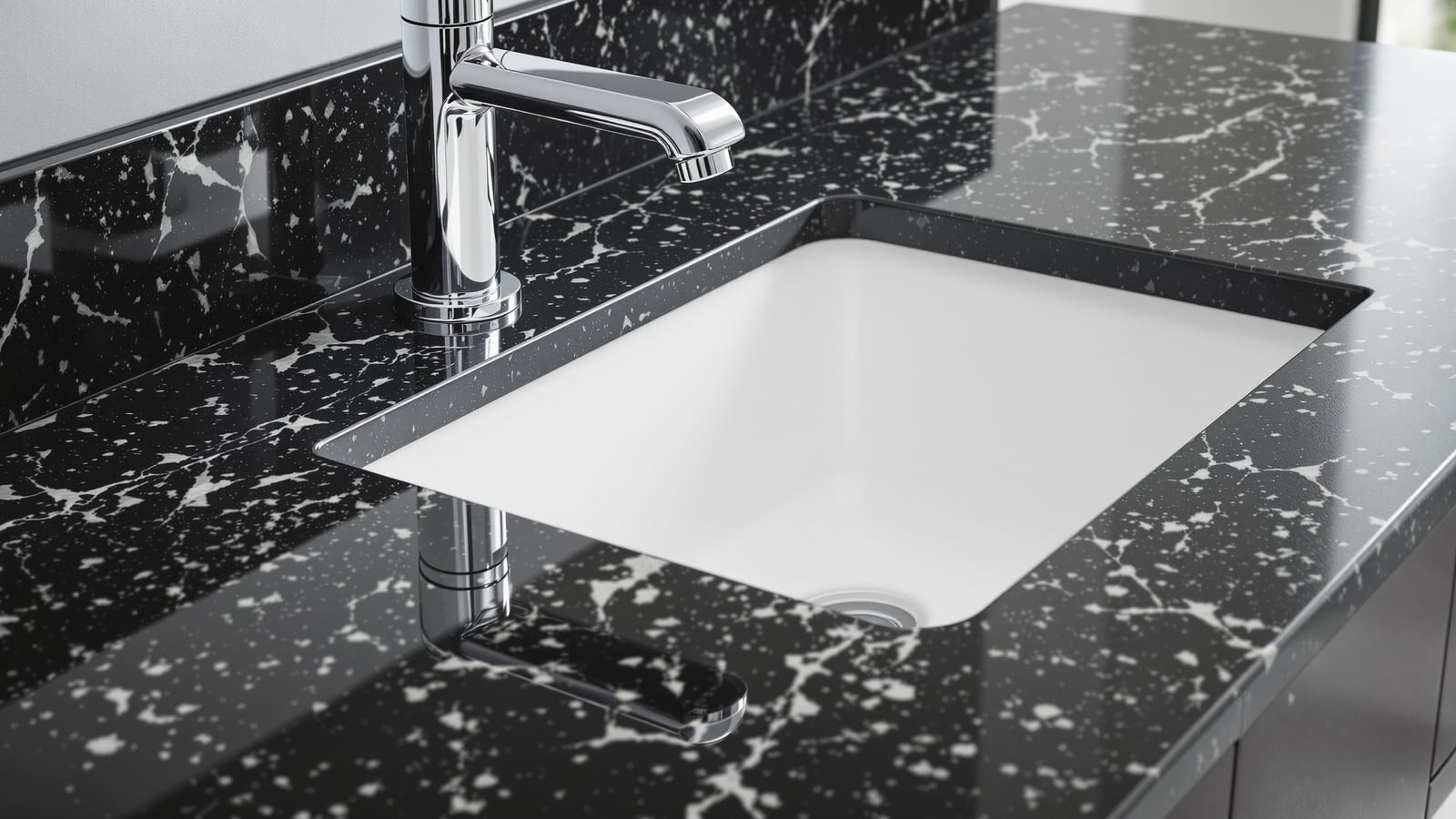
Granite Bathroom Countertop India: Vanity Tops, Sealing, Finishes & Cost
A practical, India-first guide to granite vanity countertops for the bathroom — why granite is the durable, heat- and scratch-resistant budget favourite, how to seal a porous stone against hard water and staining, polished versus leather and honed finishes, edge profiles, basin cut-outs, thickness, and honest ₹ per sq ft versus quartz, marble and solid surface.
Ask any Indian fabricator what to put on a bathroom vanity and the first word out of their mouth is granite. There is a good reason for that reflex. Granite is quarried across India — from Andhra, Karnataka, Tamil Nadu, Rajasthan — so it arrives cheaper per square foot than almost any engineered alternative, and it happens to be one of the hardest, most heat- and scratch-tolerant surfaces you can buy. Drop a hot straightener on it, drag a steel bucket across it, splash it daily with a health-faucet jet: a granite counter shrugs it off in a way that a laminate or a soft marble simply cannot. For a working family bathroom in a hard-water city, that toughness is exactly what you want under the basin.
But granite has one honest weakness that every buyer must respect: it is a natural, porous stone. Left unsealed, it drinks in water, oil, coffee, mehndi, hair-dye and toothpaste, and over a season those stains darken into the surface. The whole craft of a good granite vanity is buying the right slab, finishing it well, sealing it properly and cutting the basin cleanly. This is a materials-and-components guide in the Studio Matrx bathroom hub. Read it alongside the bathroom vanity guide for India for the cabinet and layout that this top sits on; the quartz vanity top guide for the low-maintenance engineered rival; the marble bathroom guide for the luxurious-but-fussier natural cousin; and the under-counter basin guide for how the bowl is cut into and sealed under this stone.
Granite is the toughest budget surface you can put on a bathroom vanity — but it is porous. Buy the slab, finish it, seal it, and re-seal it, and it will outlive the bathroom. Skip the sealing and it stains within a season.
Why granite is India's default vanity top
Granite earns its place on three counts, and it is worth being precise about each.
- Hardness and scratch resistance. Granite sits at roughly 6–7 on the Mohs scale — harder than a steel knife. Everyday grit, jewellery, tap spanners and dragged toiletries do not scratch it. On a family counter that gets no mercy, this is decisive.
- Heat resistance. As an igneous stone that cooled from magma, granite is genuinely heat-tolerant — a hot styling iron or a just-boiled geyser bucket will not scorch or blister it the way it would a solid-surface or laminate top. (Thermal shock from repeated extremes can still craze it over years, so it is not licence to abuse.)
- Cost. Because it is quarried and processed domestically at scale, granite is the cheapest genuine stone top in India — typically ₹90–450 per sq ft for common colours, a fraction of engineered quartz or imported marble. For a standard 2–2.5 ft vanity that is real money saved.
The trade-off is porosity and pattern variation: every slab is unique, and no two look identical, so you should select your actual slab at the yard rather than order by a sample chip.
Finishes: polished, honed and leather
The finish changes the look, the grip and — importantly in a wet room — the maintenance. This is one of the most consequential choices you will make.
| Finish | Look | Grip when wet | Stain resistance | Best for |
|---|---|---|---|---|
| Polished | Glossy, mirror-like, colours pop | Slippery when wet | Best — tight closed surface | Most dry-zone vanities; easiest to wipe |
| Honed (matte) | Soft satin, understated | Better than polished | Slightly more absorbent — seal well | Contemporary, muted schemes |
| Leather (leathered) | Textured, low-sheen, hides marks | Best — tactile grip | Good, but grain traps grime | Busy family counters, hides water spots |
| Flamed | Rough, rustic | Highest | Absorbent — needs frequent sealing | Rarely on vanities; outdoor/utility |
- A polished finish makes hard-water droplets and toothpaste splash easy to sweep off, but it also shows every chalky scale ring, so it needs wiping dry. It is the default and the safest choice for a bathroom.
- A leather (leathered) finish is the quiet hero for a hard-water Indian bathroom: its subtle texture disguises water spots, fingerprints and light scale that would glare on a polished black granite. The catch is that the texture can trap grime and needs a soft brush now and then.
- A honed matte finish suits a muted, modern scheme but is a touch more open-pored than polished, so it must be sealed diligently.
For most family bathrooms, a polished top in a mid-tone or a leathered dark granite is the sweet spot between looks, grip and upkeep.
Sealing a porous stone — the step you cannot skip
Granite is porous, so sealing is not optional in a bathroom — it is the single maintenance habit that decides whether the top stays like new or stains grey and blotchy. Sealing does not coat the surface; a good penetrating (impregnating) sealer soaks into the stone's pores and repels water and oil from within, so spills bead up and wipe away instead of soaking in.
- Test porosity with the water drop. Splash a little water on the polished top and wait ten minutes. If it beads, the seal is intact; if the stone darkens where the water sat, it has drunk it in and needs resealing.
- Frequency. A dense, dark granite (Black Galaxy, Absolute Black) may hold a seal for 2–3 years; a lighter, more open granite may need it once a year. Honed, leathered and flamed finishes absorb faster than polished and need more frequent attention.
- How to seal. Clean and fully dry the top, flood on the penetrating sealer, let it dwell as directed, then buff off the excess before it hazes. Two thin coats beat one thick one. In India, sealers from Fosroc, Dr. Fixit, MYK Laticrete and stone-specialist brands are widely available.
- Seal the cut edges too. The raw, unpolished granite around the basin cut-out and the tap holes is the thirstiest, most stain-prone part of the whole top — brush sealer into it before the basin is fitted.
Do the ten-minute water-drop test twice a year. The day the water stops beading and starts darkening the stone is the day to reseal — before a stain, not after.
Edge profiles and thickness
Granite slabs for vanities are usually 18–20 mm thick. That is plenty structurally over a supported cabinet, but a thin front edge can look mean, so fabricators fake a chunkier look with a mitred edge — two pieces glued at 45° to read as a solid 40 mm slab. The edge profile is where the counter shows its class:
- Pencil / eased — a soft, barely-rounded square edge; clean, modern, cheapest, and safest around children's heads.
- Bevel — a chamfered top edge; crisp and contemporary.
- Bullnose / half-bullnose — a fully or half-rounded edge; soft, traditional, sheds water well.
- Mitred (box) edge — the faked-thick chunky look for a substantial, high-end vanity.
- Ogee — an S-curve; ornate and traditional, best kept for classical schemes.
For a bathroom, an eased or half-bullnose edge is the practical default — no sharp corner to chip or bruise a hip, and it sheds splash rather than pooling it.
Cutting the basin: undermount, drop-in and vessel
The basin cut-out is fabricated by the stone workshop, not improvised by the plumber on site, and how it is cut depends on the basin type. Read the under-counter basin guide for the full detail; in short:
- Under-counter (undermount) — the bowl is fixed beneath the granite and the stone forms the visible deck. The cut edge is exposed to water, so it must be ground, polished and sealed, and the bowl must hang on mechanical clips, never on the silicone.
- Drop-in (self-rimming) — the bowl's rim sits on top of the granite in a simple cut hole; easiest and cheapest to fabricate, but the rim catches grime.
- Countertop (vessel) — the bowl sits fully on the stone and only a small drain hole is cut; the most forgiving cut of all.
Whichever you choose, the tap holes are drilled into the granite behind the basin for a deck-mounted mixer, so agree the tap's hole count and spacing with the fabricator before the slab is cut.
Granite versus quartz, marble and solid surface
Granite is not the only option, and the honest comparison helps you spend where it counts.
| Surface | Porosity / sealing | Heat & scratch | Look | Indicative ₹ / sq ft |
|---|---|---|---|---|
| Granite (natural) | Porous — needs sealing | Excellent | Natural, unique, varied | ₹90–450 |
| Engineered quartz | Non-porous — no sealing | Good scratch; less heat-tolerant | Uniform, consistent colour | ₹350–1,200 |
| Marble (natural) | Porous + etches with acid | Softer, scratches, stains | Luxurious, veined | ₹150–1,500+ |
| Solid surface (acrylic) | Non-porous, seamless | Poor heat; repairable | Uniform, integral basin | ₹450–1,000 |
- Granite vs quartz. Quartz is engineered stone bound in resin: non-porous, so it never needs sealing and resists stains better, but it costs more and its resin binder is less heat-tolerant than solid granite. Choose quartz for hands-off maintenance and a flawless uniform colour; choose granite for toughness, heat resistance and a lower price.
- Granite vs marble. Marble is the more glamorous natural stone, but it is softer, scratches, and — crucially — etches (dulls) when it meets anything acidic: a splash of toilet cleaner, a dropped nail-polish remover, even hard-water descaler. Granite is far more forgiving of a real bathroom's chemistry.
- Granite vs solid surface. Solid surface (acrylic composite) allows a seamless top with an integral, jointless basin and is easily repaired, but it scratches and cannot take heat. Granite wins on durability; solid surface wins on seamless hygiene.
What it costs in India
Budget the fabricated, fitted top — not just the raw slab. Fabrication (cutting, edge polishing, the basin cut-out and tap holes) is a real line item.
| Item | Indicative ₹ range |
|---|---|
| Common granite (e.g. mid-tone, local) — slab | ₹90–250 / sq ft |
| Premium / imported granite (Black Galaxy, exotics) | ₹250–450+ / sq ft |
| Leather / honed finishing surcharge | ₹40–120 / sq ft |
| Basin cut-out + edge polish (per bowl) | ₹1,500–4,000 |
| Tap-hole drilling | ₹200–600 per hole |
| Mitred (box) edge upgrade | ₹150–400 / running ft |
| Penetrating sealer (material, DIY) | ₹500–2,500 per bottle |
A standard 24 in × 21 in single vanity top in a common granite, fabricated and fitted, typically lands around ₹3,500–8,000 all-in — genuinely cheaper than the quartz or marble equivalent, which is a large part of why granite stays India's default.
Living with a granite vanity: hard water and daily care
- Wipe the top dry after use — standing hard-water droplets leave chalky scale that dulls a polished finish; a leathered top hides this best.
- Use a pH-neutral stone cleaner — never acidic descalers, CIF, lemon or vinegar, which can etch the softer minerals in some granites and strip the sealer.
- Reseal on the water-drop test, not on a calendar guess — the moment water darkens the stone instead of beading.
- Blot spills fast — hair dye, mehndi, turmeric and cosmetics stain unsealed or under-sealed granite quickly; blot, do not smear.
- Keep a moisture-proof carcass — set the granite on a BWR/BWP marine-ply or WPC vanity, never bare MDF, and bed it on neutral-cure silicone so splash cannot creep into the cabinet.
Done right, a sealed granite vanity top is close to a fit-and-forget surface: tough enough to ignore, cheap enough to afford, and handsome enough to keep looking good for the life of the bathroom.
References
- NBC 2016 (National Building Code of India) — Part 9 Plumbing Services and Part 6 Structural/finishes provisions for sanitary fixtures and vanity fittings.
- IS 14223 (Polished building stone / dimension stone) — specification and classification for granite and other dimension stones.
- IS 1130 (Marble blocks, slabs and tiles) and IS 3316 (Structural granite) — quarrying and finishing standards for natural stone.
- CPWD Specifications / CPHEEO Manual — stone countertop fabrication, fixing and sanitary appliance setting-out schedules.
- BIS product certification — confirm sanitaryware and faucets fixed into the top carry the relevant IS marking; use penetrating sealers per manufacturer data sheets.
Export this guide
Related Guides — Deep-dive reading
Quartz Bathroom Countertop India: Engineered Quartz Vanity Tops, Cost & vs Granite/Marble
A practical, India-first guide to engineered quartz vanity tops for bathrooms — why the non-porous, no-seal surface beats granite and marble on a wet counter, plus thickness, seams, heat caution, brand quality and honest ₹ per sq ft costs.
BathroomsUnder Counter Wash Basin India: Undermount Basins, Cut-outs & Sealing
A practical, India-first guide to under-counter (undermount) wash basins fixed below a granite or quartz vanity top — the clean wipe-down counter, the deck-mounted tap, the cut-out and rim seal that keeps water out, and honest ₹ costs versus a countertop basin.
BathroomsHow to Choose a Wash Basin in India: Mount Type, Size, Tap Holes & Budget (2026 Buyer's Guide)
A buyer's decision guide to picking the right wash basin — matching the mount type to your vanity and space, sizing it to the room, getting the tap-hole config right for your faucet, judging material and durability, checking what's in the box, good/better/best rupee tiers, the IS 2556 vitreous-china mark, and how to spot seconds, hairline cracks and warranty traps.
BathroomsRelated Tools — Try Free
Material Compare — Side by Side
Compare materials side-by-side: granite vs quartz vs marble, laminate vs acrylic vs PU, and more.
ComparisonMaterial Schedule Generator
Generate a room-wise finish schedule — walls, floors, ceilings, trim, and joinery by location.
Material ScheduleMaterial Comparison Sheet
India's interior material cheatsheet — plywood, finishes, hardware, countertops, paints, waterproofing.
Reference Guide