
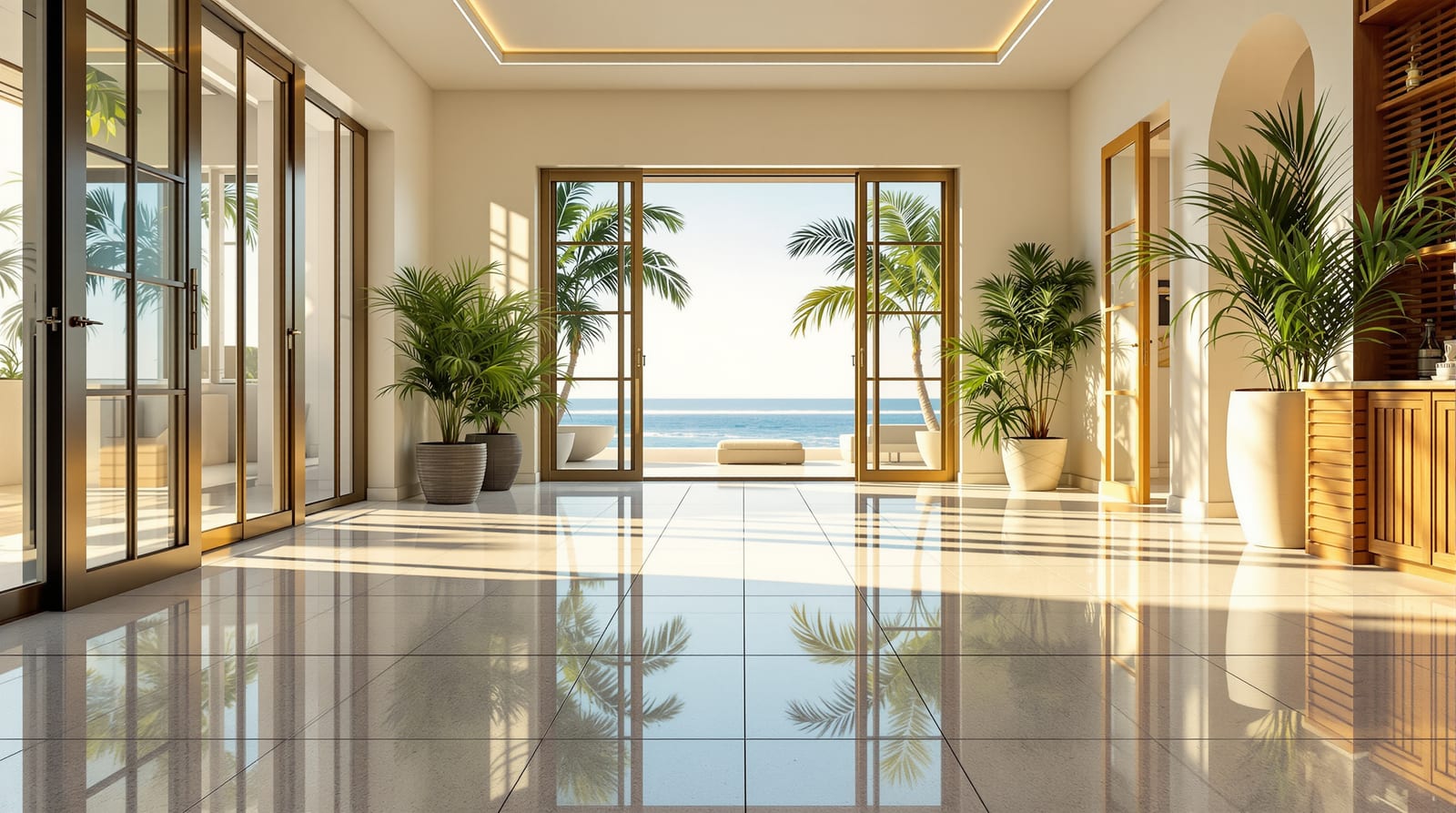
Coastal Flooring India: Best Floors for Salt Air, Humidity and Monsoon Damp in Mumbai, Goa, Chennai, Kochi and Vizag
What to choose and what to avoid for coastal and high-humidity Indian homes: why solid wood warps and carbon-steel fixings rust, why vitrified and porcelain tiles, anti-skid natural stone and SPC win, plus matte finishes for wet grip, moisture barriers, ventilation and mould-proof grout.
If you live within breathing distance of the sea in Mumbai, Goa, Chennai, Kochi or Vizag, your floor faces a fight that homes in Delhi or Jaipur never see. Salt-laden air, months of saturating monsoon humidity, damp that never quite leaves the slab, and the mould that follows it all will quietly destroy the wrong flooring within a few seasons. Choose right, and the same conditions barely touch your floor for decades. This guide names the enemies of a coastal floor, explains why solid wood and steel fixings are a costly mistake on the coast, and shows exactly which materials, finishes and details win in a high-humidity Indian home.
The four enemies of a coastal floor
A coastal or backwater home is not just "a bit damp." Four distinct forces work on the floor, and a material that shrugs off one can still fail to another.
- Salt air. Onshore wind carries fine chloride aerosol that settles on every surface, draws moisture from the air (salt is hygroscopic, it pulls water out of humid air), and aggressively corrodes any unprotected steel. This is why nails, screws, threshold strips and tackless carpet strips made of ordinary carbon steel rust and bleed brown stains in coastal homes.
- Persistent humidity. Coastal cities sit at 70 to 90 percent relative humidity for much of the year, and during the monsoon the air is effectively saturated for weeks. Organic, moisture-sensitive materials never get a chance to dry out and re-equilibrate.
- Monsoon damp and rising moisture. Heavy rain, splash at doors and balconies, and moisture wicking up through a ground-floor slab keep the underside of the floor wet. Without a damp-proof membrane, that moisture migrates into adhesives, underlay and timber.
- Mould and mildew. Warm, humid, poorly ventilated rooms are perfect for mould, which colonises porous grout lines, the edges of natural fibres and the gaps under poorly fixed planks. It is a health issue as much as a cosmetic one.
Beat these four and your coastal floor is sorted: the rest of this guide is about how.
Why solid wood and carbon-steel fixings fail on the coast
The single most expensive mistake in a coastal home is laying a beautiful solid hardwood floor. Wood is hygroscopic: it absorbs moisture from humid air and swells, then releases it and shrinks. In a climate that swings from saturated monsoon air to drier winter months, solid planks expand and contract across the grain again and again. The result is cupping (board edges rising higher than the centre as the underside soaks up slab moisture), crowning, gapping, and in bad cases planks that buckle and lift clean off the subfloor. No amount of finish stops this, because the movement comes from the back and the core, not the surface.
The second mistake is invisible until it stains: carbon-steel fixings. Nail-down wood floors, metal threshold and transition strips, tackless carpet gripper strips, and even cheap framing screws under raised floors all rust in salt air. Rust expands, loosens the fixing, and weeps rust-brown stains up through grout and around skirting. On the coast, any metal that stays in or near the floor should be stainless steel (grade 316 marine where exposed), brass, or a non-metallic fixing, never plain mild steel.
If you love the look of timber, do not give up, but change the material. Choose engineered wood (a dimensionally stable plywood-style core that resists cupping far better than solid timber) used only in dry, well-ventilated rooms, or use a wood-look porcelain plank or SPC click floor that gives you the grain without the swelling. See engineered-wood-flooring-india and engineered-wood-vs-solid-wood-india for the trade-offs, and wooden-flooring-vs-tiles-india for the wider choice.
The diagram: humidity attacking wood versus a stable tile floor
The drawing below shows why the same humid, damp slab destroys a solid-wood floor while leaving a properly laid tile floor untouched.
The lesson is in the layers: the tile floor is sealed off from the slab by a damp-proof membrane and bedded in full adhesive so moisture has nowhere to go, while the wood floor sits in the moisture path and pays for it.
What wins on the coast
Coastal flooring is mostly about choosing materials that simply do not care about water and salt. Three families do this best.
Vitrified and porcelain tiles are the default winner. Full-body and double-charged vitrified tiles have a water absorption below 0.5 percent under IS 15622, which means they barely take up moisture at all, do not harbour mould in the body, and are completely indifferent to salt air. Glazed and polished glazed vitrified tiles (GVT and PGVT) from Morbi makers give you stone, marble and wood looks at a fraction of the maintenance. They are the lowest-effort coastal floor there is. See vitrified-tile-flooring-india and porcelain-tile-flooring-india for grades and selection.
Anti-skid natural stone suits coastal homes that want a more grounded, traditional feel. Kota stone (leather-finish or honed, not mirror-polished), granite with a flamed or leather finish, and rough-cut local stone all grip well when wet and survive salt air, as long as you seal the more porous ones. Avoid high-polish marble in wet coastal zones, both because it etches and because it is dangerously slippery when wet. See kota-stone-flooring-india and granite-flooring-india.
SPC and rigid vinyl click floors are the modern answer for anyone who wants a warmer, softer, wood-look floor that is genuinely waterproof. An SPC core (stone-plastic composite) does not swell with humidity the way timber or laminate does, clicks together as a floating floor over a moisture barrier, and resists salt air. It is the safest "wood look" for a coastal home. See spc-flooring-india and spc-vs-laminate-flooring-india. Note that laminate is a poor coastal choice because its fibreboard core swells irreversibly if it ever gets wet at the edges.
Material suitability for coastal and high-humidity homes
| Material | Salt-air resistance | Humidity / mould | Wet grip (right finish) | Coastal verdict |
|---|---|---|---|---|
| Vitrified / porcelain (matte / anti-skid) | Excellent | Excellent (under 0.5% absorption) | Good with R10-R11 matte | Best all-round choice |
| Granite (flamed / leather) | Excellent | Excellent, low porosity | Good when textured | Excellent, ideal for living areas |
| Kota stone (honed / leather) | Very good | Good, seal it | Good | Very good, traditional and economical |
| SPC / rigid vinyl click | Excellent | Excellent, waterproof core | Good, embossed texture | Best warm wood-look option |
| Engineered wood | Moderate | Moderate, dry rooms only | n/a (keep dry) | Only in dry, ventilated rooms |
| Solid hardwood | Poor (steel fixings rust) | Poor, cups and buckles | n/a | Avoid in coastal homes |
| Laminate | Poor | Poor, core swells if wet | Moderate | Avoid in damp / coastal zones |
| Polished marble | Good for salt, but etches | Good body, slippery wet | Poor, dangerous wet | Avoid in wet areas, ok dry indoors |
| Natural fibre / sisal / jute | Poor | Poor, moulds readily | Poor | Avoid |
Finish matters as much as material: go matte
On the coast, finish is a safety decision, not just a style one. Floors are wet from monsoon, sea spray and tracked-in water far more often than inland floors, so matte, honed, leather and anti-skid finishes that grip the wet foot are strongly preferred over high-gloss mirror polishes that turn into skating rinks. Aim for a slip rating of R10 or higher in wet-prone areas and R11 in bathrooms and around outdoor showers, measured under DIN 51130. Glossy floors also show salt haze and water spotting more obviously. If you have already laid glossy tiles, an anti-skid retro-treatment can raise the wet grip without replacing them, as covered in anti-skid-floor-treatment-india and anti-slip-flooring-wet-areas-india.
The details that make a coastal floor last
Material choice is only half the job. These build details decide whether even a good material survives.
- Damp-proof membrane (DPM). Over any ground-contact or humid slab, lay a 200-micron polyethylene DPM (or an integral waterproofing approach per IS 2645) before underlay or adhesive. This is non-negotiable under any wood, SPC or laminate floor on the coast, and good practice under tile. It blocks rising slab moisture that would otherwise feed mould and cup timber. See underlayment-and-moisture-barrier-india.
- Stainless or non-metallic fixings. As above, no carbon steel near the floor. Use stainless, brass or polymer thresholds, clips and strips.
- Ventilation and air movement. The cheapest mould control is moving air. Cross-ventilation, exhaust fans in bathrooms and kitchens, and avoiding sealed, stagnant rooms keep relative humidity at the floor down and let any surface moisture dry. In closed AC homes, run a dehumidifier or AC dry mode during the worst monsoon weeks.
- Slope and drainage in wet areas. Bathrooms, balconies and utility floors need a fall of about 1:80 to 1:100 to drains over a waterproofing membrane so water never stands. Standing water is what feeds mould and slip risk.
- Entry strategy. A generous anti-skid entry tile plus mats catches the worst monsoon water in the first two metres, protecting the rest of the floor and cutting slip risk. This pairs with monsoon-ready-flooring-india.
Grout and mould control
Grout is where a tile floor wins or loses against mould, because the tile body is inert but ordinary cement grout is porous, holds water, yellows and grows black mould along the joints in a humid bathroom. On the coast, two moves pay off. First, use epoxy grout (such as the epoxy systems from Roff, MYK Laticrete or Pidilite) in bathrooms, kitchens, balconies and any wet zone: it is effectively non-porous, stain-proof and far more mould-resistant than cement grout, and worth the higher cost where humidity is constant. Second, where cement grout is used in drier rooms, seal it and keep it clean. Existing mouldy grout can be cleaned and whitened or re-grouted, as covered in grout-cleaning-and-whitening-india and the wider tile-grouting-guide-india. Narrow 2 mm joints with rectified tiles also leave less grout to colonise.
Putting it together by room
For a coastal Indian home, a sensible default is matte or anti-skid vitrified or porcelain throughout living areas and bedrooms, anti-skid vitrified or honed granite in kitchens, and R11 anti-skid tiles with epoxy grout, full slope and waterproofing in bathrooms and balconies. If you want warmth and a wood feel in bedrooms or a study, use SPC click over a 200-micron DPM rather than solid or laminate timber. Reserve engineered wood for dry, air-conditioned, well-ventilated rooms only, and keep solid hardwood, laminate and natural-fibre coverings out of damp zones entirely. To weigh options against your exact city and rooms, use the flooring-climate-selector tool, and read the broader how-to-choose-flooring-indian-weather and flooring-for-high-humidity-india for the humidity-specific deep dive.
Frequently asked questions
What is the best flooring for a coastal home in Goa or Mumbai?
Matte or anti-skid vitrified and porcelain tiles are the best all-round coastal flooring: their water absorption is under 0.5 percent, they ignore salt air, they do not grow mould in the body, and an R10 to R11 finish grips wet feet. For a warm, wood-look alternative, SPC click flooring over a moisture barrier is the safest choice. Avoid solid hardwood and laminate.
Why does solid wood flooring fail near the sea?
Wood absorbs and releases moisture from the air, so in coastal humidity that swings from saturated monsoon air to drier winter it swells and shrinks repeatedly. This causes cupping, gapping and buckling that no surface finish can prevent, because the movement comes from the core and the underside soaking up slab moisture. Carbon-steel nails and strips also rust in salt air and stain the floor.
How do I stop mould growing in my bathroom grout?
Use epoxy grout in wet areas, because it is effectively non-porous and far more mould-resistant than cement grout. Maintain a floor slope of about 1:100 to drains so water never stands, run an exhaust fan to move humid air out, and seal any cement grout used elsewhere. Existing mouldy grout can be cleaned, whitened or replaced.
Is SPC or vinyl flooring safe in a humid coastal home?
Yes. SPC and rigid vinyl click floors have a waterproof stone-plastic core that does not swell with humidity, unlike laminate whose fibreboard core fails if it gets wet. Lay SPC as a floating floor over a 200-micron damp-proof membrane on concrete, leave the expansion gap at walls, and it performs well in coastal homes while giving a warm, wood-look finish.
What finish should coastal floors have, glossy or matte?
Matte, honed, leather or anti-skid finishes are strongly preferred on the coast because floors get wet from monsoon, spray and tracked-in water far more often, and a high-gloss surface becomes dangerously slippery when wet. Aim for an R10 slip rating or higher in wet-prone areas and R11 in bathrooms. Matte floors also hide salt haze and water spotting better than gloss.
Export this guide
Related Guides — Deep-dive reading
Anti Slip Flooring for Bathroom and Wet Areas in India: R-Ratings, Finishes and Genuinely Safe Tile Choices
How to choose genuinely safe flooring for bathrooms, kitchens, balconies, pools, entrances and elderly- or child-friendly homes — the R-rating system, finishes that grip wet feet, anti-skid natural stone, slope to drains and the tiles to avoid.
Flooring & SurfacesFlooring for Humid Conditions in India: Best Floors for Ground Floors, Basements and Chronically Damp Rooms
Why moisture, rising damp and condensation wreck the wrong floor — and how to pick moisture-stable flooring, lay a 200-micron damp-proof membrane, run the moisture test before laying, and keep humid Indian rooms dry.
Flooring & SurfacesMonsoon Flooring in India: Slip-Safe, Quick-Dry Floors That Survive the Rains
How to choose and protect floors that stay safe and dry through the Indian monsoon — anti-skid entries, low-absorption surfaces, drainage and mould control.
Flooring & SurfacesRelated Tools — Try Free
Cross-Ventilation Analyzer
Estimate airflow and air changes per hour (ACH) from room size, window areas, layout, and local wind — with NBC 2016 Part 8 compliance check.
Ventilation CalculatorFlooring Material Selector
Get the best flooring material for your room, budget and climate, with anti-slip checks for wet areas.
Flooring ToolFull-Room BOQ — Living, Bedroom, Kitchen, Bath
Room-wise BOQ across living, bedrooms, kitchen, utility, and bathrooms with line-item pricing.
Full-Room BOQ