
Rajasthan Marble Guide: Makrana, Kishangarh & India's Marble Heartland (2026)
A buyer's guide to Rajasthan's marbles and markets — Makrana, Kishangarh, Rajnagar, Udaipur and Banswara — with varieties, looks, real prices per square foot, where to buy and how to ship to your city.
If you have ever stood in a marble showroom in Mumbai, Delhi or Bangalore and admired a white slab, there is a very good chance it began its life as a block in Rajasthan. The state is India's marble heartland — it quarries the stone, processes it at the largest marble market in Asia, and ships it to almost every city in the country. Buying closer to that source, understanding which town a variety comes from, and inspecting slabs the way a Kishangarh trader does can save you real money and spare you the slow disappointment of a floor that dulls or cracks. This is a buyer's guide to Rajasthan's marbles and the markets that sell them.
Why Rajasthan is India's marble heartland
Rajasthan accounts for the overwhelming majority of India's marble production. The geology of the Aravalli belt left vast deposits of metamorphosed limestone — true marble — stretching across Nagaur, Rajsamand, Udaipur, Banswara and neighbouring districts. Around those quarries grew an entire industry: cutting plants, gangsaw units, polishing lines and traders who move blocks and slabs by the lakh.
Two facts make the state matter to a homeowner. First, the stone is genuinely local, so the transport component of the price is lowest in Rajasthan and nearby states. Second, Kishangarh has become the clearing house for both Indian marble AND imported marble — Italian, Greek, Turkish, Egyptian — so it is the one place where you can compare a Makrana slab against a Carrara slab in the same afternoon. If you want the wider context of how regional stone is distributed across the country, the Indian marble types by region guide maps it out, and the Indian marble flooring guide covers domestic varieties in depth.
The Rajasthan marble belt — where each variety comes from
It helps to picture the belt as a rough arc across the state. The diagram below is an abstract map, not to scale, placing the main marble towns and the kind of stone each is known for.
Makrana, Nagaur — the Taj Mahal marble
Makrana in Nagaur district is the most famous marble town in India, and for good reason: it is the white marble of the Taj Mahal, the Victoria Memorial and countless temples. Makrana stone is unusually dense and low in absorption, which is why it ages so gracefully — it keeps its sheen for decades and resists the dullness that cheaper, softer marbles slide into. Grades range from the premium pure-white Makrana Dungri and Albeta down to off-white and grey-streaked varieties. It is not the cheapest white marble, and good Makrana is genuinely scarce, so verify the grade and the quarry rather than trusting the name alone.
Kishangarh — Asia's largest marble market
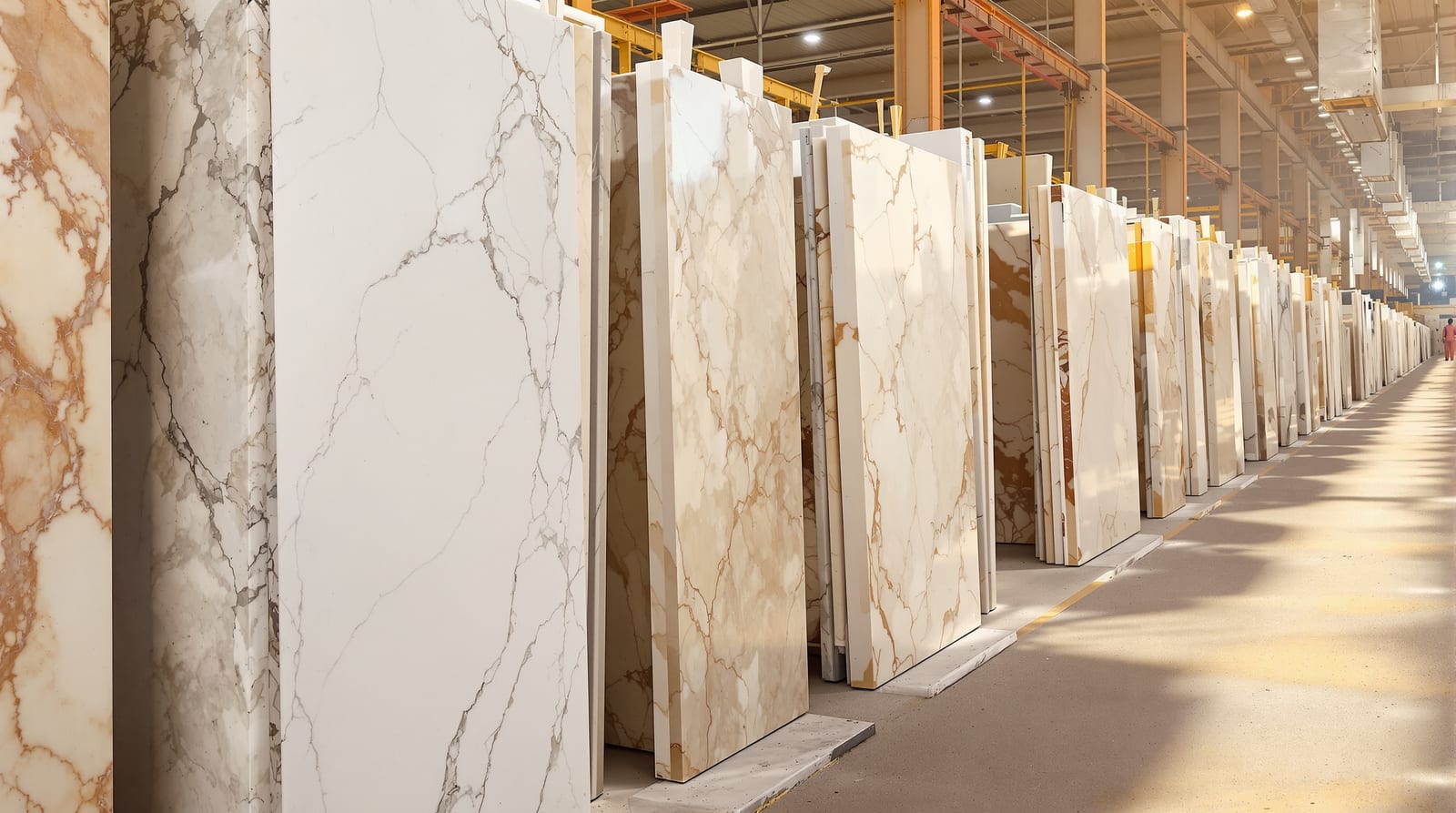
Kishangarh, near Ajmer, is the beating heart of the trade. It is described as the largest marble market in Asia: thousands of traders, gangsaw and cutting units, and acres of slab yards holding both Indian and imported stone. If you are a serious buyer, this is where you go to see the widest possible range — Makrana, Rajnagar, Morwad, Udaipur green, plus Italian Carrara and Statuario, Greek Volakas, Turkish and Egyptian marbles — and to negotiate. Kishangarh is also a processing hub: blocks from many quarries are sawn, polished and cut to size here, and most of the marble that reaches other cities passes through its mandi first.
Rajnagar and Morwad, Rajsamand
Rajsamand district — particularly around Rajnagar and the Morwad belt — supplies a large share of India's everyday commercial white and grey marble. These are the workhorse marbles: affordable, widely available, decent looking, and the default choice when a builder specifies "Indian white marble" without naming a quarry. Quality varies a lot within these names, so two slabs sold as Morwad White can differ noticeably; inspect rather than assume.
Udaipur green marble
The Udaipur region is known for green marble (often sold as Verde or Rajasthan Green) — a deep, richly veined stone that has become a design favourite for feature walls, vanities, table tops and accent flooring. It is harder and more brittle than white marble and is sometimes resin-backed for handling. Because it is a distinctive material with its own buying quirks, it has a dedicated guide: Udaipur green marble.
Banswara
Banswara, in the state's southern tip, produces white marble that competes with the Rajsamand belt and supplies markets in Gujarat and central India. It rounds out the picture: between Nagaur in the north and Banswara in the south, Rajasthan offers white marble at almost every price point.
Variety, look, price and use — at a glance
The table below summarises the main Rajasthan marbles. Prices are indicative installed-adjacent slab rates for 2026 and vary widely by grade, slab quality and city — treat them as a starting point, not a quote. All attract GST (marble slabs and tiles 18%; rough blocks 12%).
| Variety | Origin (town/district) | Look | Indicative ₹/sq ft (slab) | Best use |
|---|---|---|---|---|
| Makrana White (Dungri/Albeta) | Makrana, Nagaur | Bright to milky white, fine grain, dense, ages beautifully | 120-350+ (premium grades far higher) | Temples, premium floors, heirloom interiors |
| Makrana off-white / grey | Makrana, Nagaur | Warm white with grey streaks | 90-180 | Living areas, stairs, cladding |
| Rajnagar / Morwad White | Rajsamand | Commercial white, light veining | 55-110 | Everyday home flooring on a budget |
| Morwad / Indian grey | Rajsamand | Soft grey, subtle movement | 60-120 | Contemporary floors, large halls |
| Udaipur Green (Verde) | Udaipur | Deep green, dramatic veining | 90-220 | Feature walls, vanities, accents, table tops |
| Banswara White | Banswara | Clean white, competes with Rajsamand | 55-120 | Budget white flooring, cladding |
| Imported (via Kishangarh) | Italy/Greece/Turkey/Egypt | Carrara, Statuario, Volakas etc. | 250-1500+ | Luxury floors, statement spaces |
For how these prices fit into a full flooring budget, and a city-by-city sense of installed cost, see marble flooring cost in India, and run your own numbers in the marble flooring cost calculator.
Durability — which Rajasthan marble lasts
All marble is a calcium-carbonate stone: it is softer than granite (roughly Mohs 3-4), it etches with acids such as lemon, vinegar or harsh cleaners, and it scratches with grit. Within that family, density is the single best predictor of how a Rajasthan marble will age. Dense, low-absorption stones like good Makrana hold polish and resist staining for decades; softer, more porous commercial marbles dull faster and need re-polishing sooner.
Three practical rules follow. First, choose the densest grade you can afford for high-traffic areas — entrances, living rooms, stairs. Second, plan to seal and periodically re-polish; a marble floor is a maintained floor, not a fit-and-forget one — the marble flooring guide covers care in detail. Third, keep softer or greener marbles for low-traffic, low-spill zones where their beauty outweighs their fragility. If you are still deciding between marble and a harder surface, marble vs granite flooring and marble vs vitrified tiles lay out the trade-offs.
Where to buy — the Kishangarh mandi and beyond
For volume or premium purchases, going to Kishangarh yourself is worth the trip. You see the full range, compare Indian and imported stone side by side, inspect actual slabs rather than samples, and negotiate directly with traders and processors. Many units will cut to size and arrange transport. Even if you ultimately buy through a local dealer, knowing Kishangarh rates gives you a baseline to bargain against.
If you cannot travel, buy from an established marble dealer in your own city, but ask pointed questions: which quarry, which grade, can you see the actual slabs (not a brochure), and what is the all-in rate including cutting, transport, loading and laying. The wider discipline of inspecting and negotiating is covered in how to buy marble in India.
A short buyer's checklist for the yard:
| Check | What to look for | Why it matters |
|---|---|---|
| Quarry & grade | Named source (e.g. Makrana Dungri), not just "white marble" | Name alone is no guarantee; grade decides density and price |
| Daylight inspection | View full slabs outdoors or under daylight | Cracks, fills/resin patches and shade variation hide under shop lights |
| Hairline cracks | Sight along the slab; tap for a dull ring | Cracks worsen during transport and laying |
| Fills & resin | Look for putty/resin patches and net-backing | Heavily filled stone is weaker and ages unevenly |
| Thickness | 16-18 mm for tiles, 18-20 mm for slabs | Thin or uneven slabs chip and lippage during laying |
| Shade & lot | Buy one lot; add 5-10% spare | Marble varies block to block; matching later is hard |
| Origin claim | Verify "Italian" vs Indian | Indian marble is sometimes relabelled as imported |
Transport to other cities — getting it home
Because Rajasthan is the source, transport is what changes the price in your city. Stone is heavy, so freight is a real line item, and it scales with distance and slab quantity. Delhi-NCR is close to Kishangarh and treats Rajasthan marble almost as a local material; Gujarat and central India draw on Banswara and Rajsamand; Mumbai, Bangalore, Hyderabad, Chennai and Kolkata sit farther away, so freight, loading and breakage risk add meaningfully to the landed cost.
When buying for another city, factor in a few things: get an all-in quote that includes packing, loading, freight and unloading, not just the slab rate; insist on a proper GST invoice (marble slabs/tiles 18%) and an e-way bill for the consignment, which is mandatory for inter-state movement above the value threshold; agree a breakage policy in writing, because some loss in transit is normal with stone; and buy a little extra in the same lot so a cracked slab does not force a mismatched replacement later. For the full procurement and billing discipline, the broader buyer guides in this cluster — including how to buy marble in India — are worth reading before you commit.
Frequently asked questions
Is Makrana marble really the Taj Mahal marble?
Yes. The white marble of the Taj Mahal was quarried at Makrana in Nagaur district, Rajasthan, and the quarries still operate today. Genuine top-grade Makrana is dense, low in absorption and ages beautifully, but it is also scarce and premium-priced — so verify the specific grade and quarry rather than buying on the famous name alone.
Is buying marble in Kishangarh cheaper than in my city?
Usually, yes, because Kishangarh is the source market with the widest range and the most competition — it is described as the largest marble market in Asia. You skip several middlemen and can negotiate directly. The saving narrows once you add cutting, transport, loading and breakage to reach a distant city, so compare the all-in landed cost, not just the slab rate.
Which Rajasthan marble is best for home flooring?
For everyday flooring on a budget, Rajnagar/Morwad and Banswara white marbles are the common, affordable choices. For a premium floor that holds its shine for decades, dense Makrana grades are worth the extra. Udaipur green is best kept for feature walls and accents rather than large floors, as it is harder and more brittle.
Does Rajasthan marble need a lot of maintenance?
All marble needs care: it etches with acids and scratches with grit, so wipe spills quickly, use pH-neutral cleaners, and plan to seal and periodically re-polish. Denser stones like good Makrana need less frequent attention than softer commercial marbles. See the marble flooring guide for a full care routine.
How do I avoid being sold fake or relabelled marble?
Insist on a named quarry and grade, inspect full slabs in daylight for cracks, resin fills and shade variation, do a tap test for a dull ring, and verify any "Italian" claim — Indian marble is sometimes relabelled as imported. Get a written, GST-billed quote with the brand/origin stated. The how to buy marble in India guide covers verification step by step.
Export this guide
Related Guides — Deep-dive reading
How to Buy Marble in India Without Getting Cheated (2026 Buyer's Guide)
Inspect full slabs in daylight, spot resin fills and the 'Italian marble' relabelling scam, read grades and thickness, and price a job all-in — from Makrana and Kishangarh to your floor.
Flooring & SurfacesFlooring Buying Mistakes in India: 12 Costly Purchase Errors and How to Avoid Them (2026)
From ordering the exact area with no spare and losing the dye-lot, to mixing calibre, buying seconds for living rooms, skipping the ISI mark, paying full advance and ignoring transport and loading charges, here are the purchase mistakes that quietly inflate a floor's true cost.
Flooring & SurfacesMarble Flooring in India: Indian vs Italian, Types, Cost & Care (2026)
Marble is India's aspirational natural-stone floor — cool underfoot, luxuriously veined and re-polishable. Here is the homeowner's honest guide to Makrana and the popular Indian types, Indian vs Italian marble, ₹/sq ft costs, the staining and etching downsides, where to use it and how it is laid and polished.
Flooring & SurfacesRelated Tools — Try Free
Flooring Cost Calculator
Estimate the all-in cost of a floor — material, laying, wastage, skirting and GST — by area and material.
Flooring CalculatorMarble Flooring Cost Calculator
Estimate installed marble-floor cost — material, laying, grinding and polishing, sealing, wastage and GST.
Flooring CalculatorDoor Cost Calculator
Estimate the all-in cost of a door — leaf, frame, hardware, fitting and GST — by type, material and size.
Door Calculator