
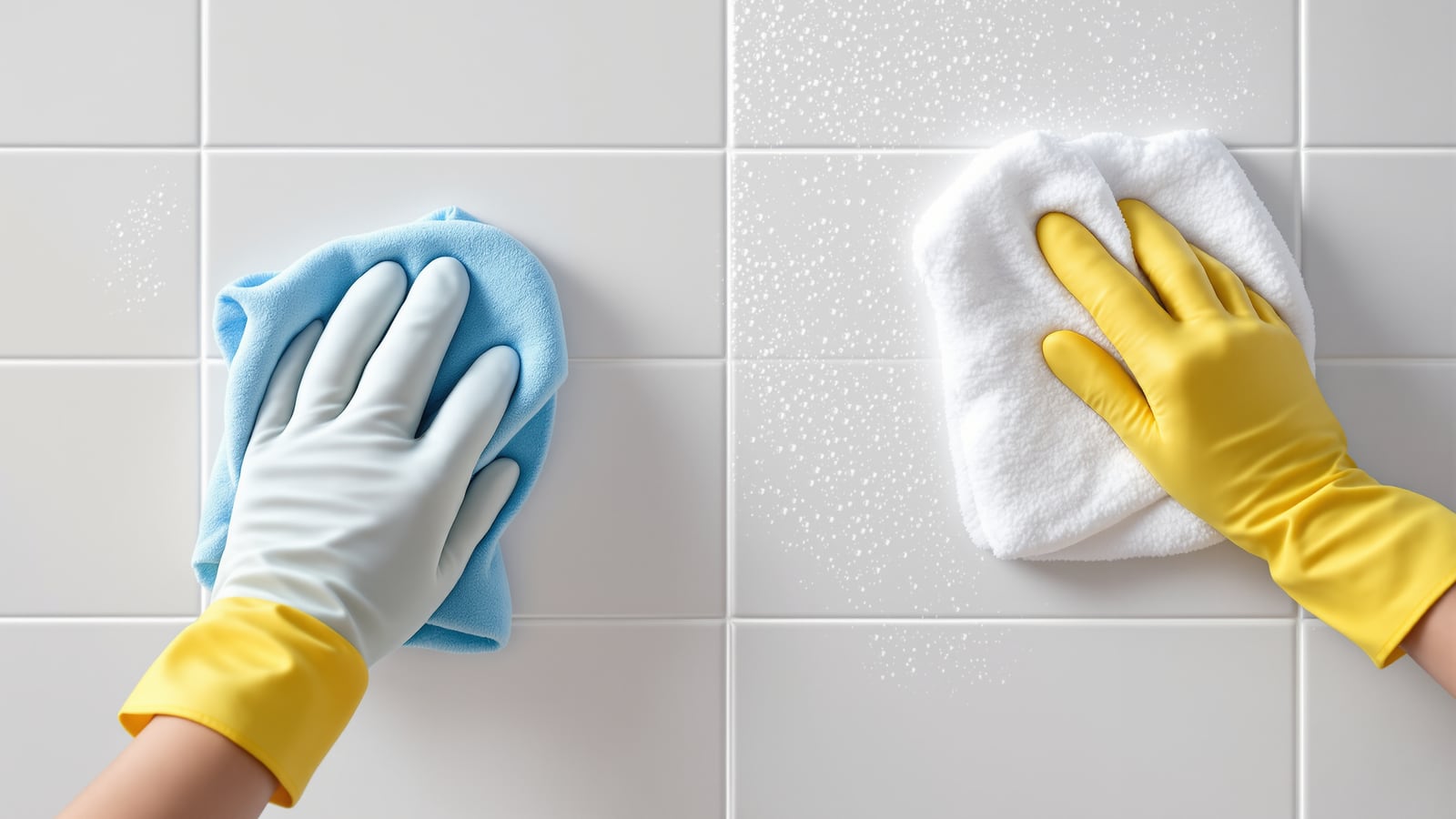
How to Clean Bathroom Tiles (India): Shine, Hard-Water Film & Soap Scum
A practical, India-first routine for cleaning bathroom tiles and keeping them glossy — the daily squeegee habit, weekly wash, monthly deep clean, and the safe cleaner for each tile type, including the golden rule that natural stone must never meet acid.
A newly tiled Indian bathroom looks like a showroom for about three weeks. Then a cloudy white film creeps across the glossy wall tiles, the floor loses its shine, and a greasy grey scum builds up where the shower spray lands. Almost none of this is dirt in the ordinary sense — it is hard-water mineral film and soap scum, the two enemies that decide whether your tiles stay bright or turn dull. Clean for those two things, on a simple schedule, and tiles that cost you a fortune to lay will still gleam a decade later.
This guide is deliberately practical: what to do daily, weekly and monthly, what to reach for, and — most important in India — the one rule that protects your most expensive surfaces. It sits under the complete bathroom cleaning guide for India and pairs with the bathroom wall tiles guide. For the lines between the tiles, read the companion grout cleaning and sealing guide; for the white deposits specifically, see removing hard-water stains.
The single biggest cause of dull tiles is not neglect — it is hard water drying on the surface. A thirty-second wipe after the last shower prevents more film than an hour of scrubbing removes.
Know your tile before you pick a cleaner
Every safe-cleaning decision starts with one question: is the tile glazed ceramic/vitrified, or is it natural stone? Get this wrong and a single wrong bottle can permanently etch a surface you cannot buff back.
- Ceramic and vitrified (porcelain) tiles have a hard, glassy, near-non-porous glaze. They tolerate a mild acid — dilute white vinegar or a branded acidic bathroom cleaner — which is exactly what dissolves hard-water film and soap scum. These are the tiles on most Indian bathroom walls and floors.
- Natural stone — marble, granite (some), limestone, travertine, slate, Kota — is calcium- or mineral-based and porous. Acid reacts with it chemically and eats a dull, rough patch called an etch. Never use vinegar, lemon, Harpic, CIF cream with acid, or any "hard-water" acid descaler on stone. Stone gets pH-neutral cleaner only, and periodic sealing.
That fork governs everything below. When in doubt about a natural surface, treat it as stone and stay neutral.
The routine vs the deep clean
Good tile care is two habits working together: a light routine that stops film forming, and an occasional deep clean that resets the surface.
Daily (30 seconds, the habit that matters most)
1. After the last shower, run a rubber squeegee down the wall tiles and glass, top to bottom.
2. Wipe the vanity backsplash and any splashed floor tile with a dry microfibre cloth.
3. Leave the exhaust fan on or a window open so surfaces dry fast.
Removing the water before it evaporates removes the minerals before they can bond. This one habit does more for shine than any product.
Weekly (10–15 minutes)
1. Sweep or dry-mop the floor to lift hair and grit.
2. Mix a mild solution — a capful of pH-neutral floor cleaner in a bucket of warm water (for stone), or a 1:4 white-vinegar-to-water spray (for ceramic/vitrified only).
3. Work top to bottom, walls then floor, with a soft cloth or a soft-bristle mop.
4. Rinse with clean water and squeegee or wipe dry — never let cleaning water air-dry, or you reintroduce film.
Monthly / deep clean
- Treat built-up soap scum and hard-water film on ceramic/vitrified with a stronger vinegar spray or a branded acidic bathroom cleaner; let it dwell 5–10 minutes, agitate with a soft nylon brush, rinse and dry.
- On stone, use a dedicated stone-safe deep cleaner and a soft pad — patience, not acid.
- Check the grout lines and re-seal if water no longer beads (covered in the grout guide).
The safe cleaner by tile type
This is the table to screenshot. Match the row to your tile before you spray anything.
| Tile type | Everyday cleaner | For hard-water film & scum | Never use |
|---|---|---|---|
| Glazed ceramic | Mild soap / neutral cleaner | Dilute white vinegar (1:4), or acidic bathroom cleaner | Steel wool, coarse scourers |
| Vitrified / porcelain | Neutral floor cleaner | Dilute vinegar or CIF-type mild acid, then rinse | Wax polishes (cause slipperiness) |
| Marble / limestone / travertine | pH-neutral stone cleaner only | Neutral cleaner + poultice; re-seal | Any acid — vinegar, lemon, Harpic, acid descaler |
| Granite | pH-neutral cleaner | Neutral cleaner; test any product first | Prolonged acid contact, bleach |
| Slate / Kota / natural | Neutral cleaner, soft brush | Neutral degreaser | Acids, abrasive pads |
| Anti-skid / textured floor | Neutral cleaner + stiff-ish nylon brush | Vinegar (if ceramic body), scrub the texture | Smooth mop alone (misses grooves) |
A few everyday-India notes. White vinegar (₹60–120 a bottle) is the cheapest hard-water solvent there is and safe on glazed tiles. Baking soda made into a paste lifts scum gently and is neutral enough for a light stone scrub. Branded acidic cleaners (Colin is neutral; CIF and toilet acids are not) work but read the label. And the safety rule that overrides everything: never mix bleach with any acid (vinegar, toilet cleaner, descaler) — the combination releases toxic chlorine gas. Use one or the other, rinse well between.
Removing hard-water film and soap scum
These are the two problems that actually dull tiles, so they deserve a method.
Hard-water film is a chalky white or rainbow haze of dissolved calcium and magnesium left behind when droplets evaporate. On ceramic or vitrified tiles, spray a 1:3 white-vinegar-and-water mix, let it sit 5–10 minutes so the acid can dissolve the minerals, scrub lightly with a soft nylon brush, then rinse and dry. Stubborn film may need a second pass. On stone, do not use acid — use a neutral cleaner and, if the film persists, a stone-specific product, then reseal.
Soap scum is a waxy grey layer of soap fats bonded with hard-water minerals. A baking-soda paste or a mild degreaser breaks it up; on glazed tiles the same vinegar spray dissolves the mineral half and lets the rest wipe away. Switching your household to a liquid body wash or syndet bar instead of traditional soap dramatically reduces future scum, because it leaves far less fatty residue.
The squeegee habit — and restoring a dull glossy tile
If you take one thing from this guide, take the squeegee. A ₹150–400 rubber squeegee kept in the shower and drawn down the walls and glass after each use is the highest-return tool in the bathroom: it removes the water before minerals can bond, so film never forms.
If your glossy tiles have already gone dull, the shine is almost never worn off — it is buried under film. To bring it back on ceramic/vitrified: deep-clean with vinegar as above, rinse thoroughly, dry completely, then buff with a dry microfibre cloth. Resist the urge to "restore shine" with wax or floor polish — on bathroom floors it turns dangerously slippery when wet and traps grime. A genuinely worn glaze cannot be polished back and needs professional attention or replacement. On stone, lost sheen is a job for re-honing or re-polishing and sealing by a stone specialist, not a home product.
Steam cleaning
A handheld steam cleaner (₹2,500–6,000) is an excellent chemical-free option: pressurised steam loosens soap scum and grime from tile faces and grooves, and the heat helps sanitise. It is ideal for anti-skid and textured floors where dirt hides in the texture. Two cautions: keep steam off natural stone (heat and moisture can worsen etching and open sealed pores), and be gentle around older cement-based grout, which prolonged steam can erode. For glazed ceramic and vitrified, steam then wipe dry is a superb monthly reset.
Do's and don'ts
- Do squeegee and dry after every shower — the habit that prevents film.
- Do match the cleaner to the tile, and test any new product on a hidden corner first.
- Do rinse cleaner off and dry the surface, so you do not swap one film for another.
- Do ventilate — a dry bathroom stays cleaner and resists mould.
- Don't put any acid on marble or natural stone. This is the rule that saves the most money.
- Don't use steel wool, coarse scourers or abrasive powders on glazed tiles — they scratch the glaze permanently, and scratches then hold dirt.
- Don't ever mix bleach with acid — toxic gas. One product at a time, rinse between.
- Don't rely on wax polishes for shine on floors — slip hazard.
When to call a professional
Handle routine and deep cleaning yourself. Call in help when the tile itself is damaged, not dirty: etched or acid-burned stone, a worn-through glaze, tiles that stay stained after correct cleaning (the stain is in the grout or under a failed seal), or loose and drummy tiles that signal a bedding or waterproofing problem beneath. Professional stone restoration and re-grouting are specialist trades and worth the ₹ when the surface is worth protecting.
Clean tiles are not about scrubbing harder — they are about interrupting hard water before it films, using the right cleaner for the surface, and keeping the daily squeegee habit. Do that, and a Studio Matrx bathroom stays showroom-bright for years.
References
- Bureau of Indian Standards, IS 15622: Pressed Ceramic Tiles — Specification, for tile body and water-absorption classification.
- Tile Council of North America (TCNA), maintenance and cleaning guidance for glazed ceramic, porcelain and natural stone tile.
- Marble Institute / Natural Stone Institute, care and cleaning guidance — pH-neutral cleaners only and periodic sealing for calcareous stone.
- Manufacturer care instructions from major Indian tile brands (Kajaria, Somany, Nitco) for glaze-safe cleaning and products to avoid.
Export this guide
Related Guides — Deep-dive reading
Bathroom Cleaning India: The Complete Cleaning & Upkeep Guide (Daily, Weekly, Monthly)
The pillar guide to keeping an Indian bathroom clean — a daily/weekly/monthly/annual schedule, the right cleaner for every surface (tiles, grout, glass, chrome, sanitaryware, acrylic), safe DIY mixes, what you must never mix, the hard-water routine, and the 5-minute daily wipe that prevents most problems.
BathroomsToilet Maintenance India: Clean the Bowl, Fix a Running or Weak-Flush WC (2026)
The WC is the hardest-working fitting in an Indian bathroom and the quietest money-waster when it fails. This is the practical, do-it-yourself guide to keeping a toilet clean and working: scrubbing the bowl and under the rim, killing the hard-water limescale ring, and fixing the four things that actually go wrong — a running cistern, a weak flush, a leak, and a blockage.
BathroomsVitrified Tile Maintenance: How to Care for Vitrified & PGVT Floors in India
Vitrified and PGVT tiles are India's most common, near maintenance-free floor; the real weak point is the cement grout, not the tile, so this guide shows the simple routine, post-construction haze and stain removal, and how to keep the gloss.
Flooring & SurfacesRelated Tools — Try Free
Window Cleaning Cost Calculator
Estimate professional window cleaning cost per visit and per year by access and frequency.
Window CalculatorTile Water Absorption Classifier
Classify a tile by its water-absorption percentage into its IS 15622 group and see where it can be used.
Flooring ToolWindow Replacement Cost Calculator
Estimate the cost to replace existing windows — material, glass, removal and floor access.
Window Calculator