
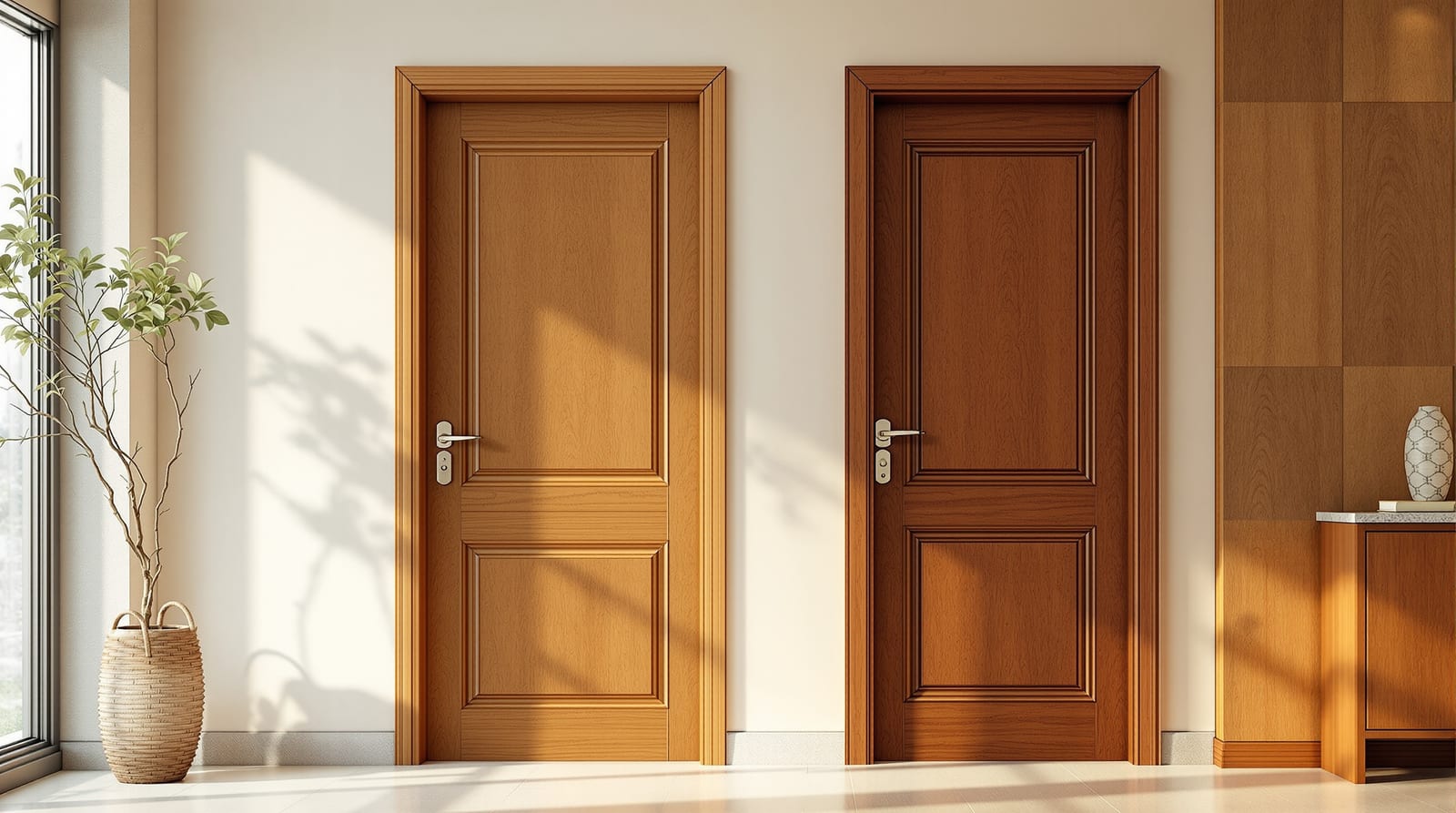
Imported vs Indian Doors: Worth the Premium? India 2026
A balanced guide to imported doors and hardware versus Make-in-India — price premium, quality reality, spare-parts risk and when each wins.
Walk into a high-end door showroom and you will be told two very different stories. One is about "German engineering", "Italian hardware" and "European-grade profiles". The other is about a sturdy, sensible, locally made door that does the same job for far less. The imported vs Indian doors question is one of the most loaded in any home project, because it mixes genuine quality differences with a fair amount of marketing. This guide cuts through it honestly: what you actually pay extra for, where imports earn their premium, and where Make-in-India gives you 90% of the door for half the money.
This is a companion to the master 2026 door cost guide and the door cost by city pillar. The short version: imported is sometimes worth it, often not — and the deciding factor is usually after-sales, not the door itself.
What "imported" actually means in the Indian door market
"Imported" is rarely the whole door. It usually means one of three things, and the price and risk are very different for each:
- Fully imported finished doors — typically Chinese, Malaysian or Vietnamese WPC and moulded doors, or European designer leaves. Often re-badged by Indian sellers.
- Imported systems, assembled in India — German or Italian uPVC profile systems (the extrusion is foreign-engineered, the door is fabricated locally). This is how most "German uPVC" doors reach you.
- Imported hardware on an Indian door — European hinges, locks, handles and closers (Italian, German, Spanish) fitted to a domestically made leaf. The most common and often most sensible kind of "import".
Knowing which one you are being sold matters more than the country flag on the brochure. A locally fabricated door on a German profile is a very different proposition from a container of finished Chinese leaves.
The price premium — what you really pay extra
Imported and imported-system doors carry a meaningful premium over comparable Indian products. Here is a realistic picture against our national-average supply prices (one standard 7×3 ft leaf, before city multiplier and 18% GST):
| Door type | Indian-made (supply, ₹) | Imported / imported-system (supply, ₹) | Typical premium |
|---|---|---|---|
| WPC door | 4,500–7,500 | 7,000–12,000 | ~40–70% |
| Moulded / membrane flush | 4,000–7,000 | 6,500–11,000 | ~40–60% |
| uPVC door (local profile) | 8,000–16,000 | 14,000–28,000+ (German/Italian system) | ~50–90% |
| Designer / carved main door | 30,000–80,000 | 60,000–1,80,000+ (European) | 80–150%+ |
| Basic hardware set | 1,200–2,500 | 4,000–12,000 (European brands) | 2–5× |
Notice the pattern: the premium is largest at the top of the range and on hardware. For a plain WPC bathroom door, paying 60% more for an imported leaf rarely makes sense. For a flagship main door or a smooth-closing handle set you touch fifty times a day, the maths shifts.
Customs and GST — the hidden add-on
Imports do not arrive at Indian-product prices. A finished imported door attracts basic customs duty (broadly 10–20% depending on HSN classification), plus IGST at 18%, plus a small social welfare surcharge — all calculated on the landed value including freight and insurance. By the time it clears the port, a door can cost 30–45% more than its foreign sticker before the dealer's margin. That cost is real and it is already inside the showroom price you are quoted. Domestic doors carry only the flat 18% GST (HSN 4418 for wooden/flush, 3925 for uPVC/PVC) — see our door GST and HSN guide. When a seller says "imported, so it's costlier", duty is a genuine part of why — but it is not a quality guarantee.
Imported vs Indian doors: the quality reality
This is where buyers get burnt in both directions. Imported is not automatically better, and Indian is not automatically inferior.
Where imports can genuinely be better:
- Premium uPVC profile systems — German and Italian extrusions often have more chambers, better steel reinforcement and tighter weather sealing, which matters for uPVC doors in coastal or extreme climates.
- Designer hardware — European hinges, multi-point locks and closers tend to have smoother action and longer rated cycle life. A good closer or a soft-close hinge is something you feel daily.
- Finish consistency on designer leaves — high-end European laminate and veneer finishes can be more uniform.
Where Indian-made now matches or beats imports:
- Solid-core and BWR flush doors — Indian factories (Yamunanagar, Gujarat, Kerala/Tamil Nadu belts) make IS-marked flush and WPC doors that are climate-tuned for India. See flush doors and WPC doors.
- Teak and hardwood panel doors — Indian teak craftsmanship is world-class; an imported carved door rarely beats good local teak doors.
- Value WPC and PVC — cheap imported (often Chinese) WPC can be thin-walled and lighter than advertised. A reputable Indian brand is frequently the safer buy at the same price.
The uncomfortable truth: a lot of "imported" budget WPC and moulded doors are simply cheaper-grade foreign stock re-priced as premium. Country of origin is not a quality certificate. Ask for the spec sheet, the wall thickness, the warranty and an IS or equivalent standard — not the flag.
The risk nobody mentions: spare parts and after-sales
This is the single biggest reason to think twice about fully imported doors, and it almost never appears in the sales pitch.
| Factor | Indian-made door | Imported door | Imported-system (assembled in India) |
|---|---|---|---|
| Spare parts availability | Easy, local | Often slow or unavailable | Usually OK (local fabricator stocks) |
| Lead time for a replacement part | Days | Weeks to months (re-import) | Days to weeks |
| Service network | Wide, brand + local carpenter | Thin, dealer-dependent | Dealer / fabricator network |
| Warranty claim ease | Straightforward | Risk if importer exits | Tied to local fabricator |
| Risk if seller stops importing | None | High — orphaned product | Low |
A designer European hinge that fails in year three is useless if the importer has moved on and nobody stocks that exact part — some homeowners end up replacing an entire imported door because one proprietary lock cylinder cannot be sourced. For a long-life product fixed into your wall, serviceability often matters more than the original finish. Read door after-sales service and the door warranty guide before committing to anything imported.
So when is imported actually worth it?
Imported (or imported-system) makes sense when:
- You are buying a premium uPVC system for a coastal, high-wind or extreme-climate home and want the better-engineered profile and sealing.
- You want designer hardware — soft-close hinges, multi-point locks, premium closers — on a high-traffic main door, and the smoother daily feel justifies the spend.
- You are doing a flagship main door where finish and a specific design simply are not available locally, and budget is not the constraint. See designer door price.
- The importer has a real, established service network in India — not a one-off container sale.
Make-in-India is the smarter buy when:
- You are fitting internal, bathroom or utility doors where an Indian flush, WPC or PVC door performs identically for far less.
- You value easy spare parts and quick service over a marketing flag.
- You want a teak or hardwood door — local craftsmanship is excellent and cheaper.
- You are doing a whole-home set of 10–14 doors and the premium would balloon your budget for no functional gain.
A common best-of-both approach: buy an Indian-made leaf and frame, fit imported or premium hardware only where you touch it daily. You get domestic value and serviceability on the structure, with the better action where it counts. Use the readymade vs custom door calculator and the door total cost calculator to see what each route does to your budget.
How to buy safely either way
- Ask what is actually imported — the whole door, the profile system, or just the hardware. Price the right thing.
- Demand the spec sheet — wall thickness, core type, warranty term, and the standard it meets (IS, EN). A flag is not a spec.
- Confirm spare-parts and service in writing for anything imported, and that the part is stocked in India.
- Compare landed cost honestly — an imported door already includes duty and GST; do not let "imported" alone justify the gap.
- Get it in writing — see the door quotation guide and use negotiating door prices, since imported quotes carry more margin to negotiate. For brand-by-brand comparisons, see best door brands and best uPVC door brands.
Frequently asked questions
Are imported doors better quality than Indian ones?
Not automatically. Premium imported uPVC systems and European hardware can genuinely outperform on engineering and action. But a lot of budget imported WPC and moulded doors are simply cheaper foreign stock re-priced as premium, and Indian-made flush, WPC and teak doors now match or beat imports for most homes. Judge the spec sheet and standard, not the country flag.
How much more do imported doors cost in India?
Expect roughly 40–70% more for WPC and moulded doors, 50–90% more for German/Italian uPVC systems, and 80–150%+ for European designer leaves. Imported hardware sets can cost two to five times an Indian set. Customs duty (broadly 10–20%) plus 18% IGST on the landed value is already baked into the showroom price.
What is the biggest risk with imported doors?
Spare parts and after-sales. If a proprietary hinge, lock cylinder or seal fails years later and the importer no longer stocks it, you may have to re-import the part for weeks — or replace the whole door. For a fixed, long-life product, serviceability often matters more than the original finish, so confirm the part is stocked in India before buying.
Do imported doors attract extra tax?
Yes. Beyond the standard 18% GST that domestic doors pay, imports carry basic customs duty (broadly 10–20% by HSN), IGST at 18% and a small surcharge, all on the landed value including freight. That is a real cost — but it is a tax, not a quality guarantee.
Is German or Italian uPVC really worth it?
For an internal door, usually not. For an external door in a coastal, high-wind or extreme-climate location, a well-engineered imported profile system — assembled by a local fabricator with a service network — can be worth the premium for its sealing and reinforcement. Confirm it is fabricated and serviced in India so spares stay easy.
What is the smartest middle path?
Buy an Indian-made leaf and frame for value and easy service, and spend on premium or imported hardware only where you touch it daily — the main door lock, soft-close hinges or a good closer. You keep domestic serviceability on the structure while getting the better feel where it actually matters.
Export this guide
Related Guides — Deep-dive reading
Premium vs Budget Door Brands: Worth It? India 2026
Where a premium door brand actually pays off in core quality, warranty and service — and where budget or unbranded is genuinely fine.
Home Doors & EntrancesCustom vs Ready-Made Doors: Buyer's Guide India 2026
Factory ready-made, made-to-order from a brand, or carpenter-built on site — costs, lead times, fit and warranty compared for Indian homes.
Home Doors & EntrancesDoor Cost in Chennai (2026): Prices, Markets & Buying Guide
What doors really cost in Chennai in 2026 — city index 1.08, worked examples with 18% GST, real markets and coastal-climate advice.
Home Doors & EntrancesRelated Tools — Try Free
Door Cost Calculator
Estimate the all-in cost of a door — leaf, frame, hardware, fitting and GST — by type, material and size.
Door CalculatorDoor Material Comparison Tool
Compare 2–4 door materials on cost, durability, maintenance, security and moisture resistance.
Comparison ToolWindow Hardware Cost Calculator
Estimate window hardware cost — hinges, handles, locks, rollers and multipoint gears.
Window Calculator