
Refrigerant Leaks & the 'Gas Refilling' Myth: What Your AC Really Needs
A sealed AC doesn't 'use up' gas — so if yours needs regular refilling, it has a leak. The signs of a refrigerant leak, why annual 'gas top-ups' are usually a red flag, the cost and climate stakes, and what to actually do about it.
Here's something most AC owners are never told: a properly working air conditioner never needs its refrigerant "refilled." The refrigerant circulates in a sealed loop — it isn't consumed like fuel. So when a technician says your AC needs a "gas top-up" every year or two, that's not routine maintenance — it's the sign of a leak that's being repeatedly papered over instead of fixed. Understanding this saves you money, keeps your AC cooling properly, and stops a potent greenhouse gas escaping into the air. This guide clears up the myth and the reality.
It builds on the HVAC Refrigerants Guide, part of the HVAC Knowledge Hub. This is genuinely useful homeowner knowledge that protects you from a common overcharge.
Scope & safety. Recognising a leak is homeowner knowledge (covered here). Finding, repairing and recharging refrigerant is qualified, licensed technician work — refrigerant must be handled safely and recovered, never vented.
The myth: "your AC needs a gas refill"
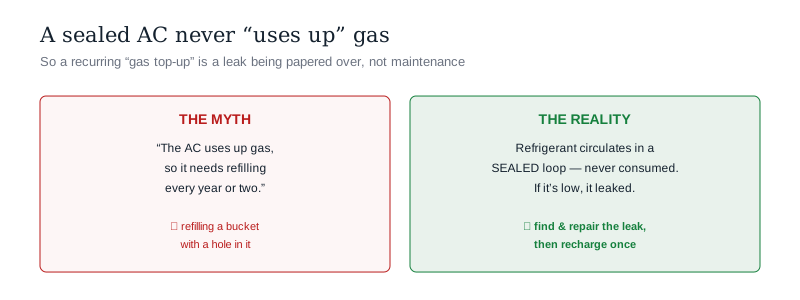
The single most useful thing to know about AC refrigerant:
- The refrigerant is sealed inside a closed loop. It evaporates and condenses around the circuit endlessly — it is not burned, used up or consumed.
- So a healthy AC keeps its charge for years — often the whole life of the unit — without ever needing more.
- If the level is low, it went somewhere: it leaked. "The gas got over" is not how a sealed system works.
- Therefore, repeated "gas refilling" is a red flag — you're paying to refill a bucket with a hole instead of fixing the hole. Each refill is temporary; the leak keeps draining it.
A one-off recharge after a genuine repair is legitimate. A recurring refill schedule is a leak being managed instead of mended.
Signs of a refrigerant leak
Low refrigerant shows itself in fairly specific ways:
- Weak cooling that worsens over time — the AC runs but the room won't get cold, especially as the charge drops (see AC not cooling).
- Ice or frost on the copper pipes or indoor coil — low refrigerant makes the coil too cold and it frosts up.
- A hissing or bubbling sound — escaping gas at the leak point.
- Longer run times and higher bills — the AC struggles to reach the setpoint.
- The AC "worked fine after a refill, then faded again" — the tell-tale pattern of an unrepaired leak.
Note these overlap with other faults (a dirty filter also weakens cooling), so proper diagnosis matters — don't let "needs gas" be the automatic answer.
Why it matters — cost and climate
- You keep paying for refills — recurring top-ups cost more over time than one proper leak repair.
- Your AC underperforms and wears — running low on refrigerant strains the compressor and can shorten its life.
- It's an environmental harm — the leaked refrigerant doesn't vanish; high-GWP gases like R410A warm the climate thousands of times more than CO₂ when released (see refrigerants and the GWP calculator). Venting refrigerant is both wasteful and, increasingly, against the rules.
A leak is not a minor quirk — it's a recurring cost, a performance drag, and a climate emission all at once.
What to actually do
- Insist on leak detection and repair, not just a refill. A competent technician can pressure-test / use a leak detector to find the leak, repair it (often a joint, valve or coil), then evacuate and recharge to the correct amount.
- Recharge to spec, once — after the repair, the system is charged to the manufacturer's weight and should then hold for years.
- Be wary of "annual gas top-up" packages — routine refilling should not be a normal service item on a leak-free AC.
- Use a licensed technician — refrigerant handling requires proper recovery equipment and training; it should never be vented to the air.
- Keep up genuine maintenance — regular servicing (coil and filter cleaning) is real; recurring gas refilling is not.
The one-line answer
A working air conditioner never needs its refrigerant refilled — the gas circulates in a sealed loop and isn't consumed, so a healthy AC holds its charge for years. If the level is low, it leaked, which means recurring "gas top-ups" are a red flag: you're refilling a bucket with a hole instead of fixing the hole. Tell-tale leak signs are cooling that weakens over time, ice on the copper pipes or coil, a hissing sound, longer run times, and the classic "cooled fine after a refill, then faded again" pattern (though a dirty filter can mimic weak cooling, so diagnose properly). It matters because a leak means you keep paying for refills, the compressor is strained, and a high-GWP gas like R410A is warming the climate thousands of times more than CO₂ as it escapes. The fix is not another refill but leak detection and repair, followed by a single recharge to the manufacturer's spec — done by a licensed technician who recovers refrigerant rather than venting it. Genuine servicing is coil and filter cleaning; a recurring gas-refill schedule is a leak being managed instead of mended.
Where to go next
- The bigger picture: HVAC Refrigerants Guide.
- The related symptom: AC Not Cooling Guide.
- The climate stakes: Refrigerant GWP Impact Calculator.
- What real servicing is: HVAC Maintenance Guide.
References
- ISO 817 & ASHRAE Standard 34 — refrigerant classification; manufacturer charge specifications for correct recharge.
- Montreal Protocol & Kigali Amendment; MoEFCC Ozone Cell (India) — refrigerant recovery, not venting: https://ozonecell.nic.in/
- IS 60335 (Part 2/Sec 40) : 2018 — Safety of electrical heat pumps, air-conditioners & dehumidifiers, Bureau of Indian Standards.
Recognising a leak is covered here; finding, repairing and recharging refrigerant is qualified, licensed technician work. Verify any standard's current status via the BIS catalogue before relying on it.
Export this guide
Related Guides — Deep-dive reading
AC & HVAC Maintenance: The Simple Routine That Keeps Cooling Efficient
Neglect is the quiet killer of cooling — the maintenance that keeps an AC efficient, healthy and long-lived: what you can safely do yourself (filters above all), what a technician must do, how often to service, and the warning signs that mean call for help.
HVAC & CoolingAC Not Cooling? The Common Causes and What to Check First
The most-searched cooling question, answered honestly — why an AC stops cooling well, the two simple things you can safely check yourself (filter and settings), the causes that need a technician (low gas, dirty coil, compressor), and how to tell them apart.
HVAC & CoolingFire Safety Maintenance Calendar for India (2026): The Year-Round Routine That Keeps It All Working
India's core fire-safety disease is installed for the NOC, then neglected. The cure is a written, owned maintenance calendar - who checks what, when - so no fire-safety element ever silently fails.
SecurityRelated Tools — Try Free
Before vs After — Cost Reality Check
Compare what you expected to pay vs what you actually paid, category by category.
Reality CheckHealing View Impact Calculator
Evidence-Based Design dashboard quantifying the recovery impact of nature view + daylight factor on analgesic use, length of stay, and HCAHPS patient-experience uplift. Calibrated against Ulrich 1984 (Science), Park & Mattson 2008, and the CHD EBD evidence base.
EBD CalculatorRefrigerant GWP Impact Calculator
The CO₂-equivalent released if an AC's refrigerant leaks — by gas (R32, R410A, R22, R290) and charge — compared and put in relatable terms to show why low-GWP refrigerants matter.
HVAC