
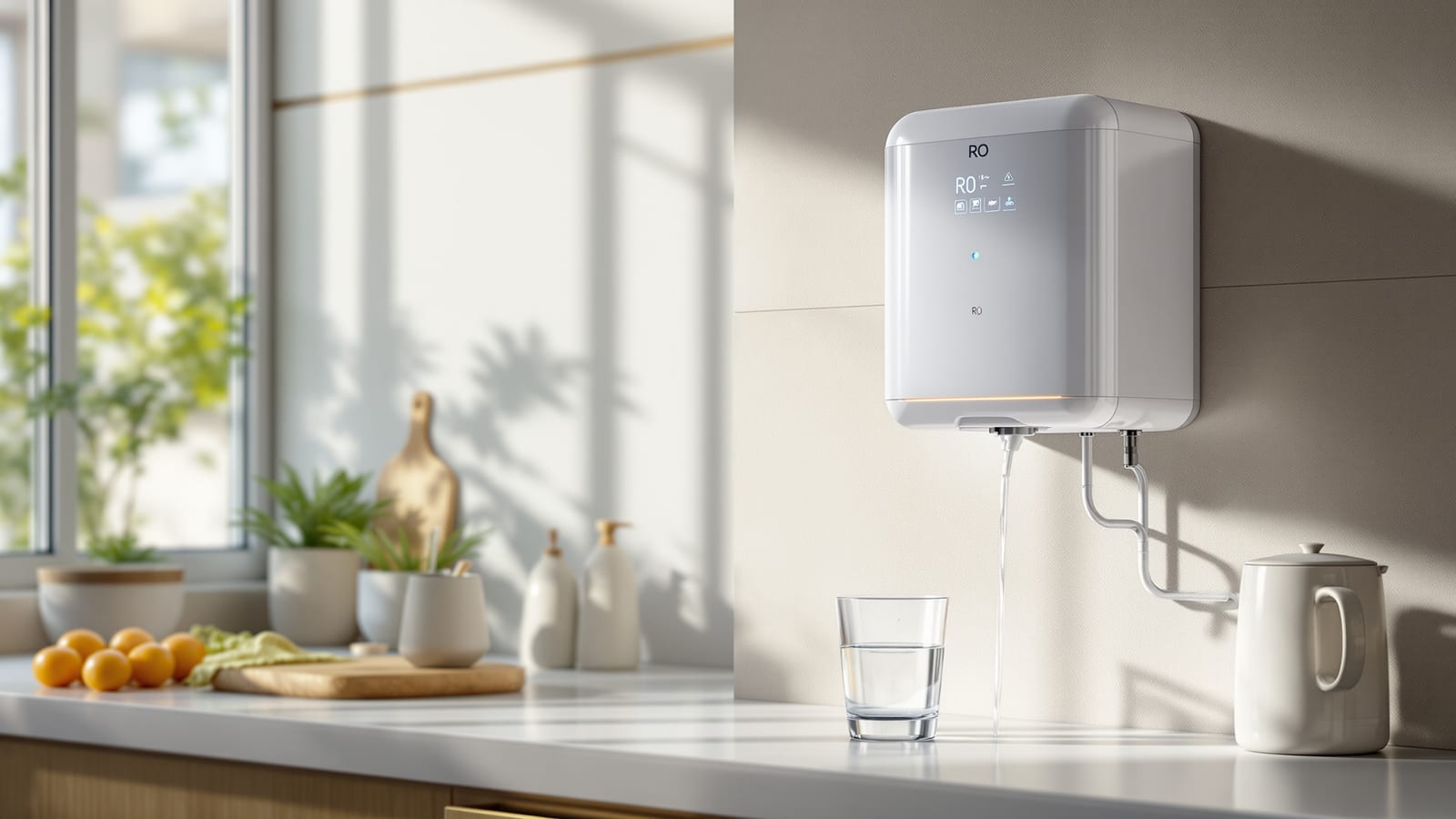
Smart Water Purifiers (RO) for Indian Homes: A Buyer's Guide
India's water is as varied as its geography — hard borewell in one city, chlorinated municipal supply in the next. This guide explains what makes an RO purifier smart, how to choose between RO, UV and UF by your actual water quality, the truth about water wastage, the maintenance and AMC reality, and which brands earn their price against IS 10500.
Water in India is not one problem but a hundred. A family in coastal Chennai draws hard, high-TDS borewell water thick with dissolved salts; a household in Bengaluru gets municipal supply that is soft but chlorinated; a village home may face fluoride or arsenic; a Mumbai flat may get water that is fine at the plant but picks up contamination in old tanks and pipes. A water purifier is one of the most bought appliances in urban India, and also one of the most oversold — millions of homes run an RO machine that quietly strips minerals and wastes litres they never needed to. Getting the choice right saves money, water and health.
This guide goes deep on smart water purifiers for Indian homes. We cover what actually makes an RO purifier "smart", how to choose between RO, UV and UF based on your real water quality rather than a salesman's fear, the truth about water wastage and recovery, the maintenance and AMC reality that dominates the true cost of ownership in India, storage and installation, the IS 10500 drinking-water standard, and brands with real prices. It sits alongside the smart water management guide and the home health monitoring guide, and slots into the wider smart homes pillar guide. To budget the system and its AMC, use the smart home cost calculator.
The right question is never "which is the best RO?" It is "does my water even need RO?" Millions of Indian homes run reverse osmosis on water that only needed ultraviolet disinfection — paying more, wasting more, and stripping minerals for no reason.
First, understand your water: TDS and IS 10500
Before choosing any technology, you need to know what is in your water. Two things matter most.
TDS — Total Dissolved Solids — measured in parts per million (ppm), is the total of dissolved minerals and salts. Low TDS water tastes flat and may be slightly corrosive; very high TDS water tastes salty or bitter and carries a heavier load of dissolved matter. Microbiological contamination — bacteria, viruses and cysts — is the other axis, and it is invisible to a TDS meter. You can have low-TDS water that is microbiologically unsafe, or high-TDS water that is bacterially clean. The two problems need different treatments.
The Bureau of Indian Standards specification for drinking water is IS 10500. It sets an acceptable limit of 500 ppm TDS and a permissible limit of 2,000 ppm in the absence of an alternative source, along with limits for hardness, fluoride, nitrate, heavy metals and bacteriological safety. A ₹300 TDS meter and, ideally, a lab test of your supply tell you which side of these limits you sit on — and that single fact decides your entire purchase.
| Water source | Typical TDS | Usual concern | Likely fit |
|---|---|---|---|
| Municipal, treated | 100–300 ppm | Chlorine, pipeline contamination | UV or UV + UF |
| Municipal, hard-water city | 300–500 ppm | Hardness, taste | UF or light RO |
| Borewell, coastal / hard | 500–2000+ ppm | High TDS, salts, hardness | RO (essential) |
| Overhead tank storage | Variable | Bacteria, sediment | UV + UF at least |
RO, UV and UF: choosing by your actual water
The three core technologies do different jobs, and the honest choice follows your water, not the biggest number on the box.
RO — Reverse Osmosis forces water through a semi-permeable membrane that removes dissolved salts, heavy metals and much else, dropping TDS dramatically. It is the only technology that reduces high TDS, so for borewell and coastal water above roughly 500 ppm it is essential. Its costs are that it wastes water as reject and strips beneficial minerals, which is why good RO units add a mineraliser or TDS controller to add some minerals back.
UV — Ultraviolet passes water past a UV lamp that kills bacteria, viruses and cysts. It does nothing to TDS, hardness or dissolved chemicals — it only disinfects. For low-TDS municipal water that is chemically fine but microbiologically suspect, UV alone (often with a carbon and sediment pre-filter) is the right, cheaper, no-waste answer.
UF — Ultrafiltration uses a membrane with pores fine enough to physically block bacteria, cysts and sediment without electricity, but it does not remove dissolved salts or viruses reliably. It is often paired with UV or used where power is unreliable.
The single most common Indian mistake is buying RO for water that only needed UV. If your municipal supply reads 150 ppm and the only real risk is bacteria from an old overhead tank, an RO machine wastes water, strips minerals and costs more to maintain for zero added safety. Test first; buy the technology your water demands.
What makes a water purifier "smart"
Once you know you need a purifier, the smart features on modern RO units range from genuinely useful to convenient. Here is the honest ranking.
Real-time TDS monitoring shows the input and output TDS on a display or app, so you can see the machine is actually working and catch a failing membrane early. Filter-life and membrane-life alerts track litres processed and warn you before performance drops — far more honest than the old fixed-calendar reminder, because a family of six exhausts filters faster than a couple. Auto-shutoff stops the machine when the storage tank is full, saving water and power. Leak detection with an auto-cut valve is genuinely valuable in India, where a burst RO connector under the sink can flood a kitchen overnight. Water-usage tracking in the app helps larger families plan filter changes and spot a leak from an unexpected spike.
| Smart feature | What it does | How much it matters |
|---|---|---|
| Input/output TDS display | Proves the machine is working | High — catches membrane failure |
| Filter and membrane-life alert | Warns before quality drops | High — usage-based beats calendar |
| Auto-shutoff on full tank | Stops when tank is full | High — saves water and power |
| Leak detection with auto-cut | Prevents kitchen floods | High in Indian kitchens |
| App usage tracking | Plans service, spots leaks | Medium |
| Wi-Fi with no sensing | Just app on and off | Low — a badge |
As with any appliance, buy the sensing and safety (TDS, leak cut-off, honest filter alerts), not the Wi-Fi badge. A purifier that tells you the truth about its own output water is worth more than one that merely connects to an app. Tie leak detection into your wider smart water management setup and your smart sensors so a burst connector triggers an alert on your phone.
Smart RO monitoring: what the machine watches
A smart RO purifier watches three things — the water going out, the filters wearing down, and the pipes for leaks — and reports them to you before they become problems.
The truth about water wastage and recovery
Reverse osmosis has an unavoidable cost: for every litre it purifies, it flushes salts away in a reject stream. Older domestic RO units waste around three litres for every one purified — a serious concern in a water-stressed country. Modern units improve on this, and some claim recovery ratios near one-to-one, but always check the real figure.
The honest fixes are simple and worth doing. Route the reject water to a bucket and reuse it for mopping, flushing, gardening or cleaning — reject water is high in salts but perfectly fine for these uses. Choose a unit with a good recovery ratio if you are on borewell water and running RO all day. And, again, do not run RO at all if your TDS does not need it — the greenest RO is the one you never installed. Fold this into your household smart water management plan.
Maintenance and AMC: the real cost of ownership in India
In India the purchase price of a water purifier is often the smaller half of what you pay over its life. The service — filter changes, membrane replacement, sediment and carbon cartridges — dominates, and this is where families are caught out.
An Annual Maintenance Contract (AMC) typically costs ₹2,000 to ₹6,000 a year depending on the brand and whether it covers only labour or parts too. A comprehensive AMC that includes filter and membrane replacement is usually the honest choice, because bought individually the RO membrane alone can cost ₹1,500 to ₹4,000 and needs replacing every two to three years, while sediment and carbon filters need changing every six to twelve months.
| Cost item | Typical range | Frequency |
|---|---|---|
| Sediment + carbon filters | ₹400–₹1,200 each | Every 6–12 months |
| RO membrane | ₹1,500–₹4,000 | Every 2–3 years |
| UV lamp | ₹500–₹1,500 | Every 1–2 years |
| Comprehensive AMC | ₹2,000–₹6,000 per year | Annual |
| 3-year total (with AMC) | ₹6,000–₹18,000 | — |
Two honest cautions. First, factor the AMC into your buying decision — a cheap machine from a brand with poor local service or overpriced proprietary filters is a false economy. Second, service on time: an RO run past its membrane or filter life quietly delivers worse water than tap, defeating the whole purpose. Model the AMC alongside the rest of your smart-home spend in the smart home cost calculator.
Storage and installation
Most RO units store purified water in a tank because purification is slower than a tap. Size the storage to your family: a couple manages with 7 to 8 litres, a family of four to six wants 8 to 10 litres or more, so nobody waits during the morning rush. Stainless-steel or food-grade tanks resist bacterial growth better than some plastics, and a UV lamp on the storage outlet keeps stored water safe. Install the unit near a drain for the reject line, on a wall that can take the weight of a full tank, and with the leak sensor sitting where a burst connector would pool. Keep the pre-filter accessible, because in silty Indian supply it needs the most frequent attention.
Brands and prices in India
| Brand | Typical range | Price band | Notes |
|---|---|---|---|
| Kent | RO + UV + UF, smart models | ₹12,000–₹25,000 | Market leader, wide service, mineraliser |
| Aquaguard (Eureka Forbes) | RO, UV, smart Wi-Fi | ₹10,000–₹22,000 | Huge service network, strong AMC |
| Livpure | RO + UV + mineraliser | ₹8,000–₹18,000 | Value, subscription/rental options |
| Pureit (HUL) | RO + UV, smart alerts | ₹9,000–₹20,000 | Trusted, good UV-only options |
| AO Smith | RO with mineral tech | ₹15,000–₹30,000 | Premium build, strong recovery |
| Blue Star | RO + UV + UF | ₹12,000–₹24,000 | Reliable, good mid-to-premium range |
Prices move with capacity, technology and smart features, so treat these as bands. The honest path is unchanged: test your water first, buy the technology your TDS actually needs — UV for low-TDS municipal supply, RO only where TDS truly demands it — pick a brand with strong local service and a fair AMC, and let smart TDS monitoring and leak detection be the useful bonus on top. A well-chosen UV unit that suits your water beats an oversold RO every time. From here, connect the purifier into the wider smart water management guide and keep an eye on the household's wider wellbeing with the home health monitoring guide.
References
- Bureau of Indian Standards — IS 10500 drinking water specification
- Central Pollution Control Board — water quality monitoring and standards
- World Health Organization — Guidelines for drinking-water quality
- Bureau of Energy Efficiency — appliance efficiency and standards
- Kent RO Systems — water purifier range and technology
- Eureka Forbes Aquaguard — water purifier lineup and service
Export this guide
Related Guides — Deep-dive reading
RO vs UV Water Purifier: Which One Does Your Home Need? (India)
A fair, India-first head-to-head decided by one number — your feed-water TDS. RO strips dissolved salts and heavy metals for hard borewell water; UV only kills microbes and suits already-clear, low-TDS municipal supply. What each removes, water wastage, running cost, and a verdict by measured TDS.
PlumbingSmart Air Purifiers for Indian Homes: Beating PM2.5
Across Delhi-NCR winters and year-round urban haze, indoor air is often worse than the street. This guide explains what actually makes a purifier smart, how CADR and room sizing work, what HEPA and activated carbon really remove, honest running costs on filters and power, and which brands earn their price in Indian conditions.
Smart HomeRO Water System for Indian Homes: How Reverse Osmosis Works, When You Need It, Reject Water and Cost
The point-of-use purifier that strips dissolved salts, TDS and heavy metals from high-TDS borewell and brackish water — how the membrane and cartridge train actually work, when RO is right (and when it just wastes water and strips minerals), how to reuse reject water, and what it costs to run in India.
PlumbingRelated Tools — Try Free
Pool Maintenance Cost Calculator
Monthly and yearly running cost of a home pool — chemicals, electricity, water and service, DIY vs AMC.
Pool CalculatorPool Water Calculator
Chlorine, shock and salt doses plus top-up water for your pool — an indicative balancing guide.
Pool CalculatorWindow Cleaning Cost Calculator
Estimate professional window cleaning cost per visit and per year by access and frequency.
Window Calculator