
Why Most Indian Homes Feel Cluttered (And How to Fix It)
The planning and storage failures behind visual chaos — and the fixes that restore calm
Walk into a recently handed-over 3BHK in Whitefield, Bengaluru. The family moved in eight months ago. The sofa is good, the paint is fresh, the modular kitchen was not cheap — and yet the home feels restless. The dining table has become a parking lot for keys, chargers, a stack of school circulars and yesterday's vegetables. The console near the door is buried under shoes, helmets and Amazon boxes. The kitchen counter has disappeared under jars. Nothing is dirty. Nobody is lazy. And still, the home will not settle into calm. The owners blame themselves — "we are just untidy people" — and quietly resign to it.
They are wrong about the cause. The home was never planned to absorb the life that was always going to happen inside it. This guide is about exactly that: why Indian homes specifically tend to feel cluttered, how to tell the difference between a home that is merely messy and a home that is cluttered by design, how to do the simple storage-deficit arithmetic that exposes the real problem, and the concrete, room-by-room fixes that restore calm — most of which are planning decisions, not cleaning habits. If you are still at the planning stage, read it alongside our pillar guide on how to plan your dream home before the architect, because the cheapest time to solve clutter is before a single wall is built.
The single idea to hold on to: clutter is not a character flaw or a tidiness problem — it is an architecture problem. A home feels cluttered when the volume of things it must hold is larger than the storage it was designed to provide. Close that gap and the calm appears almost on its own.
Why Indian homes feel cluttered — specifically
Every home anywhere accumulates things. But Indian homes face a particular combination of pressures that Western design advice — written for households with fewer possessions, smaller families and bigger built-in closets — simply does not account for. Understanding these pressures is the first step, because you cannot design storage for a life you refuse to admit you live.
More things come in, and fewer leave. Several forces multiply the inflow:
| Pressure | Why it loads the Indian home | Typical extra volume |
|---|---|---|
| Joint & extended families | More people, more belongings, more guests staying over | +30–50% over a nuclear-family assumption |
| Festivals, pooja & rituals | Diyas, decorations, brass, festival clothes, gifting stock, prasad vessels | 1–3 dedicated cubic metres, mostly seasonal |
| Bulk buying | Monthly grocery hauls, sacks of rice and atta, ghee tins, big utensil sets | Needs deep dry-store; rarely planned |
| Utensils & cookware | Indian cooking uses far more vessels than Western kitchens — pressure cookers, kadhais, idli stands, tiffin sets | 2–4× a typical Western kitchen |
| Gifting culture | Objects flow in at weddings, festivals, housewarmings — and cannot easily be discarded | Steady, hard-to-exit inflow |
| Multi-purpose rooms | The same room is living room, study, guest room and prayer space — each function brings its own kit | Storage demand stacks, floor area does not |
| "Might need it later" | A thrift-shaped instinct keeps old electronics, packaging, fabric, jars | The largest invisible hoard in most homes |
None of these are problems to be ashamed of — they are how Indian homes actually function. The festival box, the guest mattress, the spare pressure cooker and the gifted dinner set are all legitimate. The mistake is pretending they do not exist when the home is planned.
The storage that should absorb all this is usually the last thing anyone designs. In a typical builder flat, the developer optimises for sellable carpet area and a glossy show flat, not for the quiet cubic metres a real family needs. Wardrobes are shallow and badly subdivided, the utility is an afterthought, the kitchen has open shelves instead of full-height units, and vertical height above seven feet is left completely empty. The result is a home that looks spacious on handover day and feels cramped within a year.
And then there is visual noise — the second, quieter reason a home reads as cluttered even when it is reasonably tidy. Open shelves displaying mismatched objects, a dozen small furniture pieces in clashing finishes, four or five competing colours, exposed wires snaking from the TV, gadgets and chargers on every surface, and a single harsh tube-light flattening everything into one busy plane. The eye finds nowhere to rest, and the brain reads that as chaos — regardless of how much is actually out of place.
Messy vs cluttered-by-design: the distinction that changes everything
If you take one diagnostic idea away, make it this one. There are two completely different conditions that both look like "a cluttered home," and they need opposite responses.
| Messy (temporary) | Cluttered by design (structural) | |
|---|---|---|
| Cause | Things are out of place right now | There is no place for the things to begin with |
| Fix | Spend 20 minutes putting things away | Re-plan storage; cleaning does not help |
| Recurs? | No — once tidied, it stays tidy a while | Yes — it returns within days, every time |
| Feeling | "We had a busy week" | "Our home just always looks like this" |
| Real test | Can you tidy it fully in half an hour? | After tidying, is every surface still loaded? |
Here is the test that cuts through it. Tidy your home completely — put genuinely everything in its designated home. If, when you finish, there are still objects with no cupboard, drawer or shelf to live in, you do not have a messy home. You have a storage deficit, and your home is cluttered by design. The overflow has nowhere to go but onto open surfaces, and so it always returns.
This matters because the entire self-help genre of "declutter your home" assumes the messy case. It tells you to fold things into rectangles and discard what does not spark joy. That advice helps at the margin, but if your home is structurally short on storage, you will be back to chaos in a fortnight — and you will, once again, blame yourself. The honest fix is to do the arithmetic.
The diagnosis: storage-deficit math
You can estimate, in a single afternoon, whether your home suffers a real storage deficit. The logic is simple: a family generates a certain volume of things that must be stored; a home provides a certain volume of storage; the difference — if storage is smaller — is the clutter you see every day.
For a family of four to six in a typical 3BHK, the storage need breaks down roughly like this. These are indicative bands from real Indian households, not hard statistics — your numbers will vary, but the totals are usually closer than people expect.
| Category | What it holds | Indicative volume |
|---|---|---|
| Clothing (all members) | Daily, formal, ethnic, winter, kids' growing stock | 14–18 m³ |
| Kitchen & pantry | Utensils, cookware, dry groceries, appliances, crockery | 8–10 m³ |
| Linen & bedding | Bedsheets, towels, spare mattresses, guest bedding | 4–6 m³ |
| Festival & pooja | Decorations, brass, festival clothes, gifting stock | 2–3 m³ |
| Documents & misc | Files, electronics, tools, packaging, sentimental items | 3–5 m³ |
| Luggage & seasonal | Suitcases, trekking gear, coolers, off-season items | 3–5 m³ |
| Total need | ≈ 45–55 m³ |
Now the supply side. A typical 3BHK builder flat provides wardrobes (often shallow and poorly fitted), the modular kitchen's lower and a few upper units, and maybe one or two lofts. Measured honestly, that is usually 25–30 m³ of usable concealed storage — and far less if the wardrobes are badly subdivided.
The deficit — commonly 15–20 m³ — is not abstract. It is the festival box on top of the wardrobe, the suitcases under the bed, the jars colonising the kitchen counter, the documents on the dining table. Every cubic metre of deficit becomes a square metre of surface you can no longer keep clear.
A cleaner way to think about it: storage as a percentage of floor plate.
| Storage provision | % of carpet area (as concealed volume) | Result |
|---|---|---|
| Typical builder flat | 6–8% | Chronic overflow, perpetual clutter |
| Comfortably planned home | 12–15% | Surfaces stay clear, calm holds |
| Over-storaged / hoarder-proofed | >18% | Diminishing returns; floor area sacrificed |
Aim to design concealed storage equal to roughly 12–15% of your floor plate. Most homes provide half that — and then their owners blame their own untidiness for a problem the drawings created.
If you want to put real numbers against your own home rather than these bands, our storage calculator walks you through it room by room, and the pillar's broader planning logic in how to plan your dream home shows where storage fits in the wider brief.
The fixes, in principle
Before the room-by-room detail, six principles do most of the heavy lifting. They work whether you are building from scratch, fitting out a new flat, or rescuing a home you already live in.
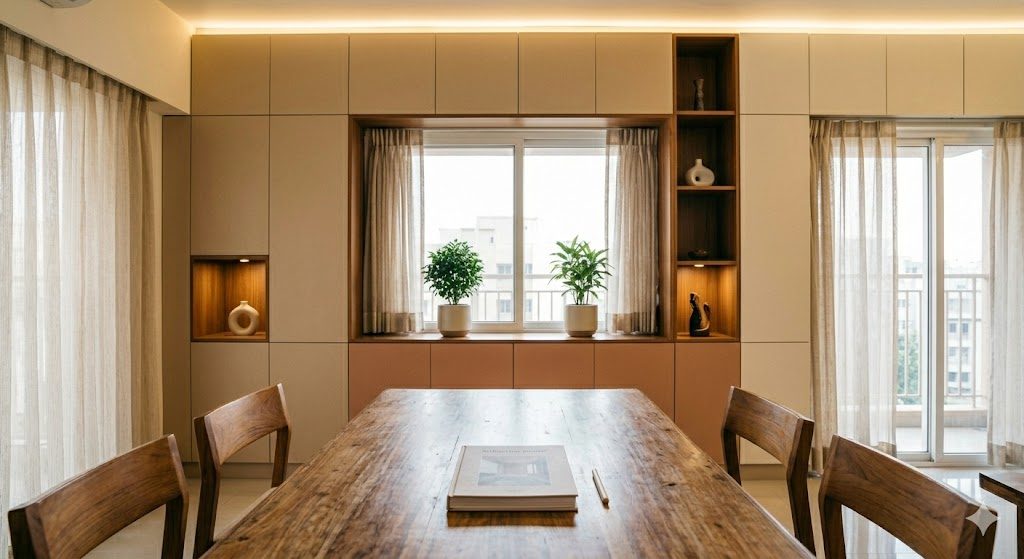
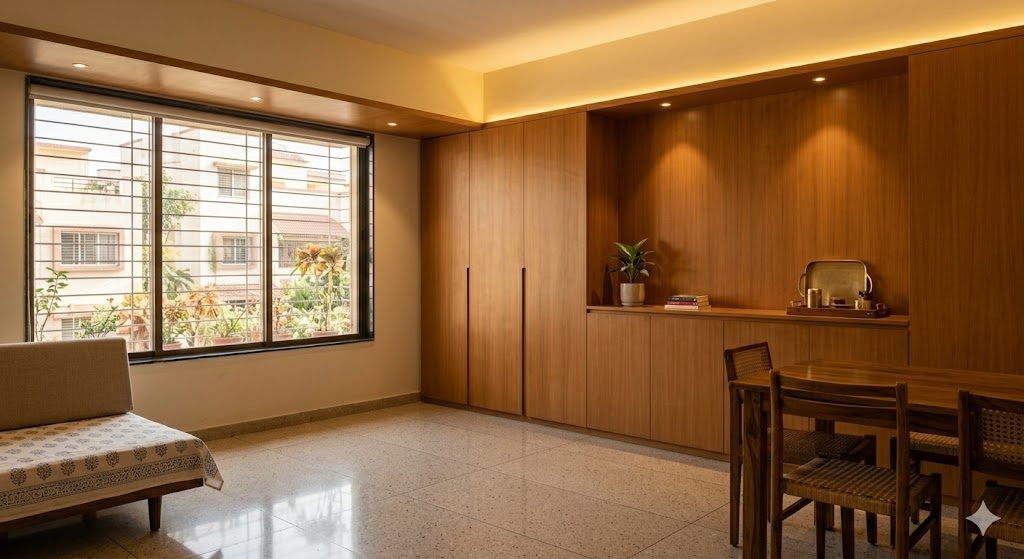
1. Design concealed storage in, at the right ratio. The single highest-impact move. Aim for that 12–15% of floor plate, and make it concealed — full-height shutters, not open shelves. Concealed storage hides the visual noise of varied objects behind a single calm plane. A continuous floor-to-ceiling storage wall in the living-dining area, in one material, can hold 8–12 m³ on its own and reads as architecture, not clutter.
2. Adopt one-surface discipline. Decide that exactly one surface per zone is allowed to hold loose objects — one tray on the console, one shelf in the kitchen. Every other surface stays clear by rule. This is the cheapest intervention in this guide and the one that survives daily life, because it gives the eye repeated places of rest.
3. Build a real entry / drop-zone. Most Indian clutter begins at the front door, where shoes, bags, keys, helmets, umbrellas and deliveries land. A planned drop-zone — a slim full-height cabinet with a bench, hooks, a key tray and shoe storage — intercepts the inflow before it reaches the living room. This one move solves a disproportionate share of visible mess.
4. Use vertical storage and dead height. Indian flats waste the volume above 2.1 m almost everywhere. Lofts, over-door cabinets, full-height wardrobes and tall kitchen units convert empty air into 5–10 m³ of storage for seasonal and rarely-used items — exactly the things that otherwise pile up.
5. Reduce visual noise with tonal and material discipline. Limit a room to two or three colours and two or three materials. A home in calm related tones — warm whites, one wood, one accent — reads as serene even when it holds a lot. A home in five clashing finishes reads as busy even when it holds little. Our guide on making apartments feel bigger goes deeper on how palette and sightlines change perceived space.
6. Conceal technology and light the room in layers. Run wiring inside the media unit and walls, not across them. A flat overhead tube-light exposes every object equally and reads as harsh and busy; layered lighting — a few warm sources at different heights — lets the eye settle and hides minor mess in soft shadow.
Room-by-room fixes
Principles are easy to nod along to. Here is where they land in each space of a real Indian home, with the specific interventions that matter most.
Living room
This is the room that gets judged, so it is where clutter hurts most. The fix is almost always a continuous storage wall: floor-to-ceiling, one material, concealed shutters, absorbing books, electronics, board games, documents and display objects behind a single calm face. Replace several small mismatched pieces — three side tables, two stools, a magazine rack — with fewer, larger, multifunctional ones. A storage ottoman beats a coffee table plus a basket. Keep exactly one curated surface for display, and route every wire behind the media unit. See our deeper treatment in storage solutions for compact apartments.
Kitchen
The Indian kitchen carries more vessels, more dry groceries and more appliances than almost any other room, and it is where counters disappear first. Plan full-height tall units for the bulk dry-store — rice, atta, pulses, tins. Specify a dedicated appliance garage so the mixer, grinder and toaster live behind a shutter instead of on the slab. Use deep drawers, not low shelves, for vessels — drawers keep the counter clear because everything has a defined slot. Aim to keep the working counter at least two-thirds clear at all times; if it cannot stay clear, the unit count is too low.
Bedroom
Bedroom clutter is mostly a wardrobe problem in disguise. A poorly subdivided wardrobe — all hanging, or all shelves, with no drawers — forces overflow onto the bed, the chair and the floor. The fix is internal: the right mix of hanging, shelving, drawers and accessory storage for what the user actually owns. Under-bed storage drawers reclaim 1.5–2 m³ that suitcases and seasonal bedding usually occupy in plain sight. Our guide on why wardrobes become inefficient is the companion read here.
Entrance
As above, the drop-zone is the single most valuable square metre in the home for clutter control. A 450–600 mm deep full-height cabinet near the door with a bench, hooks at two heights (adults and children), a tray for keys and wallets, and ventilated shoe storage will intercept the daily inflow that otherwise ends up on the living-room console.
Pooja space
Festival and ritual items are seasonal, sentimental and impossible to discard — the perfect storage trap. Give the pooja zone its own dedicated concealed cabinet sized for the brass, the diyas, the festival clothes and the gifting stock, ideally near where the rituals happen. When these items have a defined home, they stop migrating onto shelves and surfaces between festivals.
Utility & dry-store
The most under-planned space in the Indian home. A proper utility absorbs the washing machine, cleaning supplies, mops, buckets, the spare gas cylinder, bulk groceries and the recycling — all the unglamorous volume that otherwise leaks into the kitchen and balcony. Budget for it generously; every cubic metre here is a cubic metre that does not become visible clutter elsewhere. For more compact-home tactics, see smart storage ideas for India.
The decluttering method (for the part that is genuinely surplus)
Even with the storage deficit closed, some of what a home holds is genuinely surplus — and clearing it makes the designed storage last. Do this after you understand your deficit, not instead of it. A simple, India-honest method:
1. Sort by frequency, not sentiment. Group everything into used-weekly, used-seasonally, and not-used-in-a-year. The third pile is your decision pile.
2. The one-year rule, with festival mercy. If it has not been used in a year and is not a genuine festival or ritual item, it is a candidate to exit. Festival items get a pass — store them, do not discard them.
3. Stop the inflow. Decline duplicate gifts gracefully, refuse free packaging, and resist "might need it later" for cheap, easily re-bought items.
4. One-in-one-out. For categories that grow — clothes, vessels, gadgets — let something leave whenever something arrives.
5. Give surplus a dignified exit. Donate, pass to extended family, or sell. The instinct that hoards is a good instinct misapplied; redirect it.
Reducing visual noise (when the home is tidy but still feels busy)
If you have closed the deficit and decluttered, and the home still feels restless, the remaining problem is visual noise — and it is purely a design fix.
| Lever | Cluttered reads as | Calm reads as |
|---|---|---|
| Colour | 4–5 competing colours | 2–3 related tones |
| Material | Many clashing finishes | 2–3 disciplined materials |
| Surfaces | Everything open, on show | Concealed behind one plane |
| Furniture | Many small pieces | Fewer, larger, deliberate pieces |
| Wiring & tech | Visible, tangled | Run inside walls / units |
| Lighting | One flat overhead tube | Layered, warm, varied heights |
The deepest lever is tonal discipline. A room with a single wood, a warm neutral wall and one accent colour will feel ordered even when it is fully lived in. Concealing technology and layering light then do the finishing work — soft pools of warm light let the eye rest and forgive small imperfections that a harsh tube-light would expose. This is closely tied to space perception; our guide on space-planning mistakes that make homes feel smaller covers the overlap.
Get it right, in order
1. Diagnose first. Tidy completely, then check whether surfaces are still loaded. If they are, you have a structural deficit, not a messy week.
2. Do the math. Estimate your storage need (45–55 m³ for a typical family) against what the home provides (often 25–30 m³). Quantify the gap.
3. Design concealed storage to 12–15% of floor plate. Prioritise a continuous living-room storage wall, full-height kitchen units and well-subdivided wardrobes.
4. Build the drop-zone. Intercept the daily inflow at the front door before it reaches the living room.
5. Capture vertical and dead height. Lofts and tall units for seasonal, festival and rarely-used items.
6. Declutter the genuine surplus. Sort by frequency, apply the one-year rule with festival mercy, and stop the inflow.
7. Impose one-surface discipline and tonal restraint. Two or three colours, two or three materials, one allowed surface per zone.
8. Conceal the tech and layer the light. Wires hidden, warm light at varied heights.
Done in this order, calm is not a daily battle you keep losing — it is a property of the home you designed.
If you are planning or renovating and want to get the storage ratio and room-by-room briefs right from the start, DesignAI can draft a clutter-aware plan, a storage schedule and an early BOQ from your family's actual inventory — sizing concealed storage to your real life rather than a developer's show flat, so the calm is built in rather than chased forever.
References
1. Bureau of Indian Standards, National Building Code of India (NBC) 2016, Part 4 (residential occupancy and space standards) and Part 8 (building services) — baseline for room and storage planning.
2. Francis D. K. Ching, Architecture: Form, Space and Order — on how spatial order, surface and visual hierarchy shape perceived calm.
3. Francis D. K. Ching & Corky Binggeli, Interior Design Illustrated — anthropometric and storage-planning data underlying the volume bands used here.
4. Council of Architecture (CoA), India — guidance on residential space planning and the architect's scope in the brief stage.
5. Bureau of Indian Standards, IS 4963: Recommendations for Buildings and Facilities for the Physically Handicapped and allied IS standards — clearances that inform usable storage depths and access.
6. Real Estate (Regulation and Development) Act, 2016 (RERA) — carpet-area definitions that clarify how much usable floor plate is actually available for storage planning.
Read next, in this cluster: how to plan your dream home before the architect · space-planning mistakes that make homes feel smaller · storage solutions for compact apartments · smart storage ideas for India · why wardrobes become inefficient · making apartments feel bigger.
Export this guide
Related Guides — Deep-dive reading
Storage Planning Before Interior Design
Why storage must be planned first — audited, budgeted and given its floor area — before a single layout, colour or sofa is chosen. The homeowner's plan-it-first master guide for Indian homes.
StorageStorage Design for Small Apartments
How to build real storage into a 1RK, 1BHK or 2BHK builder flat from the layout stage — not by buying more boxes, but by designing for height, dead space and double-duty furniture.
StorageWalk-In Pantry Design
How to design the dedicated larder the Indian kitchen actually needs — for bulk rice and atta, masala stock, monthly rations and festival cooking — with sizing, shelving, ventilation and pest control that survives the monsoon.
StorageRelated Tools — Try Free
Apartment Interior Planning Checklist
51-item checklist across structural, ceiling, lighting, furniture, storage, electrical, kitchen, bathroom.
ChecklistApartment Furniture Size Chart
Standard furniture dimensions for Indian apartments — sofas, beds, tables, dining, storage.
Reference ChartMaterial Schedule Generator
Generate a room-wise finish schedule — walls, floors, ceilings, trim, and joinery by location.
Material Schedule