
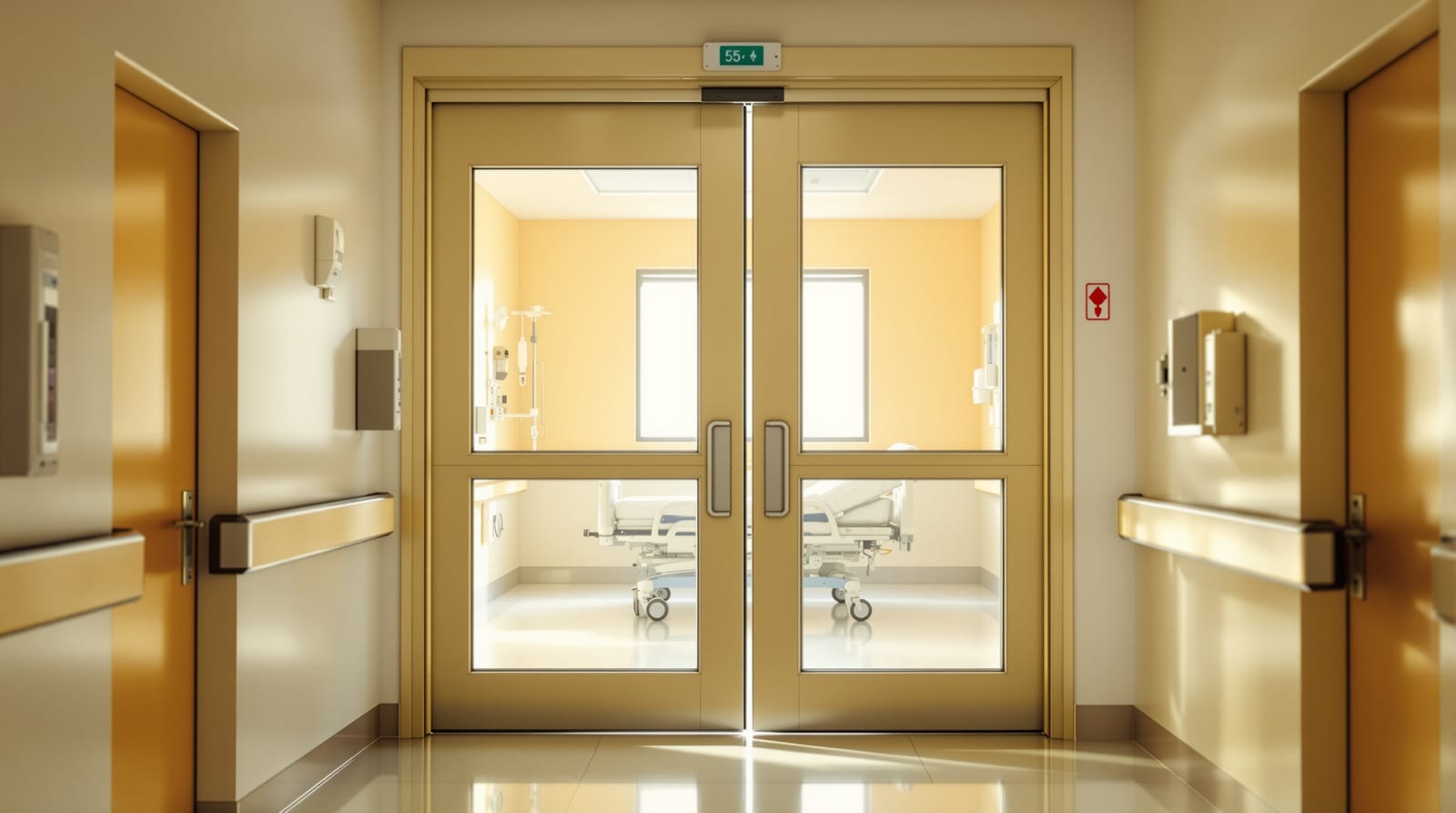
Hospital Room Door in India: Patient-Ward & Stretcher Door Specification (2026)
How to specify the patient-room / ward door in an Indian hospital - a wide 1.5-leaf flush door with at least 1200 mm clear width for beds and stretchers, antibacterial wipe-clean face, a vision panel with integral blind, hands-free or lever hardware, kick and bumper plates, and fire compliance - with indicative per-door-set costs.
A patient-room door is one of the busiest doors in any Indian hospital. Through it pass a bed on wheels, an IV pole, an oxygen trolley, a crash cart, two porters, the patient's family and, several times a shift, a nurse with both hands full. It has to swallow a 1050 mm-wide bed without scraping the knuckles of the people pushing it, wipe clean to a hygiene audit, let staff see in without opening it, take years of trolley impacts, and - where it sits on an escape route - hold a fire rating and self-close. That is a lot of work for a door, and an ordinary 900 mm flush leaf cannot do it. This guide specifies the ward / patient-room door for an Indian hospital - the leaf type, the clear width, the face material, the vision panel, the hardware and the rupee cost.
This is the room-level companion to the building-wide hospital doors in India overview; for the surgical suite see operation theatre door in India, and for a day-care or OPD setting see clinic door in India.
What a patient-room door actually has to do
Rank the demands the way a hospital planner does, because they decide the door:
1. Clear width for beds and stretchers. This is the headline driver. A hospital bed is roughly 950-1050 mm wide; a clear opening of at least 1200 mm lets it pass with a porter on each side and no barked knuckles. A single leaf cannot give 1200 mm clear comfortably, so the ward door is almost always a 1.5-leaf (unequal pair): a wide active leaf for everyday use plus a narrower inactive leaf that opens for the bed move.
2. Hygiene and infection control. The face must be seamless, non-porous and survive repeated wipe-down with hospital disinfectants. Antibacterial high-pressure laminate (HPL) or a stainless-steel face on a flush core is the norm - no carved panels, no fabric, no grooves that harbour bacteria.
3. Observation. Staff must see whether a patient is awake, in distress or being examined without opening the door and breaking acoustic or infection separation. That means a vision panel - ideally with an integral blind between the glass for privacy on demand.
4. Impact durability. Beds, wheelchairs and trolleys hit the door bottom and the wall edge dozens of times a day. Kick plates on the leaf and bumper / corner guards at trolley height keep the door looking new for years.
5. Hands-free / easy operation. Clinical staff often have full hands. Lever handles are the minimum; foot pulls, push plates or arm-pulls (no grip needed) and, in higher-grade wards, automatic or sensor operation reduce hand contamination.
6. Accessibility. Under RPwD 2021 the door must give a clear width >=900 mm (easily met here), a lever-operable latch and a near-flush, threshold-free floor line so beds, wheelchairs and trolleys roll across without a lip.
7. Fire / egress. Where the room opens onto a protected corridor or escape route, the door may need an IS 3614 fire rating, a self-closer and smoke seals - confirmed by the fire consultant against NBC 2016.
Looks matter least, but a calm, residential-feeling finish genuinely helps patients; antibacterial laminate now comes in warm wood-tones precisely for this.
The recommended specification
For the standard Indian general-ward or private patient room, the right answer is a 1.5-leaf (unequal pair) flush door, antibacterial-laminate or stainless faced, with a vision panel, kick plates and lever/hands-free hardware, threshold-free, fire-rated where the corridor demands it. Write this into the door schedule:
Configuration. A 1.5-leaf unequal pair giving >=1200 mm total clear opening - typically a ~900 mm active leaf plus a ~400-450 mm inactive leaf on concealed or flush bolts. Daily traffic uses the active leaf; the inactive leaf is released only for a bed or large equipment. A single wide leaf is possible but needs a big swing arc and stresses the hinges; the unequal pair is the Indian hospital standard. The broader mechanics of a two-leaf opening are covered in double doors in India.
Leaf type and core. A flush leaf on a solid or particleboard/tubular core - see flush doors in India. Flush is essential: smooth, no mouldings, easy to wipe and to face with laminate or steel.
Face material. Antibacterial high-pressure laminate is the workhorse for wards - hygienic, wipe-clean, available in warm finishes; the material logic is in laminate doors in India. For high-infection-risk or heavy-wear zones, a stainless-steel face (or SS on the lower half) resists disinfectant and impact better still.
Vision panel. A tall, narrow safety-glazed vision panel set in the active leaf for observation. Specify a vision panel with an integral (between-glass) blind - operated from a lever - so staff get privacy on demand without a fabric curtain that cannot be cleaned. Keep the glazing flush and gasket-sealed for wipe-down.
Hardware. Lever handles (never knobs - hard to grip with gloves or one hand), or for better hygiene a push plate / arm-pull / foot pull needing no hand grip. Add an antimicrobial finish on touch points. Where fire-rated, a self-closer is mandatory; see door closers in India. Pick locks from door locks types in India - patient rooms usually use a simple privacy/latch set, not a deadlock, so staff can always get in.
Impact protection. Stainless kick plates (~250-300 mm) on both leaf faces and bumper / corner guards at bed-rail height. These take the trolley hits instead of the door face.
Threshold. Threshold-free or a flush ramped sill <=12 mm so beds and wheelchairs roll across silently - an RPwD 2021 requirement and an everyday practicality.
Anti-ligature variant. In psychiatric / mental-health wards, swap to an anti-ligature door: sloped or recessed hardware with no fixing points, anti-barricade hinges so staff can enter even if the patient blocks the door, and ligature-resistant vision glazing.
Inline plan: a 1.5-leaf ward door
Feature, specification and why
| Feature | Recommended specification | Why it matters in a ward |
|---|---|---|
| Configuration | 1.5-leaf unequal pair (~900 + ~430 mm) | Single leaf cannot give 1200 mm clear; pair opens fully for beds |
| Clear width | >=1200 mm total (both leaves open) | Bed ~1050 mm + a porter on each side, no knocks |
| Leaf type | Flush, solid/tubular core | Smooth, wipe-clean, no bacteria-trapping mouldings |
| Face | Antibacterial HPL, or stainless-steel face | Survives disinfectant wipe-down; infection control |
| Vision panel | Tall safety-glazed panel + integral blind | Observe patient without opening; privacy on demand |
| Hardware | Lever / push plate / foot pull, antimicrobial | One-handed, hands-free, lower contamination |
| Impact protection | SS kick plates + bumper/corner guards | Trolley and bed-rail hits don't mark the door |
| Threshold | Threshold-free or <=12 mm flush ramp | Beds, wheelchairs, trolleys roll across; RPwD 2021 |
| Fire (where needed) | IS 3614 rating + self-closer + smoke seal | Corridor / escape-route compartmentation |
| Psych ward | Anti-ligature hardware + anti-barricade hinges | Patient safety, staff access |
Cost: what a patient-room door set runs in India
Indicative, per door set (1.5-leaf pair, frame, face, vision panel, kick plates and basic hardware), 2026; add about 18% GST. Automation and access control are separate line items. Costs vary by size, finish and city.
| Door set / spec | Indicative cost (₹ per door set) | What's included |
|---|---|---|
| 1.5-leaf flush, antibacterial laminate, vision panel, kick plates | 18,000 - 38,000 | General-ward standard; lever set, no fire rating |
| As above + fire rating (IS 3614, self-closer, seals) | 32,000 - 60,000 | Rooms on protected corridors / escape routes |
| 1.5-leaf with stainless-steel face + integral-blind vision panel | 45,000 - 90,000 | High-infection / premium private rooms |
| Anti-ligature psychiatric ward door set | 40,000 - 95,000+ | Specialist hardware, anti-barricade hinges, ligature-resistant glazing |
| Automatic / sensor-operated upgrade (add-on) | 60,000 - 1,80,000+ | Hands-free operator, motion sensors, fail-safe on alarm |
For a like-for-like flush baseline see flush doors in India; for the fire-rating premium see fire-rated doors in India.
How a ward door differs from an ordinary internal door
| Requirement | Ordinary bedroom / internal door | Hospital patient-room door |
|---|---|---|
| Clear width | ~750-810 mm single leaf | >=1200 mm, 1.5-leaf |
| Face | Veneer / laminate, any profile | Antibacterial seamless HPL or SS, wipe-clean |
| Vision panel | None | Yes, with integral blind |
| Hardware | Knob or lever, deadlock | Lever / hands-free, privacy latch (no entrapment) |
| Impact protection | None | Kick plates + bumper guards |
| Threshold | Often a raised sill | Threshold-free for trolleys |
| Fire / egress | Usually none | Rated + self-closing where on escape route |
Standards to quote in your schedule
- NBC 2016 - door widths, means of egress and corridor planning; fixes the clear-width and self-closing requirements where the door is on an escape route. See NBC door requirements in India.
- RPwD 2021 - accessibility: clear width >=900 mm, lever-operable latch, threshold <=12 mm. The ward door comfortably exceeds this; for the full logic see wheelchair accessible doors in India.
- IS 3614 - fire-resistant door assemblies, for rooms opening onto protected corridors; the rating belongs to the whole leaf-plus-frame assembly.
- IS 4351 / IS 1003 - door frames and timber leaf construction respectively, where applicable to the flush core and frame.
- NABH / hospital accreditation - infection-control and safety expectations that, in practice, drive the antibacterial face, hands-free hardware and observation panel.
Do and don't
Do plan the door as a 1.5-leaf pair from day one - retrofitting width into a single-leaf opening means rebuilding the frame and wall. Do specify the vision panel with an integral blind so cleaning crews never fight a curtain. Do keep the floor line flush for trolleys. Do fit kick plates and bumper guards on the first install, not after the door is already scuffed.
Don't use a knob - gloved or one-handed staff cannot work it. Don't specify a panelled or carved leaf for "warmth"; the grooves fail every hygiene audit - get warmth from a wood-tone antibacterial laminate instead. Don't put a deadlock that can trap a collapsed patient inside. Don't forget the fire consultant: a room on a protected corridor may legally need a rated, self-closing version.
For the building-wide picture this door sits inside, see hospital doors in India and the which-door-where logic in doors by space in India. To size and price a ward door quickly, use the hospital door selector at /utilities/hospital-door-selector.
Frequently asked questions
How wide should a hospital patient-room door be?
Aim for a clear opening of at least 1200 mm so a bed (around 950-1050 mm wide) passes with a porter on each side and no barked knuckles. A single leaf cannot give that comfortably, so the standard is a 1.5-leaf unequal pair - a ~900 mm active leaf plus a ~400-450 mm inactive leaf that opens for bed moves. Confirm against NBC 2016 and your hospital's own bed and trolley dimensions.
Why a 1.5-leaf (unequal pair) instead of two equal doors?
Daily traffic - nurses, visitors, a wheelchair - only needs the wide active leaf, which self-closes and stays neat. The narrow inactive leaf is released only when a bed or large equipment has to pass, giving the full 1200 mm-plus clear width. An equal pair would mean opening both leaves constantly and leaves a less stable everyday door; the unequal pair is the Indian hospital norm. The two-leaf mechanics are covered in double doors in India.
What face material is best for hygiene?
Antibacterial high-pressure laminate is the ward workhorse - seamless, non-porous, wipe-clean with hospital disinfectants and available in calming wood-tones. For high-infection-risk rooms or heavy-wear zones, a stainless-steel face (or SS on the lower half) resists disinfectant and trolley impact even better. Avoid panelled or carved leaves; their grooves trap bacteria. See laminate doors in India.
Does the patient-room door need a vision panel?
Yes for general wards - staff must check on a patient without opening the door and breaking infection or acoustic separation. Specify a tall safety-glazed panel with an integral (between-glass) blind so privacy is available on demand and there is no fabric curtain to clean. Psychiatric wards use ligature-resistant glazing instead.
Does it have to be fire-rated?
Only where the room opens onto a protected corridor or escape route - then an IS 3614-rated, self-closing version with smoke seals is required under NBC 2016. A room opening onto an internal, non-protected space often does not. Always confirm with the project's fire consultant and the local fire NOC; see fire-rated doors in India.
Export this guide
Related Guides — Deep-dive reading
Doors by Space in India: The Complete Which-Door-Where Decision Guide (2026)
Pick the right door for every room and building type in India - residential, office, hotel, hospital, retail and industrial - with the driver that should decide it and indicative costs.
Home Doors & EntrancesHospital Doors in India: The Right Door for Every Zone (2026)
A clinical, zone-by-zone guide to specifying doors for an Indian hospital - patient wards, the operation theatre, ICU, corridors, isolation, toilets, labs and fire exits - ranked for hygiene, stretcher clearance, hands-free use and NABH compliance, with indicative per-door costs.
Home Doors & EntrancesFire Rated Doors in India: IS 3614 Ratings, Cost & Where They're Required (2026)
What a fire-check door is, how the 30/60/90/120-minute ratings work to IS 3614, where the NBC makes them mandatory, and why the whole assembly must be certified.
Home Doors & EntrancesRelated Tools — Try Free
Acoustic Privacy (STC) Visualizer
Indian healthcare acoustic visualizer — compare wall assemblies and noise sources, see received SPL after STC attenuation, and check FGI 2018 / IS 1950 / NABH speech-privacy compliance with live dual-canvas waveform.
Acoustic ToolAccessible Door Checker
Check a door against wheelchair-accessibility guidance — clear width, threshold, handle and closer force per RPwD 2021.
Compliance ToolAccess-Control Schedule Generator
Build the time schedules that decide when each access group can enter — an editable list for your integrator.
Time Schedules