
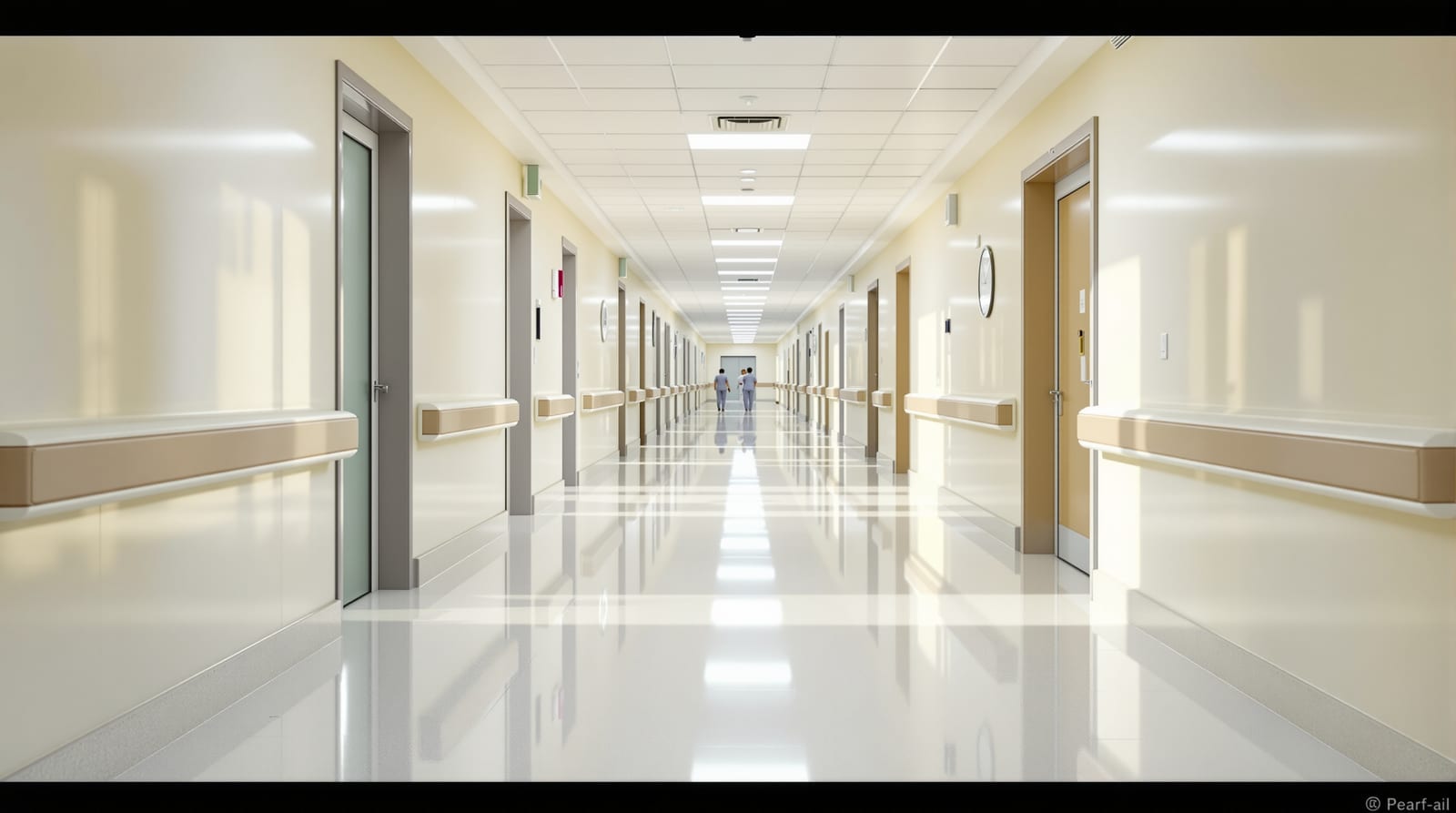
Hospital Flooring India: Infection-Control Floors by Zone, with Costs and NABH Codes
Why Indian hospitals choose seamless, coved, antibacterial PVC and vinyl sheet over tiles — a zone-by-zone guide to OT and ICU, wards, corridors, labs, lobby and wet areas, with anti-slip and anti-static grades, ₹/sq ft and NABH/IS compliance.
In a hospital the floor is not a finish — it is an infection-control surface, a safety device and a 15-year working asset all at once. Every joint is a place for bacteria to hide, every sharp wall-floor corner traps dirt a mop cannot reach, and every slip is a patient or a nurse on the ground. This is why the modern Indian hospital floor of choice is not tile but a seamless, heat-welded vinyl sheet, coved up the wall so there is no corner at all, antibacterial through its body, and anti-slip where it must be.
This guide ranks hospital floors by what each zone actually demands — from the conductive anti-static floor of an operation theatre to the quiet, washable wards, the chemical-proof labs and the impressive but practical lobby — with Indian ₹/sq ft benchmarks and the NABH and IS expectations that govern them.
Why hospital floors are different: hygiene above all
Before any material, fix the four demands that separate a hospital floor from any other commercial floor.
- Seamless and coved for infection control. Joints, grout lines and skirting gaps are where bio-burden collects. The hospital ideal is a continuous sheet whose seams are heat-welded into a single waterproof membrane, and whose edge curves up the wall in a cove (a curved skirting) so the wall-floor junction has no 90-degree corner to trap dirt. A mop and disinfectant must reach every square millimetre. Tiled floors fail here: grout joints harbour organisms and crack.
- Antibacterial and disinfectant-resistant. The surface must carry an antibacterial / bacteriostatic treatment through its wear layer (so it does not wear off) and must withstand daily contact with hospital-grade disinfectants — hypochlorite, glutaraldehyde, alcohols, quaternary ammonium — without staining, softening or bleaching.
- Anti-slip safety, but cleanable. Wet floors near scrub areas, wards and toilets need genuine slip resistance (DIN 51130 R10-R11), yet too much texture traps soil. Hospital vinyls solve this with a fine, cleanable anti-slip grade rather than a coarse industrial finish.
- Quiet, comfortable, durable under wheels. Trolleys, wheelchairs, beds and crash carts run all day; the floor must resist castor wear and indentation, deaden footfall and trolley noise for patient rest, and give underfoot comfort to staff on long shifts. Acoustic-backed homogeneous vinyl does all three.
On top of these sit the codes: NABH accreditation expects washable, non-slip, seamless surfaces in clinical zones; NBC 2016 and the Rights of Persons with Disabilities (RPwD) rules govern anti-slip and accessibility on circulation routes; and operation theatres and some ICUs need controlled electrostatic behaviour. For the broader picture of how clinical buildings are detailed, see the healthcare architecture overview, and for smaller settings the clinic flooring guide.
The hospital floor of choice: seamless homogeneous vinyl, coved and welded
For the bulk of a hospital — wards, corridors, consulting rooms, nursing stations — the default specification is homogeneous PVC / vinyl sheet: a single colour-through wear material in 2 mm thickness, supplied in 2 m wide rolls, loose-laid or adhered, with every seam heat-welded using a matching welding rod into a continuous skin. Because the colour runs through the full body, scratches and castor wear do not show a different sub-layer, and the floor can be lightly buffed over a 15-20 year life.
Why a roll and not a tile? A PVC roll floor or homogeneous vinyl floor becomes one welded membrane with the cove integral to it — there is no grout, no skirting joint, nowhere for bacteria. The same family in plank or tile format (LVT, SPC) is excellent for offices but the click joints make it second-best for a true clinical zone unless fully welded.
The detail that makes it work is the coved skirting. The sheet is turned up the wall by 100-150 mm over a cove former (a quarter-round fillet), capped with a top seal, so the floor flows seamlessly into the wall.
Flooring by hospital zone
Each zone trades the same priorities differently. Match the floor to the room.
| Zone | Recommended floor | Why this floor | ₹/sq ft (installed, 2026) |
|---|---|---|---|
| Operation theatre (OT) | Conductive / anti-static (ESD) seamless vinyl or PU, antimicrobial, coved | Dissipates static to prevent spark risk and protect equipment; fully seamless and sterilisable | 250-500 |
| ICU / critical care | Homogeneous vinyl (anti-static grade where specified), antibacterial, acoustic-backed, coved | Infection control + quiet for rest + comfort for long staff hours | 200-400 |
| Wards & patient rooms | Homogeneous / acoustic vinyl, anti-slip R10, antibacterial, coved | Washable, quiet, warm and comfortable, easy to disinfect | 150-300 |
| Corridors & circulation | Heavy-duty homogeneous vinyl, R10 anti-slip, coved | Trolley/wheelchair durability, continuity, accessibility (NBC/RPwD) | 150-260 |
| Labs & pharmacy | Chemical-resistant epoxy or PU resin, or chemical-grade vinyl, seamless coved | Resists reagents, acids and spills; impervious and sterilisable | 180-500 |
| Toilets, wet & scrub areas | Anti-slip vinyl or anti-skid vitrified, R11, with falls to drain | Slip safety on permanently wet floors | 90-260 |
| Lobby, reception & atrium | Vitrified large-format or granite, anti-skid in monsoon | Impressive, hard-wearing under heavy public footfall | 130-350 |
Pick the floor for the zone, not the building. For the slip side of each decision use the anti-slip rating selector, and to compare options for a whole project the hospital flooring selector and the commercial flooring cost calculator help size the budget.
Operation theatres and ICU: anti-static and absolute hygiene
The OT is the most demanding floor in the building. It needs everything the ward needs plus controlled electrostatic behaviour: a conductive or static-dissipative (ESD) seamless floor that drains charge to earth so there is no spark risk around oxygen-rich, flammable anaesthetic environments and no static damage to sensitive monitoring equipment. This is delivered either as a conductive anti-static / ESD vinyl sheet laid over a copper earthing grid, or as a conductive PU resin system poured seamless. Both are antimicrobial, fully coved, and chemically robust enough for repeated terminal disinfection. ICUs use the same homogeneous vinyl as wards, often in an anti-static grade, prioritising acoustic comfort and infection control.
Wards, corridors and consulting rooms: quiet, washable, kind underfoot
This is the largest area and the everyday workhorse. Homogeneous vinyl in 2 mm, antibacterial through the wear layer, in a fine R10 anti-slip finish, coved up the wall. Specify an acoustic-backed version in wards for footfall and trolley-noise reduction so patients rest, and a heavier-duty homogeneous grade in corridors where bed and crash-cart castors run hardest. Warm, slightly resilient and seamless, it disinfects in seconds and lasts 15-20 years.
Labs, pharmacy and CSSD: chemical resistance first
Pathology labs, the pharmacy and the sterile-supply (CSSD) areas meet acids, solvents and reagents that would attack ordinary vinyl. Here a seamless, coved epoxy or PU resin floor, or a dedicated chemical-grade vinyl, gives an impervious, sterilisable surface that shrugs off spills. Keep it coved and seamless for the same hygiene reasons as the rest of the building.
Lobby and wet areas: the two exceptions to vinyl
The public lobby is the one place where image and heavy footfall justify hard stone or tile. A granite floor or large-format vitrified tile reads as solid and reassuring and takes thousands of feet a day; specify an anti-skid finish at entrances because monsoon water tracks in. Toilets, sluice rooms and scrub areas — permanently wet — take an R11 anti-slip floor for wet areas, whether anti-slip vinyl or anti-skid vitrified, laid to falls toward a drain.
Costs and what drives them
Hospital flooring is a lifecycle decision, not a first-cost one. A welded vinyl floor costs more to lay than a tile but saves on infection events, replacement and downtime over 15-20 years. As an indicative 2026 installed guide: ward/corridor homogeneous vinyl ₹150-300/sq ft, anti-static OT/ICU vinyl or PU ₹250-500, lab epoxy/PU ₹180-500, lobby granite ₹130-350, vitrified ₹80-220. The big swings come from the anti-static grade, the acoustic backing, the quality of the subfloor preparation (vinyl needs a flat, dry, self-levelled screed) and the welding and coving labour — which is exactly what you must not cut, because the seam and the cove are the infection-control performance. Benchmark against the flooring cost per square foot guide and, for the wider sector view, the commercial flooring guide.
Do and don't for hospital floors
- Do weld every seam and cove every wall junction in clinical zones — an unwelded sheet with a square skirting is not a hospital floor.
- Do match the grade to the zone: anti-static in OT, acoustic in wards, chemical-resistant in labs, anti-slip in wet areas.
- Do prepare the subfloor properly — a self-levelled, dry, sound screed is non-negotiable for vinyl; moisture trapped below causes adhesive failure and bubbling.
- Do keep colours light and calm with subtle pattern to hide minor soil without looking clinical-harsh; reserve bright colour-coding for wayfinding inlays.
- Don't use grouted tile in wards, ICU, OT or labs — the joints harbour bio-burden and crack under trolleys.
- Don't specify glossy or polished surfaces in any wet or clinical area; they are slip hazards and show scuffing.
- Don't forget the earthing grid under a conductive OT floor, or it provides no static protection.
Care and maintenance
Seamless vinyl is low-maintenance by design: daily damp-mop with a neutral or hospital-grade disinfectant, periodic machine scrub, and an occasional buff to restore the matte sheen. Avoid abrasive pads that dull the antibacterial wear layer, and re-weld any seam that lifts immediately. Conductive floors should have their earth continuity tested periodically. For general routines see the floor cleaning guide.
Frequently asked questions
What is the best flooring for a hospital in India?
For most clinical areas — wards, ICU, corridors, consulting rooms — seamless homogeneous PVC / vinyl sheet, 2 mm, antibacterial through the wear layer, heat-welded at the seams and coved up the wall, is the standard best choice. Operation theatres add a conductive anti-static grade; labs use chemical-resistant epoxy or PU; lobbies use granite or vitrified. Match the floor to the zone.
Why do hospitals use vinyl instead of tiles?
Because infection control demands a seamless surface. A welded vinyl sheet becomes one continuous waterproof skin with the skirting coved into it, leaving no grout joints or wall corners for bacteria to collect — and no cracking under trolley wheels. Tiled floors have grout lines and skirting gaps that harbour bio-burden and are far harder to disinfect fully.
What flooring is used in an operation theatre?
A conductive or static-dissipative (ESD / anti-static) seamless floor — either a conductive vinyl sheet laid over an earthing grid or a conductive PU resin system. It dissipates static charge to prevent spark risk in oxygen-rich environments and protects sensitive equipment, while remaining antimicrobial, fully coved and sterilisable for terminal disinfection.
What is coved skirting and why does it matter in hospitals?
Coving is turning the floor sheet up the wall 100-150 mm over a curved fillet so the wall-floor junction is a smooth curve, not a 90-degree corner. It removes the sharp internal angle where dirt and bacteria normally collect and that a mop cannot reach, making the whole floor and lower wall one cleanable, disinfectable surface — a core NABH-aligned hygiene detail.
How much does hospital flooring cost in India?
As a rough 2026 installed guide: ward and corridor homogeneous vinyl ₹150-300/sq ft, anti-static OT/ICU vinyl or PU ₹250-500, lab epoxy or PU ₹180-500, lobby granite ₹130-350 and vitrified ₹80-220. Welding, coving and proper subfloor preparation add cost but are exactly the infection-control performance you should not cut.
Export this guide
Related Guides — Deep-dive reading
PVC Roll & Sheet Vinyl Flooring in India: Homogeneous vs Heterogeneous Rolls, Heat-Welded Seamless Floors for Hospitals, Labs & Schools — Types, Cost & Care
PVC roll (sheet vinyl) flooring lays in wide rolls that are glued down and heat-welded into a near-seamless, water-tight, hygienic surface — the standard floor for hospitals, operation theatres, labs, clinics, pharma and schools, and a budget option for homes and rentals. Here are the types, costs of ₹60–250 per sq ft, install method, where it suits, pros, cons and care.
Flooring & SurfacesClinic Flooring in India: Hygienic, Welcoming Floors for Clinics, Dental and Diagnostic Centres
How to specify clinic flooring zone by zone — seamless anti-bacterial vinyl, warmer LVT for the waiting room, anti-slip vitrified for budgets and chemical-resistant epoxy for labs — on a smaller footprint and tighter budget than a hospital.
Flooring & SurfacesUtility Room Flooring in India: Best Anti-Skid, Waterproof Floors for the Wash & Laundry Area
Anti-skid ceramic, vitrified, epoxy and kota for the wettest, hardest-working, most-neglected corner of the Indian home — with the must-do slope and floor trap.
Flooring & SurfacesRelated Tools — Try Free
Acoustic Privacy (STC) Visualizer
Indian healthcare acoustic visualizer — compare wall assemblies and noise sources, see received SPL after STC attenuation, and check FGI 2018 / IS 1950 / NABH speech-privacy compliance with live dual-canvas waveform.
Acoustic ToolCircadian Light Meter
Patient-centric circadian lighting visualizer for Indian healthcare design — time-of-day × intensity → CCT, melanopic lux (EML / mEDI), melatonin suppression, and an alertness curve. Calibrated against WELL v2 L03 Circadian Lighting Design, CIE S 026:2018, Brainard 2001, and Lucas et al. 2014.
Circadian ToolFlooring Cost Calculator
Estimate the all-in cost of a floor — material, laying, wastage, skirting and GST — by area and material.
Flooring Calculator